
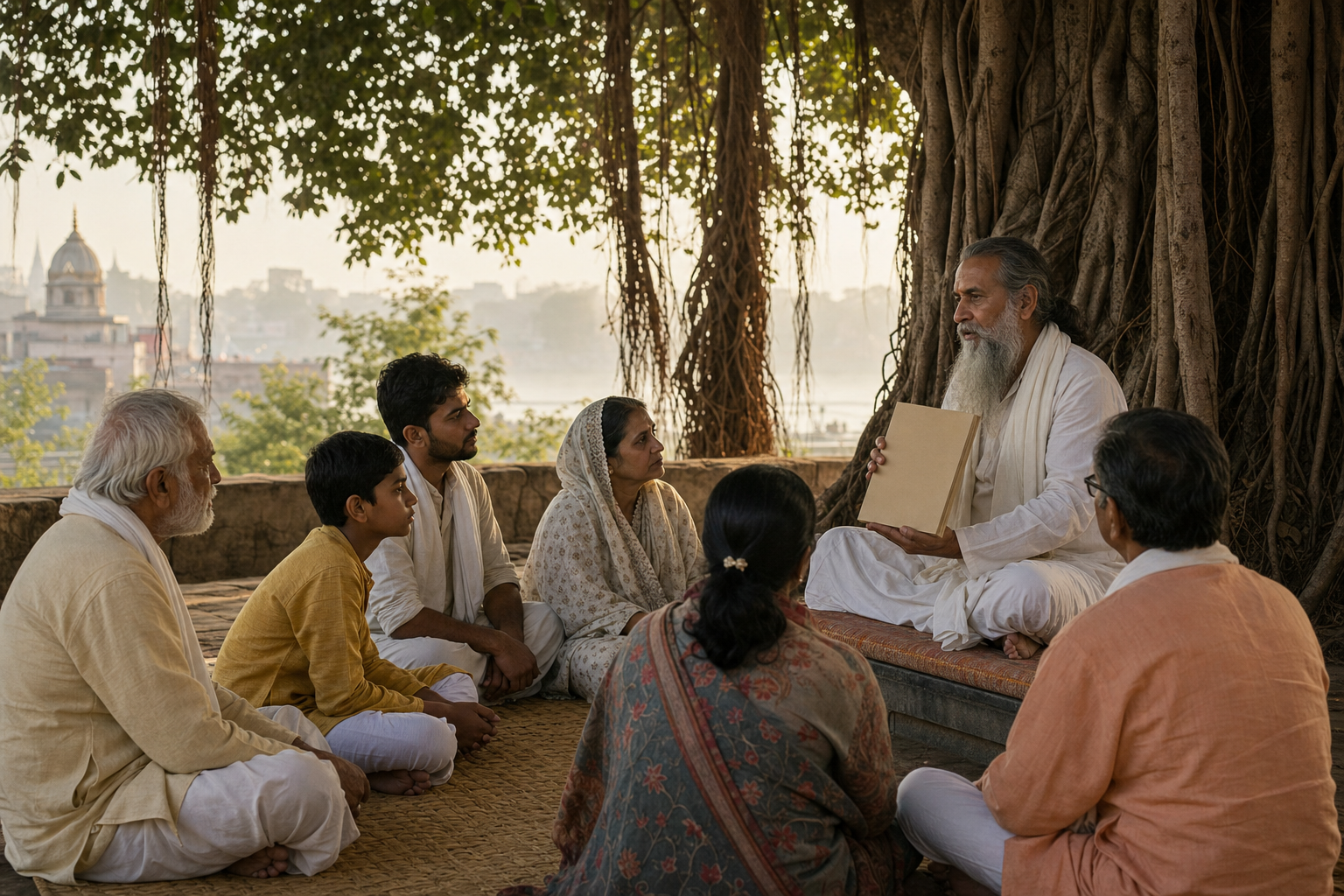
If you are deciding whether Shukratal belongs in your pilgrimage, the practical question is not how many sights it offers. It is whether you are willing to slow down enough to listen. This is a modest Ganga settlement whose significance rests on a sacred act of transmission: a teacher spoke, a king listened, and the Bhagavata became a living encounter.
You will get more from Shukratal if you prepare for that encounter rather than treating the town as a quick stop between Delhi and Haridwar. Carry a passage to read, arrive with one honest question, protect some unhurried time by the river, and leave with one practice you can sustain.
Key takeaways
- Shukratal is revered as the place where Shukadeva Goswami expounded the Srimad-Bhagavatam to Maharaja Pariksit.
- Its importance lies in the relationship among scripture, teacher, listener, and sacred place, not in the number of attractions you can cover.
- Choose one Bhagavata theme before you go: devotion, ethical duty, or inner transformation.
- Plan the final approach carefully because signage and map visibility can be limited.
- Judge the pilgrimage by what changes in your daily conduct after you return, not by whether you had a dramatic experience.
Why Shukratal matters to the Bhagavata tradition
Shukratal is revered as the place where Shukadeva Goswami taught the Srimad-Bhagavatam, or Bhagavata Purana, to Maharaja Pariksit. Within received Hindu sacred chronology, this discourse is placed approximately 5,000 years ago. A careful pilgrim can honour that tradition without pretending that sacred memory and modern historical verification are the same kind of claim.
The deeper point is that Shukratal is not merely associated with a book. It represents a complete structure of spiritual learning:
- The text gives the encounter its substance. Without the Bhagavata, the location becomes detached from the teaching that made it sacred.
- The teacher represents realised transmission. Shukadeva does not stand in the tradition merely as a supplier of information, but as the voice through which sacred knowledge is received.
- The listener makes the teaching consequential. Maharaja Pariksit reminds you that hearing scripture requires attention, humility, and a willingness to be changed.
- The place holds the memory of the encounter. The Ganga and the quiet terrain give bodily form to what might otherwise remain an idea.
Use this four-part frame when you arrive. Notice which element you usually neglect. If you read without listening, give more attention to the teacher-listener relationship. If you seek sacred places but rarely study, open the text. If you collect teachings without changing your conduct, place yourself more honestly in Pariksit’s position: not as a spectator, but as someone being addressed.
Prepare to listen before you prepare to travel

Trying to consume the entire Bhagavata during a short visit will usually scatter your attention. Choose one theme before leaving home. The three most natural starting points at Shukratal are devotion, ethical duty, and inner transformation.
Turn the theme into a question that reaches your actual life. For devotion, ask, “What receives my best attention each day?” For duty, ask, “Which responsibility am I avoiding because it is inconvenient?” For transformation, ask, “What do I understand intellectually but still refuse to practise?” A precise question gives your reading somewhere to land.
Bring a passage in a language you understand well. Read it once before the journey so that unfamiliar vocabulary does not consume your attention at the site. Read it again at Shukratal, slowly enough to notice which sentence challenges your chosen question. If you travel with others, let one person read aloud while everyone else listens without interruption. That simple arrangement places hearing before discussion.
A useful sequence at the Ganga is:
- Pause before opening the text. Let the journey and its noise settle.
- State your question inwardly in one sentence.
- Read the selected passage once without commentary.
- Sit for silent reflection or japa, allowing one teaching to remain in attention.
- Walk quietly along the ghat and decide what the teaching asks you to do after you leave.
This sequence is not a claim about ritual necessity. It is a discipline of attention. It prevents photography, conversation, and the pressure to cover more places from taking over the very listening that gives Shukratal its meaning.
Plan the route without letting logistics dominate the visit
Shukratal lies roughly midway between Delhi and Haridwar. On the Delhi-to-Haridwar approach, it is described as about 86 kilometres before Haridwar and approximately an hour east of Muzaffarnagar by road. A journey from Delhi commonly takes four to five hours, although traffic and road conditions can change that range.
The final approach deserves more preparation than the broad route. The settlement is modest, local signage can be limited, and the destination may not appear clearly on every standard map. Treat those facts as ordinary logistical constraints, not as part of a test that a sincere pilgrim should somehow pass unaided.
- Use Muzaffarnagar as the practical reference point for the final leg.
- Confirm the current destination pin and road directions shortly before departure; mapping and road conditions can change.
- Keep local directions available rather than relying entirely on one navigation result.
- Build margin around the four-to-five-hour estimate if you are travelling from Delhi.
- Avoid packing the day so tightly that a traffic delay erases your quiet time by the Ganga.
- Carry what helps you remain at the site without creating waste: your chosen text, a reusable water container, and a way to take your refuse away.
The last point matters. If Shukratal is only one item in a crowded itinerary, the town’s small scale may initially feel underwhelming. That is a planning problem, not a failure of the place. Give the visit enough space for reading, japa, contemplation, and an unhurried walk. Its value emerges through attention rather than spectacle.
Let the Ganga sharpen the teaching, not replace it

At Shukratal, the Ganga cuts through rocky terrain and creates a setting naturally suited to stillness. Landscape can deepen scriptural attention, but it should not become a substitute for study. The river does not remove the need to understand the Bhagavata; it helps you notice what the text is asking of the person who reads it.
Use the surroundings to test four forms of attention:
- Devotion: Notice where your mind returns when nothing is demanding an immediate response. That return reveals what already holds your loyalty.
- Duty: Ask which obligation remains yours even when recognition, convenience, or reward is absent.
- Restraint: Resist the urge to record every moment. Take only the images you will genuinely use, then put the device away.
- Transformation: Translate one insight into a visible action. If no action follows, the experience risks becoming spiritual consumption.
Shukratal can also support a thoughtful meeting among different Dharmic traditions. Hinduism, Buddhism, Jainism, and Sikhism are not interchangeable systems, and respect does not require erasing their doctrinal distinctions. They can nevertheless meet in a shared ethical vocabulary of compassion, truthfulness, restraint, and reverence for life.
If you visit with a mixed group, begin there. Ask how each person understands disciplined listening, truthful conduct, or restraint in daily life. This produces a more honest conversation than forcing every tradition into one theology. Shared practice can create fellowship while real differences remain visible.
Your conduct near the river should express the same values. Keep your physical footprint light, take away what you bring, avoid unnecessary noise, respect daily worship, and follow local customs. Reverence for sacred geography becomes credible when it includes care for the actual place.
Carry one Bhagavata commitment home

Before leaving Shukratal, write one sentence beginning, “Because I listened here, I will…” Finish it with an action small enough to begin immediately and clear enough to verify. “I will become more spiritual” cannot guide a day. “I will read and sit quietly before checking my phone each morning” can.
Your commitment can take one of three forms:
- Regular listening: Read a manageable portion of the Bhagavata at a consistent time, giving more attention to continuity than quantity.
- Ethical repair: Act on one neglected duty, one withheld truth, or one relationship in which impatience has replaced compassion.
- Devotional steadiness: Establish a realistic period for japa, prayer, or silent remembrance that does not depend on being in a sacred place.
Do not measure the pilgrimage only by the emotion you felt beside the Ganga. Stillness may come, or the mind may remain restless. A more demanding measure is available: does the next week contain one choice shaped by what you heard?
If you decide to go, keep the plan simple. Confirm the route, carry a passage you can understand, bring one honest question, and protect enough time to listen. Shukratal enters your life as part of the Bhagavata tradition when the journey continues as practice after the road home.
References
