

Varna is often forced into a choice between two absolute claims: that it is an inherited hierarchy fixed by birth, or that it is a completely fluid system determined only by individual ability. Read together, the Yajurveda’s cosmic symbolism and the Bhagavad Gita’s language of qualities, action, nature, and duty support a more careful interpretation.
The central questions are what these passages actually state, what readers infer from them, and what they do not establish. Keeping those levels separate makes it possible to take scripture seriously without using it to excuse discrimination or making it conform too neatly to modern categories.
Varna, jāti, and caste answer different questions
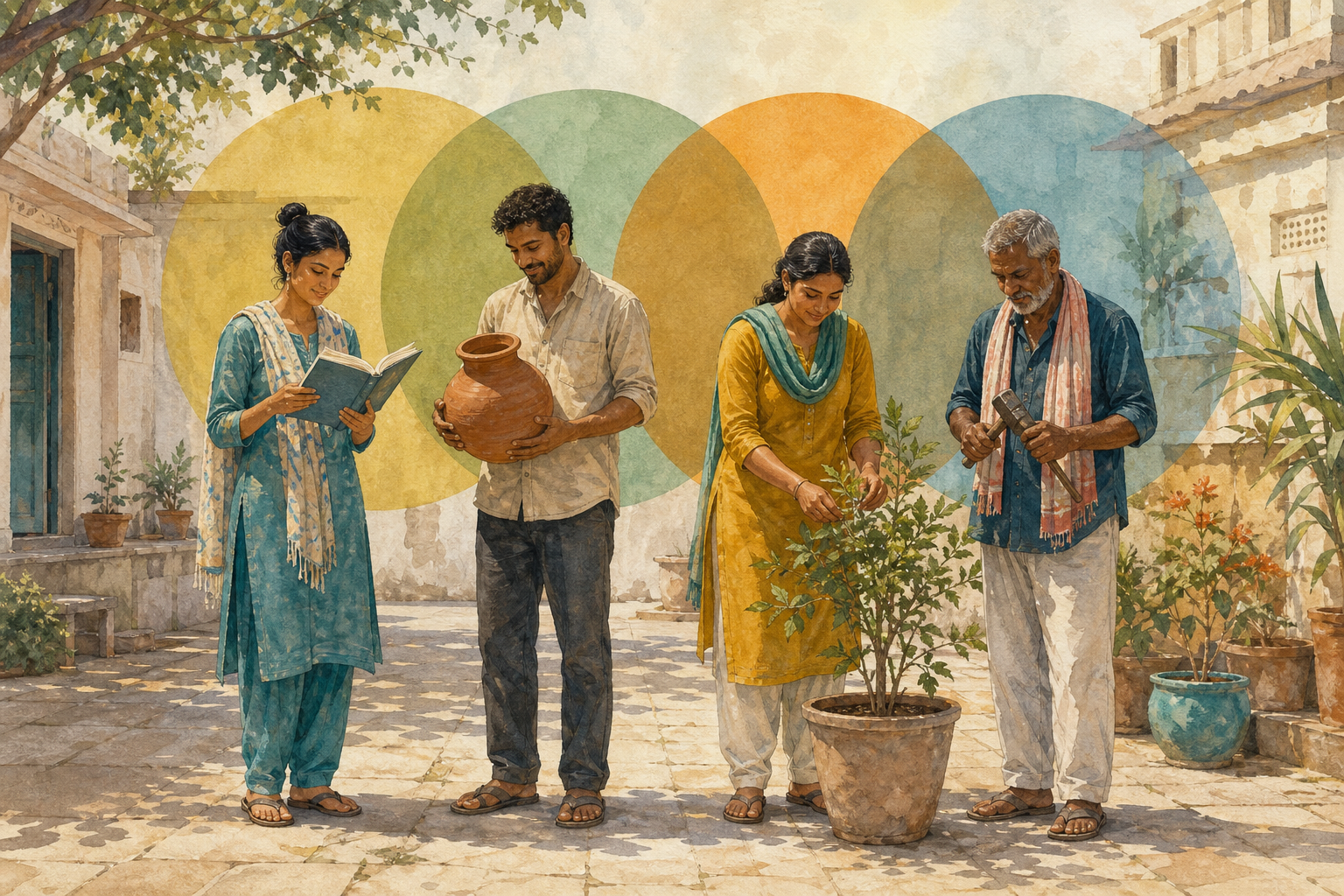
Varna is the fourfold classificatory model of Brāhmaṇa, Kṣatriya or Rājanya, Vaiśya, and Śūdra. The supplied DharmaRenaissance analysis associates these categories broadly with learning and ritual responsibility, protection and governance, production and exchange, and service or labor. This is a general social scheme, not a catalogue of South Asia’s numerous communities.
Jāti, by contrast, commonly denotes a localized birth community shaped by such factors as kinship, endogamy, region, customary occupation, and collective identity. The English term caste has been applied to both Varna and jāti, encouraging readers to treat a four-part scriptural model and a complex history of lived communities as though they were identical.
The distinction does not make hereditary exclusion or unequal treatment less real. It clarifies the object under discussion. A theological classification, a normative account of social duties, and a historical institution may interact without being interchangeable. Consequently, neither a single verse nor a single definition can explain every form of occupational restriction, unequal access, endogamy, or untouchability found across different places and periods.
The cosmic body portrays unity but does not specify assignment

Yajurveda 31.11 presents the four Varnas through the body of the cosmic Puruṣa: the Brāhmaṇa is associated with the mouth, the Rājanya with the arms, the Vaiśya with the thighs, and the Śūdra with the feet. Its direct wording gives these bodily correspondences. Explanations that identify them respectively with knowledge, protection, economic support, and labor are interpretations of the image rather than its word-for-word translation.
As a depiction of one cosmic body, the verse can be read as an account of organic interdependence. Learning requires social protection; authority requires wisdom and restraint; production depends upon work; and no function sustains a society in isolation. All four appear within the same Puruṣa rather than as separately created orders of humanity.
That symbolism does not answer every institutional question. The verse does not itself explain how an individual enters a Varna, whether that classification can change, who may judge it, or how the image should be converted into rules governing education, worship, marriage, or occupation. It therefore cannot bear the entire weight of either a rigid hereditary theory or a claim of unrestricted social mobility.
The Gita connects social duty with guṇa, karma, and svabhāva
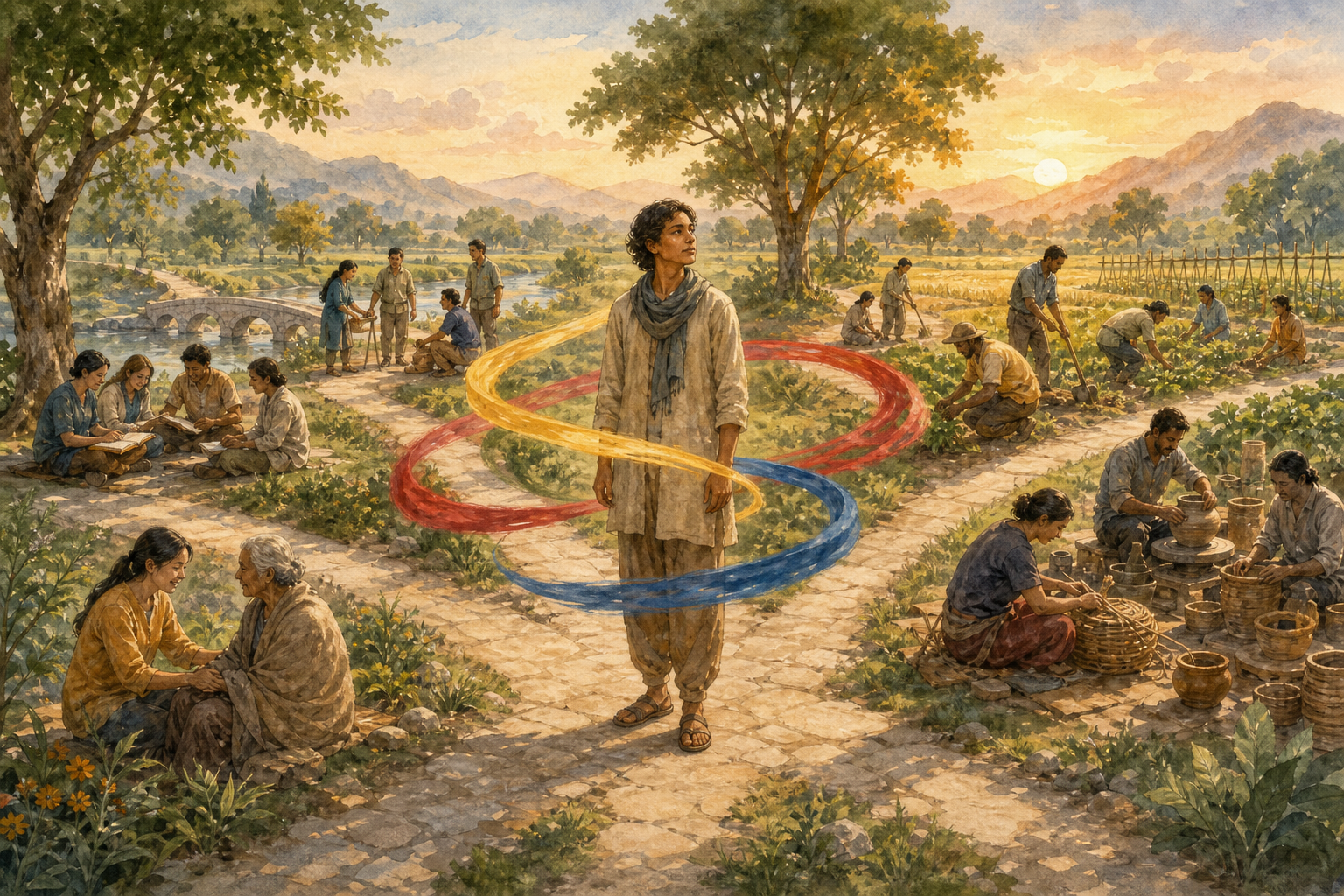
Bhagavad Gita 4.13 introduces a more analytical formulation. Krishna describes the fourfold order as divided according to guṇa and karma. The important textual point is limited but substantial: the verse explicitly names qualities and action, not birth alone, when explaining the division.
Neither term should be flattened into a modern label. In the Gita, guṇa concerns the changing influence of sattva, rajas, and tamas upon embodied life, including clarity, activity, desire, attachment, and inertia. It is not merely a measure of talent, and people are not presented as pure, permanent specimens of one quality. Karma encompasses action, responsibility, and work arising from disposition and circumstance; it is broader than a job title.
Bhagavad Gita 18.41 reinforces the connection by describing the duties of the four Varnas as differentiated through qualities arising from svabhāva, or one’s own nature. Verses 18.42 and 18.43 then describe demanding ethical profiles. The Brāhmaṇa function is linked with composure, restraint, purity, patience, uprightness, knowledge, realization, and faith. The Kṣatriya function is associated with heroism, vigor, firmness, skill, courage, generosity, and leadership.
These descriptions make inherited prestige an inadequate substitute for character and conduct. Lineage by itself cannot demonstrate self-control, knowledge, courage, generosity, or spiritual realization. Yet the verses also do not provide an administrative test, authorize social authorities to claim infallible access to another person’s inner nature, or describe Varna as a permanent personality score assigned in childhood.
Key takeaways for interpreting Varna responsibly
- Varna is a fourfold normative model; jāti is a localized community identity, and caste has been used imprecisely for both.
- Yajurveda 31.11 supplies a cosmic-body image, while its familiar occupational explanation is an interpretation of that symbolism.
- The single body permits a reading centered on mutual dependence, but the verse does not prescribe a method for assigning individuals to Varnas.
- Bhagavad Gita 4.13 and 18.41 explicitly connect the fourfold division with guṇa, karma, and qualities arising from svabhāva.
- The cited passages challenge ancestry as sufficient proof of wisdom, moral worth, leadership, or spiritual attainment without resolving every historical debate about birth and social status.
Textual care must be joined to equal human dignity

A responsible interpretation avoids turning description into entitlement. If a role requires discipline, knowledge, courage, or generosity, merely inheriting its name cannot fulfill its obligations. Likewise, a symbolic association with the feet cannot by itself justify denying another person education, vocation, worship, or social respect. Such restrictions require arguments that the cited verses do not provide.
The same care prevents the opposite overstatement. Guṇa and karma offer strong grounds for disputing claims that ancestry alone establishes worth or fitness, but these terms do not automatically produce a modern system of occupational choice. Scripture, traditional interpretation, and historical practice remain distinct fields of inquiry.
Future discussion of Varna can become more constructive by testing every social claim against the precise wording of the relevant passage, distinguishing translation from interpretation, and treating human dignity as a non-negotiable measure of present conduct.