
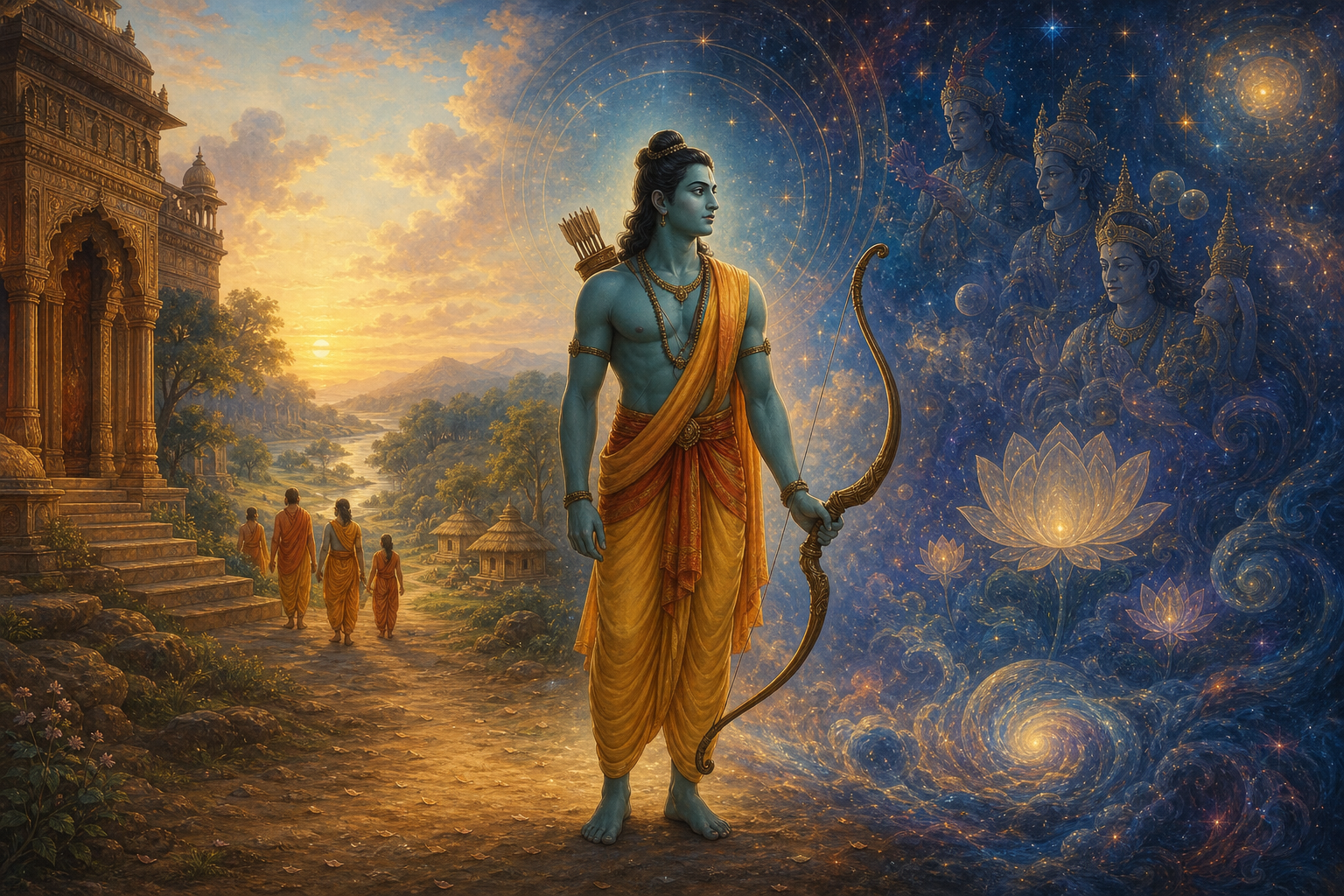
You may have met Rama in two apparently different ways: as the prince whose conduct must be judged within a demanding human story, and as Vishnu’s avatara, whose appearance serves a cosmic purpose. Add Buddhist and regional tellings, and a simple question becomes unavoidable: are these traditions speaking about the same Rama?
They are not all making the same claim, but that does not make them incoherent. The key is to separate four questions that readers often collapse into one: What happens in the narrative? What does Rama’s conduct teach? Who is Rama theologically? What has a particular community chosen to preserve or emphasize? Once you keep those questions apart, the traditions become easier to understand without forcing their differences away.
Start by identifying the question each tradition asks
The familiar choice between Rama the exemplary person and Rama the Divine is too crude. An epic can disclose divinity through human relationships, decisions, and consequences. An avatar tradition can affirm divine identity while still treating conduct as meaningful. A Buddhist telling can receive Rama within a Bodhisattva framework without adopting Vaishnava theology. A regional adaptation can retain the ethical structure of the story while reshaping its language, aesthetics, and cultural memory.
| Reading lens | Main question | What you should notice |
|---|---|---|
| Epic | How does dharma become action? | Competing duties, relationships, restraint, consequences, and righteous governance |
| Avatar | Why does the Divine descend? | The restoration of dharma, the purpose of a manifestation, and its relation to other divine forms |
| Bodhisattva | Which virtues are being cultivated and embodied? | Truthfulness, self-mastery, compassion, and ethical rule |
| Transregional adaptation | What travels, and what changes? | Continuity of characters and ethical themes alongside local poetics, values, and historical memory |
These are lenses, not sealed compartments. The Sanskrit Ramayana and the traditions that grew around it have supported literary, ethical, devotional, and theological readings at the same time. Your first task is therefore not to rank the lenses. It is to identify which question a particular passage or retelling is actually trying to answer.
Read epic Rama through moral pressure, not adjectives
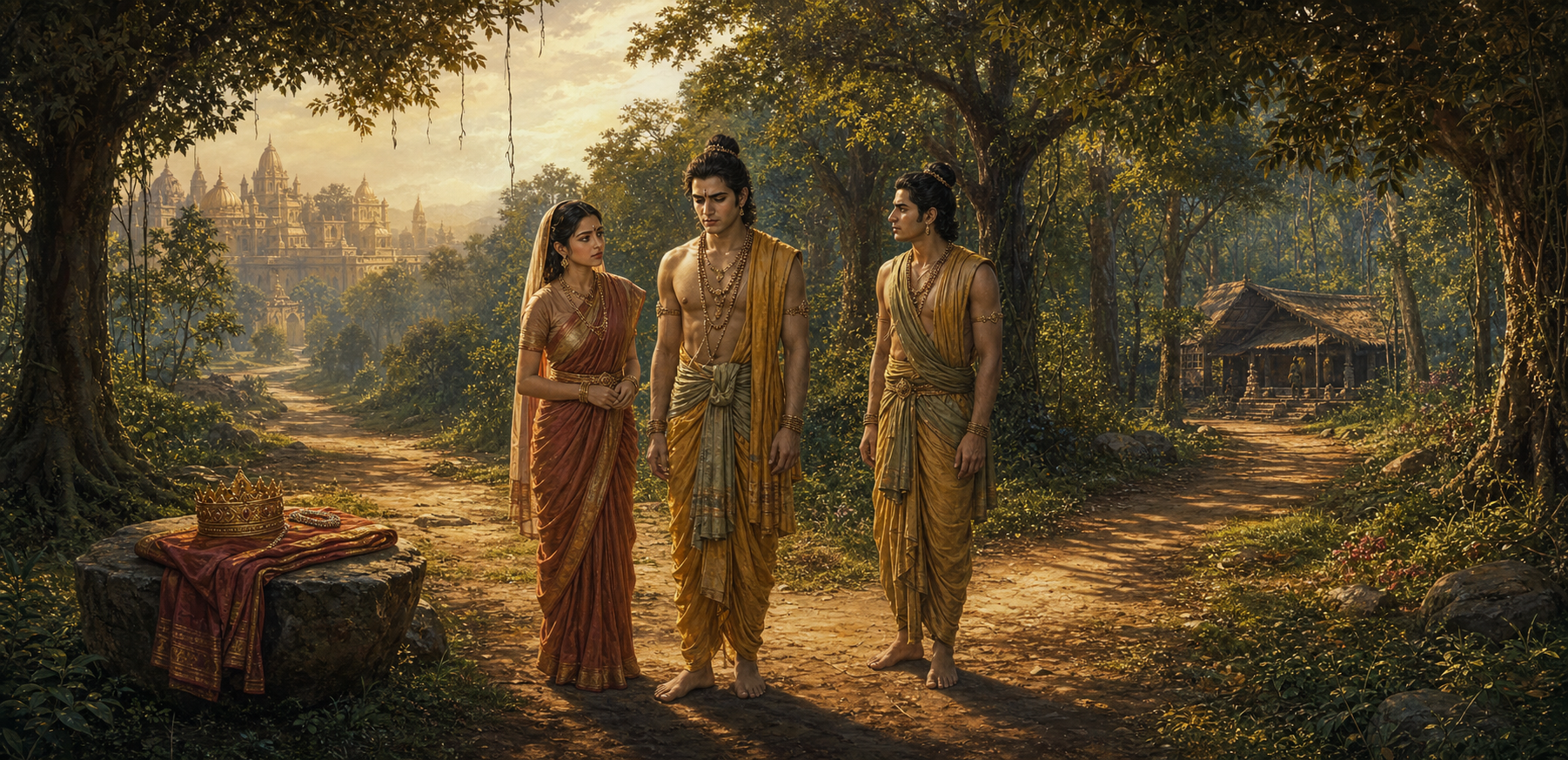
Calling Rama righteous, ideal, or perfect may express devotion, but an adjective cannot show you how dharma works. The epic lens becomes useful when you look at the pressure placed on conduct: different roles make claims, desirable outcomes conflict, and the easier choice may not be the rightful one.
Rama is closely associated with maryada, understood as disciplined or ideal conduct in personal, familial, and royal life. That does not reduce dharma to rule-following. Maryada becomes visible precisely when power, affection, obligation, and self-interest pull in different directions. Restraint matters because another course of action is available.
When you read an episode as epic, ask four concrete questions:
- Which role is active? Do not merge the duties of a family member, a ruler, a warrior, and a spiritual seeker into one vague standard.
- Which obligations collide? A difficult scene usually involves more than a contest between obvious virtue and obvious vice.
- Who bears the cost? The moral weight of a decision becomes clearer when you notice its consequences for Rama and for others.
- Which principle can travel beyond the scene? Carry forward truthfulness, restraint, fidelity to duty, or accountable rule rather than mechanically copying an ancient action under unrelated circumstances.
This method also guards against two opposite mistakes. A hostile reading may isolate an action from its narrative obligations and consequences. An uncritical reading may assume that anything done by a revered character requires no interpretation. Neither approach takes the epic seriously. Reverence should sharpen your attention to dharma, not end the inquiry before it begins.
If you discuss the Ramayana in a family, class, or study circle, require every moral claim to name both the duty and the cost. The statement Rama followed dharma is only the beginning. The useful question is what made that course dharmic within that relationship and circumstance.
Read avatar Rama through divine purpose, not chronology
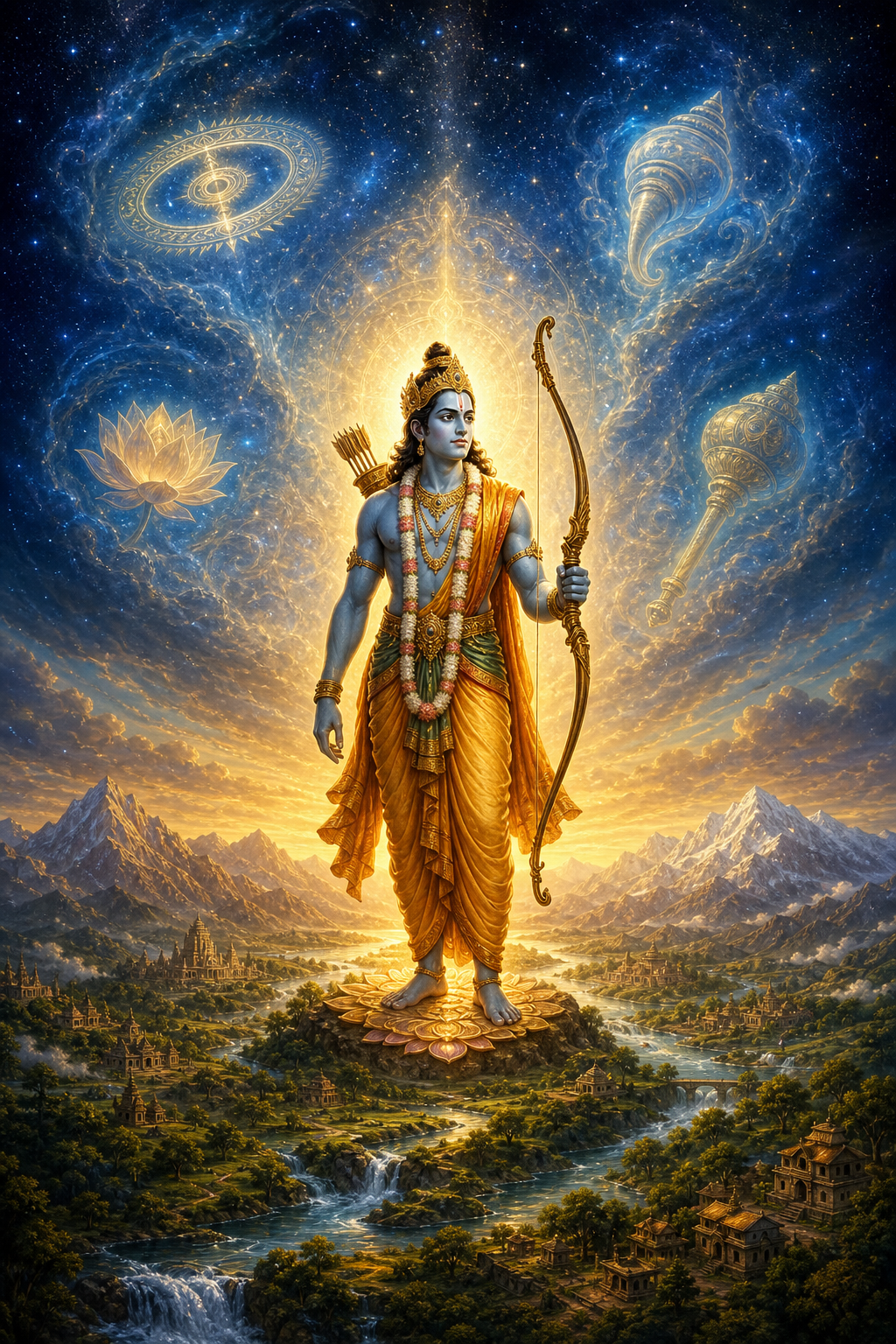
In Vaishnava theology, an avatara is a purposeful descent of Vishnu or Narayana for the restoration of dharma. The descent does not imply that the Divine has become trapped in one body or limited to one manifestation. That is why the simultaneous presence of Rama and Parashurama need not create a contradiction: divine manifestation is not restricted by linear time or a rule of one embodiment at a time.
The encounter after Rama breaks Shiva’s bow at Sita’s svayamvara makes the distinction concrete. Parashurama confronts Rama and tests him. In a familiar theological reading, Parashurama recognizes Rama’s divinity, his spiritual potency subsides, and he withdraws to tapas. The episode is better understood as a transfer of dharmic mandate than as a competition between two gods.
Their missions are complementary. Parashurama confronts the abuse and arrogance of martial power. Rama establishes a model of ordered conduct and righteous rule. One task prepares for another. Divine agency is therefore not a quantity that one manifestation must lose before another can possess it.
Some Vaishnava lineages express this relationship through classifications such as shaktyavesha or amsha avatara for Parashurama and purna avatara for Rama. These terms help those lineages describe different modes or intensities of descent. They should not be turned into a universal vocabulary that every Hindu school or every Ramayana telling must use.
When reading an episode through the avatar lens, examine three levels separately. First, identify the cosmic purpose: what form of adharma is being corrected? Second, identify the narrative function: why do these manifestations meet at this point in the story? Third, identify the devotional meaning: what does the encounter disclose about the unity of the Divine behind multiple forms? Keeping those levels distinct prevents a theological scene from collapsing into a puzzle about physical chronology.
Compare Rama traditions without forcing them to agree
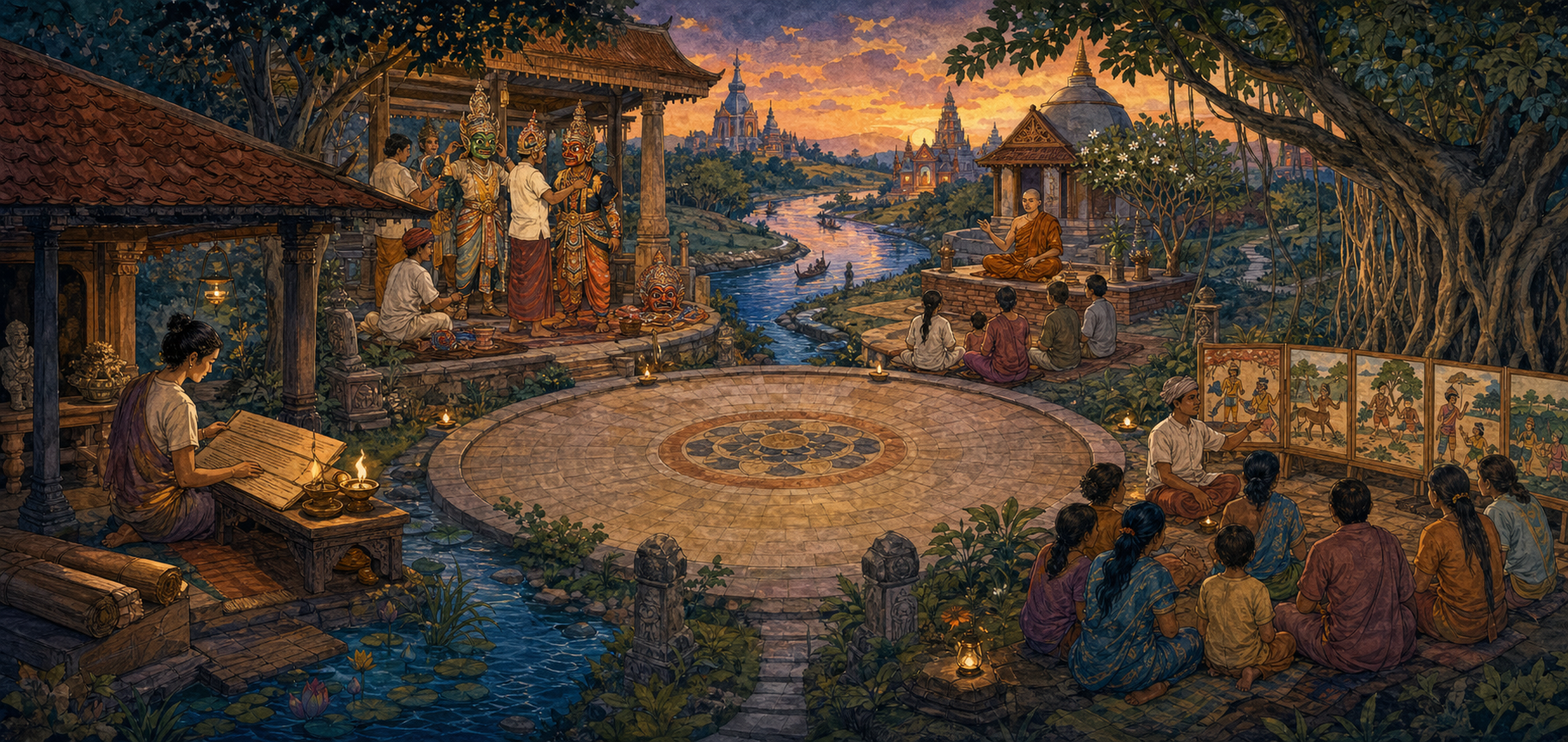
Rama’s presence across Asia demonstrates civilizational reach, but reach is not the same thing as doctrinal uniformity. The Thai Ramakien, Cambodian Reamker, Lao Phra Lak Phra Lam, Burmese Yama Zatdaw, Old Javanese Kakawin Ramayana, and Malay Hikayat Seri Rama combine recognizable characters and ethical themes with local literary forms. Their differences are evidence of active reception, not automatically evidence of a damaged original.
The Buddhist Dasaratha Jataka places Rama within a Bodhisattva framework and foregrounds truthfulness, self-mastery, and compassionate governance. A Vaishnava tradition may ask how Vishnu descends to restore dharma; a Buddhist telling may ask how a being perfects virtues for the welfare of others. Shared admiration for ethical conduct does not erase the difference between avatara and Bodhisattva.
Persian renderings sponsored at the Mughal court opened the Sanskrit epic to Persian readers and joined literary translation with illustrated manuscript culture. Their importance lies neither in proving that all readers shared one theology nor in treating translation as mere borrowing. They show how Rama’s moral world could cross a linguistic and religious boundary while remaining recognizable.
Use the following sequence when comparing any two tellings:
- Name the framework. Is Rama presented as Vishnu’s descent, a Bodhisattva, an exemplary king, or some combination of these?
- Choose one dimension. Compare truthfulness with truthfulness, kingship with kingship, or divine identity with divine identity. Do not compare the theology of one telling with the dramatic style of another and call the result a contradiction.
- Mark the continuity. Note the characters, ethical concerns, and patterns of righteous action that remain recognizable.
- Mark the adaptation. Look for changes in theological emphasis, literary form, cultural values, and historical memory.
- State a narrow conclusion. Say that the tellings share a concern for righteous governance, for example. Do not leap from that agreement to the claim that they teach an identical doctrine of Rama.
This discipline matters especially in inter-dharmic conversation. Unity is meaningful only when the things being united remain distinguishable. Hindu and Buddhist traditions can share a vocabulary of truthfulness, self-mastery, compassion, and ethical rule without becoming interchangeable. Respect grows from naming both the kinship and the boundary.
Use this five-question card on your next Rama telling
You do not need specialist terminology before opening a Ramayana or watching a performance. You need a repeatable way to notice what kind of claim is being made.
Key takeaways
- What kind of work is this? Identify whether you are reading an epic narrative, devotional text, theological explanation, Jataka, translation, courtly poem, or dramatic adaptation.
- Who is Rama within this work? Look for an explicit divine descent, a Bodhisattva identity, exemplary kingship, or a layered combination.
- Where is the moral pressure? Name the competing duties and the people who bear the consequences of Rama’s decision.
- What remains stable? Track recurring concerns such as dharma, truthfulness, restraint, devotion, compassion, and responsible rule.
- What has the community emphasized? Notice how theology, aesthetics, language, and historical memory shape the telling without assuming that every change rejects the inherited story.
On your next encounter with Rama, do not begin by asking whether the telling matches the version you already know. Pause after one decisive episode and write down its narrative conflict, ethical principle, theological claim, and local emphasis. That small practice will let you see Rama’s civilizational breadth without losing the distinctions that give each tradition its integrity.
References
- DharmaRenaissance Blog – Lord Rama’s Timeless Journey Abroad: Persian Translations and Southeast Asian Epics
- DharmaRenaissance Blog – Parashurama and Rama Together? Demystifying Vishnu’s Avatars with Timeless Wisdom
