
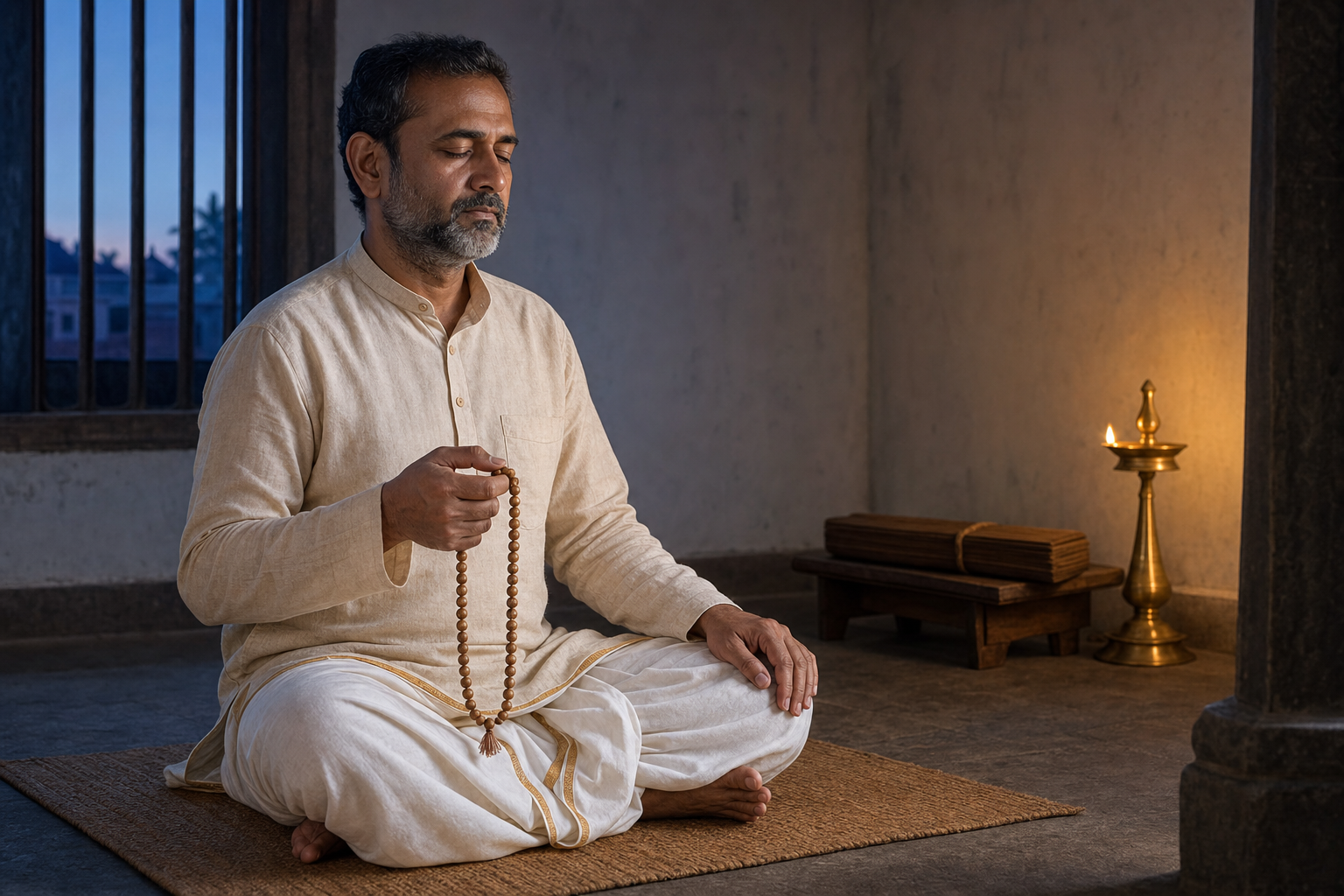
You may already have a mantra, a mala, and a quiet corner, yet still wonder whether what you are doing truly counts as japa. That uncertainty usually comes from mixing two separate questions: What should you repeat, and how should you repeat it?
Separate those questions and the practice becomes clearer. You need a mantra appropriate to your adhikara, a daily structure you can actually sustain, and a way to notice when sound, attention, and devotion have drifted apart.
Why japa is more than repeated speech
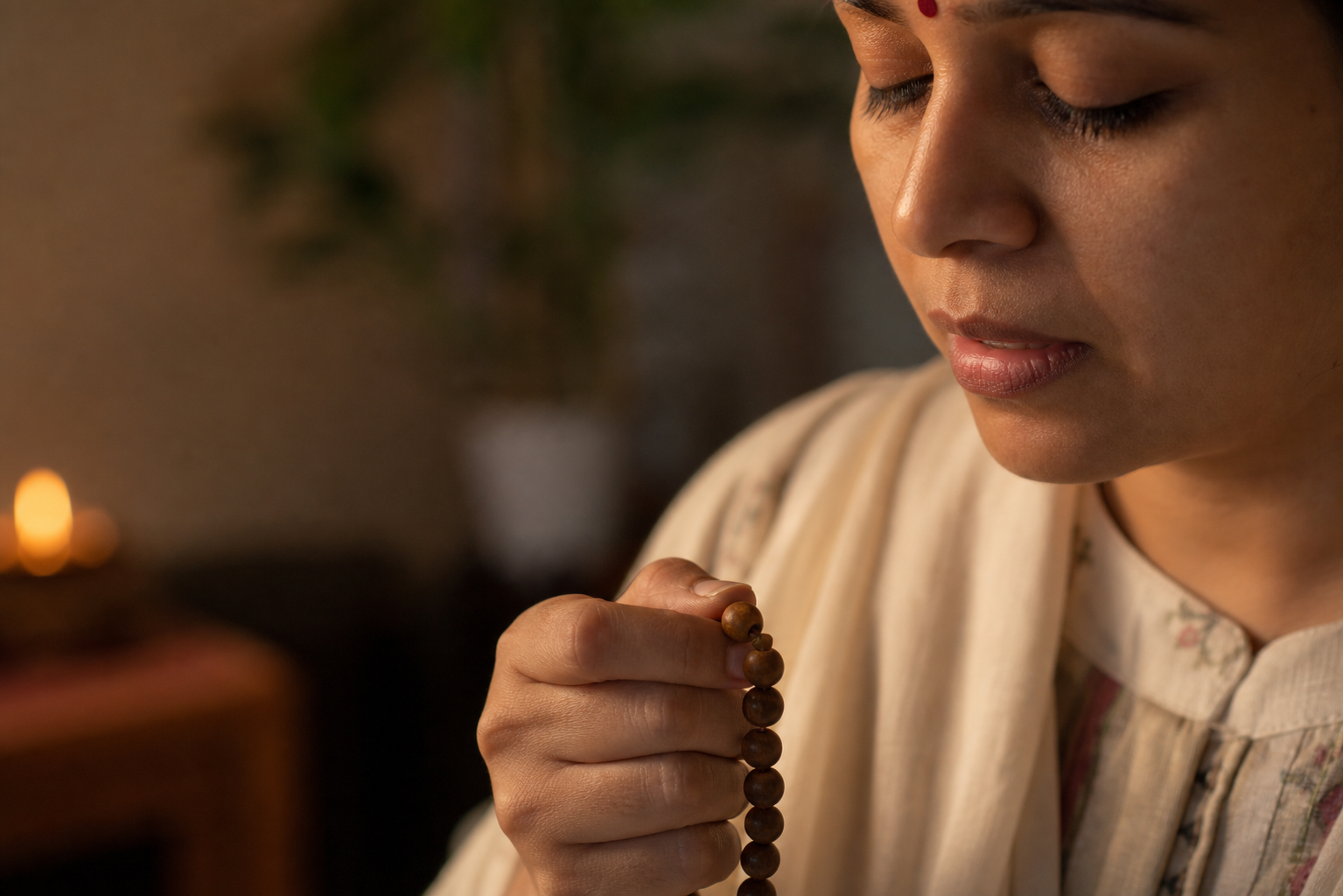
Japa is the repeated recitation of a mantra or divine name. The repetition may be audible, whispered, or mental, depending on your instruction and capacity. Yet repetition alone does not explain the practice. A distracted tongue can complete a count while the mind remains elsewhere; an attentive mind can also become so preoccupied with counting that it loses the mantra’s devotional centre.
Within Parashara Samhita, japa receives a concise but sustained treatment across eight structured chapters. That scale matters. It asks you to regard divine recitation as a discipline whose parts can be understood, practised, observed, and corrected.
A sound japa practice holds four elements together:
- Mantra integrity: You preserve the words, syllables, and pronunciation you received instead of casually editing them.
- Repetition: You return to the mantra through a definite count or period rather than stopping whenever your mood changes.
- Attention: You hear or inwardly register the mantra as it unfolds.
- Bhava: You remember the deity, reality, or devotional relationship toward which the mantra points.
If one element weakens, correct that element rather than abandoning the whole practice. Unclear pronunciation calls for instruction. Wandering attention calls for a more suitable mode of repetition. Dryness calls for recollection of meaning and devotion. None of these automatically calls for a new mantra.
Choose a mantra without outrunning your adhikara
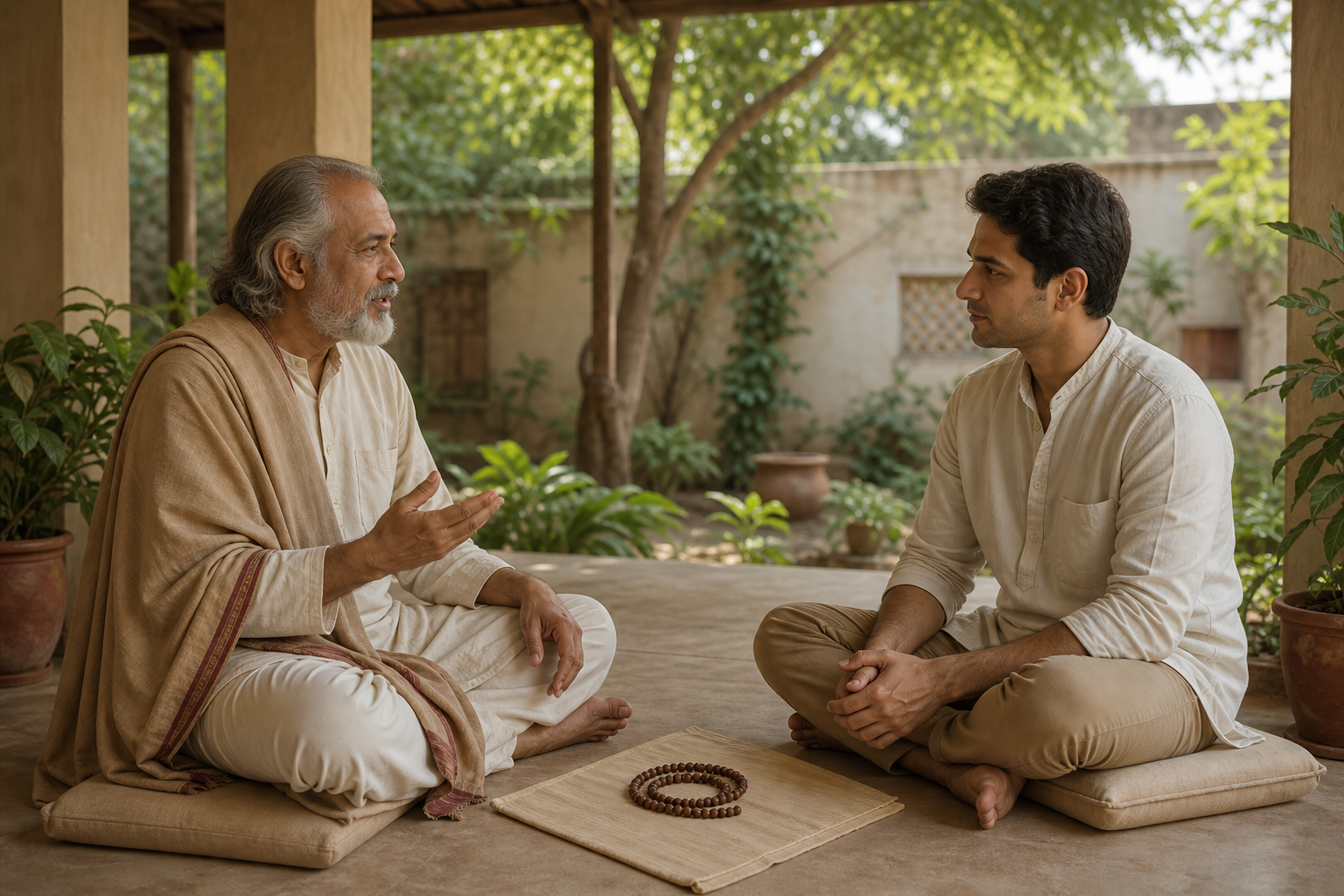
Adhikara means the fitness or authorization to undertake a particular practice. It is not a judgment of your worth. It recognizes that mantras differ in their demands and that a beginner, an initiated practitioner, and someone maintaining a family tradition may not have identical instructions.
Before you begin, identify which of these situations is yours:
- You received a mantra through initiation. Follow the pronunciation, count, method, and observances given by your guru or sampradaya. Generic advice should not replace specific instruction.
- You inherited a familiar family or community practice. Confirm its form with a knowledgeable elder, priest, or teacher from that tradition. Oral familiarity is valuable, but repeated mishearing can alter syllables over time.
- You have no formal instruction. Begin with a simple divine name already rooted in your devotion. Do not select a complex mantra merely because it is advertised as faster, more powerful, or secret.
Bija mantras and mantras accompanied by specialized ritual requirements are not good material for casual experimentation. Traditions differ over which formulas require initiation, so obtain guidance from the lineage to which the mantra belongs. A public recording or social-media graphic can help you discover that a practice exists; it cannot establish your adhikara or answer lineage-specific questions.
Use a simple provenance test before adopting anything: Can you state the mantra accurately, where you received it, whose instructions govern it, and what devotional orientation it carries? If you cannot answer those questions, resolve them before committing to a long observance.
Do not keep changing mantras in search of a stronger feeling. Novelty naturally sharpens attention for a while, which can be mistaken for spiritual superiority. The better test is whether the mantra is appropriate, accurately received, and capable of becoming a stable part of your life.
Build a daily container that protects the mantra
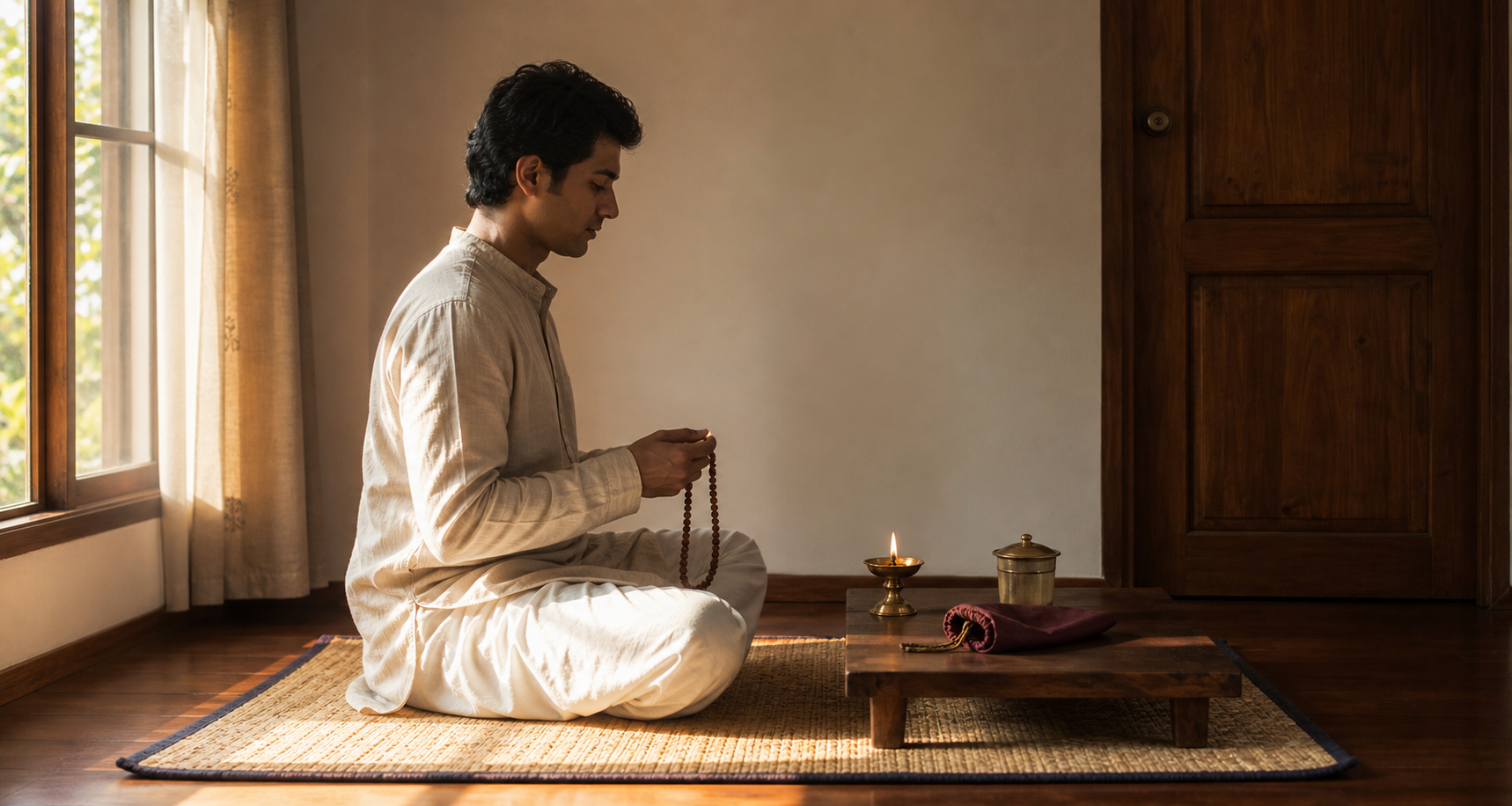
A practical routine removes avoidable decisions. If you renegotiate the place, time, posture, mode, and quantity at every sitting, much of your energy goes into arranging japa rather than doing it. Establish the container once, then make only the corrections that experience genuinely requires.
- Choose a dependable cue. Attach japa to an event that already occurs in your day, such as completing your morning preparation or entering your prayer space. A cue is often more reliable than waiting to feel devotional.
- Prepare the immediate environment. Silence the device that usually interrupts you, place the mala within reach if you use one, and settle anything that would require you to stand up moments later.
- Sit in a steady, sustainable posture. The body should support alertness without becoming the main object of attention. Persistent strain is a reason to adjust the seat, not a test of devotion.
- Recollect before repeating. Bring the deity, guru, meaning, or intention of the mantra to mind. This brief recollection helps prevent the count from becoming detached from worship.
- Use the mode that preserves attention. Audible recitation can help when pronunciation is still being learned or the mind is dull. Whispered or mental japa requires closer inward attention. A quieter mode is not automatically a better mode if entire phrases disappear unnoticed.
- Keep a definite boundary. Follow the count given by your teacher. Without a prescribed count, choose either a repeatable period or a complete mala round that remains realistic on an ordinary day. The purpose of the boundary is steadiness, not self-punishment.
- Close deliberately. When the boundary is complete, remain still briefly, offer the fruit of the practice, and then return to activity. Reaching immediately for a phone trains the mind to treat the final repetition as an escape signal.
A mala is useful because it transfers counting from working memory to the movement of the hand. That frees more attention for the mantra. Use it according to the conventions of your tradition; details about fingers, direction, concealment, and the principal bead are not identical everywhere.
Record whether you kept the session if a simple mark helps with consistency. Do not turn the record into a catalogue of imagined attainment. Completion is observable; spiritual rank is not.
Correct the practice at the point where it drifts

Most difficulties in japa do not require dramatic remedies. They require you to identify what changed: the mantra’s form, the mind’s attention, the body’s alertness, or the devotional orientation. Make the smallest correction that addresses the actual problem.
| What you notice | What may be happening | What to do next |
|---|---|---|
| You reach the end without remembering much of the recitation. | The mode is too subtle for your present level of attention. | Make the mantra softly audible and listen to each repetition. Return to mental japa only when you can retain the full sequence. |
| You are unsure whether you are pronouncing a syllable correctly. | Repetition is reinforcing uncertainty rather than accuracy. | Slow down and verify the sound with a qualified teacher from the relevant tradition. Do not fill the gap by guessing. |
| You rush near the end of the count. | The target has become more important than the mantra. | Maintain the same clarity through the final repetition. If an unprescribed boundary repeatedly forces haste, choose a more sustainable one for future sessions. |
| The practice feels mechanical. | Repetition has become separated from bhava. | Pause before the next session to recall the deity, meaning, or devotional relationship. Keep the mantra stable while renewing your orientation toward it. |
| You become sleepy every time you sit. | The time, posture, or degree of vocal engagement may be encouraging dullness. | Sit more upright, use audible recitation, or move the session to a naturally alert part of your routine. Change the condition before changing the mantra. |
| You miss a session and want to double the next one. | Guilt is trying to redesign the discipline. | Resume at the next established cue. Add compensatory repetitions only when your vow or teacher specifically requires them. |
| You keep looking for visions, sensations, or immediate results. | Expectation is competing with the act of recitation. | Return attention to the mantra. Evaluate the practice first by fidelity, regularity, and its influence on conduct, not by unusual experiences. |
When the mind wanders, notice it at the earliest syllable you can and resume there. Repeatedly scolding yourself only creates another stream of thought. Unless a particular vow requires restarting, the useful movement is from distraction back to mantra.
Meaning and sound should support one another, but they are not always handled in the same way. Some mantras have a readily expressed meaning; others contain seed syllables that cannot be reduced to an ordinary sentence. At minimum, know the devata or sacred orientation of the practice and follow the interpretive guidance of the tradition that transmitted it.
Key takeaways for a steady japa practice
- Use an initiated mantra as instructed; without initiation, begin with a simple divine name already grounded in your devotion.
- Protect the mantra’s form instead of modifying its words, pronunciation, or method for convenience.
- Fix a cue, place, mode, and realistic boundary so that practice does not depend on your mood.
- Use audible recitation when mental repetition becomes vague, fragmented, or sleepy.
- Correct distraction by returning to the next clearly perceived syllable, not by turning the session into self-reproach.
- Judge early progress by regularity, accuracy, attention, and conduct rather than by extraordinary sensations.
Before your next session, write down four decisions: the mantra, where you received it, the cue that begins your practice, and the boundary that ends it. If you cannot state where the mantra came from or whose method you are following, solve that first. Then keep the form stable enough for disciplined repetition, rather than novelty, to shape your attention.
References
