
If the desire for moksha has begun to make ordinary ambition feel thin, you may be asking a difficult question: must you leave work, family, and possessions to take spiritual life seriously? A better first question is: what are you still using to construct and defend an identity?
Renunciation begins there. Formal sannyasa is a demanding vocation, not a dramatic escape from an unpleasant season. For everyone else, the same discipline can expose possessiveness, compulsive consumption, and attachment to status without turning neglect of duty into a spiritual achievement.
Renunciation is ripe when duty has matured into insight
Across 34 concise verses traditionally associated with the Sama Veda, sannyasa stands within the ashrama framework and the pursuit of moksha. It does not function as a veto over dharma. It marks a transition from a life organized around prescribed obligations to one wholly ordered toward realization.
That distinction matters whenever suffering creates an urge to disappear. Exhaustion can resemble vairagya because both weaken your interest in ordinary pursuits. Resentment can resemble detachment because both make relationships feel burdensome. Neither state, by itself, qualifies a person for renunciation.
Use four traditional qualifications to examine the impulse:
- Viveka, or discernment: Can you distinguish what changes from what is enduring, or are you merely dividing life into things you currently like and dislike?
- Vairagya, or dispassion: Is dependence on pleasure, praise, and possession actually weakening? Aversion to the world is still a bond to the world.
- Mental steadiness: Can you maintain ethical and contemplative discipline without novelty, applause, or visible spiritual status?
- Mumukshutva, or longing for liberation: Is freedom from false identification more important than acquiring a new identity as a renunciate?
A useful test is to remain faithful to a legitimate duty while releasing the demand for recognition. If you cannot bear an ordinary obligation without resentment, changing your clothing or address will not remove the claimant within.
Do not resign from work, dispose of property, or sever family obligations merely to test a monastic impulse. Such choices can be financially and relationally difficult to reverse. First test your capacity for simplicity, truthfulness, non-harm, and sustained contemplation where you are. If formal sannyasa remains a serious calling, discern it with a trusted teacher rooted in a living tradition and with honest attention to everyone who depends on you.
What must be relinquished before possessions

The visible renunciate may possess little more than simple clothing, a staff, and a kundika. Yet having few objects is not the same as being free. Attachment can survive dispossession by fastening itself to austerity, purity, authority, or the thought that one is more spiritual than householders.
Renunciation therefore has at least three practical fronts:
- Possessiveness: The mind turns something useful into “mine” and then treats its loss as a loss of self.
- Craving: Food, comfort, attention, and praise become conditions that must be satisfied before the mind will settle.
- Identification: A changing role – parent, professional, scholar, activist, ascetic – is mistaken for the whole of what you are.
The Vedantic inward turn addresses the deepest of these. The method commonly expressed as neti, neti – not this, not this – does not deny the existence of the body, personality, or social role. It denies that any changing object of awareness can exhaust the reality of the aware self. In the nondual understanding, atman is not other than Brahman.
You can apply that discernment in the middle of ordinary activity. When a role is praised, criticized, gained, or lost, notice what has changed and what knows the change. Then fulfil the role’s rightful duty without asking it to provide permanent identity. This is more exacting than indifference: you keep the responsibility while surrendering the claim that it makes you complete.
Key takeaways
- Sannyasa culminates a life aligned with dharma; it is not permission to flee unfinished obligations.
- Viveka, vairagya, mental steadiness, and mumukshutva matter more than a sudden loss of interest in worldly life.
- Minimal possessions support freedom, but they cannot substitute for freedom from possessiveness and spiritual pride.
- A householder can practise inner non-attachment without pretending to have taken monastic vows.
Conduct is the evidence that renunciation is real
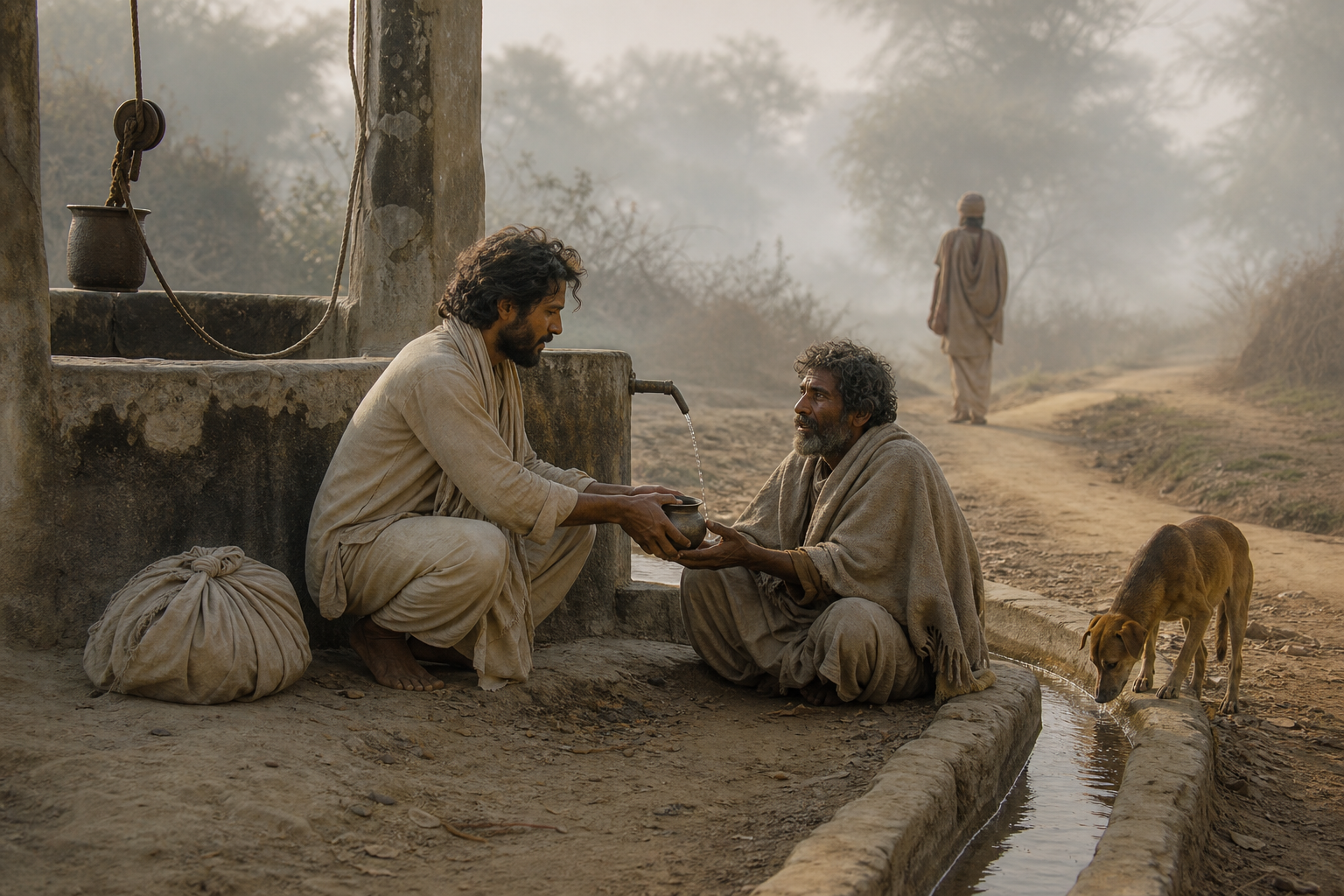
Renunciation becomes credible through conduct. Ahimsa, satya, asteya, and aparigraha are not decorative virtues added after realization. They remove the habits through which the ego protects itself at the expense of other beings.
- Ahimsa: Do not make another being pay for your austerity, anger, or desire to appear detached. Non-harm includes the consequences of what you abandon.
- Satya: Name your motive accurately. “I want freedom” and “I want relief from this conflict” may point toward very different decisions.
- Asteya: Do not build a simple life by quietly appropriating another person’s labour, time, credit, or resources.
- Aparigraha: Keep what serves life and dharma without turning ownership, accumulation, or display into a source of selfhood.
The traditional discipline also joins simple food and dress, dignified alms, mantra, contemplative silence, and meditation centered on Om. Each practice closes an avenue through which appetite ordinarily governs attention. Simplicity reduces distraction. Mauna reveals compulsive speech. Mantra gathers a wandering mind. Meditation turns awareness away from its objects and toward its ground.
A householder should preserve the principle without copying the monastic appearance. Bhiksha belongs within a disciplined renunciate life; it is not a licence to make relatives or friends finance an undefined spiritual experiment. Likewise, silence is not an excuse to withhold necessary communication. The ethical purpose of a discipline is defeated when its burden is simply transferred to somebody else.
The name kundika evokes the mendicant’s water vessel. Its symbolism offers a precise test for possessions: the vessel preserves what purifies and sustains, carries it without extravagance, and makes sharing possible. Ask the same of what you keep. Does it support life, duty, contemplation, or service? Is a simpler object sufficient? Are you maintaining it for use, or maintaining an identity through it?
This does not turn an ancient teaching into a modern environmental manifesto. It does give you a sound ecological discipline: consume with restraint, maintain what remains useful, and stop treating accumulation as evidence of flourishing. A lighter material life has spiritual value when it reduces grasping and practical value when it reduces needless consumption.
Practise inner sannyasa without abandoning your post

Inner sannyasa is an application of renunciant wisdom, not a substitute name for formal ordination. You remain a householder, worker, parent, student, or citizen. What changes is the degree to which craving and self-importance control the way you perform those roles.
Use this sequence as a practical discipline:
- Map your actual dharma. Write down the people and commitments for which you have accepted responsibility. Distinguish genuine obligations from habits maintained only for prestige or fear of opinion.
- Select a field of excess. Choose a possession, purchase pattern, entertainment habit, or demand for recognition that is not serving a real duty. Stop feeding it and observe the mind’s argument for keeping it.
- Establish a daily inward turn. Recite Om, sit in silence, and notice thoughts, sensations, and roles as objects appearing in awareness. The aim is not to manufacture a special mood but to discern the knower from what is known.
- Restrain unnecessary speech. Keep a suitable interval of mauna when it will not obstruct a duty. Notice how often speech seeks attention, victory, reassurance, or escape.
- Perform duty without displaying sacrifice. Complete a necessary task carefully and relinquish the demand that somebody notice your effort. This places non-attachment inside action instead of outside society.
- Review the ethical result. Ask whether the practice made you more truthful, less possessive, steadier, and less harmful. If it produced superiority, neglect, or concealed dependence, correct the practice rather than defending it.
Watch especially for three counterfeits. Austerity can become performance. Detachment can become emotional avoidance. Simplicity can be subsidized by invisible labour from a spouse, parent, colleague, or community. In each case, the outer reduction hides an inner demand. Return to satya and ahimsa: tell the truth about the arrangement and account for its effect on others.
You do not need to discard every comfort. The useful boundary is not between pleasant and unpleasant things but between use and dependence. Receive what supports dharma without making it a condition of inner stability. When circumstances remove it, observe the agitation without letting that agitation decide who you are.
Dharmic kinship does not erase distinct paths
The renunciant ideal also illuminates a shared ethical grammar across the dharmic family. Buddhist Vinaya gives disciplined form to monastic restraint. Jain practice presses non-violence and non-possession with exceptional seriousness. Sikh wisdom joins inner detachment to active service rather than making social withdrawal the universal ideal.
These resonances deserve respect, not flattening. Hindu, Buddhist, Jain, and Sikh traditions do not define the self, liberation, authority, or monastic life in identical ways. The family resemblance lies in the disciplined refusal to let appetite, possession, and egoic assertion rule human conduct.
When you read across these traditions, compare functions before appearances. Ask what attachment is being treated, which ethical safeguards govern the treatment, and how the practice serves compassion or liberation. That approach reveals civilizational kinship while preserving the integrity of each path.
Begin where your dharma is already clear. Find a duty that needs to be done and the self-importance you usually attach to doing it. Keep the duty; release the claim. Repeated honestly, that small inward relinquishment will show you whether your desire for renunciation is becoming freedom or merely another identity.
References
