
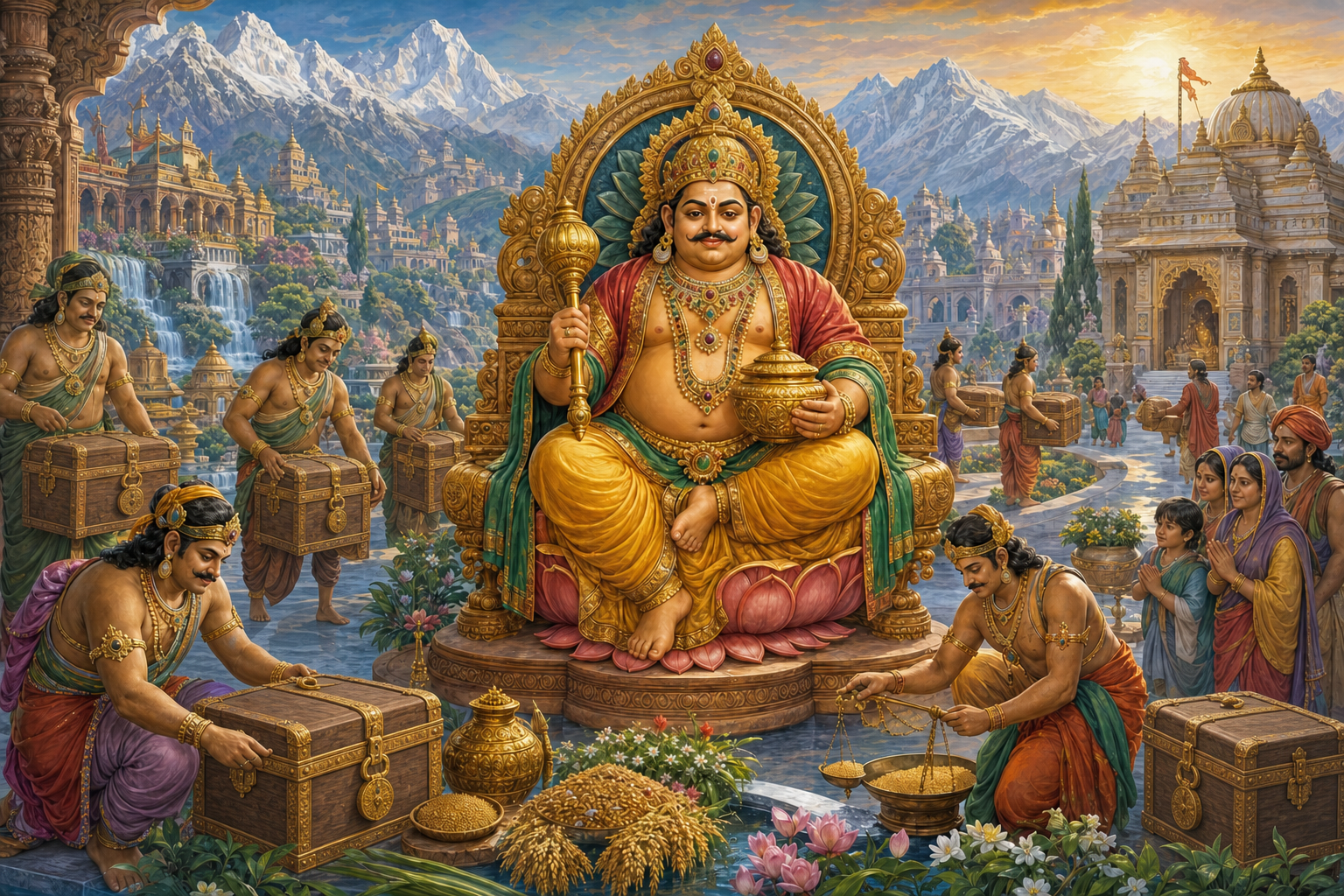
If you came to Kubera looking for a formula that will make money arrive, pause at the most revealing part of his story: he does not become Dhanada, the bestower of wealth, simply by acquiring the largest treasury. He becomes worthy of wealth through tapas and then receives an office defined by guardianship.
That distinction changes how you can approach Kubera in worship and in daily life. His transformation does not make accumulation sacred. It shows how resources become sacred when they are honestly obtained, carefully protected, properly circulated, and placed in the service of dharma.
The transformation begins with the right question
A popular shorthand describes Kubera as turning a cursed birth into divine lordship. That phrase captures the movement from adversity to responsibility, but it should not be mistaken for one uniform canonical episode. The association between Kubera and a curse belongs to a layered interpretive tradition. Iconographic manuals and regional narratives sometimes connect his short stature, large belly, or irregular features with burdened karma and bodily limitation. Different textual lineages emphasize different parts of the story.
This qualification matters. If you treat every later interpretation as an identical scriptural statement, you lose the precision needed to understand Kubera. His physical form may carry symbolic meaning, but it is not sufficient evidence for a single, universally narrated curse.
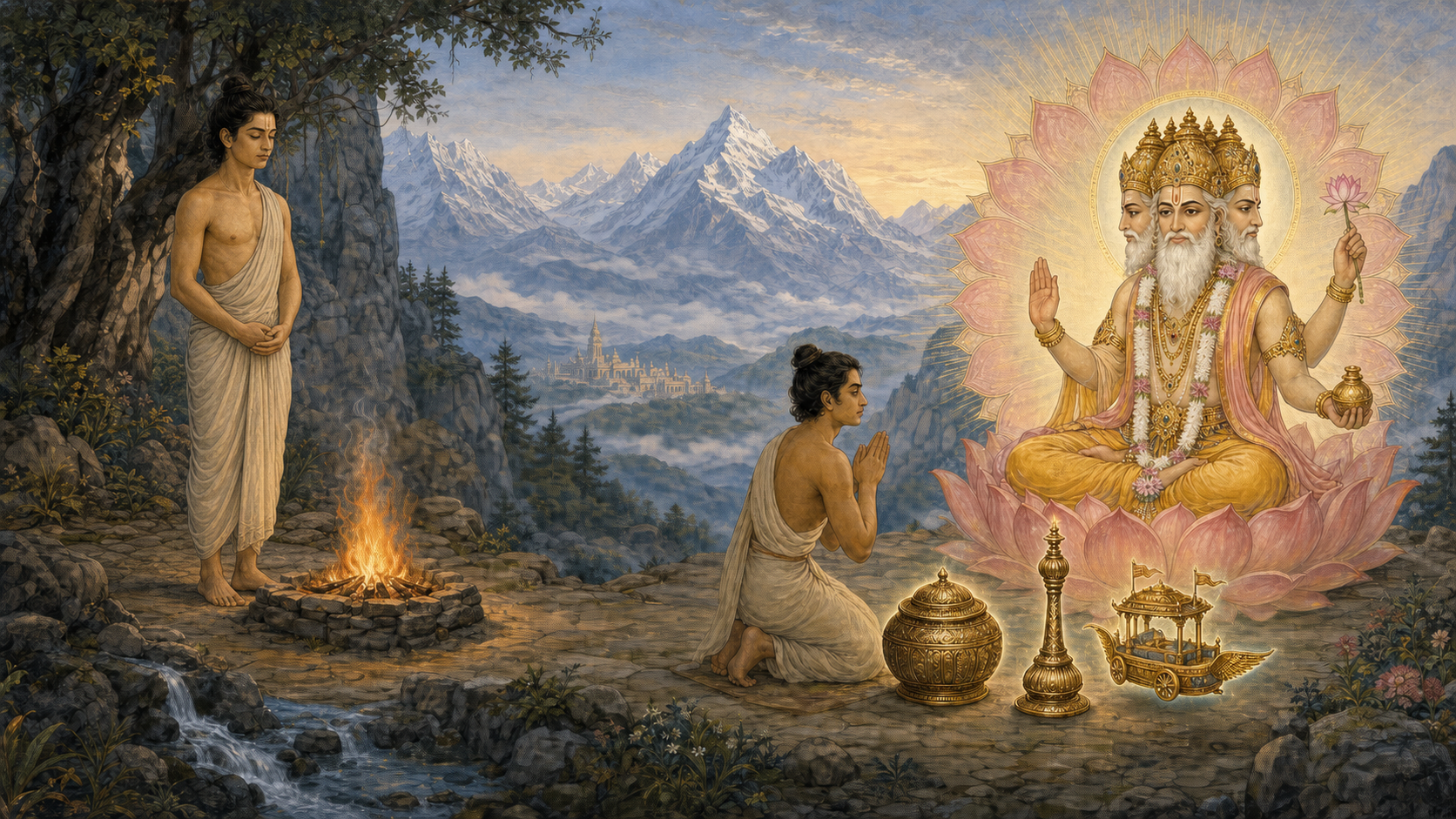
His genealogy provides a firmer foundation. Brahma’s mind-born son Pulastya is counted among the Saptarishis. Pulastya’s son was the learned sage Vishravas, whose union with Ilavila, also rendered Ilavida or Idavida in some recensions, produced Kubera. Kubera is therefore presented as Brahma’s great-grandson. This ancestry places him within a lineage of cosmic order before he ever becomes famous for treasure.
The decisive act is tapas. Kubera undertakes rigorous austerity directed toward Brahma. Tapas here is not a trick for forcing the divine to provide luxuries. It disciplines desire and prepares the seeker to carry an obligation larger than personal appetite. Brahma’s response is correspondingly significant: Kubera is given authority, but each form of authority comes with a sphere of duty.
This is the first practical lesson. Whenever a teaching invokes Kubera as a dispenser of riches, ask what it requires of the recipient. Does it speak about restraint, accountability, right livelihood, and the people affected by the wealth? If it promises gain while removing responsibility, it has detached Kubera from the very transformation that makes him a divine steward.
Brahma’s boons define an office, not a jackpot
The details vary across Puranic recensions, so Kubera’s honours should not be forced into one supposedly exhaustive list. A stable pattern nevertheless emerges: Brahma does not merely enrich Kubera. He assigns him a place, a community, instruments of authority, and responsibility for stores of value.
- Guardian of the North: Kubera is installed as the Dikpāla of the northern quarter. Directional guardianship gives his power a boundary and a public purpose. He must preserve order in a defined part of the cosmos rather than exercise appetite without limit.
- King of the Yakshas: As Yaksha-rāja, Kubera governs Yakshas and Guhyakas, beings closely associated with concealed riches and treasure-bearing places. Sovereignty over them turns access to wealth into an obligation to regulate, protect, and restrain.
- Bearer of the Pushpaka Vimana: Brahma grants Kubera the celebrated airborne vehicle. Pushpaka signifies mobility and sovereign reach, but mobility is attached to duty. It allows its rightful holder to move across realms; it is not presented merely as an extravagant possession.
- Lord associated with Alaka and Lanka: Kubera is closely linked with Alaka or Alakapuri in the Himalayan region. Several traditions also connect him with golden Lanka, built by Viśvakarma under divine commission before Ravana’s usurpation. These cities express ordered prosperity under legitimate rule, although the emphasis differs by lineage.
- Custodian of the nidhis: Puranic traditions place archetypal treasures under Kubera’s care. Some enumerate aṣṭa-nidhi, eight treasures, while others speak of nava-nidhi, nine. The variation is a reason to identify the tradition behind a particular list rather than declaring one regional enumeration universally final.
The nidhis also prevent you from reducing wealth to coins. They represent prosperity in several forms: liquidity, fertility, durability, resilience, and the less visible capacities through which a household or community continues to flourish. A school, a body of knowledge, a reliable institution, a productive skill, and a reserve maintained for genuine need can all help you notice the wider moral field represented by treasure.
The pattern within the boons and offices attributed to Kubera is remarkably consistent. Power is paired with a direction. Treasure is paired with custody. A vehicle is paired with service. A splendid city is paired with governance. Divine authority is therefore not freedom from limits; it is the capacity to uphold the right limits.
You can apply that distinction without pretending that an ancient cosmology is a modern financial manual. A family reserve is serving dharma when it protects legitimate obligations and supports health, learning, and care. A business reserve gains moral meaning when accounts are transparent and commitments are honoured. A community treasury deserves reverence only when its custodians can explain what it protects, who may use it, and how misuse is prevented.
Ravana reveals the difference between possession and legitimacy
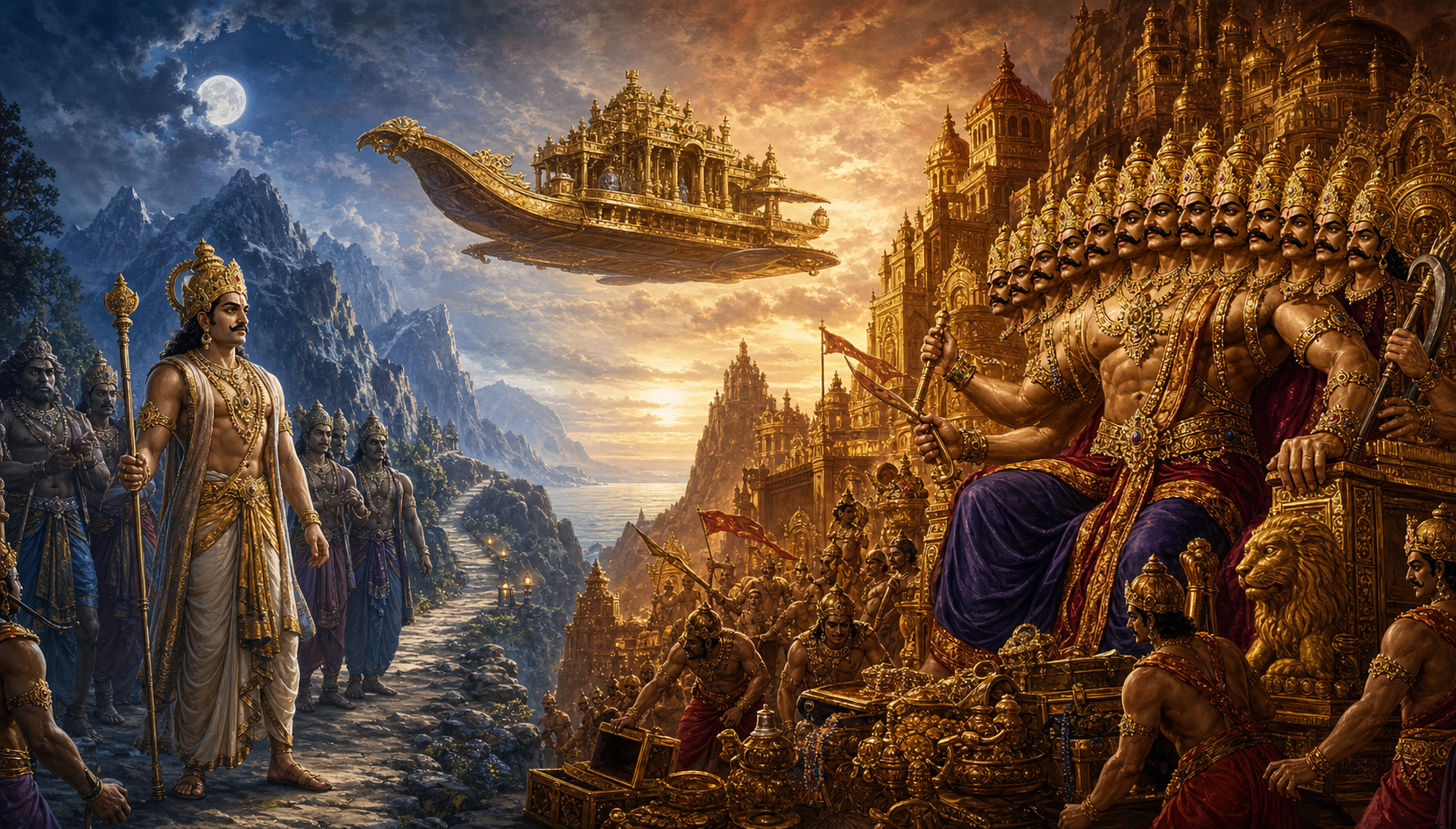
Kubera’s half-brother Ravana provides the sharpest warning in the story. Both are sons of Vishravas through different maternal lines, yet kinship and access do not produce the same relationship with power. Ravana takes Lanka and seizes the Pushpaka Vimana from Kubera. He can possess what belongs to a steward, but seizure cannot give him the steward’s legitimacy.
The contrast is not between a rich person and a poor person. It is between custody and conquest. Kubera’s wealth exists within an assigned order; Ravana treats magnificence as something power entitles him to take. The same object can therefore signify service in one set of hands and domination in another.
The Ramayana completes this contrast after Ravana’s fall. Pushpaka carries Rama and Sita to Ayodhya and then returns to Kubera. The vehicle’s return matters because it restores the distinction between temporary use and rightful custody. Dharma does not require every useful possession to remain untouched. It requires use to respect purpose, limits, and the claims of the rightful guardian.
The Mahabharata develops a related lesson in the Vana Parva. Kubera’s Yakshas test the Pandavas around Gandhamadana, and Kubera’s subsequent blessings affirm Yudhishthira’s dharma-centred kingship. Resources and royal power are measured against restraint, truth, and justice. Splendour alone never settles the moral question.
When you evaluate wealth in public or private life, use the same distinction. Do not treat visible success as automatic proof of virtue, and do not treat access as ownership. Ask four concrete questions:
- Was the resource obtained rightfully, or was it taken through deception, coercion, or abuse of power?
- Can the holder explain the obligations attached to it?
- Does its use protect legitimate dependants, workers, institutions, and communities, or merely magnify the holder?
- Can something borrowed, delegated, or temporarily controlled be returned when its purpose is complete?
These questions expose the difference between the appearance of Kubera and the conduct of Ravana. A person may display the symbols of prosperity while practising the ethics of seizure. Another may quietly administer modest resources with accuracy, restraint, and generosity. In dharmic terms, the second person stands closer to Kubera’s office.
Read Kubera’s image without caricature or confusion

His form is a visual teaching about capacity
Kubera’s iconography often includes a broad or pot-bellied body, rich ornaments, attendants, and emblems such as a coin-pot, lotus, citron, or conch. Not every image contains every emblem. Regional and sectarian forms should be allowed to retain their differences.
The large belly is commonly read as capaciousness: the ability to hold abundance without being overwhelmed by it and to release resources when their proper use demands it. The interpretation is ethical rather than anatomical. It should never be turned into a judgement about the bodies, disabilities, or moral worth of real people. Sacred iconography uses form as a language; it is not a licence to stigmatize human difference.
Ornaments and the coin-pot make abundance visible, while the lotus and citron introduce fertility, auspiciousness, and cultivated life. His association with the northern quarter and with radiant or crystalline cities evokes steadiness, coolness, and clarity. Those are precisely the qualities a custodian needs when wealth creates pressure, temptation, or conflict.
The next time you encounter Kubera’s image, do not stop at the thought, “He is rich.” Read the image through three questions: What must a steward be able to hold? What must a steward be willing to release? What clarity is needed to distinguish rightful protection from fearful hoarding? This turns darśana into ethical reflection.
The same ethical pattern crosses Dharmic traditions
Kubera’s identity also helps you see a family resemblance across Dharmic traditions without pretending that those traditions are interchangeable. Buddhist traditions know Vaiśravaṇa, or Vessavaṇa in Pali, as the Lokapāla of the North and a protector of the righteous. Vajrayāna traditions closely associate Jambhala with generous abundance directed by bodhisattva ethics. Jain cosmologies integrate Yaksha lineages into an ordered karmic world in which treasure-guarding beings remain subject to ethical structure.
Sikh teachings do not need to be collapsed into Kubera worship to participate in the same moral conversation. Honest livelihood, sharing, and service likewise challenge the idea that wealth becomes good merely because someone owns it. The common thread is not a claim that every tradition teaches an identical theology. It is the insistence that prosperity must answer to conduct.
This gives you a reliable way to discuss shared Dharmic values. Name the differences in deity, doctrine, ritual, and cosmology. Then identify the ethical convergence precisely: resources should be rightly acquired, responsibly guarded, generously used, and subordinated to a path larger than the individual ego. Unity becomes more credible when it does not erase distinction.
Use a Kubera audit to turn devotion into stewardship
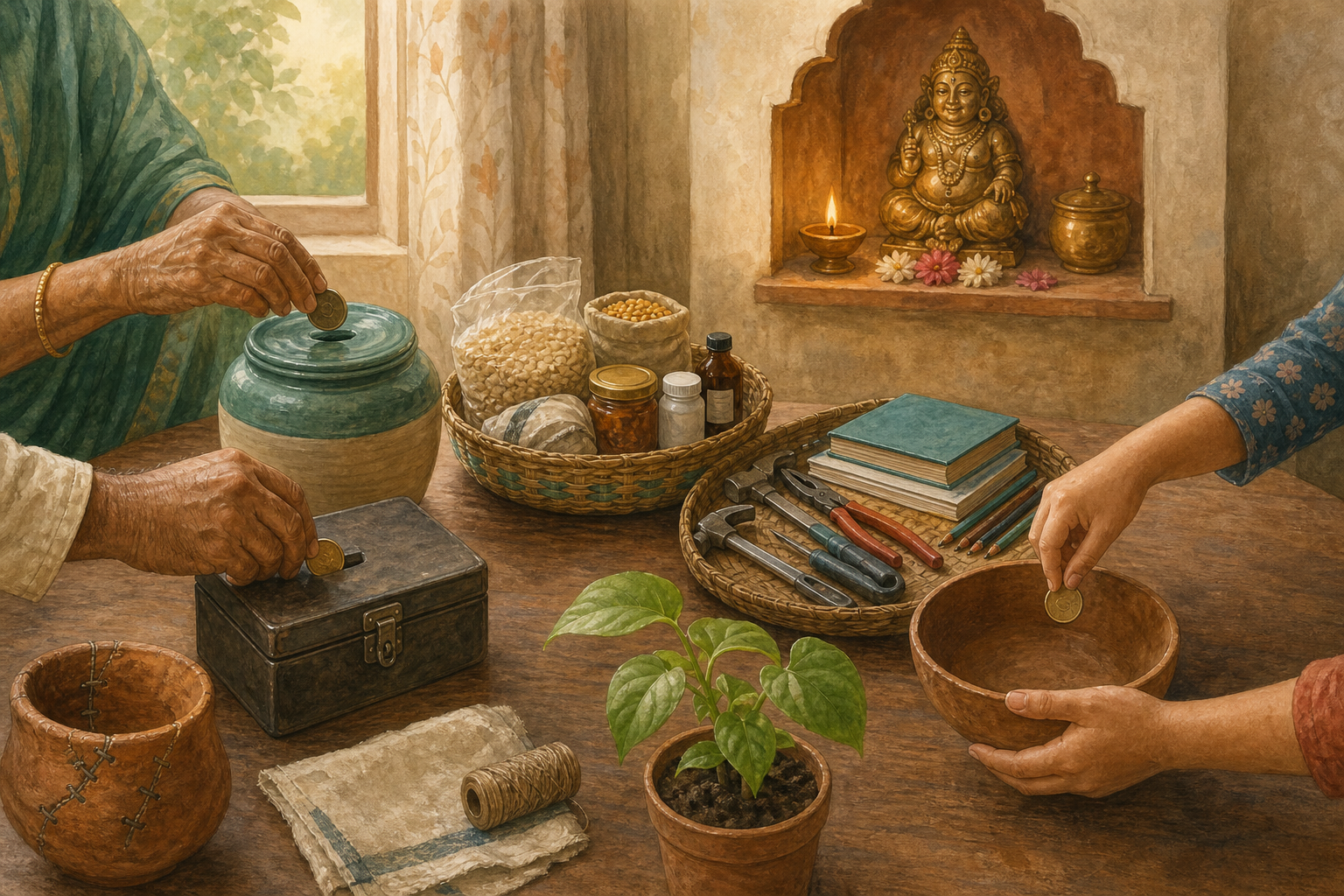
Lakshmi-Kubera worship during Deepavali and regional vratas is often associated with auspicious prosperity, or śrī. You can keep the prayer for abundance while making its ethical content explicit. Take one sheet of paper and examine one resource you actually control. It might be money, property, professional authority, specialized knowledge, a community fund, or time that other people depend upon.
- Name the trust. Complete the sentence, “I hold this resource in trust for…” Name the people, institution, duty, or dharmic purpose it is meant to sustain. If you can name only yourself, notice the gap before trying to justify it.
- Trace its acquisition. Write down how the resource came under your control. Ask whether you could explain that process plainly to everyone materially affected by it. Opacity does not prove wrongdoing, but resistance to honest explanation is a reason to examine the arrangement more closely.
- List its first obligations. Identify the payments, care, maintenance, promises, or access that must be honoured before discretionary display. This is the modern equivalent of recognizing that treasure comes with a guarded domain.
- Set a boundary against Ravana’s error. Mark what you may use but do not have the moral right to seize, conceal, or treat as exclusively yours. Shared funds, delegated authority, borrowed property, and institutional knowledge all require this distinction.
- Create an intelligible account. Record what enters, what leaves, who authorizes its use, and who can review the record. Kubera’s stewardship is not served by accounts that only the custodian can understand. Transparency allows trust to survive the absence of one powerful person.
- Choose one act of circulation. Direct part of the resource toward a named purpose such as learning, health, service, or community resilience. Give the act a recipient and a date. A good intention becomes stewardship only when someone can tell that it occurred.
This is an ethical audit, not investment, tax, or legal instruction. If completing it reveals contracts, regulated funds, tax exposure, or contested ownership, take the factual record to an appropriately qualified professional before changing the arrangement.
The audit does not demand that you empty every reserve. Kubera is a guardian of treasure, so protection and continuity matter. It also does not permit endless accumulation under the label of prudence. Kubera is Dhanada, the giver of wealth. Holding and giving are not rival virtues here; both are duties that must be governed by discernment.
A household can apply this by making educational, care, and service commitments visible beside its ordinary expenses. A business can reconcile an opaque account, clarify delegated authority, or document the purpose of a reserve. A temple or community organization can record who may authorize spending and how members receive an account. Each action converts a pious aspiration into a structure that can outlast mood and personality.
Key takeaways
- Kubera’s transformation is from adversity to accountable office, not from poverty to unrestricted consumption.
- Brahma’s gifts pair authority with boundaries: a direction to guard, beings to govern, a vehicle to use, and treasures to protect.
- Ravana’s seizure of Lanka and Pushpaka proves that possession, power, and splendour do not create moral legitimacy.
- Kubera’s iconography teaches capacity, clarity, protection, and circulation; it should not be used to judge real human bodies.
- Across Hindu, Buddhist, Jain, and resonant Sikh ethical frameworks, prosperity is answerable to honest conduct and service.
Before your next Lakshmi-Kubera prayer, choose one resource and complete the six-part audit. Place the written obligation beside the lamp, then carry out the named act of correction or service. That is how Kubera’s transformation becomes more than a story you admire: it becomes a discipline governing what passes through your own hands.
References
