
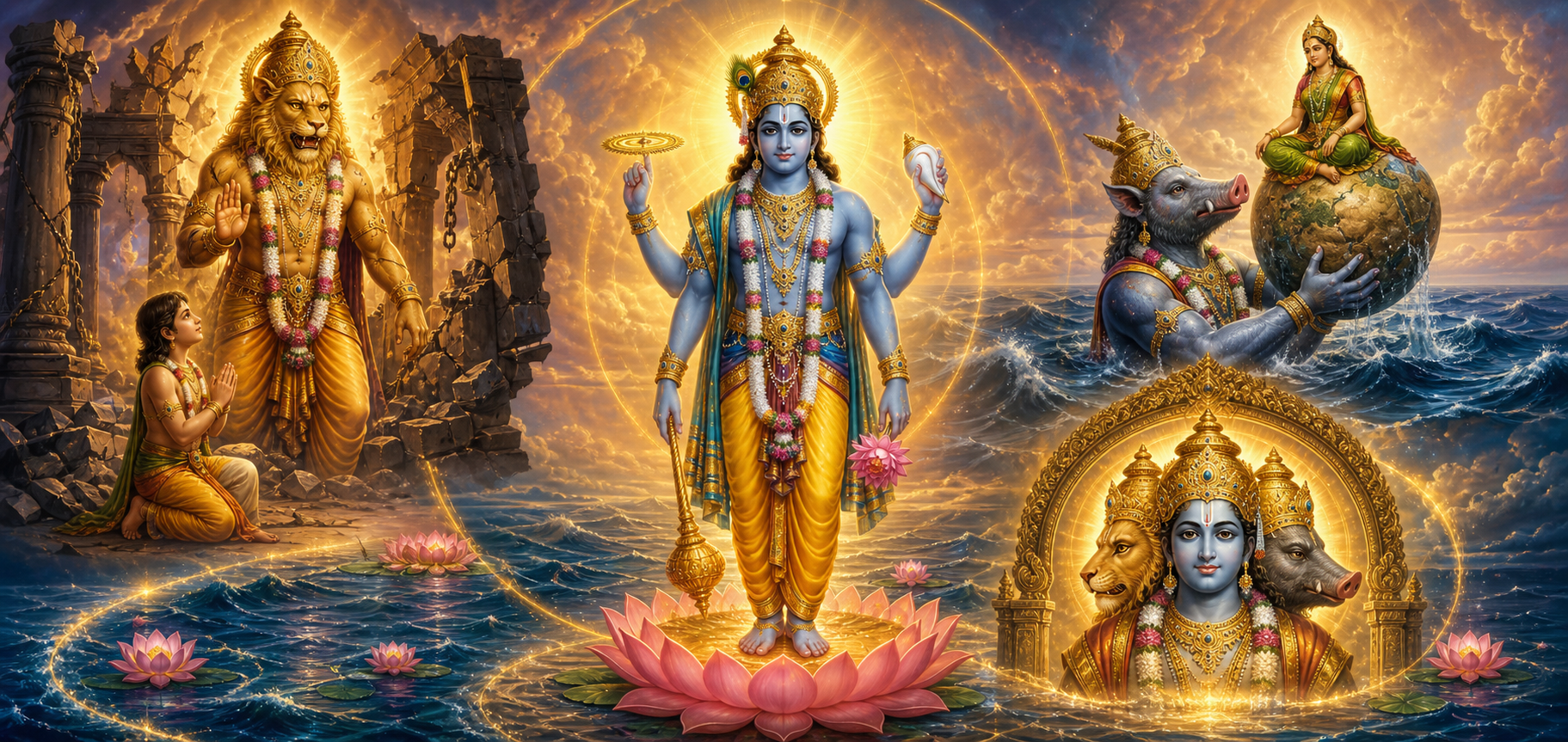
If you are turning to Vishnu because something in your life feels threatened, the useful question is not which form is strongest. Ask what kind of protection the situation requires. Fear, active injustice, collapse, and inner obstruction are not the same problem.
Prahlada, Narasimha, Varaha, and Vaikuntha Chaturmurti give you a practical map. They reveal protection as sustained integrity, decisive intervention, restoration, and purification. You can use that map without reducing a sacred manifestation to a tool: begin with bhakti, discern the duty before you, and then act in a way that preserves dharma.
Key takeaways
- Prahlada shows that protection can first appear as the strength to remain truthful under pressure, even before the danger visibly ends.
- Narasimha represents precise and decisive protection when adharma appears to have made itself untouchable.
- Varaha shows that rescue is incomplete until what has fallen into disorder is lifted and restored.
- Vaikuntha Chaturmurti holds compassion, courage, restoration, and fierce purification within one integrated vision.
- Bhakti does not require passivity. Divine trust should clarify safe, proportionate, and dharmic action in the world.
Prahlada shows the protection that begins within

Prahlada’s ordeal in the Vishnu Purana corrects a common misunderstanding about divine protection. Hiranyakashipu subjects his son to an extraordinary range of dangers, including poison, serpents, fire, water, falls from heights, elephants, starvation, weapons, sorcery, and hostile mantras. A devotional memory of eighteen attempted killings and rescues is widely repeated, although the precise enumeration varies among puranic recensions.
The important feature is not the arithmetic. Every available kind of pressure is brought against Prahlada, yet the pressure never gains control of his allegiance. He does not allow fear, family authority, physical danger, or isolation to redefine what he knows to be true. Vishnu’s protection is therefore visible before Narasimha appears: it is already present in Prahlada’s unbroken bhakti and moral steadiness.
This gives you a concrete way to examine your own difficulty. Separate the outcome you want from the principle you must not abandon. You may want approval, victory, security, or a quick resolution. The non-negotiable principle could instead be truthfulness, protection of another person, fidelity to a duty, or refusal to participate in wrongdoing. Outcomes can remain uncertain while the principle becomes clear.
- Name the pressure. Is fear pushing you to lie, submit to an unethical demand, abandon someone vulnerable, or act from hatred?
- Name the dharmic commitment. State what must remain true in your conduct even if the situation does not resolve as you hope.
- Separate steadiness from exposure. Remaining faithful to dharma does not mean remaining unnecessarily available to someone who intends harm.
- Check your response. A protective action can stop wrongdoing without turning cruelty, humiliation, or revenge into its goal.
Prahlada’s fearlessness should never be used to romanticize preventable danger. If your real situation includes violence, coercion, or abuse, move toward physical safety and seek competent local help. Trust in Vishnu is not a command to give an aggressor continued access to you. The transferable lesson is fidelity under pressure, not passive acceptance of harm.
Narasimha protects by breaking the trap without breaking dharma
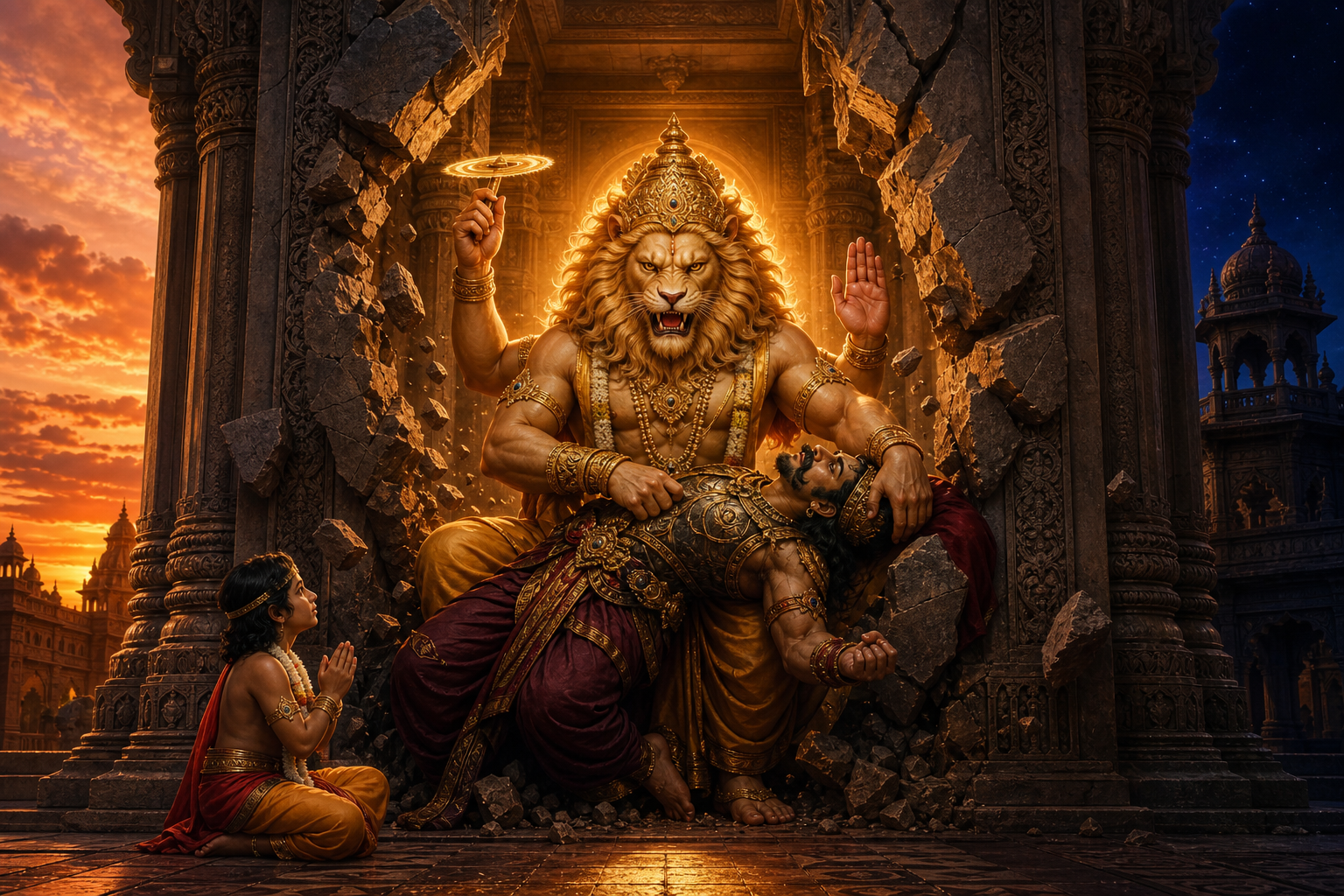
Hiranyakashipu’s apparent security rests on conditions that seem to place him beyond defeat. The culmination at the palace pillar, at twilight, and on the threshold answers the boundaries of day and night, inside and outside, weapon and no weapon. Narasimha, Vishnu’s man-lion manifestation, ends the tyranny without granting those protections authority over cosmic order.
Narasimha is therefore more than an image of overwhelming force. The manifestation embodies precision. The response fits the actual structure of the injustice. It does not accept the tyrant’s claim that every path to justice has been closed, and it does not discard dharma merely because ordinary categories appear inadequate.
When a harmful situation feels airtight, examine its frame before escalating. People and institutions often appear invincible because genuine constraints have become mixed with untested assumptions. Use three questions to separate them:
- What exactly is being harmed? Name the person, duty, relationship, institution, or truth that requires protection.
- Which limits are real? Distinguish law, safety, responsibility, and ethical restraint from assumptions such as nothing can be challenged or no one will help.
- What proportionate action interrupts the harm? Look for an action that is truthful, lawful where applicable, protective, and directed toward stopping the wrong rather than feeding personal vengeance.
The fierce form is easily misread when anger is already present. Narasimha does not make rage sacred merely because the angry person claims a righteous cause. The protective movement is toward ending adharma and restoring order. If an action continues mainly to humiliate an opponent after the danger has been contained, it has departed from that logic.
This is where courage must remain joined to restraint. Compassion without the capacity to set a boundary can leave the vulnerable unprotected. Force without discernment can reproduce the disorder it claims to oppose. Narasimha asks for neither weakness nor uncontrolled fury, but moral clarity strong enough to act at the decisive point.
Varaha and Vaikuntha Chaturmurti reveal protection as restoration
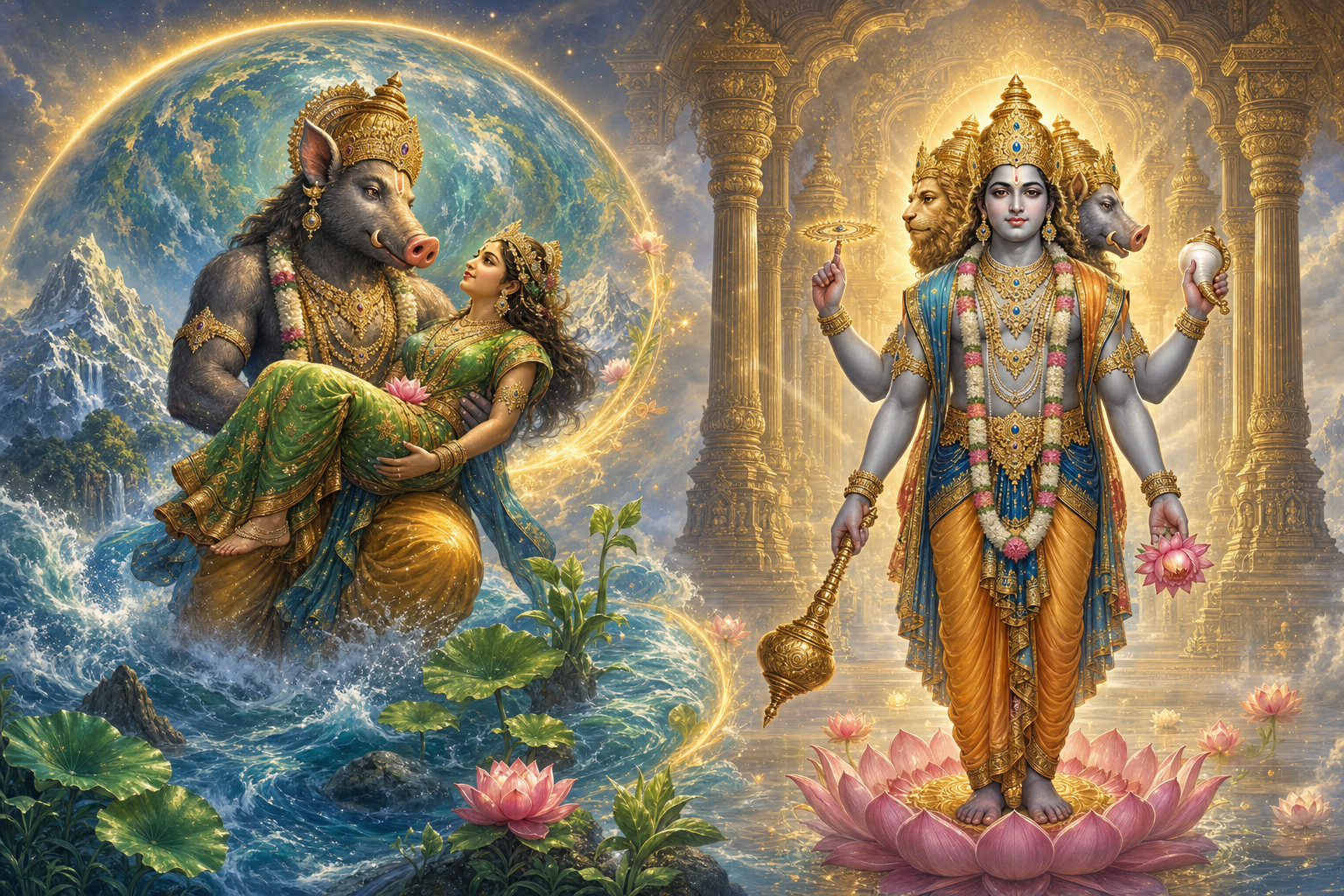
Stopping danger is only one part of preservation. Varaha represents the restorative movement of Vishnu: the boar lifts the earth from chaos and returns it to balance. This matters whenever the immediate crisis has passed but its damage remains. A conflict can end while trust, routine, responsibility, or communal order still lies buried beneath the aftermath.
Vaikuntha Chaturmurti makes this wider understanding of protection visible in one sacred form. Especially venerated in the temples and visual culture of Kashmir, the manifestation combines a human head, a lion head, a boar head, and a fierce head. The fourfold vision expresses Vishnu’s capacity to preserve, defend, uplift, and remove adharma from every direction.
| Aspect | Protective movement | Question for you |
|---|---|---|
| Human head | Compassion, discernment, and steady guardianship | Can I see the situation clearly without losing empathy? |
| Lion head | Fearless defence and decisive correction of injustice | What must be protected or confronted now? |
| Boar head | Rescue from chaos and restoration of balance | What has fallen into disorder and must be lifted back into place? |
| Fierce head | Removal of adharma, fear, ego, and spiritual obstruction | What must be relinquished or removed rather than continually accommodated? |
The fierce head is not an invitation to cultivate cruelty. Within the composite image, fierceness has a disciplined purpose: the removal of what obstructs dharma. Likewise, the human face is not weakness, the lion is not anger for its own sake, and the boar is not merely recovery after defeat. Each aspect corrects the excess of another. Strength remains accountable to compassion; discernment must be willing to defend; victory must be followed by repair; and restoration must address the causes of disorder.
You can apply this sequence after any serious disruption. First see the people and duties involved without dehumanizing anyone. Then establish the boundary that prevents further harm. Next restore what has been damaged. Finally, remove the habit, fear, falsehood, or neglected responsibility that would allow the same disorder to return. This is not a prescribed temple ritual. It is an ethical reading of the integrated form.
Turn contemplation of Vishnu’s forms into a dharmic decision
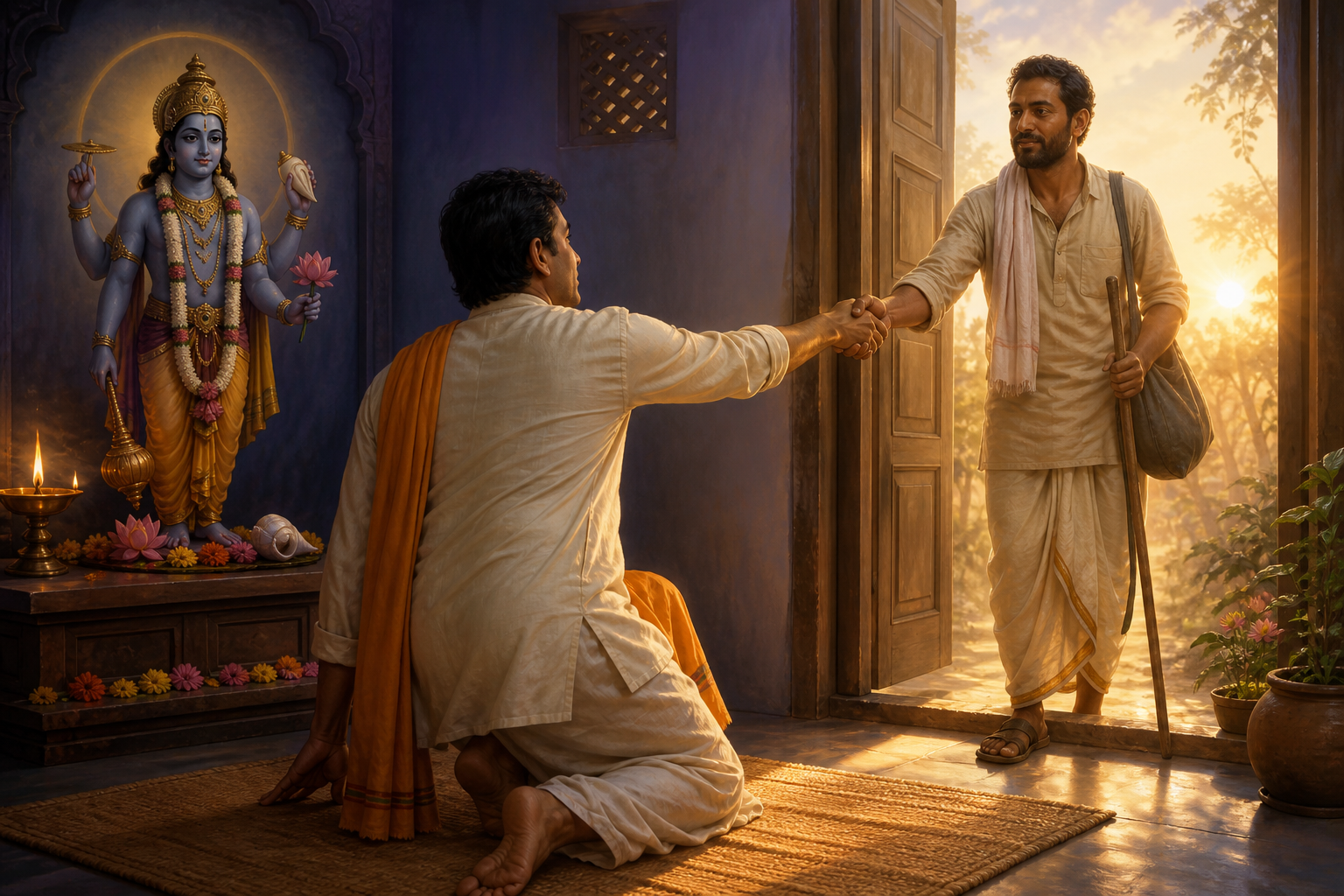
Devotees approach Vaikuntha Chaturmurti through darshan, mantra japa, and quiet contemplation, with particular practices varying by temple and tradition. If you belong to a sampradaya, let its teachings govern mantra and ritual. The following process is a reflective aid for connecting devotion to conduct, not a replacement for inherited practice.
- Describe the disturbance plainly. Complete the sentence What is threatened is… Name the actual duty or good at stake rather than beginning with the person you blame.
- Choose the protective movement. Remember Prahlada when fear is weakening fidelity, Narasimha when ongoing adharma requires a decisive boundary, Varaha when the central task is repair, and Vaikuntha Chaturmurti when the situation requires all these capacities together.
- Pair strength with a guardrail. Decide both what you will do and what you refuse to become. You might speak firmly without insulting, withdraw without retaliating, correct a wrong without falsifying evidence, or restore a neglected duty without pretending the injury never occurred.
- Make devotion concrete. After prayer or contemplation, identify the next visible action: tell the truth, ask for help, establish a boundary, protect someone at risk, repair a responsibility, or remove your own contribution to the disorder.
- Examine the motive again. Ask whether the action protects dharma or merely gives anger a sacred vocabulary. A clean action may be firm, but its purpose remains protection and restoration rather than the enjoyment of another person’s suffering.
If you cannot identify one form because the difficulty has several layers, contemplate Vaikuntha Chaturmurti as a complete diagnostic. Begin reflectively with the human capacity to understand, move to the lion’s courage to protect, continue with the boar’s labour of restoration, and finish by identifying the obstruction represented by the fierce aspect. Keep this as contemplation unless your tradition specifically teaches it as ritual.
Vishnu’s protective manifestations do not promise that devotion will place you outside every painful circumstance. They show how dharma can remain alive within danger, how injustice can be stopped without accepting its terms, and how order can be rebuilt after rescue. The next time you invoke Vishnu’s protection, ask not only to be spared. Ask which protective movement the moment requires from you, and take the next action that keeps courage, compassion, and truth together.
References
- Hindu Pad – 18 Miraculous Rescues: How Lord Vishnu Shielded Prahlada from Hiranyakashipu’s Fury
- Hindu Pad – Vaikuntha Chaturmurti: Decode Vishnu’s Four Heads, Sacred Symbolism, and Kashmir Devotion
