

Your saved queue of ISKCON classes can grow faster than your understanding. You hear a thoughtful explanation, feel its force for an hour, and then struggle to recall the passage or the point when ordinary life resumes.
You probably don’t need another lecture in the queue. You need a deliberate way to choose, hear, remember, and apply what is already available. The aim is not to consume more devotional media. It is to let hearing become remembrance and remembrance shape practice.
Decide what kind of teaching you are hearing
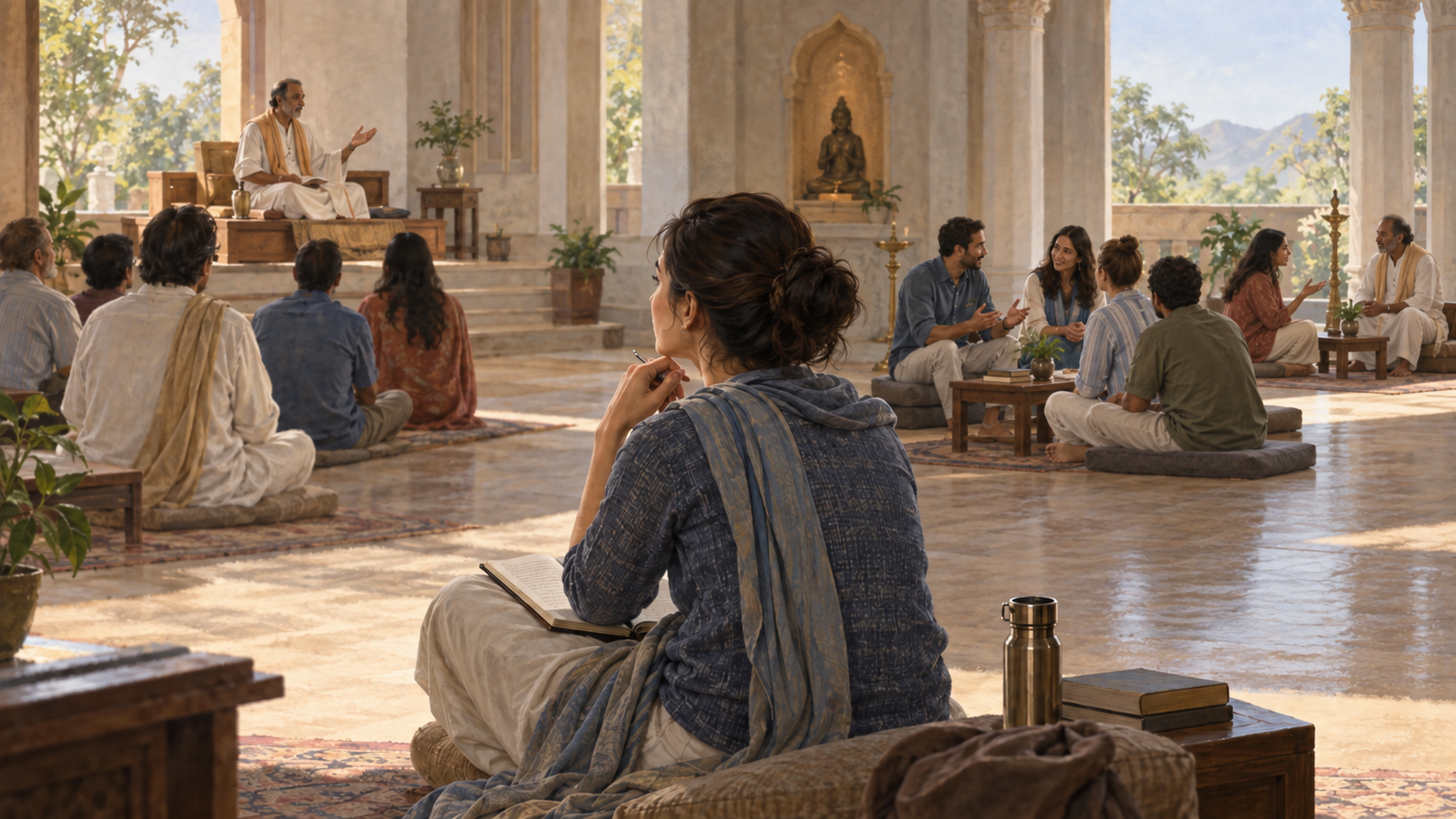
Contemporary ISKCON teaching does not arrive in a single format. In one late-September cross-section, listeners could choose verse-specific classes on Srimad Bhagavatam 4.25.15, 11.5.41, 4.9.55, and 3.28.28, a discussion of how the Bhagavatam transforms the heart, a Bhadra Purnima programme, and a Books Are the Basis presentation. A Caitanya-caritamrta Adi-lila 5.84 class and a Vrindavan session on Srila Prabhupada Lilamrita added two more modes of learning.
These forms belong to the same devotional culture, but they ask different things of you. If you treat all of them as interchangeable videos, you will retain impressions while losing structure. Label the session before you begin:
- Verse exposition: Follow the wording, context, argument, and practical consequence of a specified scriptural passage.
- Thematic teaching: Trace one question, such as transformation of the heart, through several ideas or passages.
- Festival hearing: Enter the devotional purpose of an observance such as Bhadra Purnima and understand why that occasion directs attention toward a particular text or practice.
- Sacred biography: Remember an acharya through choices and events that embody teachings.
- Movement reflection: Examine how books, temples, leadership, preaching, and personal practice relate to one another.
This first decision changes how you listen. In a verse class, keep the passage open and test every major explanation against it. In biography, listen for the principle embodied by an action. In a thematic presentation, identify the main question and note how each point helps answer it. The right question is not simply, “Was this inspiring?” It is, “What kind of instruction was offered, and what response does it require from me?”
Put the scriptural passage before the speaker

A title containing a book, chapter, and verse gives you a built-in discipline. Read that passage before pressing play. If possible, read the preceding and following passages as well. You are establishing the textual ground before receiving an interpretation.
Begin your notes with the exact reference. Under it, leave separate spaces for the text, the speaker’s explanation, and your application. This separation matters. Scripture provides the shared point of return; a speaker selects emphases and makes connections; you then decide how the teaching addresses your conduct. Blurring those layers makes it hard to revisit a teaching honestly.
<!– wp:list {
Leave a Reply
You must be logged in to post a comment.