

You may already have a sacred text, a commentary, and more recorded classes than you can finish. Yet reading, hearing, worship, and daily conduct can remain in separate compartments. You complete a chapter but cannot say what it asked of you or what you will carry into the next day.
The way forward is not to consume more material. It is to give each form of study a clear job, connect study to a concrete devotional response, and return often enough for the text to correct your first impression. The method below works for individual reading, a temple class, or a small study circle.
Give the journey and the passage different jobs

Vaishnava study benefits from two complementary lanes. The first follows a work continuously. The second slows down over a defined passage. Confusion begins when you expect one lane to do everything.
- The journey lane keeps you moving through a complete work in order. A sustained journey through Brhad Bhagavatamrita, for example, invites continuity rather than isolated quotation. Use this lane to notice recurring persons, questions, contrasts, and changes in spiritual understanding.
- The passage lane confines attention to a clearly marked unit. A Bhagavatam class identified as 5.8 1-25 illustrates the value of a bounded scope. Use this lane to examine wording, sequence, context, and the point at which your own assumptions enter the reading.
Keep both lanes active, but do not keep opening new texts. Choose one principal work for continuity and one passage from that work, or from the text currently being taught in your community, for closer attention. Stay with those choices until you reach a natural stopping place. This prevents enthusiasm from turning into a shelf of abandoned beginnings.
Before beginning, make a short study covenant. Record the exact title and edition, the translator or commentator, your current stopping place, the question you are carrying, and the devotional practice you intend to examine. The edition matters because translation and commentary are not interchangeable. If you later consult another rendering, label it clearly instead of silently blending its wording into the first.
Use a study cycle that ends in practice and returns to the text

A devotional reading session needs more than an opening prayer and a set of notes. It needs a complete cycle: orientation, attentive reading, questioning, response, and return. Without the final two movements, study easily becomes religious information rather than formation.
- Orient yourself. Identify where you are in the work. Note who is speaking, who is listening, what has just happened, and what question or tension is present. If the text does not supply an answer, leave the field open rather than filling it with memory or assumption.
- Read the unit without interruption. Let the passage establish its own movement before consulting explanations. On the first pass, mark only transitions, repeated terms, surprising statements, and anything you cannot yet understand.
- Read again with a precise question. Ask what the passage reveals about Bhagavan, devotion, a devotee’s disposition, or an obstacle to remembrance and service. A precise question is more useful than a broad request for inspiration.
- Separate observation from interpretation. Write what the passage actually states before writing what you think it means. Then mark what came from a commentary or teacher. This simple distinction exposes conclusions that the words themselves may not support.
- Choose a devotional response. Translate your reading into an act you can recognize: return to a neglected prayer, restrain a recurring fault in speech, give fuller attention during worship, repair an avoidable offence, or hold a particular teaching in mind during service. Choose something proportionate to the passage and your actual responsibilities.
- Return before advancing. At the next session, read your previous response and ask what happened. If you forgot it, that is useful information. Read the relevant lines again and refine the response rather than inventing a grander resolution.
Your notes do not need to become an archive. A compact entry is enough: the passage, what it says, the question it raises, the explanation you received, the response you chose, and what you noticed when you returned. If note-taking begins to consume the time meant for reading and remembrance, shorten the notes.
When a Sanskrit term matters, copy it accurately from the edition in front of you and place its supplied meaning beside it. Do not build an argument from a half-remembered definition. If translations differ, preserve the difference as a question until you can check a reliable commentary or ask a qualified teacher within the relevant sampradaya.
Let guided hearing sharpen your attention, not replace it
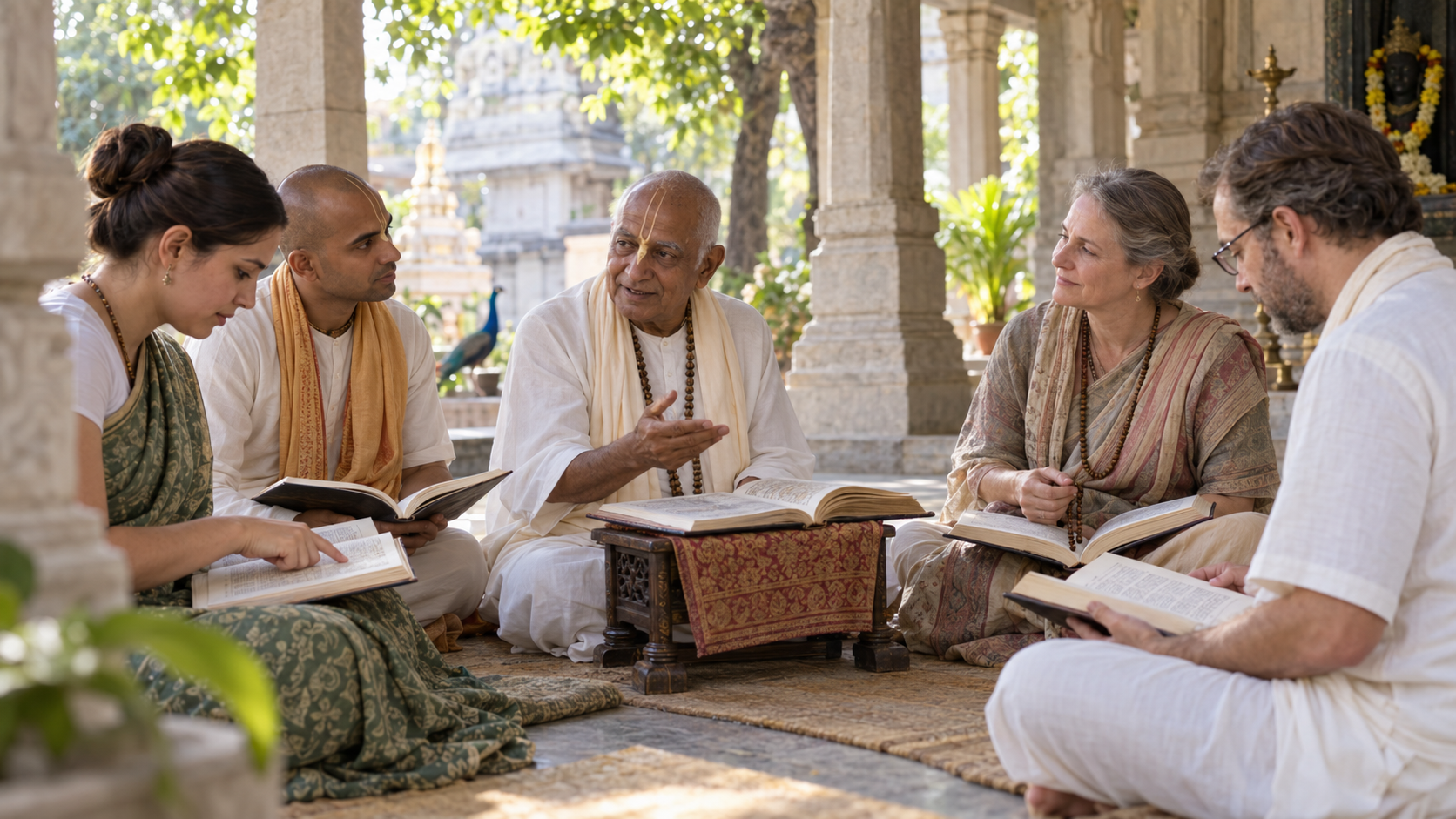
A class can reveal context, connections, and devotional implications that you did not see alone. It can also become passive consumption if you arrive without reading, copy every sentence, and leave without revisiting the passage. Treat guided hearing as a second encounter with the text.
- Before the class: read the announced verses or section. Write the main movement in plain language and record the question you most need clarified.
- During the class: keep the text open. Note where the teacher clarifies a word, corrects a likely misreading, supplies context, or draws out a practice. You do not need a transcript of everything said.
- After the class: label your notes as text, teacher’s explanation, or personal inference. Then reread the passage and revise your earlier understanding where necessary.
- Before the next class: formulate any unresolved question with a verse or line attached to it. A question anchored in the text is easier for a teacher or study group to address than a general request to explain the entire subject.
This discipline is especially important when you learn from teachers belonging to different Vaishnava lineages. Shared devotion does not make every doctrinal vocabulary, interpretive method, or devotional emphasis identical. Record who is teaching and which edition or commentary is being used. When explanations appear to differ, do not rush either to erase the distinction or to declare a contradiction. First check whether the teachers are answering the same question and using key terms in the same sense.
If you study in a group, spend less time collecting reactions and more time locating claims. Ask participants to point to the phrase that prompted an observation. Distinguish a sincere personal application from the meaning of the passage itself. Both can matter, but they are not the same kind of statement.
Look for changes in attention, conduct, and teachability
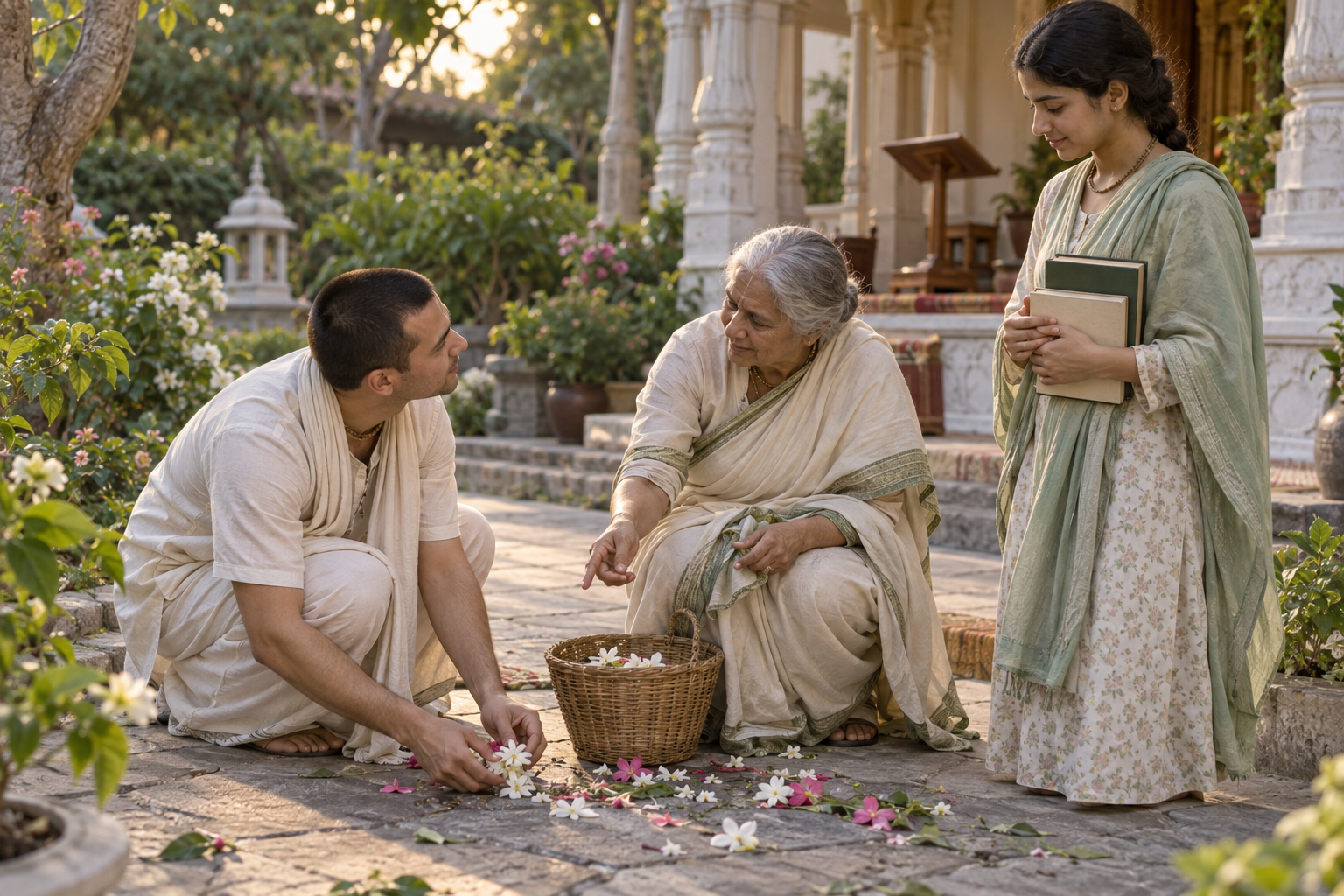
Devotion cannot be reduced to a scorecard, and a strong emotional response does not by itself prove deep understanding. You can still examine whether study is bearing observable fruit. The useful signs are modest and concrete.
- You can state the passage’s movement without replacing it with a slogan.
- You can distinguish what you observed from what a teacher or commentary supplied.
- You can name an unresolved question without pretending certainty.
- You notice when the text challenges a habit, preference, or judgement you normally defend.
- You carry a selected teaching into worship, service, speech, or a relationship.
- You return to the text after trying to apply it and permit that second reading to correct you.
Watch for the opposite pattern as well. Quote collecting can create the appearance of learning while leaving context behind. Constantly changing teachers can keep you stimulated while preventing sustained apprenticeship. Searching only for confirmation turns scripture into support for conclusions already reached. Using a passage mainly to diagnose other devotees moves attention away from the self-examination that made the passage uncomfortable.
When you miss a study period, resume from the place you marked. Do not keep restarting the book to recover an ideal beginning. At the end of each natural unit, write a bridge note for your future self: what changed in the discussion, what remains unresolved, and what you need to remember before continuing. That note preserves the journey without requiring perfect continuity.
You should also know when to slow down. Pause if a passage seems to justify contempt, rash renunciation of an existing duty, rejection of all other teachers, or certainty about an issue your edition leaves unclear. Recheck the context and seek guidance from a trustworthy teacher who understands both the text and your tradition. Intensity is not a substitute for sound interpretation.
Key takeaways
- Keep a journey lane for continuous reading and a passage lane for close attention.
- Record the edition, translator, commentary, scope, and guiding question before taking detailed notes.
- Read the passage yourself before hearing a class, then return to it after the class.
- Label the text’s words, a teacher’s explanation, and your own inference separately.
- End each session with a proportionate devotional response and begin the next session by reviewing it.
- Preserve real differences among Vaishnava lineages instead of blending their vocabulary prematurely.
- Judge progress by clearer attention, more responsible conduct, and greater willingness to be corrected.
At your next study time, do not redesign your entire spiritual routine. Open the text already in front of you. Mark your place, read the selected unit without interruption, write the question it genuinely raises, and choose a response small enough to carry into the day. Then return to that same page before moving on. A devotional journey becomes real through this repeated meeting between sacred words and a life willing to answer them.
References
- Dandavats – Gopal’s Garden Mumbai – Journey Through Brhad Bhagavatamrita
- Dandavats – Bhagavatam Class 5.8 1-25 | Kalakantha Prabhu

Leave a Reply
You must be logged in to post a comment.