

You may finish a Bhagavatam class with a marked verse and a sincere mood, then meet the same irritation, indecision or compulsive habit before the day is over. The missing step is often not another explanation. It is a way to carry shravana into the exact moment when your mind chooses.
The passages considered here offer a practical sequence: expose the desire beneath action, become receptive when outward searching fails, speak knowledge until it becomes remembrance, and judge dharma by conduct rather than appearance. In the Bhagavatam’s bhakti frame, this is not self-mastery for its own sake. Attention is purified so that it can be offered to Bhagavan in service.
Diagnose the motive before you repair the circumstance

When something hurts, the mind usually proposes an external repair. Change the arrangement. Defeat the opponent. Obtain the missing object. Recover the lost recognition. Some circumstances genuinely must be changed, but an outward change cannot release you from a desire you continue to protect inwardly.
Narada’s explanation of Puranjana in Srimad Bhagavatam 4.29.56-85 places the problem beneath surface behaviour. The visible body is not the full account of conditioned experience: the mind retains desired and remembered objects, while action driven by the same karmic orientation cannot finally free the actor from reaction. Moving a burden does not remove it.
You can see this mechanism without waiting for a dramatic crisis. You decide not to send an angry message, yet spend the rest of the day rehearsing how thoroughly the other person deserves humiliation. The outward action has stopped, but the appetite for vindication remains. Or you perform seva while quietly insisting that everyone acknowledge your importance. The activity looks devotional; the demand for ownership still governs it.
The instruction is not to become passive. Dharma still requires truth, protection, correction, work and responsible care. The question is whether your action serves the duty in front of you or merely gives attachment a more respectable costume.
- Name the fruit you are demanding. Is it justice, or the pleasure of seeing someone defeated? Is it service, or control over how the service is done?
- Name the identity being defended. What would feel diminished if you received no praise, victory or final word?
- Separate duty from appetite. State what must actually be done even if the emotional reward never arrives.
- Offer the result before acting. Do the necessary work carefully, but refuse to make your inner steadiness depend on the outcome.
This distinction is especially important in religious life. A pious object does not automatically purify an possessive motive. Donation, study, vrata, debate and temple service can all be drawn into ahankara. Before adding another discipline, examine who within you wants credit for performing it.
When effort reaches its limit, become receptive

Intelligence can gather information, compare arguments and plan competent action. It cannot compel spiritual disclosure. Brahma’s bewilderment is instructive precisely because extraordinary capacity and elevated position do not make him self-sufficient.
The movement surrounding Srimad Bhagavatam 2.9.8 proceeds from unsuccessful outward searching through tapasya to a vision granted by Bhagavan. Brahma does not manufacture Vaikuntha by analysis. Disciplined attention prepares him to receive what independent searching could not seize.
This corrects two common mistakes. The first is restless accumulation: when clarity does not come, you collect more opinions, open more arguments and keep moving so that you never have to admit uncertainty. The second is spiritual bargaining: you treat austerity as a payment that obliges Bhagavan to provide the answer you prefer.
Tapasya is neither restlessness nor self-punishment. It is the voluntary ordering of body, speech and attention toward truth. Its immediate work is to make you teachable. When a decision remains clouded, stop feeding the demand for instant certainty and sort the question honestly:
- What is already known from shastra, guru, sadhu and the duties of your ashrama or role?
- What are you merely inferring from fear, hope or social pressure?
- Which answer do you want because it protects comfort or prestige?
- What responsible action remains possible even while part of the situation is unresolved?
Then make room for prayerful attention. Reduce unnecessary speech. Suspend the search for an argument that flatters your preference. Keep performing the duty that is already clear. Receptivity is not inactivity; it is action without pretending that your own mind is the supreme source of illumination.
There is also a safeguard here. A private feeling of certainty is not automatically divine guidance. Test any conclusion against shastra, sound character, responsibility and its likely effect on others. Tapasya should weaken self-deception, not give it a mystical vocabulary.
Recitation must cross the distance from page to choice
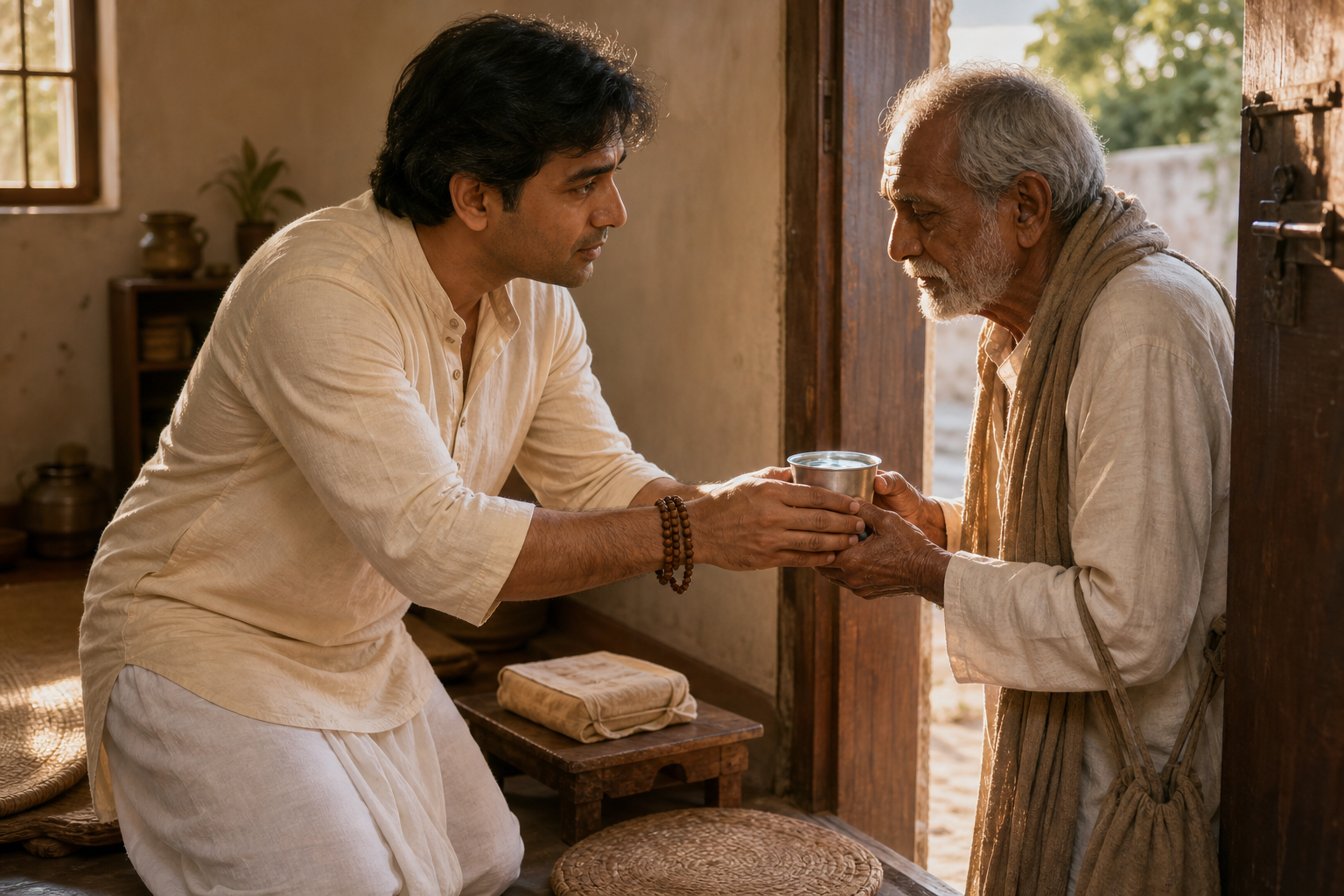
A teaching can remain intellectually correct and practically absent. You agree with it while reading, but it does not appear when anger, fear or attraction takes command. The problem is not always disbelief. Often it is failed retrieval: the truth has not been made sufficiently available to memory.
In Srimad Bhagavatam 11.11.48, Bhagavan connects daily recitation of sacred knowledge with purification and with illumination by the lamp of knowledge. Recitation matters because knowledge is not meant to remain an object observed at a distance. It is spoken, heard again and brought into the living field of attention.
Reading aloud can reveal where you have been skimming. The eye may pass quickly over a familiar expression while the tongue hesitates and the ear notices that its meaning is still vague. Sound also gives you language that can return under pressure. A remembered line cannot make the choice for you, but it can interrupt the mind’s claim that its present impulse is the only possible response.
- Read the verse and its meaning aloud with enough care to hear each claim.
- Close the text and restate the teaching in plain words. If you cannot do that, comprehension is not yet complete.
- Name a real situation in which the teaching would change your response. If no situation comes to mind, application is still abstract.
- Carry a short phrase from the passage into the day and recall it when the relevant desire appears.
- At the next reading, notice whether remembrance altered your speech, restraint or duty. Do not grade the session only by the mood it produced.
Repetition should not become superstition. The mouth can move while attention wanders, and polished recitation can itself become a performance of status. When attention slips, return without drama. When conduct contradicts the recited teaching, repair the conduct. Sacred sound is not an excuse to postpone apology, restitution or responsibility.
Sacred appearance is not the same as dharmic conduct

Religious people are rightly moved by sacred forms, names and symbols. That reverence also creates a vulnerability: appearance can be used to delay moral judgment. A Sanskrit label, traditional dress or declared loyalty to dharma cannot convert harmful conduct into righteous conduct.
Srimad Bhagavatam 10.36.6-15 makes the distinction vivid through Aristasura. The threatening being enters Vraja in the form of a bull, an animal strongly associated with dharma, yet his conduct is violent and terrorising. Krishna is not deceived by the form. He responds to what the being is doing.
The practical lesson is not that you should label every opponent demonic. Nor does Krishna’s action in lila grant a private licence for aggression. Imitation would miss the point. The episode trains discernment: a sacred appearance must be tested by truthfulness, restraint, protection, accountability and actual consequence.
- Apply the symmetry test. Would you defend the same conduct if it came from a rival community, institution or leader?
- Distinguish loyalty to dharma from loyalty to personality. Can a respected person be questioned without the questioner being treated as an enemy?
- Establish the act before assigning the label. Rumour, edited fragments and collective anger do not become evidence because the cause feels sacred.
- Look for correction. A dharmic response can acknowledge error, repair harm and accept proportionate accountability.
- Examine the fruit in yourself. If defence of dharma requires falsehood, cruelty or delight in humiliation, your motive needs correction even when the underlying cause is just.
The same test belongs inside your own sadhana. Ahankara rarely introduces itself plainly. It speaks as purity, seniority, orthodoxy or concern for standards. Ask whether you are protecting a principle or protecting your position as the person who defines the principle. That question does not weaken dharma. It prevents ego from borrowing dharma’s authority.
Use a complete reading cycle
You do not need to turn every reading into a large project. You do need to close the gap between hearing and choosing. Bring one live concern to your next sitting: a recurring resentment, a duty you are avoiding, a decision clouded by preference, or a religious dispute in which your judgment has hardened.
- Locate the binding desire. Write down the result, recognition or identity your mind insists on preserving.
- Clarify the duty. Remove the fantasy of total control and state the action that remains yours to perform.
- Become receptive. Set aside argument long enough to pray, listen and let the shastric claim challenge your preferred answer.
- Speak the teaching. Recite the relevant passage and express its principle without borrowed jargon.
- Test the proposed action. Ignore its religious packaging for a moment and examine its truthfulness, restraint, accountability and effect.
- Act, then review. Notice whether the action reduced attachment and increased remembrance, or merely gave the old desire a new route.
Key takeaways
- If the circumstance changes but the protected desire does not, the burden has probably moved rather than ended.
- If you are forcing certainty, practise tapasya as receptivity and continue the duty that is already clear.
- If a teaching disappears under pressure, recite it, restate it and attach it to the situation in which you need to remember it.
- If sacred appearance conflicts with conduct, judge the act by dharmic criteria and apply the same standard to ally, opponent and self.
At your next Bhagavatam sitting, bring the decision you have been avoiding. Read until the passage exposes the motive, quiet the demand for an instant answer, speak the teaching aloud, and take the dharmic action you already know is yours. The test is not how elevated the session felt. It is whether remembrance is present when the choice returns.
References
- Dandavats — Bhagavatam Class 4.29 56-85 | Mother Urmila Devi Dasi (Dr. Edith Best)
- Dandavats — Srimad Bhagavatam 2.9.8 Class with HH Svayam Bhagavan Keshava Swami – Wednesday 29th July 2026
- Dandavats — Srimad Bhagavatam 11.11.48 I HG Krsnarcana Dasi I 07/29/2026
- Dandavats — Srimad Bhagavatam 10.36.6-15 | Prabhupada Priya Devi Dasi | July 30, 2026
