
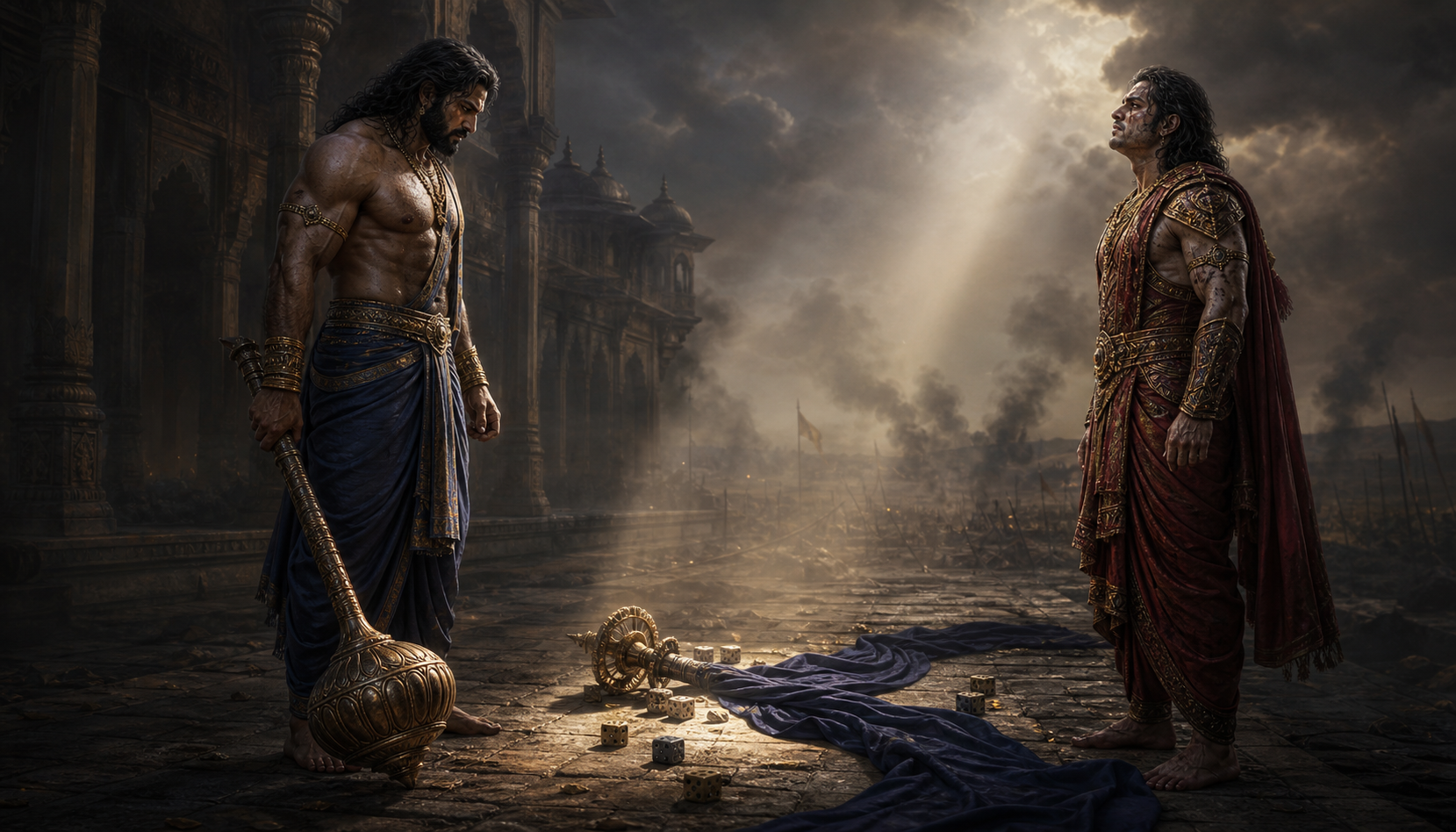
If you are trying to understand why Dushasana’s death is treated as karmic justice rather than one more atrocity of the Kurukshetra War, begin with an uncomfortable distinction: the Mahabharata explains Bhima’s violence without asking you to enjoy it.
Dushasana’s reckoning makes sense only when you follow the entire chain from the Kuru assembly to the sixteenth day of battle. That chain reveals a judgment on deliberate cruelty, corrupted institutions, and power protected from timely accountability. It also warns you not to turn karma into a religious excuse for revenge.
The verdict begins in the Kuru assembly, not on the battlefield

Dushasana does not merely stand beside Duryodhana during the dice-hall outrage. He becomes the physical executor of the court’s adharma. He seizes Draupadi, drags her into the assembly, subjects her to public humiliation, and attempts to strip her before the gathered guardians of Kuru law and honour.
The legal question surrounding the dice game is real. After Yudhishthira had lost himself, did he retain any authority to stake Draupadi? The dispute exposes the danger of treating a contrived procedure as morally decisive. Even if the gamblers could manufacture an argument about ownership, no technicality could transform the abuse of a woman into righteous royal conduct.
That is why the episode must be read on three levels:
- Personal wrongdoing: Dushasana knowingly uses force to degrade Draupadi. He is not an accidental participant or a confused observer.
- Institutional failure: The assembly does not protect the person being abused in its presence. Vidura objects, but hesitation and equivocation among the powerful leave the assault unchecked.
- A crisis of sovereignty: A royal court that permits humiliation for factional advantage forfeits its claim to dispense justice impartially.
If you reduce the scene to a private quarrel between two families, Dushasana’s later punishment looks like excessive retaliation. If you notice that the Kuru court itself fails its duty, the conflict becomes a breakdown of rajadharma. The battlefield reckoning is still terrible, but it is no longer causeless.
Draupadi’s treatment also clarifies what the epic means by honour. Her dignity is not a possession belonging to her husbands, nor is the wrong serious only because she is a queen. The outrage lies in converting a human being into an object of political entertainment. Stri-maryada, the boundary of respect owed to women, is therefore inseparable from the legitimacy of the realm.
Bhima’s vow carries the unresolved crime into the war
Bhima’s pratijna is the bridge between the dice hall and Dushasana’s death. In the assembly, Bhima vows to drink Dushasana’s blood. He also vows to break the thigh that Duryodhana uses in his obscene gesture toward Draupadi. These promises give the later battles a structure: particular deeds generate particular claims of retribution.
A vow does not automatically become dharmic merely because a powerful warrior makes it. Its narrative force comes from the failure that precedes it. The lawful assembly had the opportunity to stop the abuse, condemn it, and impose a remedy. It did not. Bhima’s oath preserves the demand for accountability after the institution responsible for justice abandons that responsibility.
The causal sequence is precise:
- Dushasana commits an intentional assault under royal protection.
- The Kuru assembly fails to correct the wrong when correction is still possible.
- Bhima publicly binds himself to punish the offender.
- Dushasana continues to fight for the order that enabled the original outrage.
- Bhima fulfils his vow during the declared war.
On the sixteenth day of the war, while Karna commands the Kaurava army, Bhima overpowers Dushasana, brings him down, tears open his chest, and drinks his blood. The scene deliberately recalls the words spoken in the assembly. It is not an interchangeable battlefield death; the punishment has been written as the settlement of a named debt.
The exact embellishments vary across recensions and later retellings. The image of Draupadi leaving her hair unbound until it can be washed or anointed with Dushasana’s blood is especially prominent in parts of the wider narrative tradition. You should not assume that every familiar detail appears identically in every textual form. The stable ethical sequence is more important than any one embellishment: humiliation, uncorrected wrong, vow, pursuit, and reckoning.
This gives you a practical way to read retributive episodes elsewhere in the Mahabharata. Do not begin by asking whether the final punishment is emotionally satisfying. First identify the original duty, the agent who violated it, the authority that failed to respond, and the words or vows that connect the wrong to its consequence. That method separates moral architecture from spectacle.
Karmic accountability is not the same as personal revenge

Karma is often reduced to the slogan that everyone eventually gets what they deserve. That shortcut is both philosophically weak and morally dangerous. It can encourage people to treat another person’s suffering as proof of hidden guilt. Dushasana’s story supports no such inference.
His reckoning is intelligible because the narrative makes the causal chain unusually visible. The harmful acts are public. His intention is not obscure. He is warned by the opposition within the court. He neither repents nor withdraws from Duryodhana’s cause. The eventual punishment is explicitly tied to Bhima’s earlier vow. We are not asked to guess why an innocent person suffers; we are shown an unrepentant agent carrying an acknowledged wrong toward its consequence.
Four signs distinguish this karmic pattern from impulsive revenge:
- The wrong is specific: Dushasana is punished for identifiable conduct, not for belonging to a disliked group.
- The agency is clear: He personally performs the assault and repeatedly chooses the Kaurava cause.
- The consequence is connected: Bhima’s battlefield act fulfils a vow made at the moment of the violation.
- The reckoning has public meaning: It condemns the abuse of power that the court had allowed, rather than settling a secret personal grievance.
Even these signs do not give an ordinary person permission to imitate Bhima. The episode takes place within the epic’s exceptional world of kshatriya obligation, binding vows, dynastic collapse, and declared war. It cannot honestly be converted into a standing warrant for vigilantism. In ordinary life, ahimsa, restraint, truthful testimony, protection of the vulnerable, and legitimate adjudication remain the proper first responses.
The wider dharmic family offers related languages of moral causation without teaching an identical metaphysics. Hindu thought speaks of karma and karmaphala; Buddhist traditions examine intention and the ripening of karma-vipaka; Jain teaching describes the bondage produced by passions such as anger, pride, deceit, and greed; Sikh wisdom places accountable action within Hukam and the moral discipline of the sangat. The common ethical recognition is useful: cruelty shapes the doer and produces consequences. The doctrinal differences should still be respected rather than compressed into a claim that all four traditions mean exactly the same thing.
Bhima’s excess should trouble you rather than entertain you
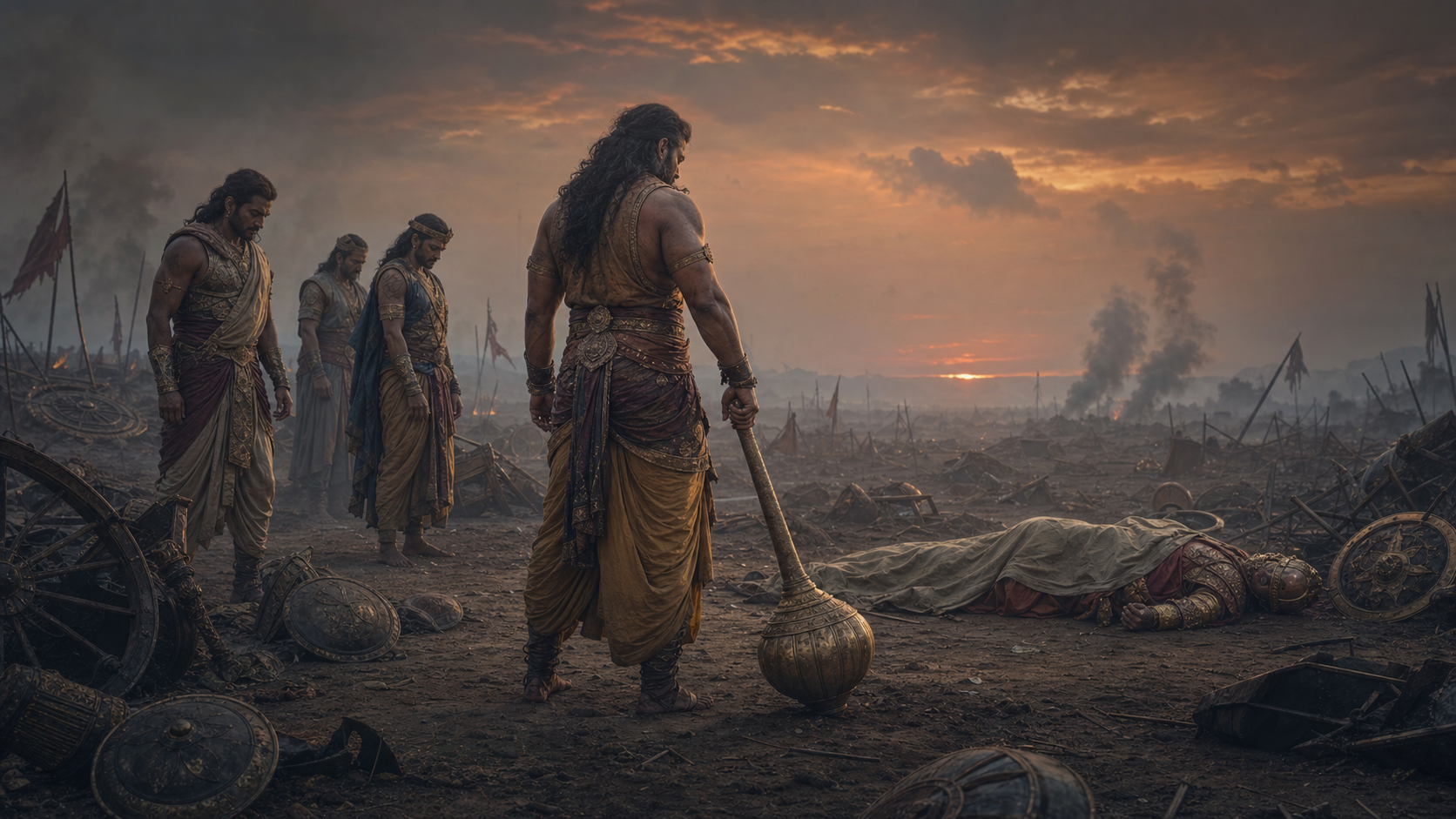
Drinking an enemy’s blood is not a normal model of righteous conduct. The extremity is the point. It shows how far the Kuru order has fallen by the time an unresolved crime reaches the battlefield. Justice that could have been administered through counsel, censure, restitution, and lawful restraint now appears in a savage form.
Apad-dharma, duty under extreme emergency, helps explain the epic’s departure from ordinary norms. It does not make every wartime action pure. Kurukshetra repeatedly exposes the erosion of yuddha-dharma: warriors are attacked under prohibited conditions, restraints collapse, and the killing of Abhimanyu demonstrates how quickly collective expediency can replace martial honour. Dushasana’s end belongs to that damaged moral environment.
You do not have to choose between declaring Bhima entirely innocent and declaring the reckoning meaningless. A more faithful reading can hold two judgments at once: Dushasana’s deliberate abuse demands accountability, and the form that accountability takes reveals the catastrophic cost of delayed justice.
When someone invokes an emergency to justify an exceptional response, use four questions:
- What ordinary duty has actually become impossible? Mere inconvenience does not create apad-dharma.
- Who has authority to act? Injury alone does not grant unlimited jurisdiction to every aggrieved person.
- Is the response tied to protection and restoration? Cruelty pursued for enjoyment cannot be redeemed by attaching the word dharma to it.
- Will the exception end with the emergency? A temporary departure from a norm must not become a permanent appetite for violence.
This test also sharpens the contemporary lesson. A family, community, workplace, court, or government should respond when humiliation first occurs, not after resentment has hardened into a demand for ruin. Name the violation, protect the targeted person, preserve truthful testimony, refuse procedural excuses, and require accountable authorities to act. Prompt justice is not only kinder. It prevents extraordinary remedies from becoming imaginable.
The symbolism associated with Draupadi’s hair belongs here. Unbound hair represents an injury that has not been socially or ritually closed; its restoration marks the public recognition that her humiliation cannot simply be forgotten. Yet restoration is not the same as erasing trauma, and another person’s death cannot make the original assault cease to have happened. The image asks the community to remember whose dignity its institutions failed to defend.
Key takeaways
- Dushasana’s karmic reckoning begins with his intentional assault on Draupadi and the Kuru assembly’s refusal to stop it.
- Bhima’s vow connects a specific public wrong to a specific battlefield consequence; the death is not presented as random carnage.
- Karma does not mean that every sufferer secretly deserves suffering. Dushasana’s accountability is legible because his agency, intention, warnings, and continuing choices are made explicit.
- Bhima’s act can be understood as an exceptional response without being adopted as an ordinary ethical model.
- The political lesson is immediate: institutions that hide abuse behind procedure do not preserve order. They postpone the reckoning and increase its eventual cost.
The next time you encounter Dushasana’s death in a recitation, adaptation, or discussion, resist the invitation to stop at the blood. Trace the path back to the silent assembly. Then ask the question the episode places before every holder of authority: what consequence are we creating when a preventable wrong is allowed to stand?