

If someone has told you that the Purāṇas prove Hindus believed in a flat Earth—or that they secretly describe the modern globe in exact scientific terms—you do not have to choose between those slogans. Both can move faster than the texts allow.
The useful question is more precise: what does a particular Sanskrit term denote in its passage, what kind of description is being given, and does the claim concern the measurable planet at all? That distinction lets you defend Dharma without denying observation, forcing modern science into ancient vocabulary, or surrendering a profound cosmology to a crude diagram.
The word “Earth” is carrying four different questions
The dispute becomes confused as soon as several meanings of “Earth” are compressed into one English word. A description of an inhabited region is not automatically a description of the whole planet. A cosmological realm is not automatically a land map. A circular representation is not automatically a claim that its subject is a flat physical disc.
| Question being asked | Object under discussion | Evidence needed |
|---|---|---|
| What is the physical shape of Earth? | The measurable astronomical body | Observation, measurement and repeatable physical evidence |
| How does the world appear from a human location? | The observer’s horizon and visible sky | Phenomenology and the passage’s stated viewpoint |
| How is terrestrial space arranged? | A map, region or schematic model | Scale, orientation, boundaries and mapping conventions |
| Where does human life stand in cosmic order? | A cosmological, moral or sacred realm | Textual context, theology and the relationships among realms |
Before debating the flat-Earth or globe-Earth framing of Purāṇic geography, make the claim complete. Ask the person presenting it to identify four things:
- The exact Sanskrit term in question.
- The passage in which it occurs.
- The physical or cosmological object the term is supposed to denote.
- The reasoning that moves from the passage to a conclusion about planetary shape.
Most weak arguments fail at the third or fourth step. They quote a term that can mean ground, world, realm, region or ordered expanse, silently replace it with “planet Earth,” and then treat the replacement as a translation rather than an inference. Once you expose that move, the discussion becomes manageable.
Bhū, Bhū-loka and Bhū-maṇḍala are not interchangeable
You cannot read Purāṇic geography responsibly by translating every related word as “Earth” and assuming each instance names the same object. Sanskrit compounds carry context, and the same root can work at more than one scale.
- Bhū can refer to earth, ground, land or the terrestrial world, depending on its grammatical and literary setting.
- Bhū-loka names a terrestrial realm within a larger cosmological ordering. The word loka directs attention to a world or domain, not merely to the geometry of a solid object.
- Bhū-maṇḍala should initially be retained as a technical expression. Maṇḍala can indicate a circle, circuit, domain or ordered whole; the word by itself does not decide whether the referent is a physical disc, a mapped expanse, an astronomical framework or a cosmological system.
- Jambūdvīpa is a named region in Purāṇic cosmography. Its identity and scale must be established from the surrounding description rather than imported from an English atlas.
- Bhārata-varṣa is presented within that nested cosmographic vocabulary. It must not be made synonymous with Bhū-maṇḍala, Jambūdvīpa, the modern Republic of India and the entire globe all at once.
The central discipline is simple: preserve the technical noun until you know its referent. In Purāṇic discussions of Bhārata-varṣa, a familiar place-name can participate in a larger sacred geography. That does not erase its geographical sense, but it does prevent you from assuming that every level of the account uses the scale and boundaries of a modern political map.
When you encounter a translation, perform a substitution test. Replace the translator’s “Earth” with “physical planet,” “inhabited land,” “terrestrial realm” and “cosmographic domain,” one at a time. Then reread the surrounding sentences. If one option produces contradictions that the Sanskrit term itself does not require, the translation may have settled the debate prematurely.
A circular diagram cannot settle the planet’s shape
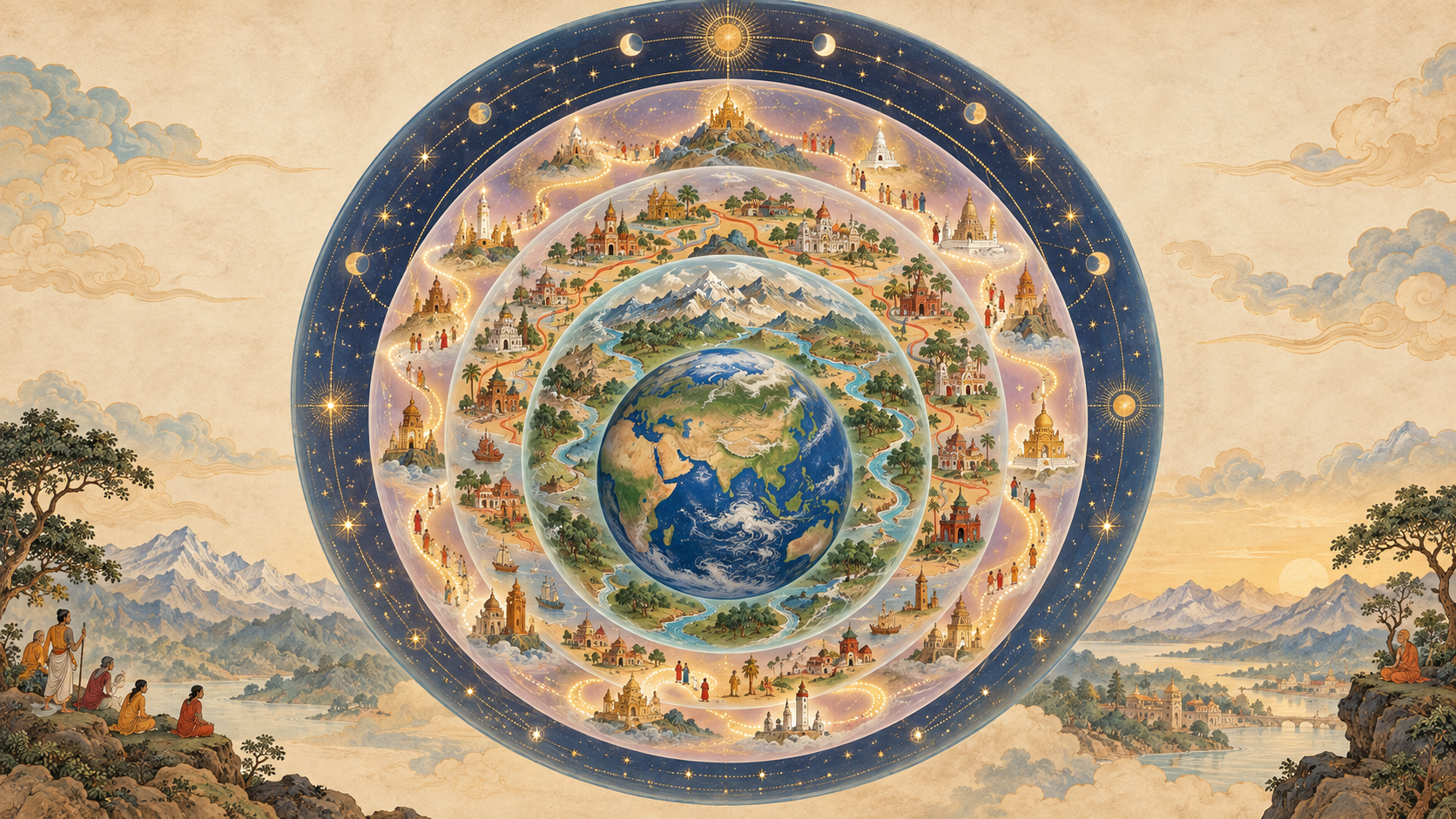
A picture has two shapes: the shape of the representation and the shape of the thing represented. Confusing them is the most common visual error in this debate.
A world map can place a spherical planet on a flat sheet. A route map can distort distance while preserving sequence. An astronomical diagram can place bodies in circles to show relationships without depicting their surfaces. Conversely, a circular Purāṇic diagram could be intended literally by a particular interpreter. Its circular outline alone proves neither a flat planet nor a hidden globe.
Before treating any reconstruction as decisive, ask:
- What is the viewpoint? Is the scene shown from above, from an observer’s location, along a celestial plane or through no stated perspective?
- What is preserved? Does the image preserve distance, direction, sequence, proportion or only conceptual relationships?
- What is omitted? Does the passage specify thickness, curvature, underside, scale and physical material, or have those features been supplied by the illustrator?
- What does “above” mean? It may indicate physical altitude, visual position, rank or cosmological precedence. The surrounding verbs and relations must decide.
- Where did the diagram come from? A modern image based on a Purāṇic passage is an interpretation of that passage, not the passage itself.
Keep four possible kinds of reading separate
Purāṇic cosmography can be approached through several lenses. You should not assume in advance that one lens explains every detail, and you should not blend them merely to escape a difficult verse.
- Literal-material: the passage describes measurable physical features and therefore makes claims that can be tested against physical observation.
- Observer-centred: the description organises what appears from a particular human or celestial standpoint.
- Cartographic or astronomical: the arrangement is a working schematic that preserves selected relationships without functioning as a scale model of terrain.
- Sacred or theological: the geography locates beings, duties, realms and spiritual possibilities within an ordered cosmos.
These readings can sometimes overlap, but overlap is not a licence to switch meanings halfway through an argument. If a claim begins literally, its defender cannot retreat to symbolism only when a measurable prediction fails. If a reading begins symbolically, its critic cannot refute it merely by showing that the image is not a road map.
For the physical question, use physical evidence: Earth is an approximately spherical astronomical body. For the interpretive question, use language, context, genre and the internal structure of the cosmography. Accepting the globe does not require you to treat Purāṇic cosmology as worthless. Respecting the Purāṇas does not require you to make a cosmological passage perform the work of modern geodesy.
A six-step method for testing any Puranic geography claim
You can use the following method whether the speaker is attacking Hindu scripture, defending a literal flat-Earth model or claiming exact anticipation of modern astronomy.
- Demand a textual address. Record the Purāṇa, section, verse, edition and translation. A screenshot of an unattributed diagram is not enough.
- Keep the decisive Sanskrit words visible. If the argument depends on “Earth,” “planet,” “disc,” “sphere,” “above” or “below,” identify which Sanskrit expression has been translated that way.
- Name the referent in a full sentence. Write, “In this passage, X refers to Y.” If Y changes from region to realm to planet during the discussion, the argument is equivocating.
- Separate the layers of interpretation. Mark what the Sanskrit text states, what the chosen translation adds, what a traditional commentary explains, what a modern illustrator depicts and what a present-day harmonisation proposes.
- Ask what the reading predicts. A literal physical model should generate measurable consequences. A theological ordering should be judged by the relationships and meanings it actually claims, not by predictions it never makes.
- Grade the conclusion honestly. Label it explicit, strongly supported, possible or speculative. “Possible” is not “proved,” and a devotional preference is not a philological demonstration.
This method protects you from three tempting but fragile claims:
- “The Purāṇas teach a flat Earth, full stop.” This is too broad unless “Earth,” the relevant text and the intended level of description have all been established.
- “The Purāṇas describe the modern scientific globe exactly.” Similarity in one feature does not establish identity across scale, purpose and structure.
- “If a description is symbolic, it is false.” Symbolic and sacred geographies can communicate real claims about order, value and human orientation without pretending to be satellite cartography.
A more defensible vocabulary is available. Say, “This verse explicitly describes…” when the wording is direct. Say, “This diagram is one reconstruction…” when interpretation is involved. Say, “The physical Earth is approximately spherical…” when answering the empirical question. Say, “The proposed identification remains uncertain…” when the textual bridge has not been demonstrated. Precision makes the Dharmic case stronger because it removes claims that an opponent can defeat simply by asking for the missing premise.
Key questions about Purāṇic cosmography
Do the Purāṇas say that Earth is flat?
That English question is underspecified. Purāṇic descriptions employ several terms, scales and cosmological levels, while “Earth” may mean a planet, land, a realm or an ordered expanse. A passage may describe a planar arrangement within a cosmographic model without thereby making a complete claim about the three-dimensional physical planet. The exact passage and referent must come first.
Does maṇḍala mean a flat disc?
Not automatically. “Circle,” “circuit,” “domain” and “ordered whole” capture different possibilities, and compounds develop technical meanings from context. Even when a representation is circular, you still have to establish what it represents and whether its geometry is literal, schematic or cosmological.
Is accepting a globe a rejection of Hindu scripture?
No. The measurable shape of the physical Earth and the interpretation of Purāṇic cosmography are related only when a passage is shown to make a literal claim about that same physical object. Dharma is not served by creating a conflict before the shared referent has been established.
Can Purāṇic geography remain meaningful if it is not a modern atlas?
Yes. A cosmography can order sacred space, locate human life within a greater whole, express relations among realms and connect geography with dharma. Those functions should be examined on their own terms. They are neither rescued nor refuted by pretending that every sacred description must be a scale drawing of the physical planet.
The next time someone shows you a dramatic Purāṇic map, do not begin with belief or ridicule. Ask for the passage, the Sanskrit term, the intended referent and the bridge from text to diagram. If those four answers are missing, neither “flat Earth” nor “ancient modern science” has been established. Hold that line, and you can affirm observable truth while giving Dharmic cosmology the careful reading it deserves.



References

Leave a Reply
You must be logged in to post a comment.