

You may come to Dhruva’s encounter with an uncomfortable question: if your prayer begins in hurt, ambition, or the wish to prove yourself, can it still become bhakti? Dhruva gives a demanding but hopeful answer. A mixed motive can bring you to the Lord, but it cannot remain the measure of spiritual success.
What matters is what happens to the desire in the Lord’s presence. Dhruva does not merely receive attention from Bhagavan. He acquires a different understanding of speech, agency, other beings, and the reward he had wanted. That transformation gives you a practical way to examine your own prayer without pretending that your motives are purer than they are.
Dhruva is received before his motive is perfect
Dhruva approaches spiritual practice from a place of injury. He wants a position that will answer the humiliation he has suffered. His determination is extraordinary, but its first object is still bound to comparison: someone denied him honour, so he wants an honour no one can deny.
This is precisely why his encounter remains useful. Bhakti does not have to wait until your psychology is spotless. If it did, wounded people could never begin. Yet sincerity does not mean declaring every wounded demand sacred. It means bringing the demand into a relationship in which Bhagavan may expose, redirect, or surpass it.
It helps to distinguish three things that are often confused:
- Your entry motive is what first drove you to pray: fear, grief, longing, anger, gratitude, curiosity, or need.
- Your governing motive is what you are prepared to obey when devotion conflicts with pride or convenience.
- The fruit of practice is the kind of person your worship is making you: more truthful and responsible, or merely more certain that your preferences deserve divine approval.
You do not need to deny the entry motive. Before japa, puja, or silent prayer, complete one sentence plainly: ‘Lord, this is what I want, and this is the wound or fear beneath it.’ Then add a second: ‘If this desire is distorting my duty, change the desire before changing my circumstances.’ That is more honest than disguising self-vindication as surrender.
Dhruva’s beginning therefore offers permission to approach, not permission to remain unchanged. The difference is decisive. Devotion can start amid resentment, but resentment cannot be allowed to become its deity.
Darshan changes the centre of Dhruva’s attention
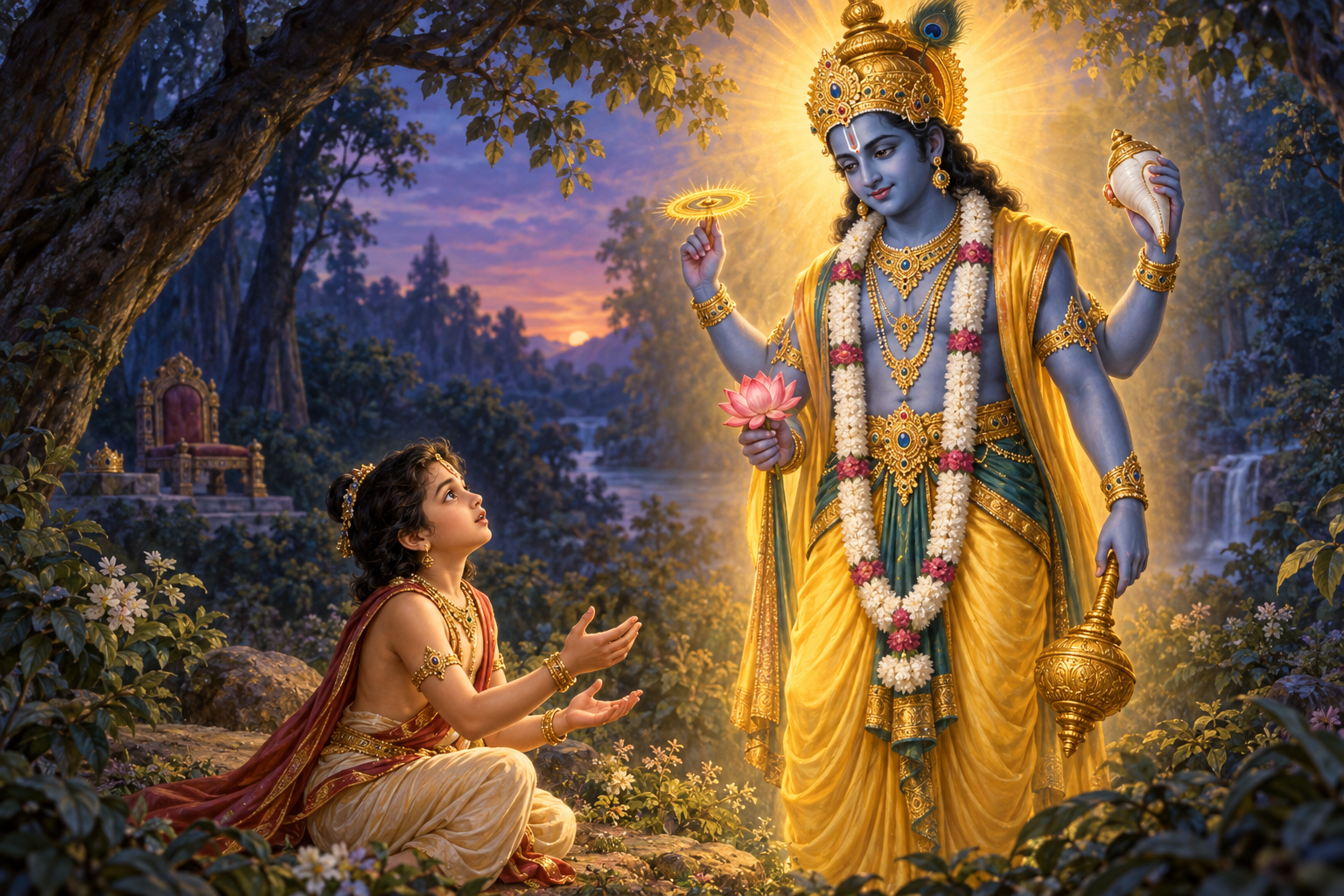
Dhruva has contemplated the Lord within his heart. When that inwardly perceived form disappears, he opens his eyes and beholds the Lord before him. He wants to respond but cannot find the words. The Lord understands and enables him to speak. The encounter moves from inward contemplation to visible presence, and then from stunned silence to prayer.
That sequence matters. Darshan in this Bhagavata setting is not visual consumption, as though the devotee had succeeded in obtaining an impressive spiritual experience. Dhruva is also known, understood, and enabled by the One he sees. Bhagavan is not an object captured by concentration. The Lord takes the initiative within the encounter.
Dhruva’s attention consequently moves away from the social injury that began his quest. His first response does not rehearse the insult or demand the promised reward. He recognizes dependence on Bhagavan. His ability to speak, perceive, and act is not self-produced. The Lord’s grace does not merely place a prize in Dhruva’s hands; it awakens the faculties with which he can know and praise their source.
This gives you a sharper test for prayer than asking whether it felt intense. After worship, notice where your attention goes. Do you return immediately to the person who slighted you, the outcome you want, or the recognition you think you deserve? Or has the centre shifted, even slightly, toward gratitude for the life and capacities you already receive?
The shift need not be dramatic. It may appear as one restrained sentence, one abandoned retaliation, or one duty performed without an audience. Those changes are spiritually more significant than using devotional language to make an old grievance sound holy.
One Lord within the many does not erase the many

In Srimad Bhagavatam 4.9.7, Dhruva recognizes one Supreme Lord whose power brings forth the manifested order and who enters it, appearing amid diverse conditions as fire appears in different pieces of wood. His vision has widened from one child’s disputed place in a household to the relation between Bhagavan and the whole field of existence.
The image of fire is worth holding carefully. The Lord’s presence can be recognized amid plurality without reducing Bhagavan to the temporary qualities of any particular body. Nor does divine indwelling make every conditioned impulse infallible. Presence is not permission to call anger, appetite, prejudice, or vanity the voice of God.
At the same time, the diversity of beings does not place anyone outside divine concern. If the Lord sustains life beyond the narrow circle of your preferences, another person cannot be treated as mere scenery in your spiritual drama. You may oppose wrongdoing, protect a boundary, or refuse a false claim while still remembering that the other being is not disposable.
Use that recognition in the next difficult encounter. Before answering someone, separate three layers:
- The person is a living being sustained by the Supreme Lord.
- The person’s present conduct may still be mistaken, harmful, or adharmic.
- Your response remains answerable to dharma; another person’s fault does not sanctify your cruelty.
This prevents two opposite mistakes. One is contempt, which forgets the Lord’s presence beyond the self. The other is moral vagueness, which uses spiritual unity to avoid judgement and responsibility. Dhruva’s enlarged vision supports reverence and discernment together.
Awakened speech is a response to grace, not a performance

Dhruva cannot initially manufacture an adequate response to the Lord. Bhagavan enables the speech by which Dhruva offers praise. The theological point is subtle: even the devotee’s act of glorification depends upon the One being glorified.
This does not make learning, memorization, or disciplined recitation unnecessary. It puts them in their proper place. Received prayers can train attention and give truthful form to devotion when spontaneous speech is confused, self-centred, or absent. You do not have to counterfeit eloquence to prove sincerity.
When your own prayer feels scattered, follow a simple sequence shaped by Dhruva’s response:
- Acknowledge the giver before naming the gift: recognize that the capacity to think, speak, remember, and act is received.
- Name the actual desire without embellishment: say what result you want and why you want it.
- Place the desire under discernment: ask to see where fear, status, rivalry, or wounded pride is directing it.
- Ask for the next dharmic action: not an entire private revelation, but the duty you can perform truthfully now.
- Release the demand for a sign: finish the prayer without requiring an unusual emotion, vision, or coincidence as proof that you were heard.
Then watch your speech during the rest of the day. Does it become less manipulative? Can you admit what you do not know? Can you correct someone without humiliating them? Can you refrain from turning a private act of worship into evidence of your superiority? If Bhagavan awakens speech, that speech should become more accountable to truth.
Silence is not necessarily spiritual failure. Dhruva’s inability to speak does not disqualify him from the encounter. If words do not come, remain with the divine name or a received prayer rather than forcing an elevated mood. The goal is responsiveness, not performance.
The real change appears in what Dhruva values

Dhruva sought a form of greatness that would answer his humiliation. After encountering Bhagavan, that former aspiration no longer looks commensurate with what he has received. The desired status has not grown larger; his scale of value has changed.
This is one of the clearest ways to distinguish devotion from a religious transaction. In a transaction, the deity remains a means and the requested outcome remains the end. In bhakti, a person may arrive asking for an outcome, but relationship with Bhagavan gradually becomes more valuable than the original demand.
That transformation does not require contempt for worldly responsibilities. Dhruva does not use realization as an excuse for passivity. A changed heart still has duties, consequences, and relationships to honour. What falls away is the claim that a particular achievement must establish the worth of the self.
Four questions can help you notice whether that change is occurring:
- If the desired result is delayed, can you continue your practice without treating Bhagavan as a failed supplier?
- If the result arrives, does it make you more grateful and responsible, or more contemptuous of those who lack it?
- Has prayer clarified your next duty, or merely supplied a spiritual vocabulary for avoiding it?
- Can correction enter your devotional life, or must every preference be defended as divine guidance?
You may not be able to answer every question favourably. Do not invent progress. Identify the one attachment that remains most resistant and carry that specific attachment into practice. Honest incompleteness is more useful than a declaration of surrender contradicted by conduct.
You also do not need to imitate the extraordinary outward features of Dhruva’s journey. His encounter is not a demand that every practitioner reproduce a vision. The repeatable discipline lies in telling the truth about desire, receiving sacred language, remembering the Lord’s presence, and allowing devotion to reorder action.
Key takeaways
- A wounded or ambitious motive does not prevent you from beginning bhakti, but sincere bhakti submits that motive to transformation.
- Dhruva’s darshan shifts attention from the reward he wanted to the Bhagavan who sustains his capacity to perceive, speak, and act.
- The one Lord’s presence amid many beings calls for reverence without erasing moral distinctions or personal responsibility.
- Prayer is not measured by eloquence, emotional intensity, or unusual experiences; its fruit becomes visible in truthful speech and dharmic conduct.
- The decisive boon is a changed scale of value: Bhagavan ceases to be a means to status, and status ceases to function as a substitute for Bhagavan.
At your next time of worship, do not wait for a flawless motive. Name the desire you actually carry, place it before the Supreme Lord, contemplate the vision expressed in Srimad Bhagavatam 4.9.7, and choose one duty that a less self-centred response requires. Dhruva’s encounter becomes practical when the thing you wanted is no longer permitted to become your lord.
References

Leave a Reply
You must be logged in to post a comment.