
If you have agreed to help with the Bhadra 2026 Srimad Bhagavatam campaign, your difficulty is probably not finding enthusiasm. It is turning goodwill into completed, respectful handoffs without losing track of recipients, books, funds, or follow-up.
The aspiration to make Bhadra 2026 a historical event is worthy. But a memorable result will come from ordinary acts done carefully: naming a recipient, making an honest invitation, delivering the promised edition, and helping the person begin reading.
Define distribution by the completed handoff

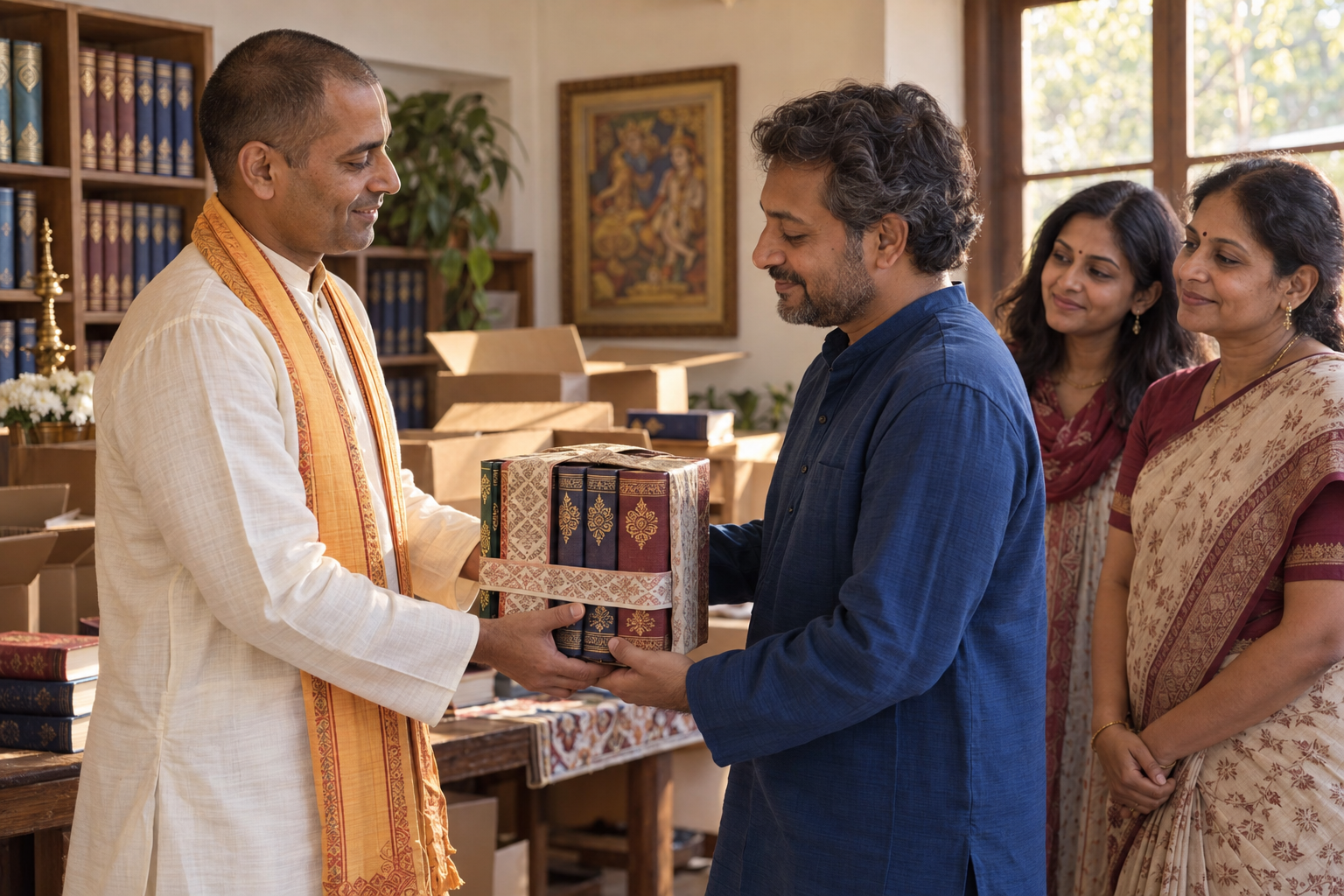
A pledge is not a distribution. A donation is not a distribution. A book waiting in a temple storeroom is not a distribution. Count the work as complete when an identified recipient has willingly accepted and received the Srimad Bhagavatam that was promised.
This distinction prevents the most common campaign confusion. Sponsorship, ordering, arrival, allocation, and delivery are different stages. If they are collapsed into one total, the campaign can look successful while books and intended readers remain separated.
Before collecting names or funds, write a campaign brief that answers these questions:
- What exactly are you distributing: a complete set, a particular volume, or another clearly identified edition?
- Which languages and formats are actually available?
- Who may receive the books, and how will recipients be approached?
- What costs, suggested contributions, or sponsorship arrangements must be explained?
- Who is responsible for ordering, inventory, money, delivery, and reader follow-up?
- What event marks completion: payment, arrival, allocation, or confirmed receipt by the recipient?
Use a shared tracker with separate statuses such as proposed recipient, permission requested, accepted, funded, ordered, received into inventory, handed over, and follow-up arranged. Record an owner beside every open action. A row without an owner is usually a task that everyone assumes someone else will complete.
Keep the tracker proportionate. A recipient’s name, contact preference, requested language, assigned volunteer, and current status may be enough. Do not collect personal information merely because a spreadsheet makes it easy. Restrict access to the people coordinating the campaign, and do not publish recipient names or photographs without permission.
Build the goal from commitments you can verify

The campaign’s productive posture is to assume it can be done. That does not mean replacing planning with optimism. It means beginning with confidence and then asking each participant for a commitment that can be named, recorded, and supported.
Ask volunteers to commit in distinct ways. One person may identify willing readers. Another may sponsor books. Another may manage inventory. Someone else may deliver locally or host a reading gathering. These contributions are all useful, but they are not interchangeable. A sponsor without a recipient does not complete the same work as a volunteer who has secured consent for a handoff.
Set a committed floor from pledges that people are prepared to own. Keep any larger aspiration as a stretch goal. This preserves ambition without turning hopeful interest into an inflated public promise.
At each campaign review, ask concrete questions:
- Which intended recipients have actually said yes?
- Which books are funded but still need recipients?
- Which accepted requests still need funding, ordering, or delivery?
- Are the requested language and edition available?
- Which handoffs are blocked, and who will remove each block?
- Which recipients have invited further contact after delivery?
Keep financial handling equally clear. Use the collection method approved by the responsible temple or organisation. Explain whether a payment is a purchase, a donation, or sponsorship for another recipient. State what happens if the requested edition cannot be supplied. Record funds and issue whatever acknowledgement the authorised process provides. Devotional purpose does not make financial ambiguity harmless.
Invite a person instead of pitching a target

The most useful recipient list begins with relationships, not raw reach. Think of people who have asked about Krishna, Bhagavata teachings, meditation, dharma, Sanskrit texts, or the philosophical foundations of bhakti. A sincere question is a stronger starting point than an unqualified contact list.
Your invitation should explain why you thought of that person and leave room for an unpressured answer. A simple version is: I am helping place Srimad Bhagavatam during Bhadra 2026. I thought of you because of your interest in this tradition. Would you like to receive it? I can explain the edition and any cost before you decide.
Adapt the reason, but do not manufacture intimacy or urgency. Avoid implying that someone must accept the book to respect you, the temple, or the tradition. Do not hide the size of the work, the language, the edition, the expected payment, or the practical requirements for delivery. Consent obtained through social pressure is a poor foundation for sacred reading.
If a person is interested but uncertain about a substantial set, answer the uncertainty rather than pushing past it. Show the actual edition when possible. Explain how it is organised only to the extent you can do accurately. Let the recipient decide whether the format, language, and commitment suit them. If you do not know an answer, connect the person with a knowledgeable reader instead of improvising.
A sponsor needs the same clarity. State whether the sponsorship supports a particular named recipient, a defined community placement, or a general campaign pool. If no recipient has yet accepted, say so. That honesty lets the sponsor make an informed offering and prevents organisers from accumulating books that have no path to readers.
Plan the first reading before the book arrives

Delivery is the campaign’s operational finish line, but it should be the beginning of the recipient’s relationship with the text. A Srimad Bhagavatam placed on a shelf and never opened has completed the logistics, not the deeper purpose.
Ask before the handoff whether the recipient would welcome help beginning. The answer may be no, and that should be respected. If the answer is yes, agree on the next action while the interest is present:
- Introduce the edition and its basic organisation.
- Ask what drew the recipient to the Srimad Bhagavatam.
- Suggest a suitable starting passage with help from a qualified reader.
- Offer a local or online reading group if one is genuinely available.
- Agree on the recipient’s preferred way to reconnect.
- Record the follow-up owner and the agreed action in the campaign tracker.
Do not turn follow-up into surveillance. The recipient does not owe the campaign a reading report, testimonial, photograph, or social-media post. A useful follow-up asks whether the person found a starting point and whether any practical or interpretive question needs attention.
Campaign leaders should also close the administrative loop. Reconcile books received, books handed over, remaining inventory, money collected, and outstanding obligations. Investigate mismatches while the people involved still remember the transactions. Retain only the recipient information needed for consented follow-up, and remove access when coordination ends.
Key takeaways for Bhadra 2026 organisers
- Define a distribution as a willing recipient receiving the promised book, not merely a pledge, payment, or order.
- Track sponsorship, inventory, acceptance, delivery, and follow-up as separate stages.
- Build the committed goal from named responsibilities rather than expressions of general enthusiasm.
- Tell every recipient exactly what edition, language, cost, and delivery arrangement is being offered.
- Use personal, permission-based invitations instead of pressure or artificial urgency.
- Arrange optional reading support before interest is lost after the handoff.
- Handle money, personal data, photographs, and campaign reporting with explicit accountability.
Before your next campaign meeting, create the tracker, define the completion rule, and ask every participant to claim a specific responsibility. Once recipients, books, funds, and owners are visible in the same workflow, the Bhadra 2026 aspiration becomes work that your community can actually finish.
References
- Dandavats — “Let’s Make this a HISTORICAL Event!” – Bhadra 2026 Message by Svavasa Prabhu
- Dandavats — ASSUME IT CAN BE DONE!!! Vaisesika Prabhu

Leave a Reply
You must be logged in to post a comment.