
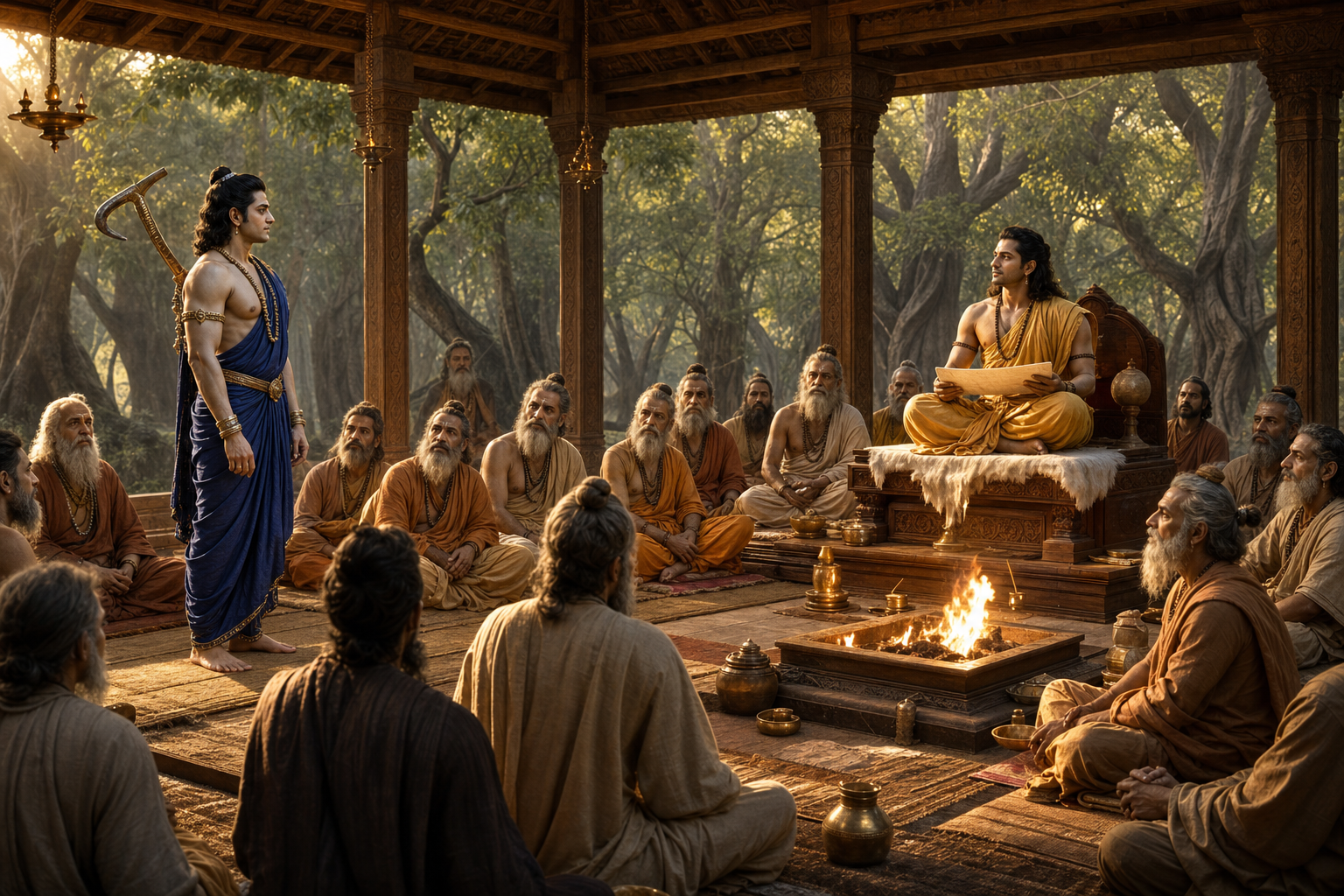
If Balarama’s killing of Romaharshana for remaining seated has ever seemed impossible to defend, do not begin by forcing yourself to defend it. Begin with three questions: Which duties collided, who was permitted to challenge power, and what was repaired after the judgment?
Those questions reveal why this is neither a simple etiquette lesson nor permission to punish religious disrespect. It is a tightly constructed dharma-sankata about knowledge, office, humility, vows, corrective authority, and institutional continuity. Its practical value lies in reading the entire sequence rather than isolating its most violent moment.
Begin with the seat, not the refusal to stand
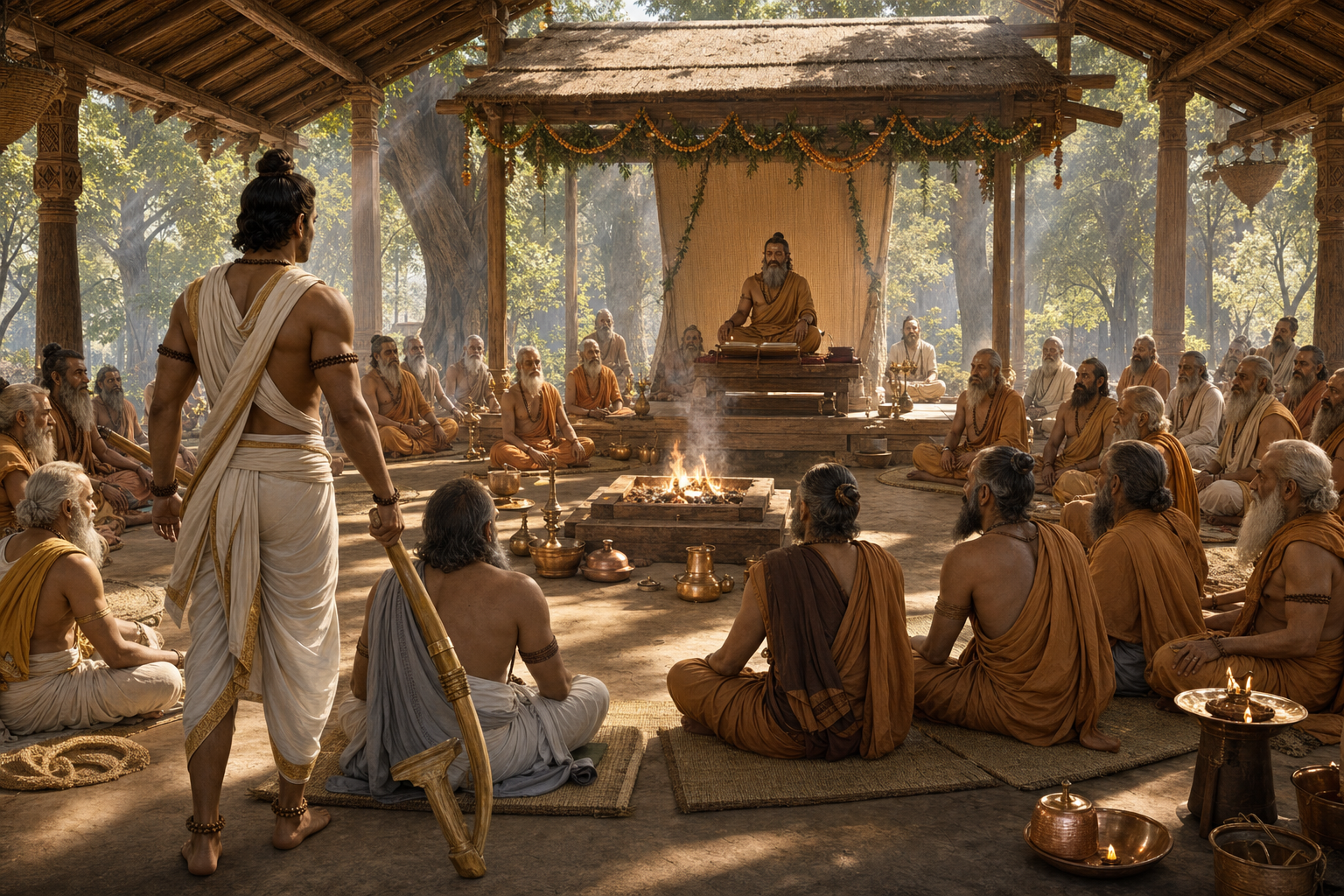
Naimisharanya was not the setting for an informal gathering. It was a consecrated center of yajna and sacred narration, where Shaunaka and other rishis assembled to preserve and hear the itihasa-purana tradition. Identified with modern Nimsar in Uttar Pradesh, it remains a living tirtha as well as one of the great narrative settings of Hindu scripture.
Romaharshana, also called Lomaharshana, was a distinguished disciple of Veda Vyasa and a member of the Suta tradition. A Suta in this setting was not merely an entertainer. He was a professional custodian of civilizational memory: a reciter, compiler, interpreter, and transmitter of histories and sacred teachings.
Romaharshana had been installed on the vyasasana, the authoritative seat of sacred recitation. That seat represented more than personal rank. It linked the speaker to Vyasa and placed the accumulated memory of the tradition in his care. The assembly had also blessed him with the long life needed to complete his work.
Balarama arrived at Naimisharanya during a pilgrimage undertaken instead of joining the opposing sides at Kurukshetra. The expected maryada was to rise and honor the arriving elder. Romaharshana remained seated, and the confrontation ended when Balarama struck him with a blade of kusa grass.
The central difficulty is that remaining seated can carry two different meanings. One reading treats it as pride: Romaharshana allowed learning and office to place him above ordinary courtesy. Another treats it as fidelity to the vyasasana: he remained in the seat because its ritual authority should not be interrupted, even by the arrival of an eminent guest.
You should not pretend to know Romaharshana’s unrecorded inner motive. The narrative gives us an observable act, an established expectation, a sacred office, and Balarama’s judgment. Traditional disagreement about the motive is part of the dharmic problem, not an inconvenience to be erased.
This gives you a useful discipline for interpreting disputes in a temple, ashram, gurudwara, sangha, or other religious institution. Separate these three things before passing judgment:
- The observable conduct: What did the person actually do or fail to do?
- The duty attached to the role: What did the seat, office, vow, or established protocol require?
- The inferred motive: Are you calling the conduct proud, defiant, negligent, or reverent without evidence of intention?
If the third item is doing all the moral work, you are not yet ready to judge. Romaharshana’s case warns both against excusing visible misconduct through status and against inventing an evil motive merely because a protocol was breached.
The episode is a conflict of duties, not a one-rule fable
A shallow reading reduces the scene to one rule: a younger or subordinate person must stand before a respected elder. But at least four valid claims are present at Naimisharanya:
- The reciter’s duty: Someone entrusted with Vyasa’s seat must unite learning with humility and proper conduct.
- The dignity of the seat: The vyasasana exists to protect the authority and continuity of sacred teaching, not to decorate its occupant.
- The sages’ vow: Their promise of longevity to Romaharshana created an obligation that could not simply be treated as nonexistent.
- The community’s welfare: The recitation and transmission of sacred memory had to continue after the conflict.
These claims form a collision map, not a hierarchy in which one slogan automatically cancels every other duty. Balarama judged that Romaharshana’s conduct was incompatible with the humility required of his office. Yet the sages immediately identified a different breach: the killing appeared to frustrate the boon they had granted so that the recitation could be completed.
The sages’ objection is essential. They do not become silent merely because Balarama possesses extraordinary authority. They speak for their vow, their yajna, and the continuity of the teaching. Balarama, in turn, addresses the objection rather than dismissing it. The narrative therefore binds corrective power to accountability before the affected community.
This is where the familiar union of vidya and vinaya becomes concrete. Knowledge without humility is not just an unattractive personality trait. It can corrupt the exercise of a public religious role. The person speaking from the vyasasana speaks with inherited authority, so personal conduct can either confirm or weaken trust in the institution represented by the seat.
The higher the office, the less useful it is to say that etiquette does not matter. Courtesy is not a rival to sacred authority when it expresses freedom from ego. At the same time, communities should state their protocols clearly instead of assuming that everyone understands how duties attached to one office interact with duties owed to another.
This narrow principle also resonates beyond Hindu institutions. Buddhist vinaya, Jain disciplines of restraint, and Sikh maryada each connect the custody of teaching with disciplined conduct, although their rules and structures remain distinct. The common point is not that all Dharmic traditions are interchangeable. It is that sacred knowledge does not exempt its bearer from ethical formation.
The blade of kusa limits what you may imitate
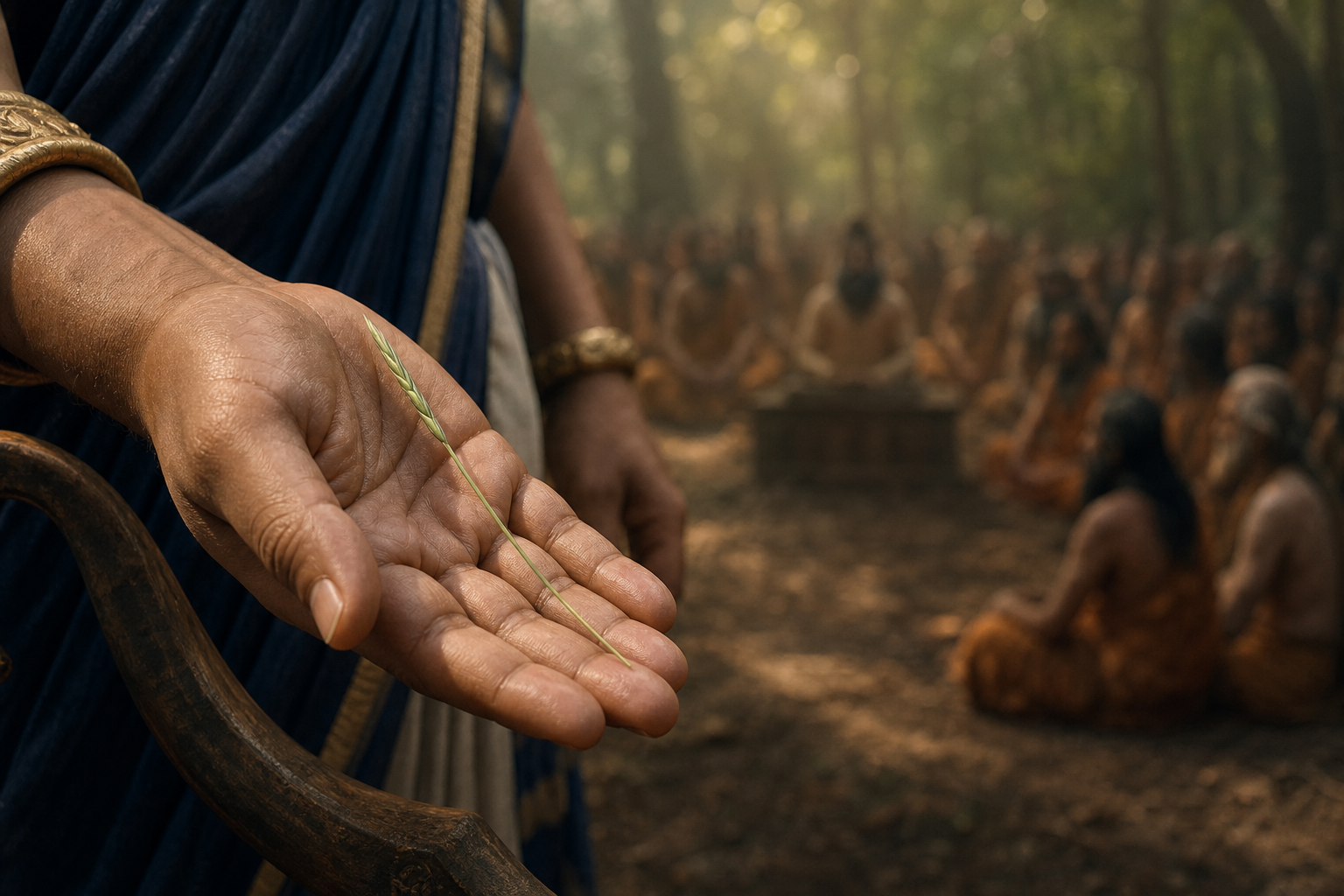
Kusa is ordinarily associated with ritual purity, concentration, and the marking of sacred boundaries. In Balarama’s hand, a single blade becomes the means of judgment. The force plainly does not belong to the grass as an ordinary object; it belongs to the extraordinary agent who wields it.
That distinction sharply limits the episode’s human application. The miraculous use of a ritual implement is not a penal procedure that a priest, teacher, administrator, or devotee can reproduce. Within the theological world of the narrative, it presents an exact divine intervention. It does not grant human leaders permission to answer discourtesy with assault, threats, humiliation, or uncontrolled anger.
The symbolism of purity cannot make bodily harm safe or legitimate in ordinary community life. If someone invokes Balarama to excuse personal vengeance, the analogy has already failed: human anger is not divine discernment, and private retaliation is not dharmic danda-niti.
Three interpretive boundaries will keep a retelling honest:
- Name the exceptional actor. Do not silently transfer Balarama’s Puranic agency to an ordinary officeholder.
- Retell the complete sequence. The sages’ protest, the obligation of prayascitta, and the restoration of the recitation belong to the event as surely as the strike does.
- Translate the ethical principle, not the physical act. Human institutions should use clear rules, a fair hearing, proportionate nonviolent consequences, and a remedy for the people harmed by the disruption.
The narrative also moves rapidly from raudra, the fierce mood, toward shanta, the restoration of peace. That movement is an interpretive clue. Wrath is not presented as the final achievement. If a retelling dwells on miraculous punishment but neglects objection, atonement, and repair, it has stopped before the moral resolution.
Ugrasrava’s succession shows what the judgment must protect
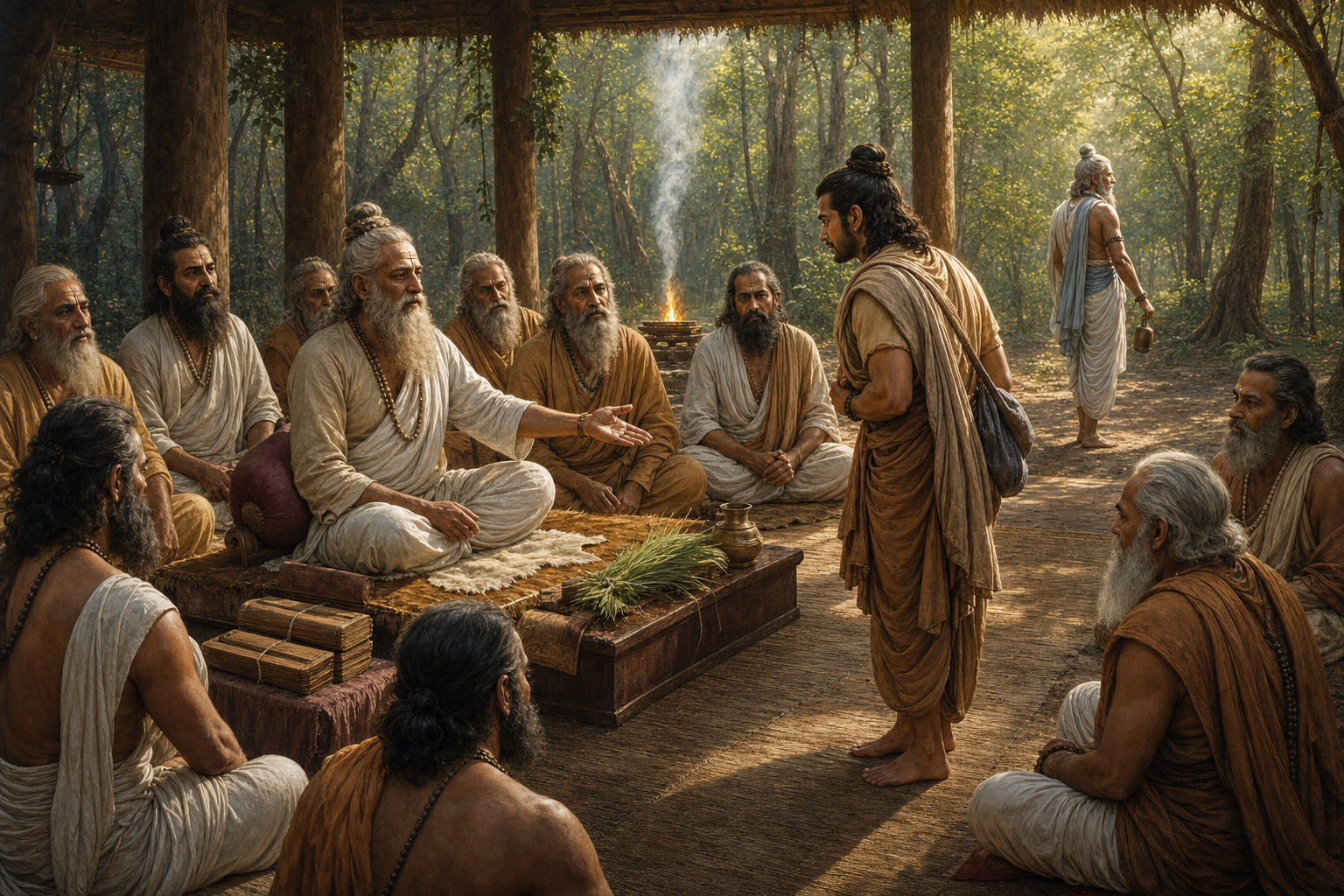
The sages had promised Romaharshana a long life for a particular purpose: the sacred recitation had to be completed. His death therefore endangered more than an individual privilege. It placed the assembly’s word and the transmission of knowledge in jeopardy.
Balarama’s resolution was to empower Romaharshana’s son, Ugrasrava Sauti, with the authority and longevity required to continue the task. Ugrasrava subsequently stands in the narrative tradition as the great reciter before Shaunaka and the assembled sages at Naimisharanya. The office continues, the assembly’s commitment is honored, and the teaching lineage survives the removal of its previous holder.
This ending establishes four tests for a dharmic institutional remedy:
- Accountability must remain real. Continuity cannot become an excuse to ignore misconduct by an indispensable teacher or official.
- Existing promises must be addressed. A correction that casually breaks the institution’s own vows creates a second wrong.
- The shared work must survive. Removing an officeholder should not needlessly destroy the teaching, service, archive, or ritual entrusted to the office.
- Correction must not become collective contempt. One person’s failure does not justify degrading a family, lineage, vocation, or social group.
The fourth test matters especially in reading Romaharshana’s identity as a Suta. The episode does not dismiss the Suta vocation. Its resolution depends upon that vocation: Ugrasrava is entrusted with the same civilizational work and becomes one of the best-known voices of Puranic transmission. The point is accountability within a knowledge office, not contempt for the community that sustains it.
It is tempting to label the whole event restorative justice, but that description needs precision. Romaharshana’s death is irreversible; it is not restored. What follows is a restorative settlement of the institutional breach. The sages’ vow, the recitation, the lineage, and the community’s spiritual purpose are repaired as far as the narrative permits. A more accurate description is a punitive intervention followed by an accountable and restorative resolution.
For a contemporary organization, the practical analogue is a succession plan tied to an accountability process. Establish who can investigate the officeholder, who can hear an objection, what nonviolent consequences are available, which commitments must survive a removal, and who is qualified to continue the work. Waiting until a crisis makes every decision look personal.
Four questions readers usually bring to the episode
Was Romaharshana definitely acting out of arrogance?
No inner motive should be asserted with certainty. One traditional reading sees arrogance; another emphasizes his obligation to remain on the vyasasana. What is clear is that Balarama judged a separation between Romaharshana’s learning and the humility demanded by his role. You can accept that ethical concern without pretending the narrative gives a complete psychological account.
Why did the sages object if Balarama’s correction was dharmic?
Because one justified claim does not erase another. The sages had granted Romaharshana longevity so he could complete the recitation. Their objection defends the integrity of that boon and their own ritual word. Balarama’s willingness to answer them shows that dharmic authority must reckon with the obligations its action disrupts.
Does the episode endorse violence in response to disrespect?
No ordinary human permission follows from Balarama’s extraordinary act. Treating the kusa blade as a model for physical punishment removes the theological setting, the sages’ jurisdiction, the demand for atonement, and the restorative settlement. In present institutions, the transferable principles are humble conduct, transparent accountability, nonviolent discipline, and continuity of service.
What should a religious community do differently because of it?
Do not leave maryada unwritten until someone is accused of violating it. Before conflict arises, define the duties attached to prominent seats, explain how competing protocols are resolved, distinguish conduct from presumed motive, give affected vow-holders a formal voice, and prepare a way for sacred work to continue if an officeholder must step aside.
The next time you hear this episode, resist asking only whether Romaharshana should have stood. Ask what the vyasasana required, what the sages had promised, who could challenge the exercise of power, and how the teaching survived. Then put those same questions into your own community’s rules before a dispute arrives. That is how vidya and vinaya are kept together in practice.