

You want more than an attractive image of Vishnu’s discus, but you may not know where reverent contemplation ends and lineage ritual begins. That distinction matters. Sudarshana practice can train clear, protective attention, yet its mantras, nyāsa and formal yantras should not be treated as interchangeable techniques collected from different traditions.
A sound beginning is simpler: contemplate the wheel as right vision, keep its still center before the mind, and test every insight against dharma and compassion. You can practise that openly without pretending to have received a ritual initiation.
Begin with the wheel’s function, not its complexity
Sudarshana can be understood as excellent, auspicious or right seeing. In contemplation, do not begin by imagining a weapon directed at an enemy. Begin with the power that cuts through your own confusion. The Chakra protects because it distinguishes truth from distortion and disciplined action from impulsive reaction.
The image gives you four practical anchors:
- The bindu, or central point: awareness that remains still while thoughts, duties and events move around it.
- The turning circumference: time and action. Life does not stop while you seek clarity; the task is to move without losing the center.
- The ring of flames: tapas, the heat that refines attention and burns through confusion rather than feeding anger.
- The ordered spokes and surrounding geometry: the gathering of scattered faculties around one dharmic purpose.
Traditional Sudarshana diagrams are not uniform. Some show six spokes, others eight, while ritual descriptions may emphasize innumerable flames. Petal counts and angular arrangements also vary by lineage. That variation is a reason to be precise about the method you have received, not a reason to manufacture a supposedly universal yantra from several unrelated designs.
If you have no received design, a plain mental image of a radiant circle and still center is enough for the open contemplation described here. Treat it as a contemplative symbol, not as a consecrated ritual yantra. If you do use a detailed image, choose one trusted by your own sampradāya and work with that one consistently.
The wheel also has resonances across the wider Dharmic family: the Buddhist Dharma-Chakra turns the teaching; Jain symbolism associates the wheel with law and ethical order; and the Sikh chakkar signifies unity and timeless truth. These resonances reveal a shared Indic intuition about order around a stable center. They do not make the doctrines or practices identical. Sudarshana contemplation remains specifically rooted in the Vaishnava world of Vishnu and Narasimha.
Choose an open or lineage-guided form before you sit
An open contemplative form
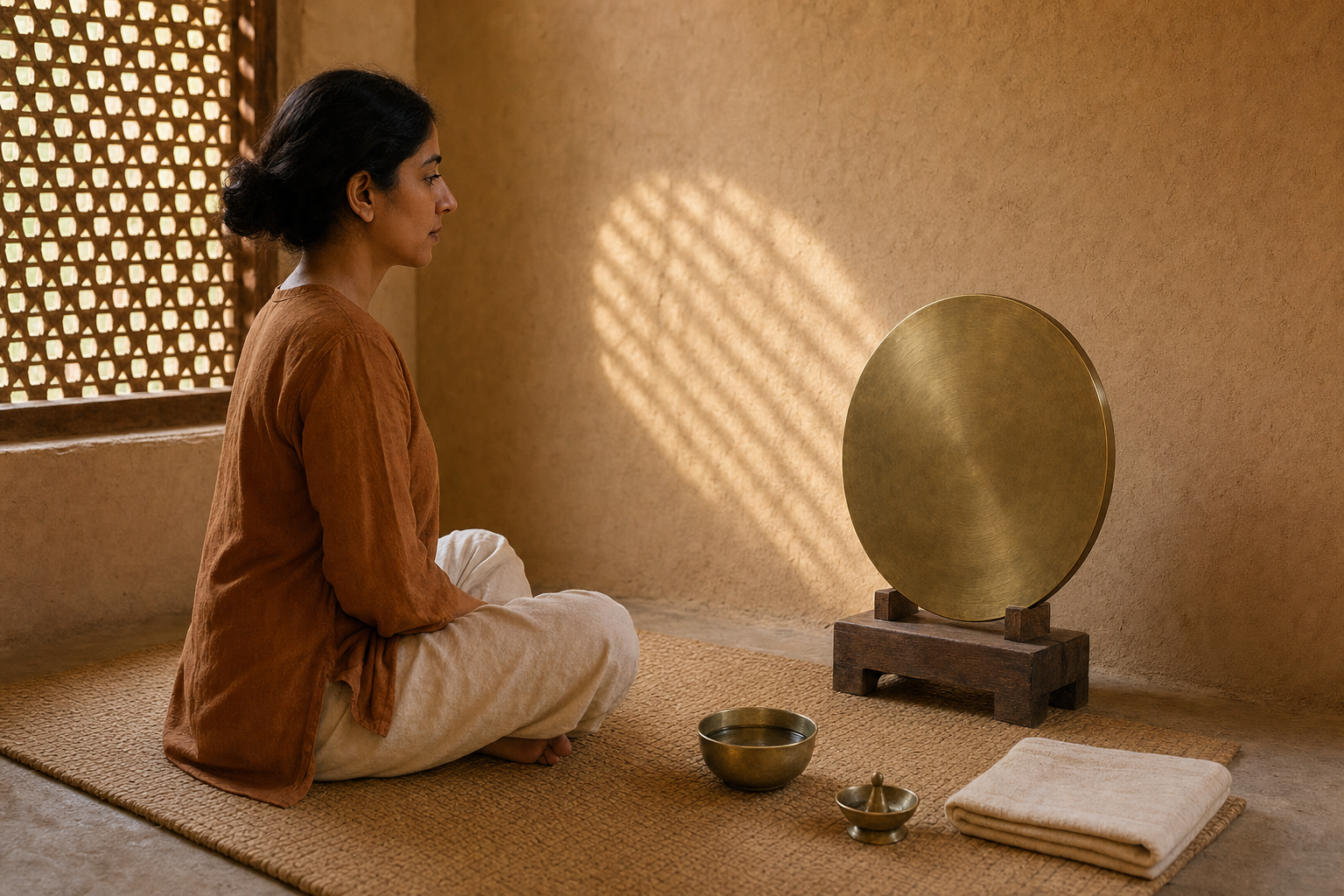
Use this form if you have devotion to Vishnu, Narasimha or Sudarshana but have not received formal instruction. It requires a clean seat, an uncomplicated visual focus, natural breathing, prayer in words already familiar to you, and silent attention. You do not need to add seed syllables, ritual placements or an elaborate imagined mandala.
This is not a lesser practice. Its discipline lies in refusing to turn a sacred method into a collection of impressive details. Your task is to see one situation more truthfully and to act with less fear, hostility and confusion.
A lineage-guided ritual form
Formal Narasimha-Sudarshana disciplines can combine yantra, mantra-japa, kara-nyāsa and aṅga-nyāsa. Nyāsa sanctifies the hands and limbs through prescribed mantra placement. The Narasimha bīja kṣrauṁ may also appear in received sequences. Pronunciation, order, rhythm, repetition and ritual context belong to the instruction, so they should not be improvised from a printed outline.
A traditional Sudarshana Gāyatrī is:
ॐ सुदर्शनाय विद्महे महाज्वालाय धीमहि तन्नो चक्रः प्रचोदयात्।
Traditional Sudarshana Gāyatrī
In transliteration: Om sudarśanāya vidmahe mahājvālāya dhīmahi tanno cakraḥ pracodayāt. Its movement is toward contemplation of Sudarshana and the great flame, followed by a prayer that the Chakra direct or illuminate understanding.
If this mantra is already part of your received practice, preserve the pronunciation and method you were taught. If it is not, reading it for recognition is different from adopting it as a self-initiated ritual. Remain with silent contemplation until a qualified guru gives you a specific procedure. The same rule applies to bīja practice and nyāsa.
A repeatable practice from outer form to inner clarity

No universal session length or japa count applies across lineages. Decide your sitting period before you begin so that you are not repeatedly checking the clock. If you have received a count, follow it. If you have not, do not invent a supposedly sacred number to make the practice feel more authoritative.
- Name one dharmic purpose. Bring one real duty or decision, not a catalogue of problems. You might frame the intention as: May I see this clearly and act without cruelty. This is a suggested ethical intention, not a canonical mantra.
- Establish the seat. Use a clean, quiet place. Sit steadily without forcing the body. Let the breath become even on its own. The purpose is alert composure, not physical strain or dramatic breath retention.
- Offer a familiar invocation. Make praṇāma to Vishnu, Narasimha or Sudarshana according to your tradition. Ask for protection from confusion and for the courage to uphold dharma. Use a prayer you already know rather than adding an unfamiliar bīja.
- Trace the form from outside inward. If your trusted yantra contains a bhūpura, recognize it as the boundary of the sacred field. Move to the flames as transforming tapas, the lotus petals as unfolding śakti, the intersecting triangles as the union of principles, and finally the bindu as the still point. If your image does not contain all these elements, do not draw extra layers into it merely to match a description.
- Use mantra or silence honestly. Perform the mantra-japa you have actually received. Otherwise, remain silent and attend to the meaning of right seeing. Silence is more disciplined than uncertain pronunciation performed for effect.
- Rest at the bindu. Let thoughts and emotions move at the rim without chasing each one. Return to the center whenever attention scatters. A hazy visual image is not failure; the essential movement is from dispersion to ordered attention.
- Bring the decision into view. Look at the matter without rehearsing an argument against another person. Separate what you know from what you assume, what dharma requires from what pride demands, and necessary firmness from the wish to punish.
- Close with gratitude and one action. Offer a flower if that is customary, or make a simple gesture of thanks. Sit in silence before rising. Then name one truthful, proportionate action you can take. A contemplation that never reaches conduct has stopped at the image.
For a difficult decision, write four short lines after the sitting:
- The fact I can presently verify is…
- The duty or relationship I must honor is…
- The fear, anger or attachment distorting my view is…
- The least harmful truthful action available now is…
This written test prevents an intense feeling from masquerading as revelation. Sudarshana’s discernment should make the next duty cleaner. It should not make your preferences unquestionable.
Judge the practice by what happens at the rim
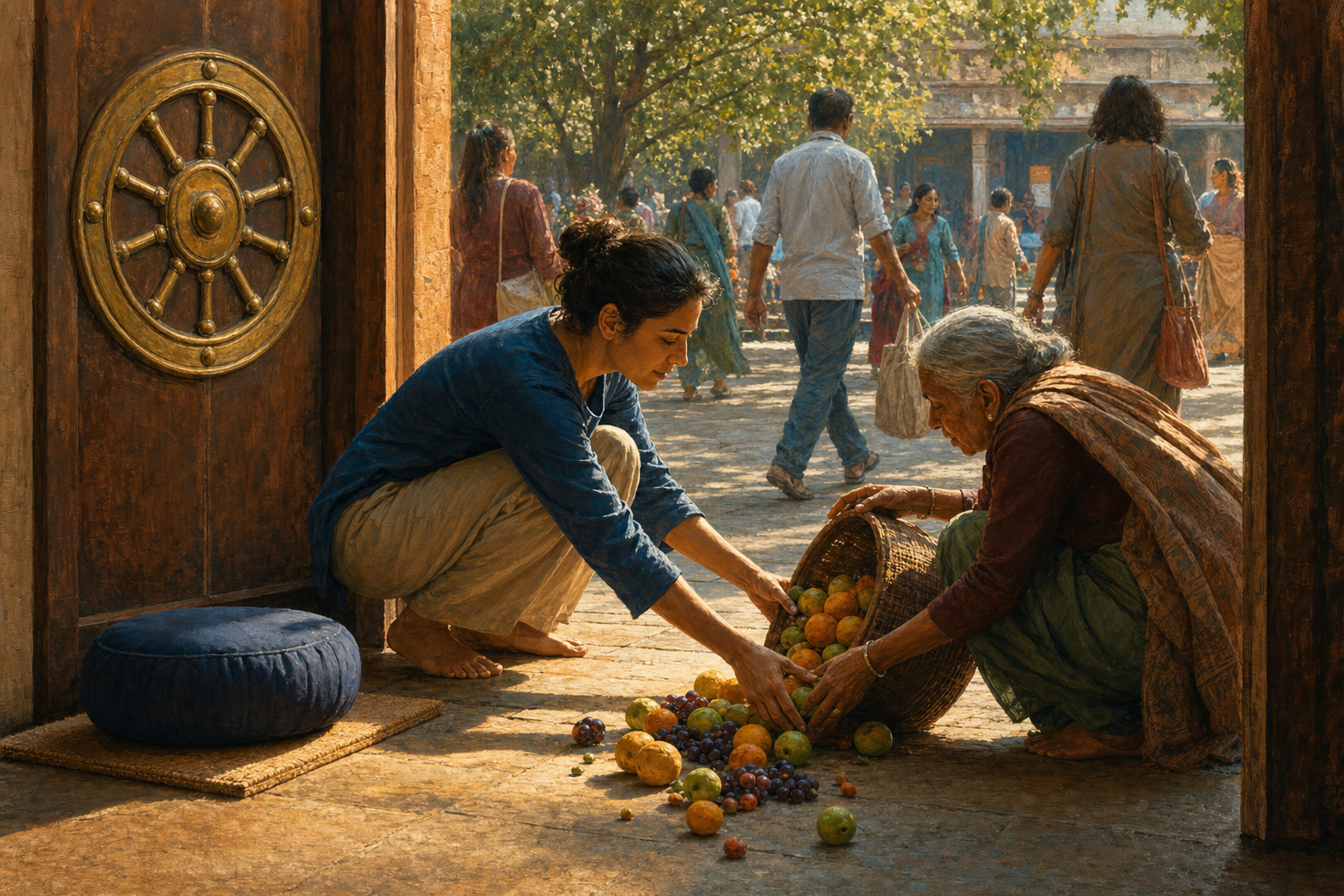
The center of the wheel is tested at its circumference: conversation, work, family obligation, public duty and conflict. A striking visualization may be memorable, but it is not the most reliable measure of progress. Look for changes you can observe in conduct.
- Clarity becomes more discriminating. You can distinguish a fact from an interpretation and a duty from an impulse.
- Courage loses its aggression. You can state what must be stated without needing humiliation, rage or theatrical severity.
- Protection becomes less self-centered. You consider truth, vulnerable people and the wider consequences of action, not only your own comfort or status.
- Vigilance loses its anxiety. You notice risk without treating every disagreement as a threat.
- Compassion gains structure. Dayā does not become passivity; it guides you toward a proportionate response that avoids needless harm.
A steadier breath, lucid quiet and a protective feeling may accompany the contemplation. Receive them without clinging. A sensation is neither a command nor proof that every conclusion reached during meditation is correct.
Several common errors can be corrected immediately:
- Geometry fixation: if you spend the sitting worrying about petal counts while ignoring your actual ethical question, return to the center and the function of right seeing.
- Power-seeking: if the attraction is control over other people, pause formal experimentation and restore prayer, humility and ahiṁsā.
- Identity hardening: if protection means imagining whole groups as enemies, the practice is feeding confusion rather than cutting it.
- Method collecting: if you continually add mantras and diagrams from different lineages, choose one received method and stop combining instructions.
- Using clarity without compassion: if a conclusion is technically sharp but needlessly cruel, examine it again. Discernment and dayā are meant to correct one another.
No vision, bodily sensation or feeling of divine protection authorizes reckless or harmful conduct. Sudarshana is dharma’s vigilant clarity, not a sacred label for anger.
Key takeaways
- Without formal instruction, use a simple wheel-and-bindu contemplation, familiar prayer, natural breath and silence.
- With formal instruction, preserve your lineage’s yantra, mantra, pronunciation, order and japa count instead of mixing systems.
- Move from the outer boundary toward the still center, then return to one real decision in your life.
- Measure the practice through courage without aggression, vigilance without anxiety and firmness without needless harm.
- If contemplation hardens hostility or inflates certainty, stop and re-establish humility, ahiṁsā and compassion.
At your next sitting, bring one live decision to the wheel. Rest at the bindu, separate fact from reaction, and leave with one proportionate action. That small return from vision to duty is where Sudarshana contemplation becomes a practice rather than an idea.