

You open two panchanga apps for the same puja and get two different answers. One places the muhurta in the morning. Another shifts it later or assigns the observance to a different civil date. The natural question is, “Which app is wrong?” That is often the wrong place to begin.
Your real task is to separate three kinds of exactness: the position of celestial bodies, the calendrical rules used to interpret those positions, and the ritual authority you have chosen to follow. Once you make those layers visible, technology becomes far more useful and far less intimidating.
The time on your screen is the end of a chain

A digital time may be displayed to the minute or second, but the number is not self-explanatory. It is the final output of a chain of astronomical models, reference-frame choices, location settings, calendar conventions, and ritual rules. Precision at the end of that chain cannot repair an unexamined choice near its beginning.
The traditional panchanga itself contains five distinct limbs: vara, tithi, nakshatra, yoga, and karana. They do not merely provide five names for the same moment. Each describes a different calendrical feature. A muhurta may require several of them to be considered together, while a festival rule may give decisive weight to one particular feature.
- The astronomical layer estimates the relevant positions and relationships of the Sun, Moon, equinoxes, and stars.
- The reference layer decides how those positions are expressed, including whether a tropical or sidereal framework is being used.
- The calendrical layer translates celestial relationships into tithi, nakshatra, yoga, karana, solar transitions, and civil-date labels.
- The ritual layer decides which of those features governs a particular vrata, samskara, temple observance, or family practice.
- The community layer identifies whose calendar has standing when many people must observe together.
Astronomy can tell you when a calculated celestial relationship occurs. It cannot, by itself, tell you which relationship your sampradaya treats as decisive. A calendar can label a festival date. It cannot, by itself, replace the temple, lineage, family tradition, or teacher responsible for applying the rule.
This distinction prevents a common mistake: treating every disagreement as a failure of calculation. Sometimes one tool has bad settings. Sometimes both tools calculate competently but implement different conventions. Sometimes the disagreement is not astronomical at all; it is about which ritual rule should govern.
Ayanamsha explains why an exact number still needs a stated basis
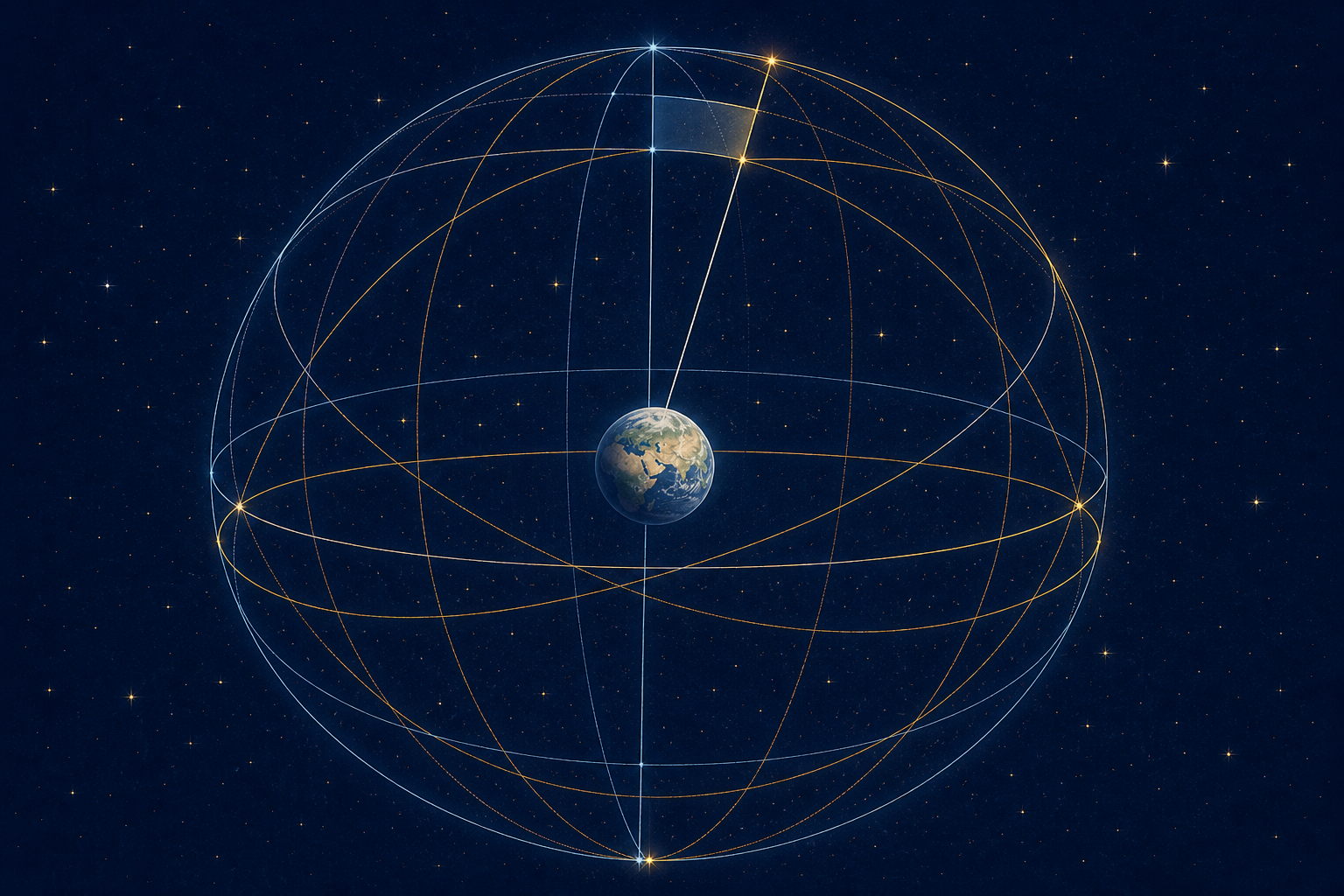
The ecliptic is the Sun’s apparent path through the sky, while the celestial equator is the projection of Earth’s equator. Their intersections mark the equinoxes. Because Earth’s axis slowly changes orientation, the equinoctial points drift relative to the fixed stars. This is ayanacalana, commonly described as precession.
Ayanamsha expresses the offset between an equinox-based tropical reference and a star-based sidereal reference. It is not a decorative setting. It affects how a computed position is aligned with the 27 nakshatras and can therefore affect downstream calendrical results near a boundary. The Lahiri ayanamsha is widely used in Indian calendrical practice, but seeing “Lahiri” in an app does not tell you everything about the app’s festival rules, location handling, or day-label convention.
This is why two screens can look equally scientific while answering slightly different questions. One may use your current device location and time zone; another may retain a default city. One may disclose its ayanamsha; another may hide the choice. One may show the precise transition of a tithi; another may display only a festival label produced after applying an internal rule.
You should also identify the kind of observance before comparing outputs. Solar observances such as Makar Sankranti are anchored to solar longitude, while new-moon and full-moon rites depend on lunar factors such as tithi and nakshatra. Debugging a solar transition as if it were a lunar-date problem sends you into the wrong settings. Begin with the celestial event the observance actually uses.
Do not compare only the large date or festival name on each screen. Open the detailed view and compare the underlying transition times. If the tools agree about when a tithi or nakshatra begins and ends but assign different festival dates, the disagreement probably lies in the observance rule. If their transition times differ, inspect the astronomical and location settings first.
Give the machine the calculation, not the sankalpa
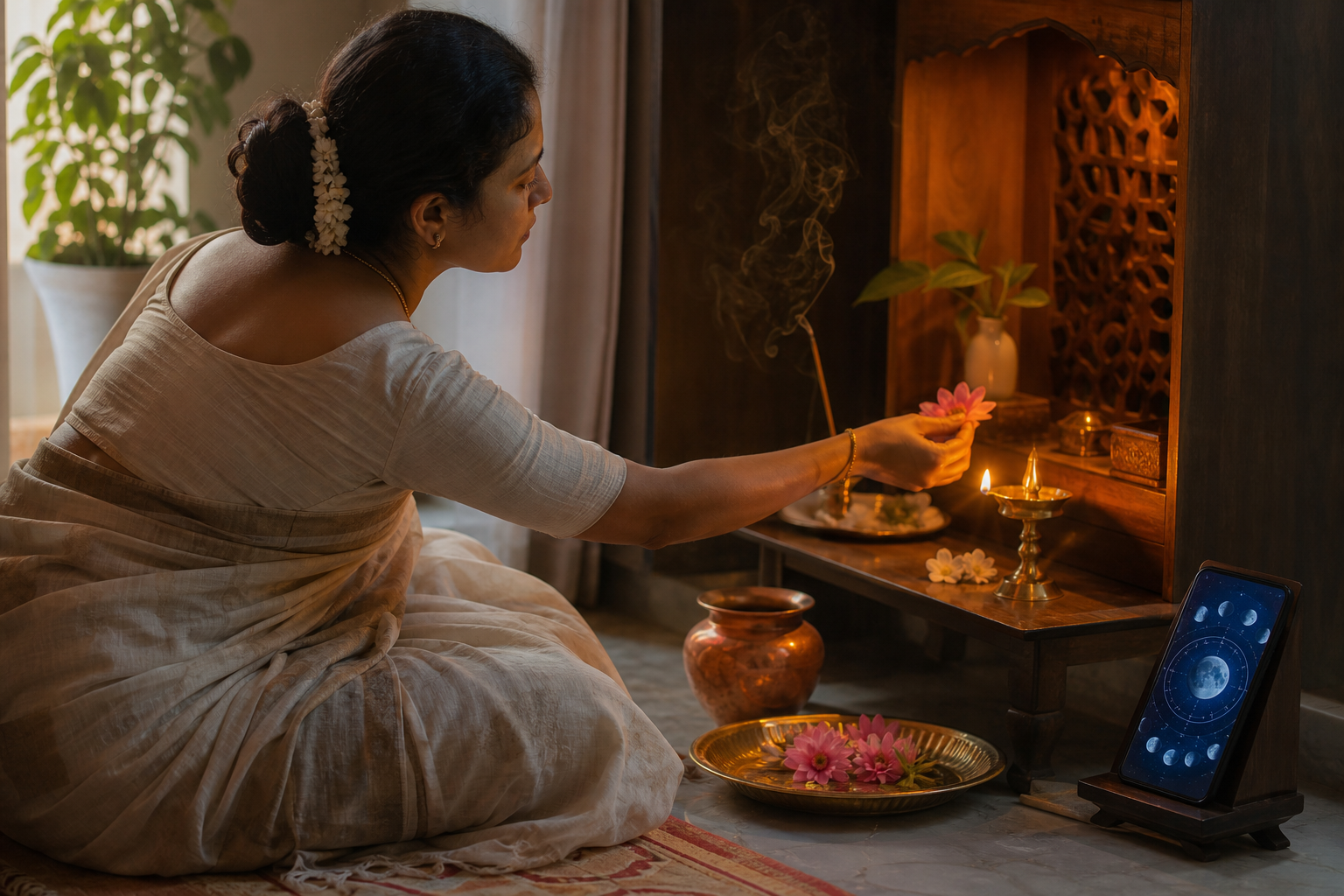
Technology is strongest where repetition, calculation, search, and consistency matter. It can maintain schedules, compute panchanga elements, compare candidate intervals, flag a transition, provide pronunciation benchmarks, and preserve liturgical material. These are substantial services, especially for a diaspora family without easy access to a printed local almanac or for a temple coordinating many observances.
Yet procedural fidelity is not the whole of religious practice. In Hindu ritual, bhava and sankalpa belong to the practitioner. In Buddhism, cetana places intention at the centre of karmic action. Jain discipline joins vows to conscious restraint, ahimsa, and aparigraha. Sikh practice gives living form to remembrance, seva, humility, and sangat. These concepts are not interchangeable, but none can be outsourced merely by generating the correct sequence of words or gestures.
A machine can display a sankalpa formula. It cannot form your resolve on your behalf. It can remind you of a vrata. It cannot undertake restraint for you. It can schedule seva. It cannot supply the humility and care that make service morally significant. This is not an argument for careless ritual. It is a boundary between assistance and agency.
The description “incorruptible machine” is also misleading. Software may not become tired or envious, but its output still depends on selected data, design decisions, defaults, and institutional control. Transparent oversight and accountable stewardship are therefore part of trustworthy sacred technology. An unexplained algorithm can conceal a systematic error more effectively than a human being can conceal a moment of uncertainty.
Ask an AI assistant or calendar service to expose its reasoning rather than to pronounce on the validity of your worship. A useful request is: “Show the location, time zone, ayanamsha, relevant tithi or nakshatra transition, and the rule used to select this interval.” A poor request is: “Tell me the one universally correct time.” The first request produces information you can verify. The second asks software to erase real differences among traditions.
Use this six-step protocol when timings conflict

You do not need to become an astronomer every time two calendars disagree. You do need a consistent order of operations. Use the following protocol before changing plans or declaring one panchanga defective.
- Name the observance precisely. Distinguish a daily home practice, a family samskara, a lineage vrata, a temple festival, and a public community event. They do not all have the same governing authority.
- Normalize the civil settings. Confirm the city, time zone, date, and any seasonal clock adjustment. A correct calculation for another location is still the wrong answer for your purpose.
- Expose the astronomical settings. Check whether the tool identifies its tropical or sidereal basis, ayanamsha, and calendar method. If these are hidden, treat the output as a convenience rather than a final ruling.
- Compare boundaries rather than labels. Look for the beginning and ending times of the relevant tithi, nakshatra, or solar transition. Agreement on the boundary but disagreement on the festival date points toward different interpretive rules.
- Apply the rule through the proper authority. Follow the temple’s published calendar for a temple observance, the officiating purohit and family tradition for a samskara, or the relevant lineage and teacher for a vrata. Do not let an unaffiliated app silently overrule the community that owns the observance.
- Record the basis and proceed consistently. Note the tool, settings, chosen calendar, and human authority. This prevents repeated software-shopping when another app later offers a more convenient answer.
If you have no established temple, teacher, or family practice to consult, choose a transparent panchanga that serves your location and is consistent with the tradition you intend to follow. Use it consistently for that cycle of observances. Consistency does not prove that every disputed calendrical question has been settled, but it gives your practice an intelligible basis and keeps convenience from becoming the hidden rule.
For a collective observance, coordination is itself part of the practical duty. You may privately prefer another calculation, but a temple or sangha cannot function if every participant imports a different app at the last minute. Raise a methodological concern before the calendar is announced. Once plans are public, any correction should come from the responsible institution, with the reason stated clearly.
For personal practice, use greater precision when the tradition actually makes a boundary decisive. Do not manufacture anxiety by treating every displayed second as spiritually determinative. False precision begins when the screen shows more decimal places than the underlying convention can justify, or when a person measures the minute carefully while ignoring the rule, intention, preparation, and conduct that give the observance its form.
Key takeaways for your next observance
- An exact-looking muhurta is an output, not an authority. Verify the assumptions behind it.
- Separate astronomical disagreement from disagreement about calendrical or ritual rules.
- Check location, time zone, reference frame, ayanamsha, and transition times before comparing festival labels.
- Match the tool to the observance: solar transition, lunar tithi, and nakshatra-based decisions are not the same calculation.
- Let technology handle computation and reminders while a practitioner, lineage, temple, or community retains ritual responsibility.
- Choose your governing panchanga and human authority before the day of the observance, then document the choice and follow it consistently.
Before your next festival or samskara, open the settings page of the calendar you already use. Write down its location, time zone, ayanamsha, calendar convention, and the authority whose practice you are following. If the tool cannot disclose its basis, use it as a reminder, not as a verdict. The worthwhile form of precision is not the most impressive timestamp; it is precision whose assumptions you can see and whose ritual purpose you understand.
References
- DharmaRenaissance Blog – Ayanacalana Explained: The Essential Guide to Mastering Hindu Timekeeping and Rituals
- DharmaRenaissance Blog – Essential Insights on AI and Dharma: Do Incorruptible Robots Understand Religion Better?
