
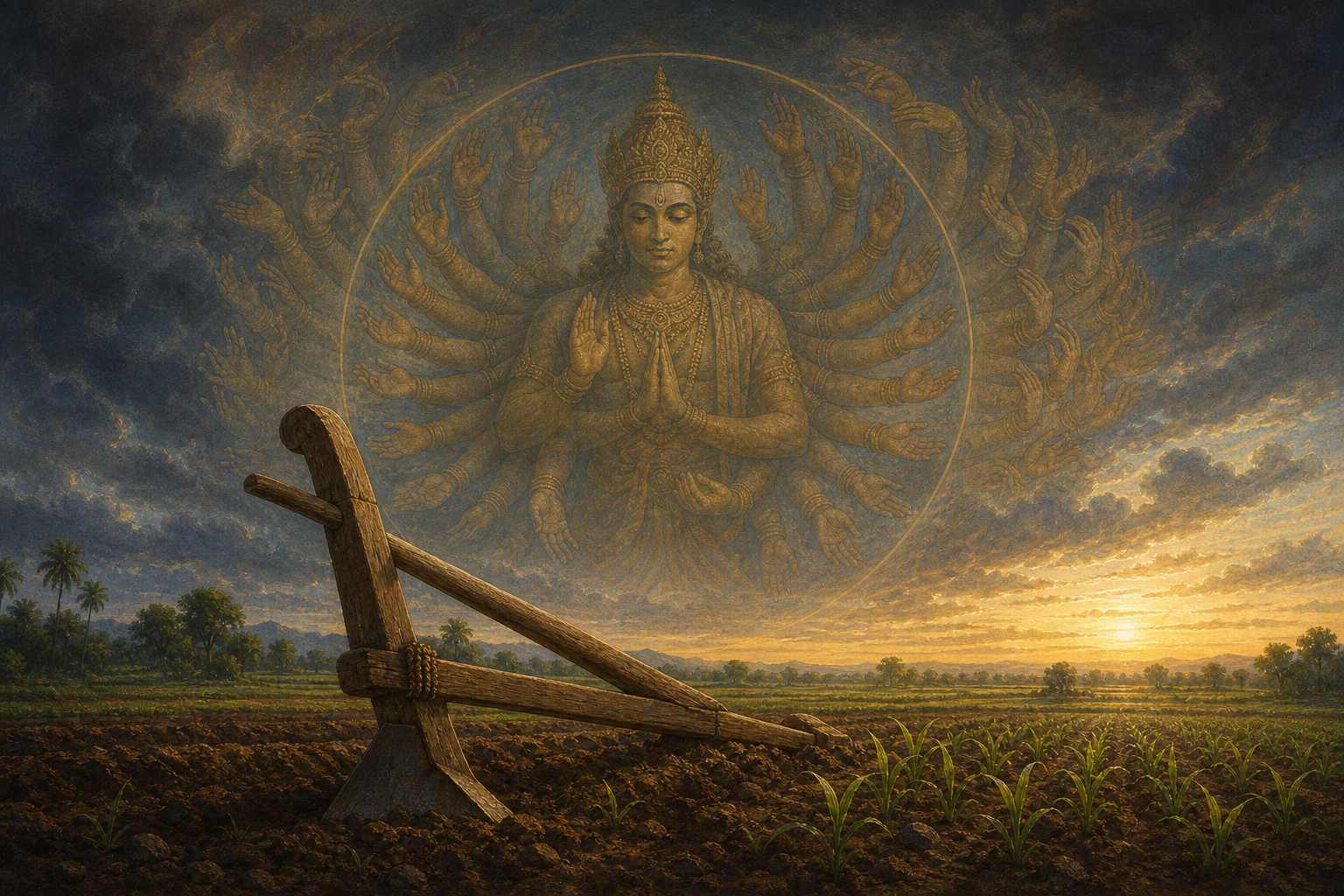
You’re not always choosing between strength and weakness. More often, you can intervene, expand, command, correct, or refuse – and the difficult question is whether you should.
Dharmic iconography gives you a practical way to judge that choice. Balarama’s plough shows power grounded in sustenance and protection. Kartaviryarjuna’s thousand hands show capacity expanding beyond a person’s ordinary reach. One asks what your strength cultivates; the other asks whether you can govern everything your strength enables.
Read the emblem as a discipline, not a decoration
Power, duty, and restraint are not three unrelated virtues. Power is the capacity to act. Duty gives that capacity a rightful direction. Restraint keeps action within its purpose. Without power, duty may remain an intention. Without duty, power becomes appetite. Without restraint, even a legitimate responsibility can grow into permission to do whatever the powerful person wants.
This is why a sacred emblem should not be treated as a superhero’s accessory. Its form tells you what kind of power is being displayed, what that power is for, and what must govern it. When you encounter an extraordinary weapon, tool, vehicle, limb, or bodily form in a Dharmic narrative, ask three questions:
- What is the source of the power? Was it cultivated, inherited, granted, or seized?
- Whom does the power serve? Does it nourish and protect, or merely enlarge the holder?
- What stops the power? Is there a duty, vow, discipline, relationship, or moral boundary stronger than desire?
Balarama and Kartaviryarjuna produce different answers. Balarama, the elder brother of Bhagavan Sri Krishna, is called Halayudha, the one armed with the hala or plough. His paired emblems are the plough and the musala, a club or pestle. The first evokes cultivation and nourishment; the second carries the capacity to defend order.
Kartaviryarjuna, also remembered as Sahasrabahu Arjuna, presents the image of a ruler with a thousand hands. In a symbolic reading, sahasra points toward the innumerable: many abilities, duties, resources, impulses, and opportunities gathered around one center of will. The image is therefore not an uncomplicated tribute to strength. It poses a harder question: can one ethical center direct so much reach without being captured by it?
Balarama’s plough judges strength by what it sustains
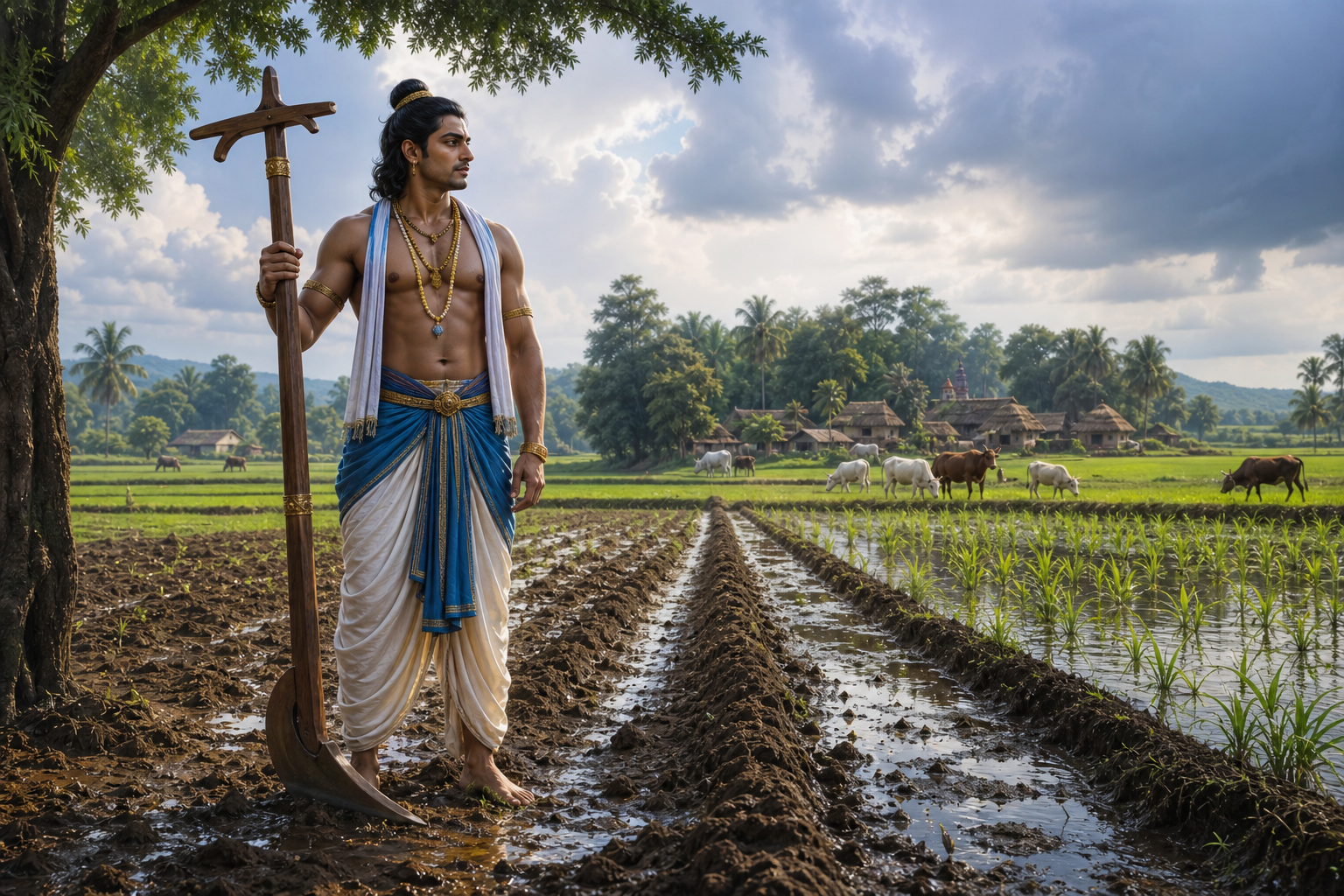
A plough is powerful because it changes the ground. It cuts, turns, and orders the soil, but its purpose is not the cut itself. The disruption prepares the conditions in which food can grow. That makes the hala a particularly exact symbol of Dharmic strength: firm action is justified by the life it enables, not by the force it displays.
The musala prevents that teaching from becoming sentimental. Sustenance sometimes needs protection. A society cannot cultivate its fields, feed its households, or maintain order if it has no capacity to confront what threatens them. Yet the pairing matters. Productive and corrective power remain parts of one duty; force does not become an independent source of glory.
An episode associated with Bhagavata Purana 10.65 depicts Balarama using his plough to draw the Yamuna toward him and alter her course. The account displays command over nature, but its symbolism should not be turned into a blank cheque for domination. Read through the plough, strength remains connected to stewardship, order, and the conditions that sustain life.
The Mahabharata adds another kind of restraint. Balarama trains both Duryodhana and Bhima in gada-yuddha, or mace combat, yet remains apart from the Kurukshetra War. Whatever judgement a reader makes about that distance, the juxtaposition is instructive: possessing martial knowledge does not compel its use in every conflict. Knowing how to fight and deciding whether to enter a particular fight are separate moral questions.
The association survives in worship rather than remaining confined to narrative. In the Puri tradition, Balabhadra is identified with the plough and mace, while his Ratha Yatra chariot is named Taladhwaja. Agrarian labor, protection, temple life, and public celebration therefore meet in the same sacred image. The field is not outside spiritual life. Food, work, soil, community, and restraint are among the places where dharma must become visible.
You can apply the plough’s test whenever your action will disrupt an existing situation. Do not ask only whether you have the authority to act. Ask what your intervention will cultivate, what genuinely needs protection, and whether you will stop once that duty has been met. If you can name the disruption but not the life it is meant to support, the action is not yet well grounded.
Kartaviryarjuna’s thousand hands expose ungoverned ambition

Kartaviryarjuna was a Haihaya king associated with Mahishmati. His extraordinary prowess is traditionally linked to the grace of Dattatreya. His reign is remembered for order and prosperity, and his power was sufficient to humble even Ravana. Yet the same career moves toward conflict with the household of the sage Jamadagni and retribution from Parashurama. The movement from celebrated ruler to destructive excess makes the thousand hands a warning as well as a wonder.
The warning is not that ambition, leadership, or unusual capability is inherently wrong. Kartaviryarjuna’s early achievements would make little sense if power itself were the fault. The danger appears when increased capacity weakens rather than deepens self-command. Each new hand can perform a duty, but it can also grasp another possession, extend control into another domain, or answer another desire.
That is the practical difference between having many hands and having a governing center. Skills, resources, followers, offices, and opportunities do not coordinate themselves. If ahankara becomes the center, every ability starts to look like an entitlement. If dharma remains the center, capability stays answerable to purpose, consequence, and limit.
When your responsibilities begin to multiply, sort them under three headings:
- Duty: an obligation created by your role, promise, or responsibility to another person or community.
- Capacity: something you are able to do, but are not automatically required or entitled to do.
- Appetite: an expansion you want because it increases possession, recognition, influence, or control.
The categories prevent a common mistake: treating every available hand as a mandated hand. If you can launch another initiative, direct another group, acquire another resource, or intervene in another dispute, that proves capacity. It does not by itself establish duty.
Consider a temple or community committee with willing volunteers, donor support, a venue, and public attention. Those resources may enable a larger program, but scale is not yet the purpose. The committee should first identify whom it is serving, which obligations are non-negotiable, what costs the expansion places on volunteers, and what condition would make it decline further growth. Defining that boundary before success arrives is far easier than discovering it after recognition and momentum have begun feeding the institution’s appetite.
Yogic disciplines such as yama, niyama, and attentive self-observation matter here because restraint cannot be outsourced entirely to circumstance. The more hands you possess, the more important the inner work of coordinating impulses becomes. Capability without integration produces fragmentation; disciplined capability can become stewardship.
A shared Dharmic grammar does not erase distinct traditions
The ethical pattern reaches beyond these two Hindu figures, but it should be described carefully. Hinduism, Buddhism, Jainism, and Sikhism are not interchangeable systems, and a resemblance between symbols does not eliminate their distinct teachings. The useful connection lies in a shared question: how should human capacity be directed so that it does not become domination, attachment, or ego?
- Hindu narratives place power under dharma. Balarama’s plough joins force to nourishment, while Kartaviryarjuna’s many hands reveal what happens when vast reach loses its ethical center.
- Buddhist traditions turn multiplicity outward through the thousand-armed Avalokiteshvara, whose many arms signify compassion reaching in many directions. Some royal ploughing traditions in Asia also honor cultivation and the dignity of the life supported by it.
- Jain thought applies restraint through Aparigraha. Multiplying possessions and attachments can multiply bondage, so the answer to greater capacity is not endless acquisition but a more careful relationship with desire, living beings, and the material world.
- Sikh teaching directs human effort through kirat karo, earning through honest work, and through seva, which turns many hands toward humble service. Collective strength becomes meaningful through the work it performs for others.
These pathways converge ethically without becoming identical doctrinally. Compassion governs reach. Non-possession governs acquisition. Honest labor governs livelihood. Seva governs collective effort. Dharma governs the use of capability. The shared civilizational intuition is not that power must disappear, but that it must answer to something higher than the powerful person’s own enlargement.
This distinction also helps when you speak about Dharmic unity. Name the precise value being shared instead of claiming that every tradition says the same thing. Unity becomes more credible when it respects difference: several paths can discipline power without using the same theology, vocabulary, or sacred form.
Use the plough and the thousand hands before your next decision

You do not need royal authority or supernatural strength to face this problem. It appears when you lead a household, accept a professional role, organize a religious celebration, manage community funds, teach a skill, moderate a dispute, or speak for a public cause. Run the decision through this sequence before momentum makes the decision for you:
- Name the field. Identify the person, relationship, institution, or condition of life that your action is supposed to cultivate. A vague promise to do good is not enough; say what should be better because you acted.
- Separate duty from ability. State what your role actually requires. Put everything you merely can do outside that boundary until a clear responsibility justifies it.
- Choose the right instrument. Decide whether the situation calls for cultivation, protection, correction, or refusal. Do not use the musala for work the plough can accomplish, and do not mistake passivity for restraint when something entrusted to you genuinely needs protection.
- Declare the limit in advance. Define the scope, the resources you will use, the people whose consent matters, and the condition that will end the intervention. A stopping rule stated only after power has expanded is easily rewritten by appetite.
- Make the center answerable. Give a trusted person, council, discipline, or established principle the authority to question your decision. Self-mastery is essential, but private confidence that you will remain virtuous is not the same as accountability.
Restraint will not always produce inaction. Balarama’s emblems include both a cultivating implement and a protective weapon. The point is to keep firm action bounded by its duty. Once protection turns into humiliation, stewardship into possession, or leadership into personal expansion, the center has shifted even if the original cause was just.
Key takeaways
- Sacred power is judged by its purpose and limit, not merely by its size.
- Balarama’s plough makes sustenance the first test of strength; the musala keeps protection within that same duty.
- Kartaviryarjuna’s thousand hands distinguish capability from entitlement and expose the danger of ambition without self-command.
- Buddhist compassion, Jain Aparigraha, and Sikh kirat karo and seva offer distinct ways to direct power away from ego and toward ethical responsibility.
- Before acting, define what you must cultivate, what you must protect, and the boundary at which you will stop.
The next time authority, skill, resources, or public support make it possible to do more, do not begin and end with, “Can we?” Ask what your plough will cultivate, which of your many hands are serving duty, and what you are prepared to refuse. Then use the strength you need – and no more than the work of dharma requires.
References
- DharmaRenaissance Blog – Halayudha Unveiled: Why Balarama’s Sacred Plough Embodies Strength, Earth, and Dharma
- DharmaRenaissance Blog – Thousand Hands of Kartaviryarjuna: A Powerful Symbol of Ambition, Dharma, and Restraint
