
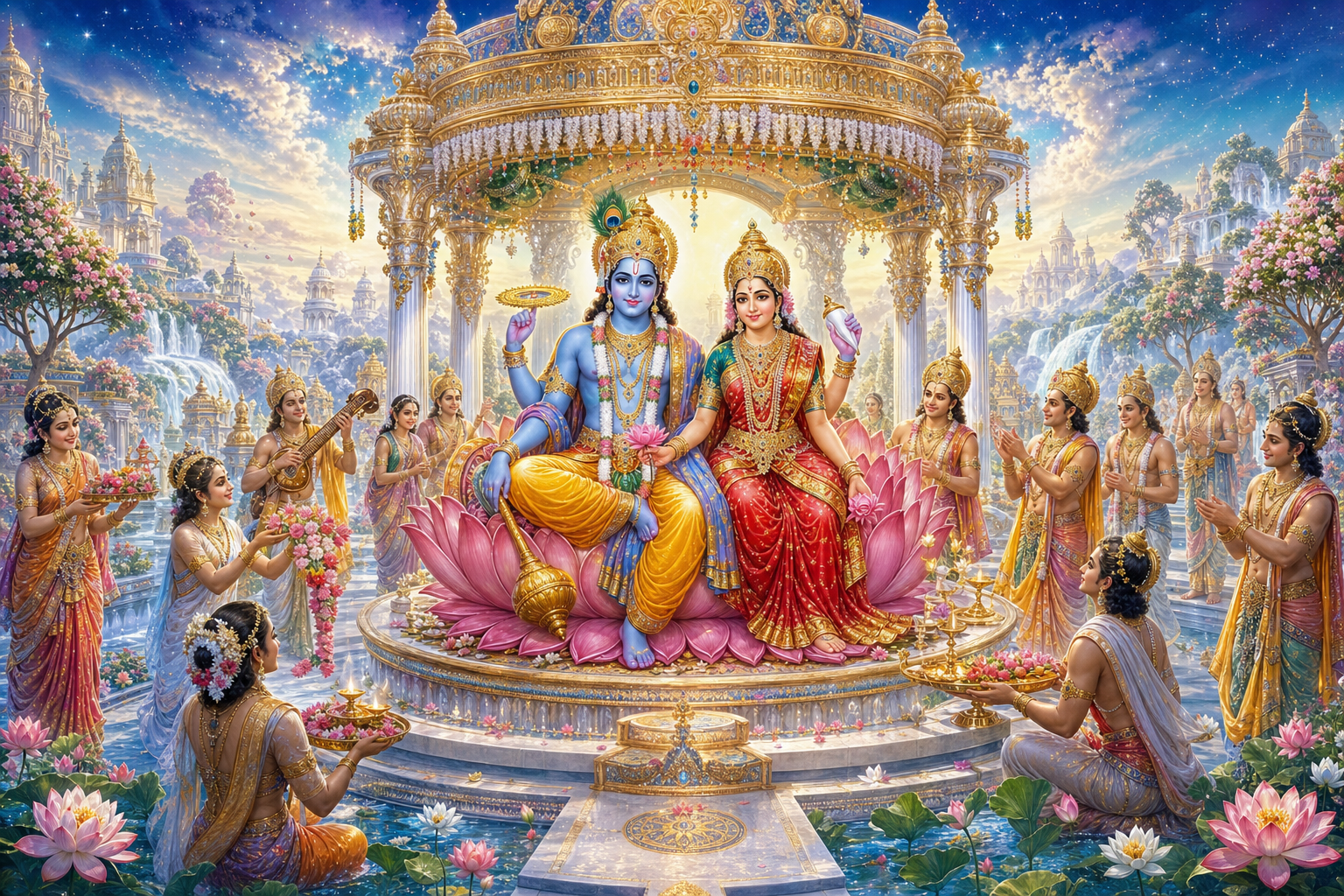
If moksha ends birth and death, what remains for the liberated soul? Does the soul disappear, rest forever, or continue to act?
In the Vaishnava vision of Vaikuntha, liberation is neither disappearance nor endless inactivity. The mukta is free from karmic bondage and lives in willing service to Lord Vishnu. Understanding the difference between bondage and service resolves the apparent contradiction.
Liberation ends bondage, not the soul’s relationship with Vishnu
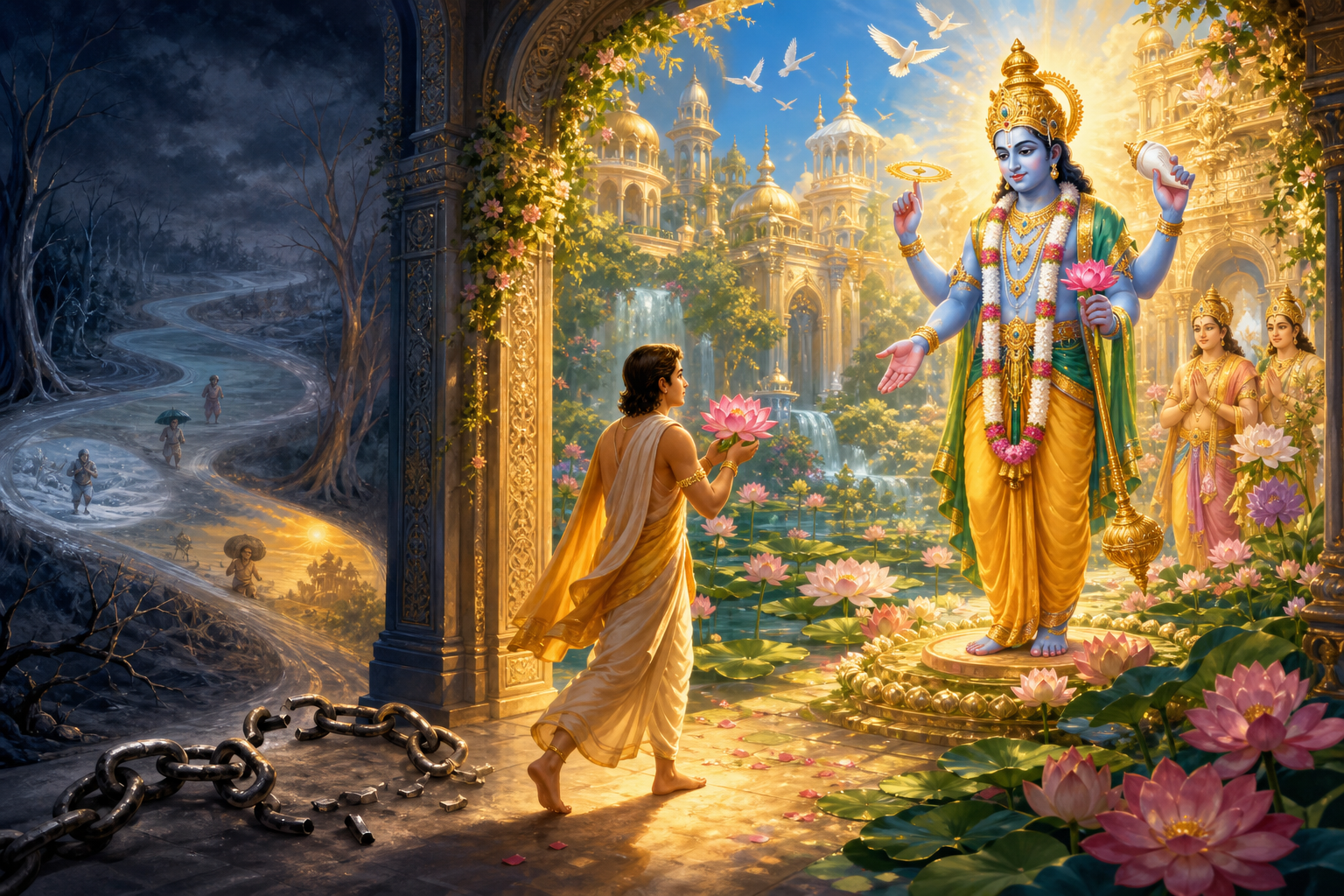
A mukta is a liberated soul. Before liberation, the soul is bound by karmic debts and the recurring cycle of birth and death. Within this Vaishnava account, many lives of effort and devotion culminate, through the grace of a Guru and surrender to Lord Vishnu, in freedom from those karmic bonds.
The important word is freedom. Vaikuntha is not merely a more pleasant location to which the unchanged ego is transferred. If craving, possessiveness, rivalry, and karmic debt remained intact, the central problem of bondage would remain intact as well. Liberation concerns the condition of the soul, not simply its surroundings.
That condition can be understood through three movements:
- The soul is freed from repeated birth and death.
- The soul is freed from the karmic debts that previously held it.
- The soul is freed for unbroken divine service.
The third point prevents moksha from being reduced to mere escape. The mukta is not simply released from suffering and then left without purpose. Freedom reaches its positive form as communion with Vishnu, expressed through service.
This is a specifically Vaishnava way of speaking about liberation. Hindu traditions do not all describe moksha with identical metaphysical language. Even within Vaishnava thought, teachers may explain the precise relation between the liberated soul and the Supreme in different ways. You do not have to flatten those differences to understand the central claim: the language of service preserves a meaningful, loving relationship between the mukta and Vishnu.
Why service remains after karma has been exhausted
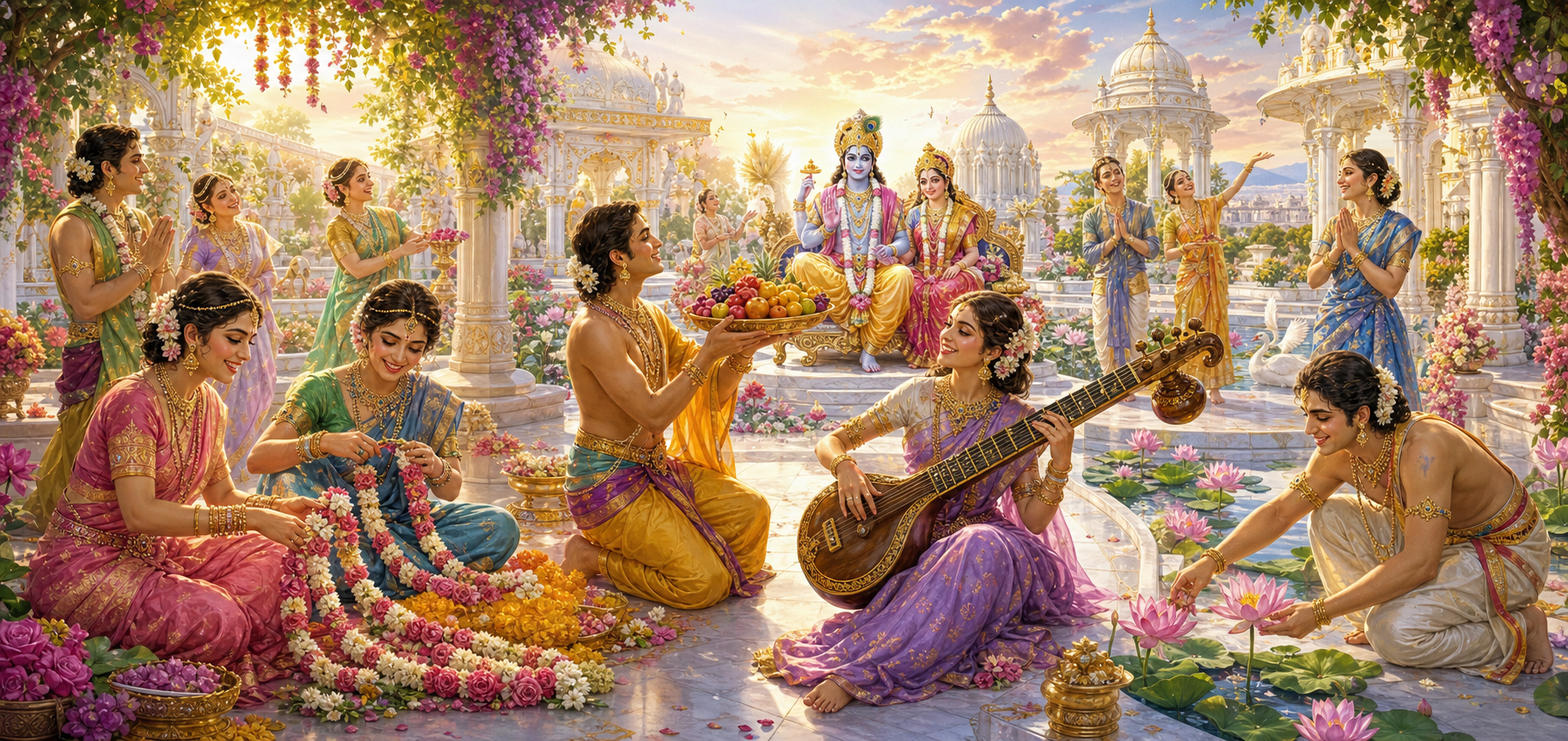
Service sounds paradoxical only when every kind of action is treated as bondage. That is not the distinction being made. Bondage does not arise merely because something is done. It arises when the soul is caught in karmic obligation, egoistic ownership, compulsion, and attachment to what the action will produce.
Divine service in Vaikuntha belongs to another order. It is not undertaken to accumulate merit, purchase liberation, build status, or force Vishnu to grant a desired result. A liberated soul has no liberation left to earn. Service is therefore not the price paid for admission to Vaikuntha; it is the liberated mode of life in Vaikuntha.
You can see the distinction imperfectly even in ordinary life. Two outwardly similar acts may arise from very different inward movements. A person may help in order to be praised, obey in order to avoid punishment, or give in order to create a debt. Another may perform the same visible act without trying to possess the recipient or advertise the deed. The hands may do something similar while the ego does something entirely different.
The analogy has limits because an embodied person is still subject to karma. Its value is diagnostic: it shows why action and bondage are not synonyms. What binds is not simply movement, attention, or service. The issue is the appropriation of action by the self that insists, “This is mine, I control it, and its fruit must return to me.”
The mukta’s service expresses surrender without that bargain. It is compatible with liberation precisely because it no longer functions as a transaction. Love does not become more perfect by becoming inactive. In this vision, it becomes free of everything that once distorted it.
Four common misunderstandings about muktas in Vaikuntha
1. “Moksha means that nothing of the soul remains”
That reading does not fit this account of Vaikuntha. Divine service requires a real relation: Vishnu is served, and the mukta serves. This does not by itself answer every philosophical question about identity, difference, or divine dependence, but it does rule out interpreting the liberated soul as a spiritually meaningless blank.
When you encounter descriptions of muktas serving in Vaikuntha, read them as affirmations that liberation has positive content. Something more profound than the cessation of pain is being described: the fulfilment of devotion.
2. “Eternal service is only another form of servitude”
Earthly servitude is associated with coercion, exploitation, fear, exhaustion, and unequal access to power. Carrying all of those conditions unchanged into the word “service” creates the confusion.
The mukta is not laboring under karmic debt or trying to satisfy an insecure ruler. The soul serves after bondage has ended. Service here names free devotion, not forced work. If a description of Vaikuntha makes divine service sound like an oppressive institution, the earthly analogy has been allowed to overrule the theological meaning.
3. “Surrender means that effort no longer matters”
Surrender is not spiritual laziness. The path described here includes effort and devotion across many lives, the guidance and grace of a Guru, and surrender to Vishnu. Grace does not turn carelessness into a discipline. Nor does effort make liberation a possession that the ego can demand as wages.
Hold effort and grace together. Practise sincerely, receive correction, and relinquish the claim that your effort places the Divine under obligation. That is more demanding than passivity because it asks you to act without making yourself the ultimate owner of either the path or its result.
4. “Vaikuntha is a reward for a successful spiritual career”
A reward-based reading quietly preserves the very transaction that surrender is meant to transform: “I performed enough, so now I am owed the highest return.” Devotion then becomes a contract, the Guru becomes a credential, and Vishnu becomes the distributor of a prize.
The liberated soul’s divine service exposes the weakness in that picture. If service continues after liberation, service was never merely a temporary payment made to obtain something else. It belongs to the goal itself. The path and the destination are connected by devotion, even though embodied practice remains incomplete and liberation is freedom from the bonds that still condition it.
Let Vaikuntha examine the way you practise now

A teaching about liberated souls should do more than satisfy curiosity about the afterlife. It should reveal what is still transactional in your present devotion. You can use the following examination after worship, seva, study, or any recurring duty you consciously offer to Vishnu.
- Name the act precisely. Do not settle for “I serve” or “I practise.” Identify the actual act: preparing an offering, helping at a temple, studying, giving, chanting, cleaning, caring for someone, or completing a duty.
- Identify the return you are demanding. It may be praise, recognition, control, emotional reassurance, a visible result, or the feeling of being more advanced than another devotee.
- Separate excellence from ownership. Surrender is not an excuse to perform carelessly. Do the act attentively while releasing the belief that careful performance makes you the owner of its fruit.
- Notice your response when the return does not arrive. Resentment, self-advertisement, and the urge to keep score disclose the bargain more accurately than your original intention did.
- Offer the next act with one less claim. Do not wait for a perfectly selfless state. Remove one concrete demand: the need to be thanked, consulted, seen, or repaid.
This exercise does not pretend that an embodied person’s action is already the action of a mukta. Its purpose is narrower and more honest. It helps you notice the habits that make service feel like a contract and surrender feel like a loss of control.
The role of a Guru also becomes clearer in this light. Genuine guidance should deepen surrender to Vishnu and expose self-deception, not give the ego a more religious vocabulary with which to protect itself. Receiving guidance matters most where you resist it, because resistance often marks the exact claim of ownership that practice has reached.
Vaikuntha then becomes more than a distant answer to “Where do liberated souls go?” It becomes a standard by which you can judge the direction of devotion: Is your practice making every act more possessive, anxious, and transactional, or is it teaching you to serve with fewer claims?
Key takeaways
- A mukta is free from karmic debt and the cycle of birth and death.
- In the Vaishnava vision of Vaikuntha, liberation does not erase the soul’s meaningful relationship with Lord Vishnu.
- Divine service is not a new bondage because it is no longer driven by karmic compulsion, egoistic ownership, or the need to earn liberation.
- Grace, the guidance of a Guru, effort, devotion, and surrender should not be turned into rival explanations; each has a distinct place in the movement out of bondage.
- You can apply the teaching now by identifying the hidden return you demand from service and deliberately releasing one concrete claim at a time.
The next time you offer worship or perform seva, do not ask only whether the act was completed. Ask what you were trying to possess through it. Then perform the next act carefully, offer it to Vishnu, and loosen that claim. That is a practical way to let the vision of the mukta shape the devotee you are becoming.