

You may understand every word in a passage on Hindu philosophy and still misread its argument because of one translation: dravya rendered simply as matter. That shortcut fails as soon as a school counts time, space, self or mind among its dravyas, or organizes reality through a different concept altogether.
The practical question is not merely what dravya means. You need to know what work the term performs inside a particular darshana. Once you ask whether it names an independent reality, a bearer of qualities, an evolved principle or a reality dependent on Brahman, the differences among the schools become much easier to follow.
The translation trap: substance does not mean material stuff
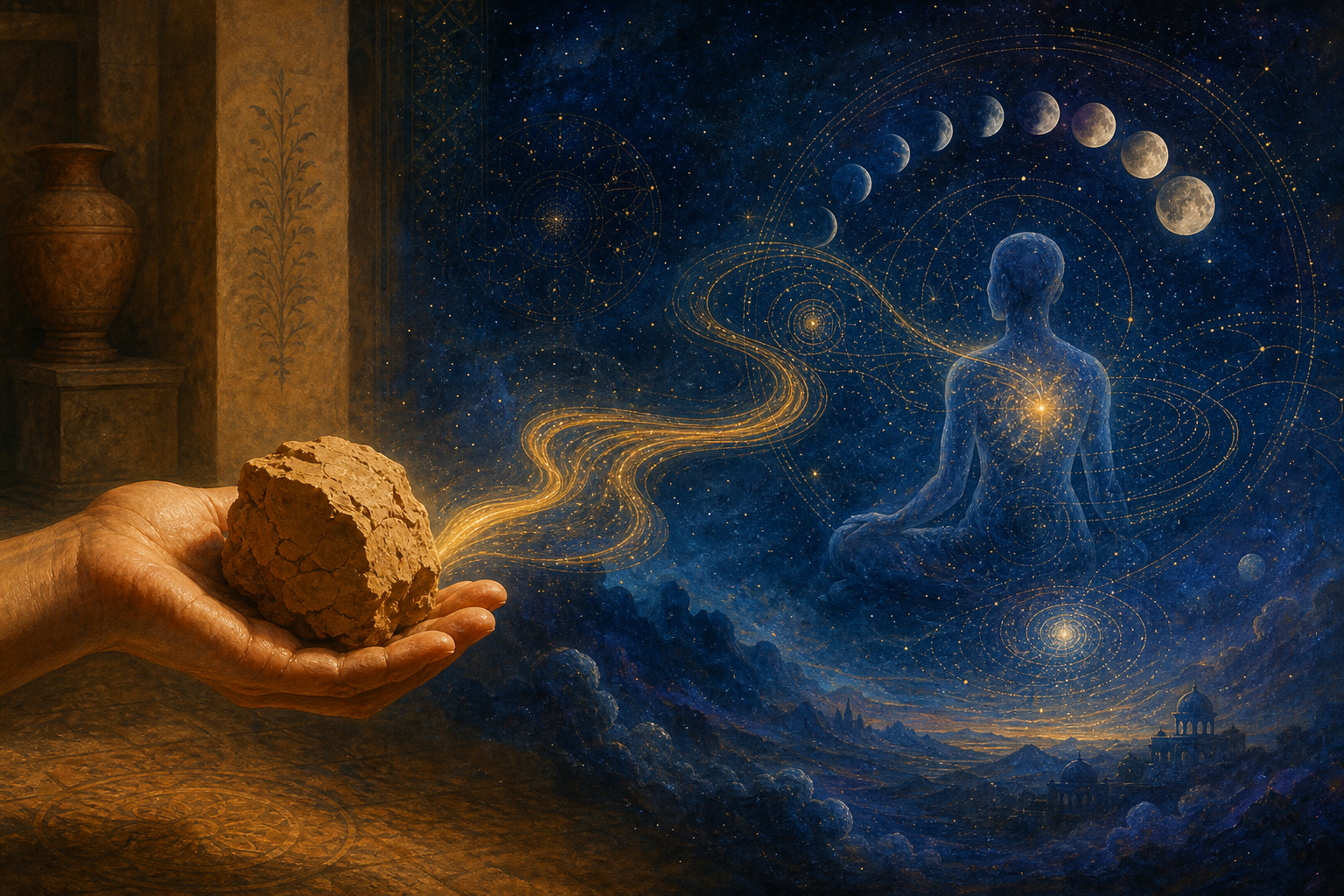
At its broadest, dravya refers to the fundamental substances or entities through which a philosophy accounts for the universe. Substance is usually the least misleading English translation, provided you do not hear it as a synonym for physical material.
A philosophical substance is something treated as an existent in its own right or as the support of qualities, actions and relations. Depending on the school, that can include an earthen pot, an individual self, mind, time or akasha. The question is ontological: what must exist for experience, change and liberation to be intelligible?
You should therefore keep three distinctions in view whenever dravya appears:
Dravya is not automatically physical. A system can be realist without being materialist.
Dravya is not a universal master term shared in exactly the same sense by every darshana. Samkhya, for example, builds its map around tattvas.
A thing can be real at one level of analysis without being ultimately independent. This distinction becomes decisive in Vedanta.
Do not begin by asking which English noun replaces dravya everywhere. Begin by asking what the school permits dravya to explain. That change in method prevents most cross-school confusion.
Nyaya-Vaisheshika gives dravya its most exact taxonomy

Vaisheshika gives dravya a precise categorical role. It is one of the padarthas, the fundamental categories under which knowable reality is analyzed. In the mature Nyaya-Vaisheshika framework, there are nine kinds of dravya:
<!– wp:list {