
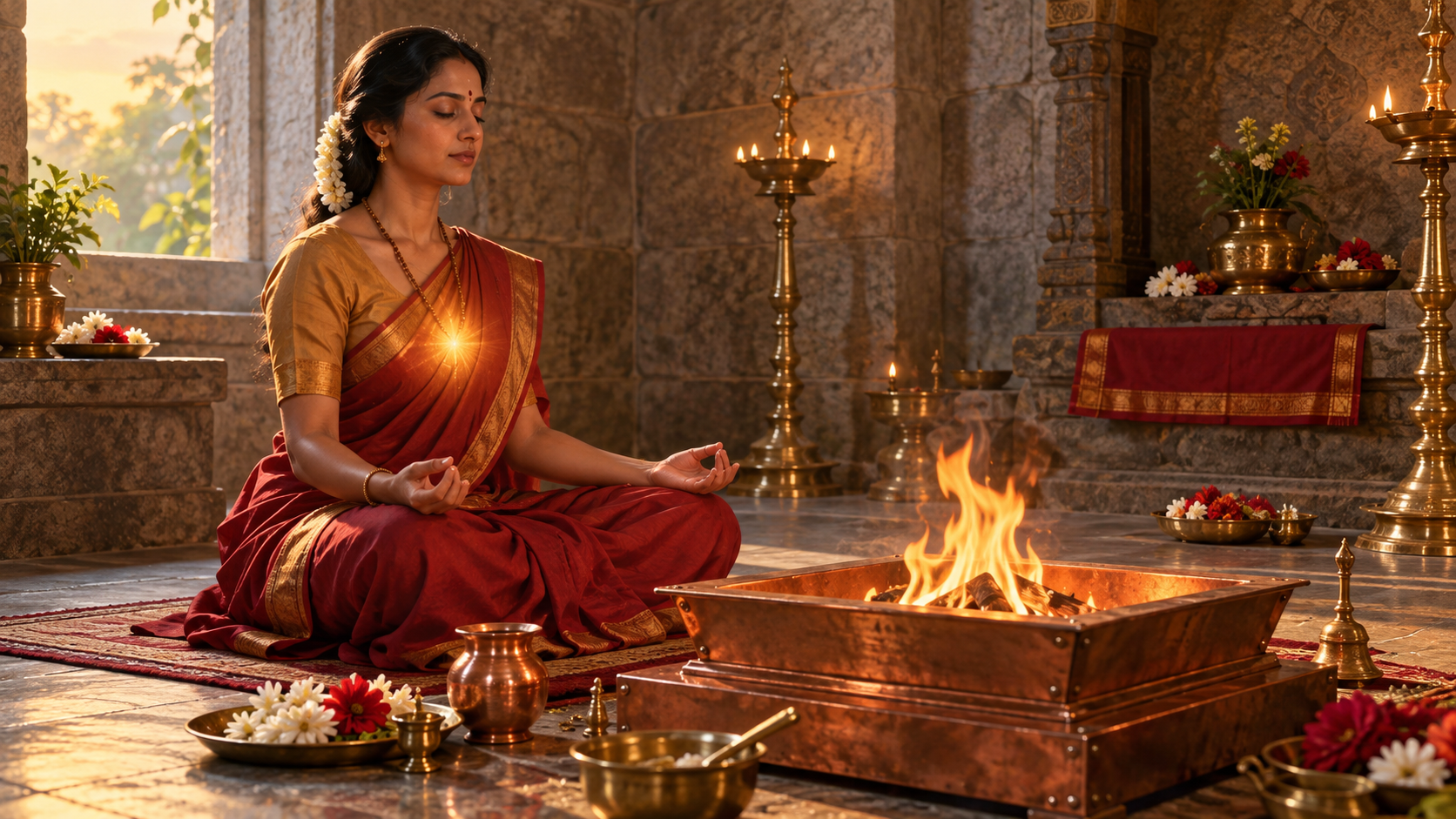
You may be drawn to Srividya yet unsure where its practice truly begins. Does worship happen inside the body and mind, or before a consecrated fire? Treating those as rival answers creates confusion before you have taken the first serious step.
Inner worship gives the ritual an inward centre. Homa gives that inward orientation a disciplined, visible act of offering. You need to understand both, while also knowing which parts you may approach through ordinary devotion and which require instruction from a qualified teacher.
One tradition, two directions of worship
Srividya belongs to the Shakta vision in which Devi is not approached as a distant object alone. The worshipper, the act of worship and the presence being worshipped are brought into an increasingly integrated relationship. That is why an altar outside you and a shrine within you need not compete.
Inner worship turns attention towards the body, consciousness, intention and identity of the worshipper. Fire ritual turns intention into ordered action through a real flame and real offerings. One direction asks whether you are inwardly present; the other asks whether you can embody that presence through disciplined ritual.
- Inner worship asks: What in you is approaching Devi, and what are you prepared to relinquish?
- Homa asks: Can an offering be made in the proper way, rather than according to impulse?
- Their meeting point is intention governed by discipline. Private emotion alone is insufficient, but outward correctness without attention is also incomplete.
Do not force these two dimensions into a simplistic ladder in which one is always elementary and the other always advanced. A lineage may arrange them in a precise relationship. Your first task is to learn that relationship rather than invent one from isolated practices.
This gives you a useful test when assessing a teaching. Ask what is being worshipped, where worship is located and what qualifies someone to perform the stated practice. If a teaching promises access to powerful rites but cannot answer those questions clearly, step back.
The inner shrine is a discipline of attention

Within Kerala’s Srividya inheritance, the body is approached as an inner shrine and consciousness as its illuminating principle. This changes how you understand inwardness. The body is not merely an obstacle to escape, and inner worship is not permission to invent whatever imagery feels impressive.
The practical question is whether you can become attentive enough to recognise what you are bringing into worship. Agitation, pride, fear, impatience and the desire for extraordinary experiences do not disappear because sacred vocabulary has been placed around them. Inner practice brings those movements into the light so that they can be offered rather than secretly directing the ritual.
If you have not received a formal Srividya practice, you can still cultivate the orientation on which responsible practice depends. The following is a preparatory exercise, not a substitute for an initiated ritual sequence:
- Sit in a clean, quiet place and begin with a simple, non-secret expression of reverence to Devi familiar from your family or public devotional tradition.
- Bring attention through the body without rejecting it or indulging every sensation. Regard embodiment as the present field of responsibility.
- Notice the strongest demand occupying the mind. Name it plainly to yourself instead of covering it with spiritual language.
- Ask what that demand is doing to your speech, conduct and obligations. Choose one concrete correction you can carry into the next part of your day.
- Close deliberately. Do not label this exercise a complete Srividya puja or claim an authority you have not received.
If you have been given a formal sequence, follow the method you received. Do not insert an attractive exercise from elsewhere simply because it appears compatible. In an inherited ritual system, a seemingly small addition can alter the attention, order or meaning your teacher intended to establish.
You can judge the direction of your inner practice by its effects on ordinary conduct. Greater reverence for the body should produce responsibility rather than vanity. Awareness of Devi should make careless speech harder to excuse. Concentration should reduce the urge to collect techniques or advertise experiences. These are more useful signs than unusual sensations, vivid images or claims of hidden attainment.
Homa makes offering concrete
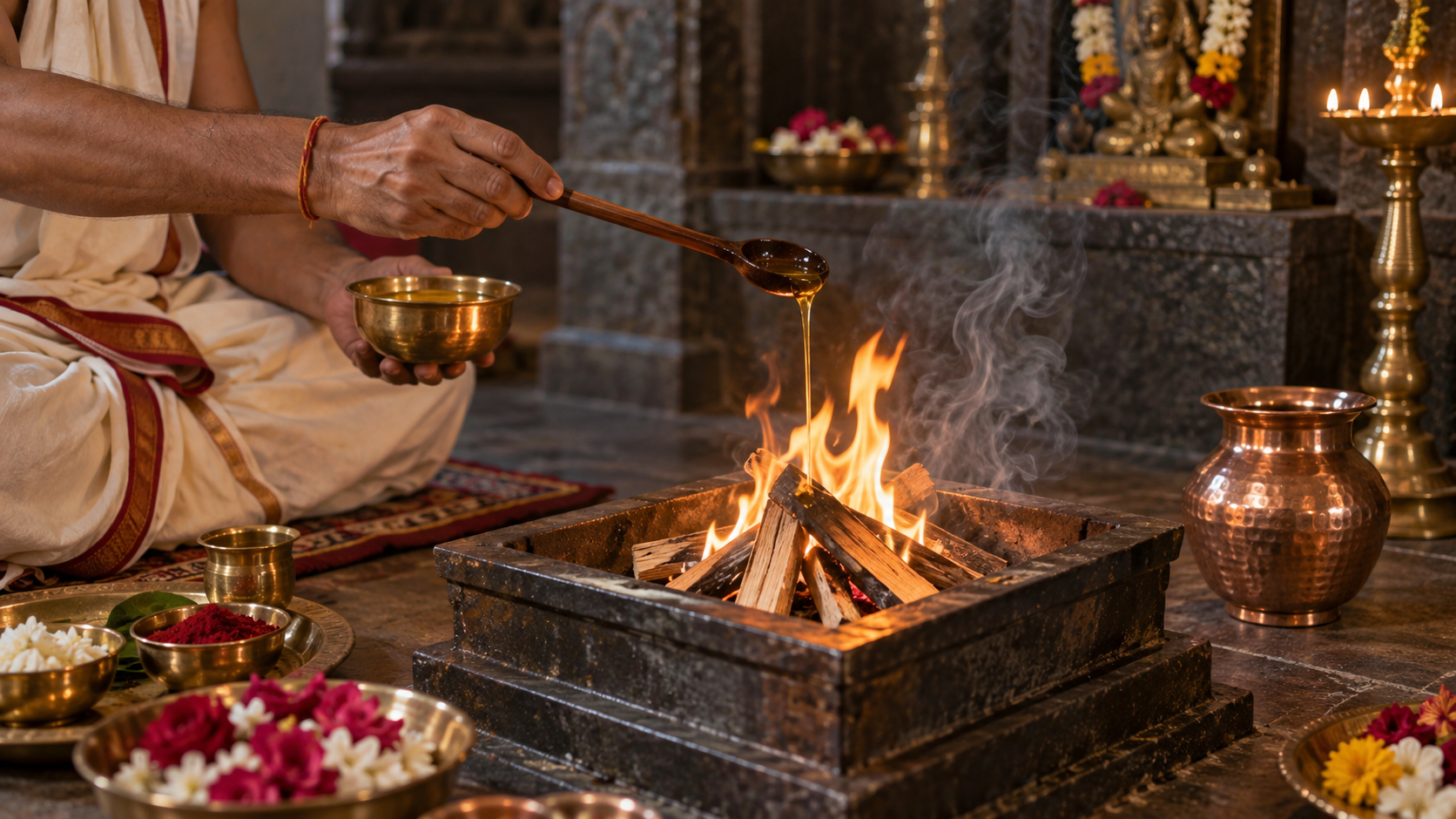
Homa, also called yajna in the broader tradition of fire worship, is not merely a symbolic way of lighting a flame. Oblations are offered into an actual fire within an ordered rite. That ordered character is preserved in Homavidhih, the ninth chapter of the Parashurama Kalpasutra, where fire worship is treated as a disciplined offering to the Divine.
This distinction matters because a devotional fire and a formal Srividya homa are not automatically the same thing. The relevant mantras, offerings, ritual order and manner of completion can depend on the lineage and the purpose of the rite. A generic recipe assembled from fragments cannot preserve those relationships.
Your permitted role also matters. Attending a homa, placing an offering when directed and officiating the rite are different responsibilities. If you are attending, arrive knowing who is conducting it, what participation is expected and whether you should bring anything. During the rite, follow the officiant’s direction instead of copying gestures or adding offerings on your own.
If you want to perform a formal homa yourself, first obtain direct instruction in the complete sequence. Ask how the fire is established, which materials are permitted, what must happen if the sequence is interrupted and how the rite is properly closed. Knowing an invocation or watching a ceremony does not answer those practical questions.
Fire is a physical hazard as well as a sacred presence. Ritual intention does not prevent burns, smoke exposure or a spreading flame. Before any permitted home rite, use a stable non-combustible hearth in a suitably ventilated place, keep an appropriate means of extinguishing fire within reach, secure loose clothing and keep children and animals outside the working area. Never use an accelerant, burn an unidentified substance or leave the flame unattended. Follow local fire restrictions. If the space, ventilation or legal conditions are unsuitable, participate in a properly managed temple or teacher-led homa instead.
The inward question must remain active during the outward offering: what are you actually prepared to give up? If the hand places material into the fire while the mind protects every resentment, vanity and attachment, the outer act has not yet penetrated your conduct. The fire makes offering visible; inner worship prevents visibility from becoming spectacle.
Choose your next step by readiness, not fascination
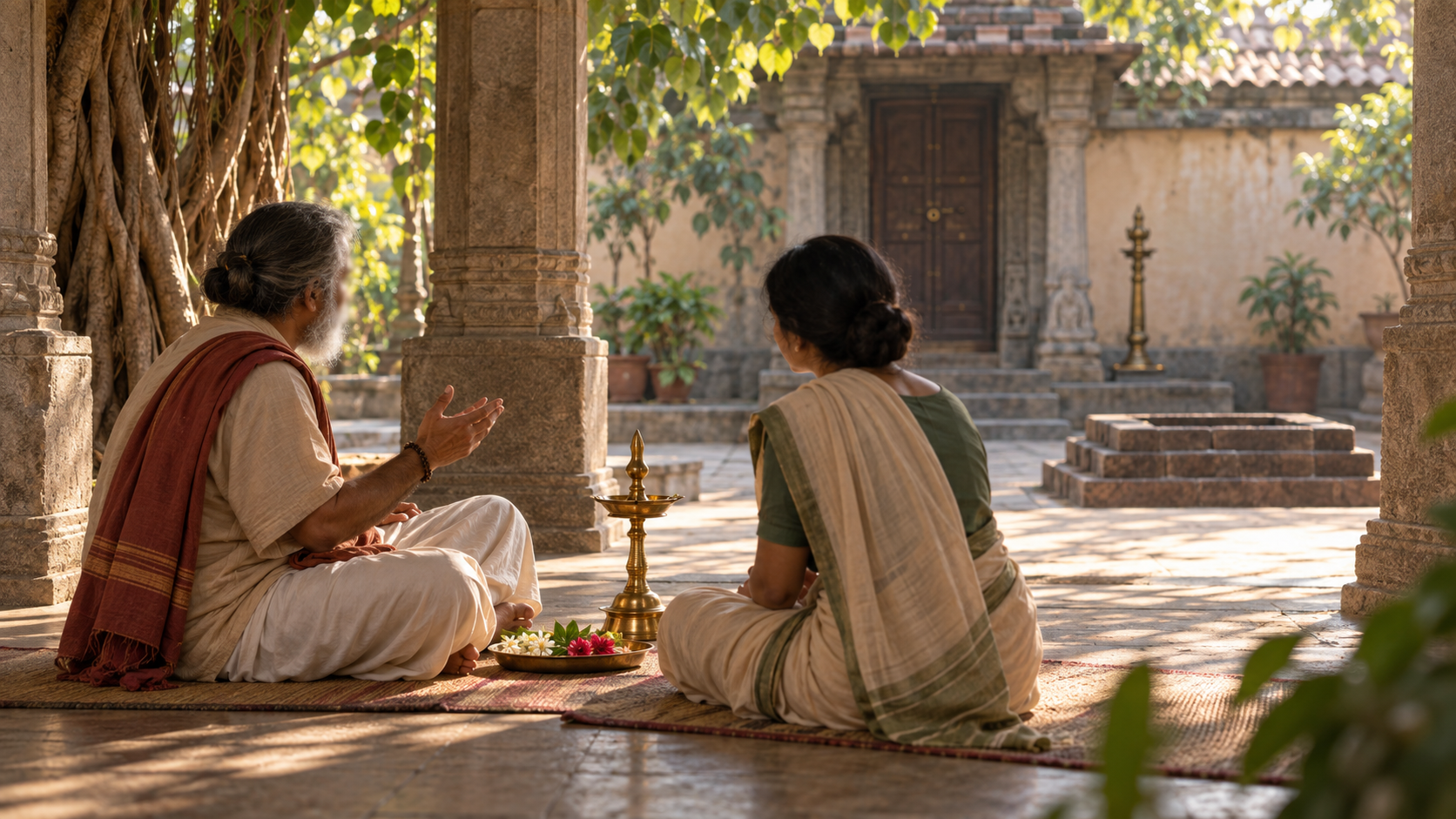
The safest and most fruitful doorway depends on the authority and instruction you actually have. Curiosity, devotion and formal preparation are all legitimate starting conditions, but they do not grant the same ritual role.
- Name your present position. Are you trying to understand Srividya, establish ordinary devotion to Devi, find a teacher, or carry out a practice you have already received? Do not answer with the status you hope to possess.
- Match the action to that position. A curious reader can study public philosophy and attend public worship. A devotee can deepen simple, non-secret worship. A formally instructed practitioner should work within the received sequence.
- Verify the teacher and context. Ask which lineage is represented, which elements are public, which require preparation and what obligations follow instruction. A responsible teacher should be able to distinguish devotion open to everyone from a formal practice given under specific conditions.
- Establish inward steadiness. Keep a regular period for attention, prayer and examination of conduct. If you cannot sustain a simple commitment without constantly replacing it, collecting more elaborate rites will magnify distraction rather than resolve it.
- Enter homa through the correct role. Attend and observe before assuming you can officiate. When invited to participate, ask exactly when and how offerings are made.
- Carry the offering beyond the ritual. After worship, identify the next duty affected by what you offered: an apology, a restrained response, an obligation completed or a habit no longer defended.
Be cautious when secrecy is used to prevent reasonable questions about lineage, safety, money or personal boundaries. Some teachings may properly remain restricted, but restriction does not require blind acceptance of avoidable risk. Promises of instant powers, pressure to collect initiations and contempt for ordinary ethical duties are reasons to disengage.
Also resist the opposite mistake: treating all boundaries as superstition and every ritual detail as freely interchangeable. Respect for transmission is not passive obedience. It is recognition that a living practice has relationships, responsibilities and an order that cannot be recovered from a list of ingredients alone.
Key takeaways
- Inner worship approaches the body as a shrine and consciousness as the light by which intention becomes visible.
- Homa gives offering a physical and disciplined form; it is more than lighting a devotional fire.
- Inner attention and outer precision correct different failures. Neither private imagination nor ritual display is enough by itself.
- If you have not received formal instruction, stay with public learning, simple devotion and properly led communal worship rather than reconstructing restricted practices.
- If you have received a sequence, follow it without casually mixing methods from other teachers or lineages.
- Any fire rite requires practical precautions, suitable space and compliance with local safety rules.
Your next move can be simple. Write down whether you are seeking understanding, daily devotion or formal sadhana. Then choose the doorway that actually matches that aim: careful study, steady non-secret worship, attendance at a properly conducted homa or a direct conversation with a qualified Srividya teacher.
References
- Hindu Blog — Chitpradeepam Malayalam Shakta Text: Illuminating the Srividya Path Through the Body’s Inner Shrine
- Hindu Blog — Parashurama Kalpasutra Chapter 9 – Homavidhih – Content, Teachings And Importance
