
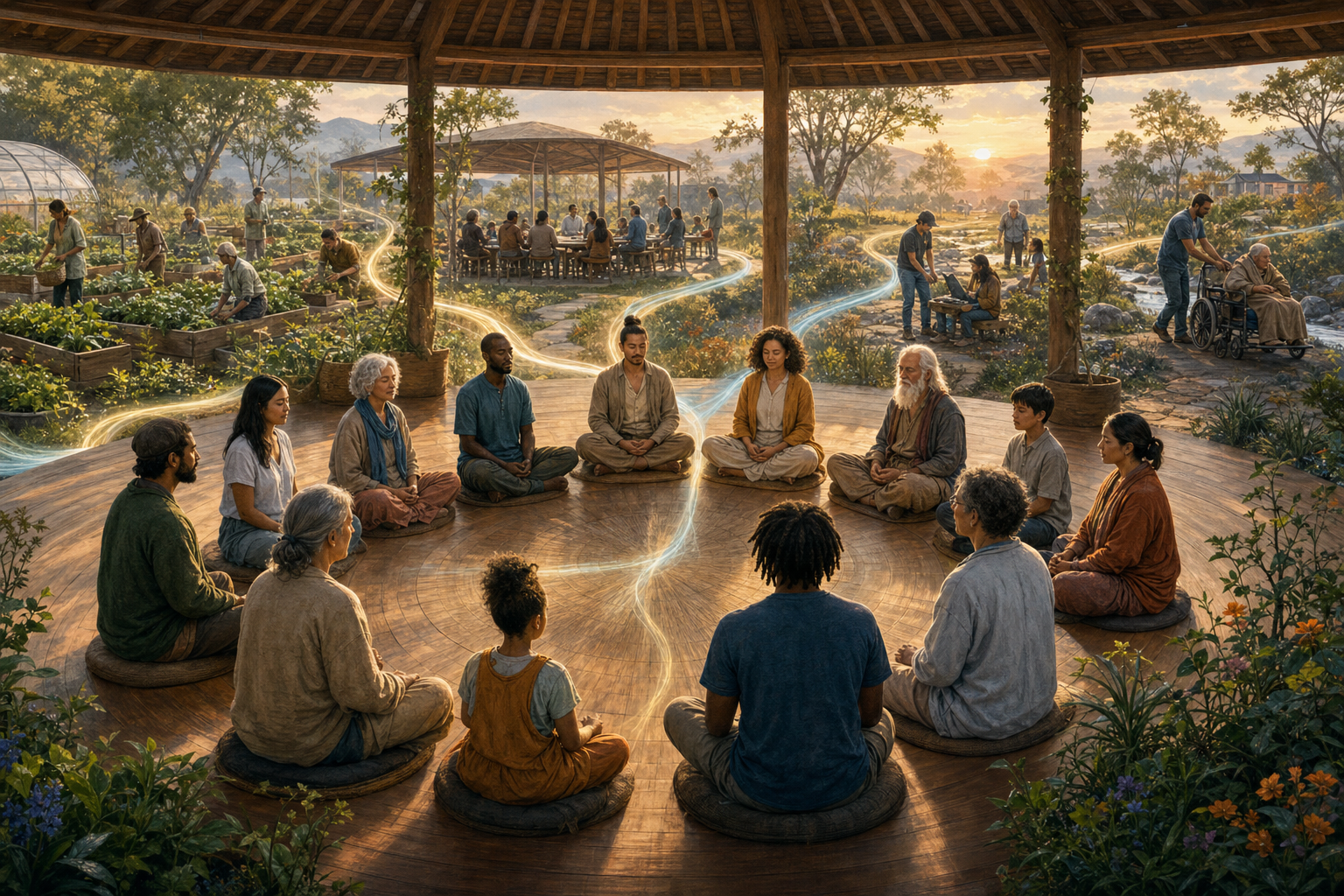
Qapel’s proposal for collective awakening asks a sharper question than whether people can meditate together: can realization become a shared capacity expressed through relationships, community culture, institutions, and service? Read together, the source articles present collective awakening not as a synchronized mystical state, but as the integration of contemplative insight with psychological maturity, differentiated cooperation, and responsibility for the larger world.
This synthesis connects four strands of that vision: Qapel’s proposed Fifth Turning of the Wheel of Dharma, the living-systems metaphor of human beings as conscious cells, the testing ground of sangha, and the transition from a teacher’s personal influence to a community’s embodied legacy.
Collective awakening changes the unit of practice
Traditional spiritual language often places the individual seeker at the center: a person suffers, practices, gains insight, and becomes freer. Qapel’s integral vision retains that work but situates it within larger fields. A practitioner is also a participant in relationships, organizations, cultures, economies, and ecological systems. Patterns operating at those levels cannot always be transformed by private insight alone.
The clearest image for this shift comes from the article on evolving consciousness and living systems. It compares people in a conscious community to specialized cells in a body. A neuron, liver cell, and immune cell remain different, yet each contributes to an organization larger than itself. Applied socially, the metaphor suggests that mature integration should preserve individuality while reorganizing it around participation and mutual responsibility.
The same article places an important limit on the analogy: biological evolution is not a straight ladder leading inevitably toward a spiritually unified humanity. The cellular image is therefore a heuristic, not proof that society must become a single organism. It is useful insofar as it illuminates cooperation, differentiation, communication, and feedback. Used carelessly, it could obscure boundaries or make conformity sound sacred.
Collective awakening is better understood as a change in the unit of concern, not the replacement of the person by the group. Individual clarity remains indispensable, but its credibility is tested by what happens between people and through the systems they create. As the account of Integral Evolution argues, a path that produces calm individuals while leaving collective structures untouched remains incomplete; activism without inner discipline is vulnerable to reactivity and exhaustion.
The Fifth Turning is an expansion, not a replacement
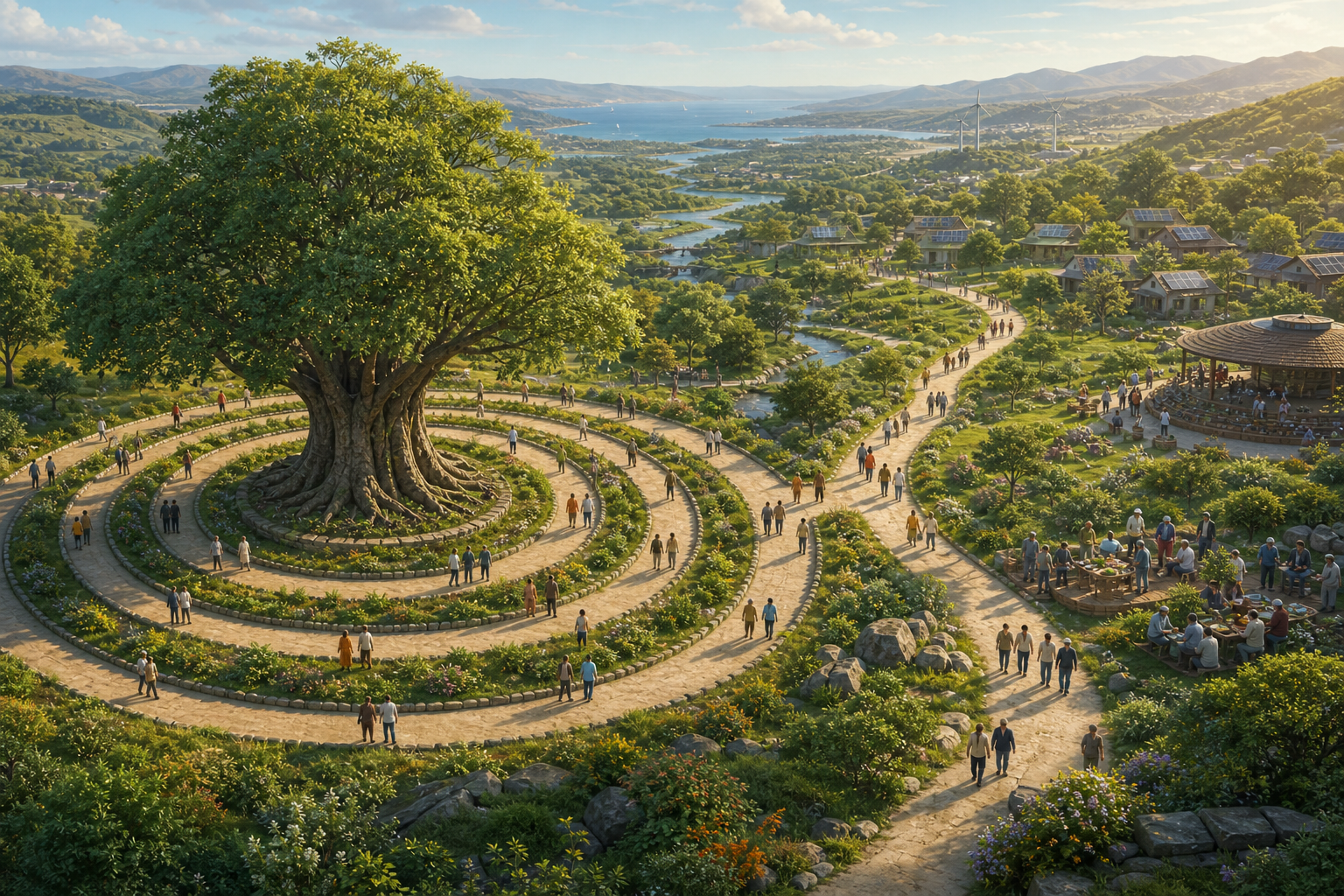
Two source accounts report that Qapel delivered his final public teaching on September 22, 2024, during Clear Sky Meditation Center’s 20th anniversary celebration. The account of that final teaching reports that he died suddenly on October 5, giving the address the character of both a closing statement and a proposal for what should follow. The companion article on the future of Dharma likewise presents the teaching as a map for carrying realization into contemporary life.
Qapel’s outline arranged Buddhist development into four earlier turnings. The first addressed suffering, causation, impermanence, karma, and non-self. The second, associated in his account with Nagarjuna and Mahayana thought, deepened the analysis through emptiness. The third, linked with Asanga, Vasubandhu, and Yogacara, challenged attachment even to emptiness as a final position. The fourth, identified with Tantrayana or Vajrayana, brought form, body, symbol, energy, and ritual imagination back into the field of awakening.
The governing principle was cumulative rather than dismissive: later developments preserve essential earlier insights while addressing their limits. Qapel’s proposed Fifth Turning should therefore not be mistaken for a claim that classical Buddhism has become obsolete. It asks what additional disciplines are needed when practitioners must navigate trauma, developmental differences, intimate relationships, money, power, institutional governance, ecological pressures, science, and technological change.
This is why the shift in terminology from Integral Spirituality to Integral Evolution matters. Spirituality can be treated as one protected compartment of life. Evolution, as the articles use the term, concerns human development across contemplative, emotional, ethical, relational, intellectual, cultural, and practical dimensions. The Fifth Turning is thus less a new doctrine than an enlarged diagnostic field: it asks where realization has become embodied and where older conditioning still governs behavior.
The framework also contains its own warning. The Integral Evolution article emphasizes that any developmental map can harden into ideology. Its value depends on whether it supports direct experience, better conduct, and compassionate action. Openness to psychology or science is not automatically integral; those resources must illuminate practice without becoming new identities to defend.
Sangha becomes the laboratory and the evidence
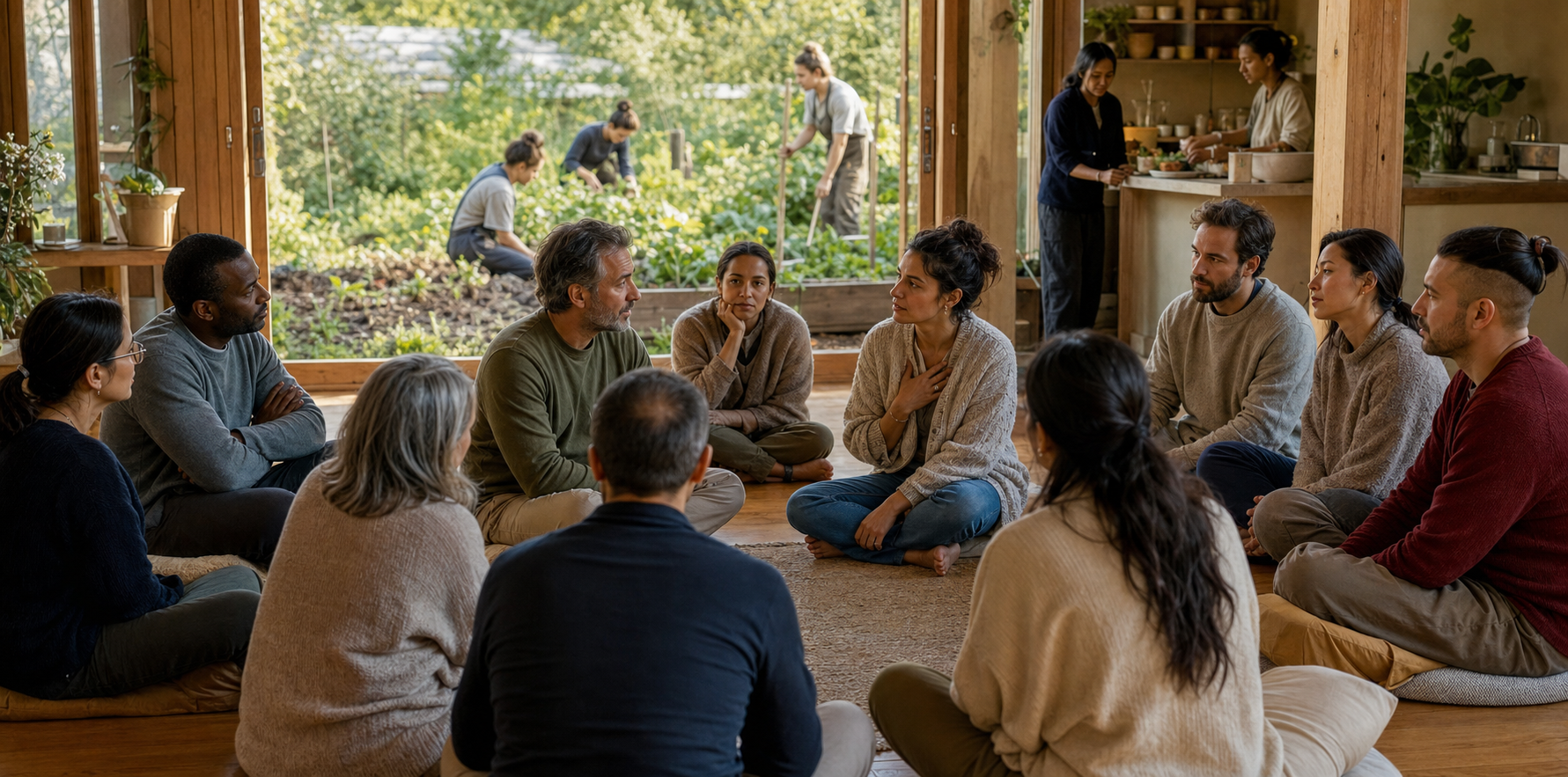
Once awakening is defined across several dimensions, community acquires a more demanding role. Sangha is no longer only the setting in which individuals receive teachings. It becomes a laboratory where communication, authority, labor, conflict, care, and service reveal whether insight survives contact with other people.
The collection of student remembrances, recorded six months after Qapel’s death, describes an environment combining meditation, study, karma yoga, shadow integration, and conscious community. Students remembered philosophical instruction, direct confrontation, humor, tenderness, and ordinary moments. Taken together, those memories portray transmission as more than the delivery of ideas: the teacher-student relationship exposed habitual patterns and made the path concrete within daily life.
Humor is particularly relevant to collective practice. The remembrances suggest that Qapel’s playfulness could interrupt spiritual solemnity and loosen fixed self-images. Candor served a related function by challenging self-deception. Yet such methods depend heavily on context, trust, discernment, and accountability; intensity by itself is not evidence of transformation.
The student stories also reveal the challenge that appears when a root teacher dies. A community must preserve teachings, metabolize grief, reconsider how authority is held, and prevent devotion from becoming nostalgia. This is where a personal legacy either narrows into memory or becomes distributed capacity. Students must learn to embody discernment, service, humor, ethical seriousness, and responsibility rather than merely reproduce a teacher’s style.
The sources provide philosophical interpretation and testimony, not a standardized measurement of community-wide awakening. That distinction matters. A group may sincerely value shadow work and still mishandle conflict; it may praise interdependence while concentrating power; it may celebrate service while neglecting exhaustion or boundaries. Within an integral framework, those discrepancies are not peripheral administrative failures. They are evidence about the actual depth of the practice.
Integral practice must cross four boundaries

The first boundary lies between contemplative realization and human development. The articles repeatedly distinguish waking up from growing up, cleaning up, and showing up. A person may experience genuine insight while remaining reactive, relationally unskilled, or unaware of disowned psychological material. Shadow integration and developmental work do not replace meditation; they address forms of conditioning that meditative attainment may not automatically resolve.
The second boundary separates private spirituality from material life. The future-of-Dharma account uses the final Zen ox-herding image of returning to the marketplace to expose the missing details: how realization functions amid illness, money, leadership, disagreement, family obligations, and cultural change. These are not distractions from awakening. They are the conditions under which its ethical and practical consequences become visible.
The third boundary is between personal freedom and collective coordination. The living-systems metaphor suggests that a healthy whole requires differentiated contributions rather than identical members. Applied to spiritual communities, this means that belonging should not erase judgment, boundaries, creativity, or dissent. Collective intelligence becomes plausible only when participants can communicate information honestly, recognize mistakes, and revise group patterns.
The fourth boundary lies between lineage fidelity and wider inquiry. The source articles connect Qapel’s primarily Buddhist framework with Hindu teachings on dharma, karma yoga, seva, and lokasangraha; Jain commitments to ahimsa and Anekantavada; and Sikh emphases on seva, sangat, remembrance, and responsibility. Their proposed unity does not depend on declaring the traditions metaphysically identical. It rests on differentiated cooperation around disciplined transformation, compassion, truthfulness, restraint, and service.
Crossing these boundaries also clarifies spiritual bypassing. Sacred concepts become evasive when emptiness is used to avoid accountability, compassion to suppress difficult emotions, surrender to excuse unhealthy dependency, or tradition to block needed reform. Integral collective awakening is credible only when spiritual language increases the capacity to face such problems rather than providing a refined vocabulary for escaping them.
Key takeaways
- Qapel’s collective awakening does not eliminate individual practice; it tests personal realization within relationships, communities, institutions, and service.
- The proposed Fifth Turning preserves earlier Buddhist insights while expanding the field of practice to include psychology, development, trauma, ecology, science, and systemic life.
- The metaphor of humans as conscious cells is useful only when integration preserves differentiation, boundaries, and responsible participation.
- Sangha is both a method of transformation and a source of evidence: its handling of power, conflict, work, grief, and accountability reveals what has actually been integrated.
- Qapel’s legacy becomes forward-looking when students and communities embody the functions of his teaching instead of preserving only its language or personality.
The next phase of Qapel’s legacy will be determined less by how often the integral map is repeated than by whether communities can build cultures in which insight, candor, differentiated belonging, and accountable service reinforce one another. If that work remains experimental and self-correcting, collective awakening can function as a discipline rather than a slogan.
References
- DharmaRenaissance Blog – Qapel’s Final Dharma Teaching: A Powerful Map for Collective Awakening
- DharmaRenaissance Blog – Evolving Consciousness and Dharmic Unity: Powerful Lessons from Living Systems
- DharmaRenaissance Blog – Qapel Remembered: Powerful Student Stories on Dharma, Loss, and Living Legacy
- DharmaRenaissance Blog – Integral Evolution: A Powerful Dharmic Map for 21st-Century Awakening
- DharmaRenaissance Blog – Future of Dharma: A Powerful Integral Map for Collective Spiritual Awakening