

You stand before an image of Parashurama, and the axe commands your attention. Is this a celebration of anger, a warning against injustice, or an instruction about when strength becomes righteous?
The answer lies in reading the entire form, not isolating the weapon. Parashurama’s ascetic appearance places a condition upon his martial power: before you confront disorder outside yourself, you must bring motive, emotion, and ego under discipline. That is what makes the warrior-sage useful when you face a difficult boundary, a public wrong, or a decision carrying real consequences.
The image must be read as a whole
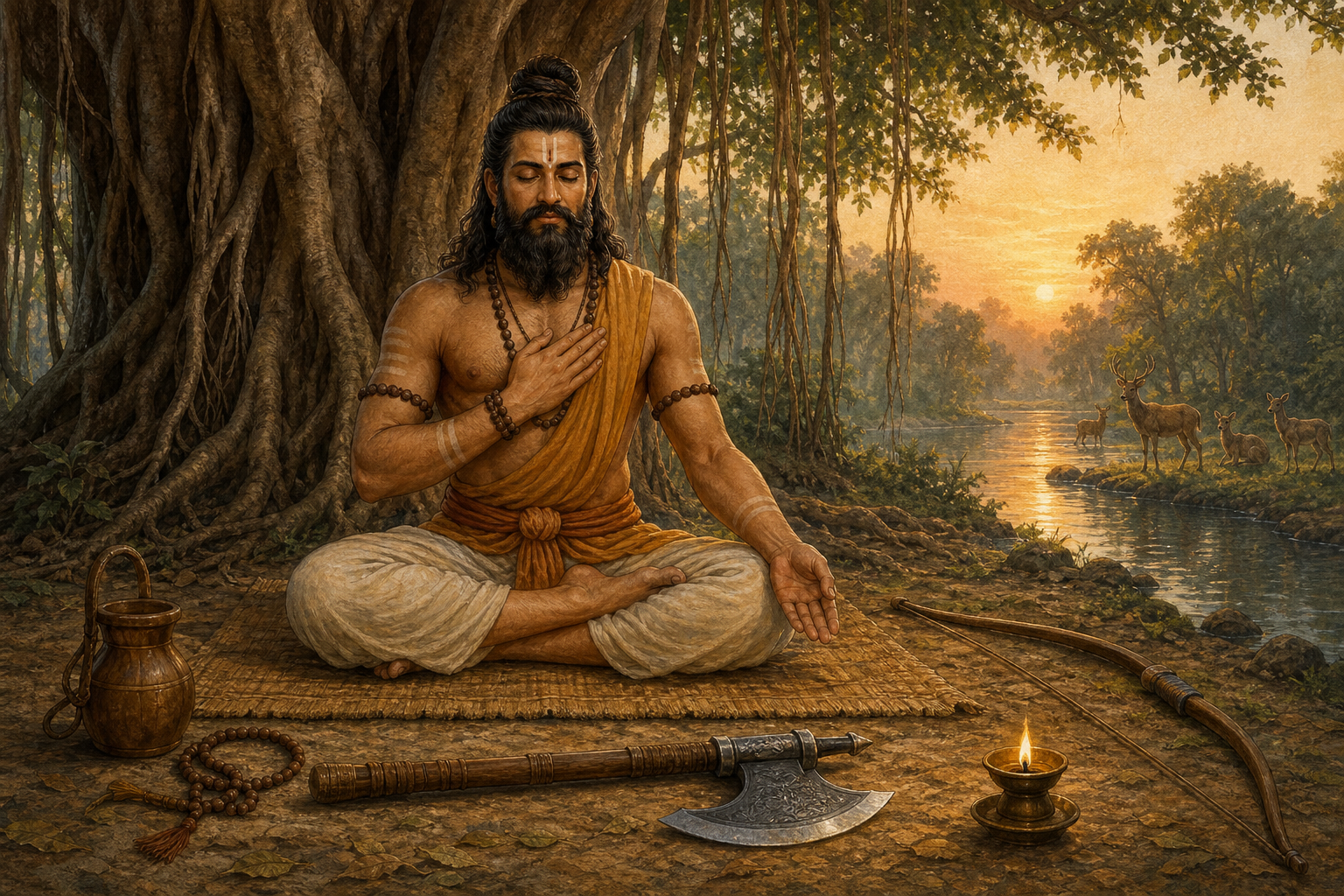
Parashurama is revered as the sixth avatar of Vishnu, yet his iconography deliberately joins social and spiritual roles that are easy to separate in ordinary thinking. The sacred thread and ascetic markers point toward Brahmin learning, austerity, and inward discipline. The powerful body and weapons express kshatra: the capacity to defend, restrain disorder, and accept responsibility for difficult action.
This is not a compromise between half a sage and half a warrior. It is a hierarchy. Tapas, or disciplined self-mastery, must govern kshatra, or protective strength. Knowledge that never acts can abandon what it knows to be right. Strength that refuses the rule of wisdom can become another form of adharma.
When you examine a murti or painting, sort what you see into three groups:
- Markers of inward rule: jata, simple clothing, sacred thread, and an expression of composure.
- Markers of protective capacity: the parashu, a bow and arrows where present, a firm stance, and physical readiness.
- Markers of the purpose of power: Vaishnava signs, protective or generous mudras, and a posture that reassures rather than intimidates the protected.
Not every representation contains every feature. Mudras and secondary weapons vary, and regional settings may add another layer. Read the relationship among the elements rather than turning one detail into the whole meaning.
The axe cuts, but it also clears
The parashu gives Parashurama both his name and his most immediate visual identity. At the inner level, its edge represents the clarity required to sever ahankara, confusion, destructive attachment, and repeated patterns of harm. At the social level, it signals decisive resistance to injustice.
Yet an axe is also a working implement associated with clearing and cultivation. That practical character changes the symbolism. The worthy question is not merely, “What must be struck?” It is also, “What must be made fit for life after the obstruction is removed?” Protection that leaves nothing capable of flourishing has misunderstood its own purpose.
Use this distinction when you contemplate the parashu. Name one pattern that must end, then name the good that ending it is meant to protect. If you can identify an enemy but cannot identify a protected good, indignation may be driving you more than dharma.
The bow represents readiness without haste
When a bow and arrows accompany the axe, they add concentration, vigilance, and controlled readiness. An arrow cannot be recalled after release. Its straight path therefore makes a sharp ethical demand: establish the aim before committing to action.
In practical terms, readiness is not the same as eagerness. You can prepare evidence, clarify a boundary, organize support, or strengthen a community without seeking confrontation. The warrior-sage does not wait until a crisis to become capable, but capability does not create a duty to use every power available.
The face and hands tell you who the strength serves
A fierce expression can convey resolve, but the figure’s steadiness keeps resolve from becoming rage. The significant contrast is not fierceness versus softness. It is purposeful intensity versus uncontrolled hostility.
Abhaya and varada gestures make this especially clear. Abhaya assures protection; varada conveys generosity or the granting of a boon. When either appears beside a weapon, the combination teaches that power has two audiences. It confronts what causes harm while reassuring those whom it exists to protect.
Regional imagery can extend the same lesson from the individual body to the land. Associations with Parashurama Kshetra along the Konkan and Kerala coasts, including traditions of land reclaimed from the sea, may appear through shorelines, forests, or mountain horizons. These settings should be approached as sacred geography and cultural memory, not treated as scenery without meaning. They connect authority with stewardship of a place and the communities rooted in it.
The warrior-sage gives you an ethical test for power
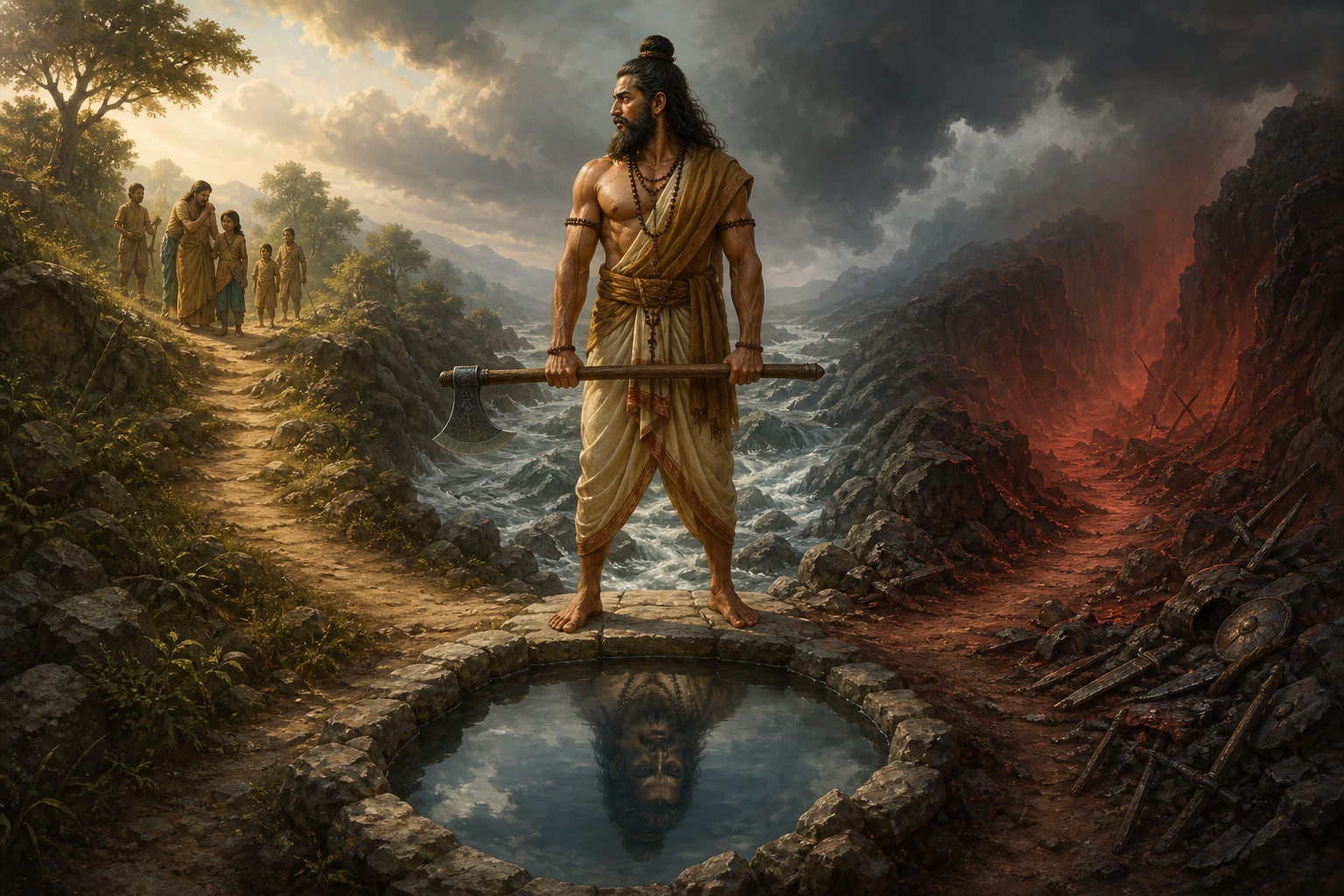
Calling an action dharmic does not make it so. Anger can borrow sacred language, and revenge can disguise itself as protection. Parashurama’s combined ascetic and martial signs give you a practical way to test a consequential action before taking it.
- Name what you are protecting. State the good in concrete terms: a person’s safety, truthful public memory, the integrity of a temple, fair treatment, freedom to practise, or a community’s ability to live without intimidation. “Defeating them” is not a protected good.
- Identify what must be cut within you. Look for humiliation, vanity, the desire to dominate, group hatred, or the pleasure of retaliation. The parashu points inward before it points outward.
- Distinguish discomfort from danger. An insult, a false claim, institutional misconduct, and an immediate threat do not call for the same response. Treating every offence as an emergency destroys proportionality.
- Choose the least harmful effective response. Correction, documentation, a firm boundary, withdrawal of cooperation, due process, or lawful collective advocacy may protect the good without escalation. Force is not made righteous merely because restraint feels unsatisfying.
- Define the stopping point. Decide what repair, accountability, or restored boundary would bring the intervention to an end. A campaign without a stopping condition can continue long after protection has turned into punishment.
- Accept review after acting. Ask whether your conduct actually protected the stated good, whether avoidable harm occurred, and what restitution is owed. Accountability is part of strength, not an admission that strength was unnecessary.
This test does not turn iconography into a mechanical rulebook. It keeps the central moral order visible: restraint governs capacity, capacity serves protection, and protection aims at restored conditions for life, learning, livelihood, and spiritual practice.
Nothing in this symbolism grants private permission for violence. If a situation involves an immediate threat, prioritize safety and appropriate lawful assistance. If it involves wrongdoing that requires judgment, use competent institutions and fair process. A sacred archetype can examine your motive; it cannot replace evidence, law, or accountability.
Use the symbolism without turning every dispute into a battle
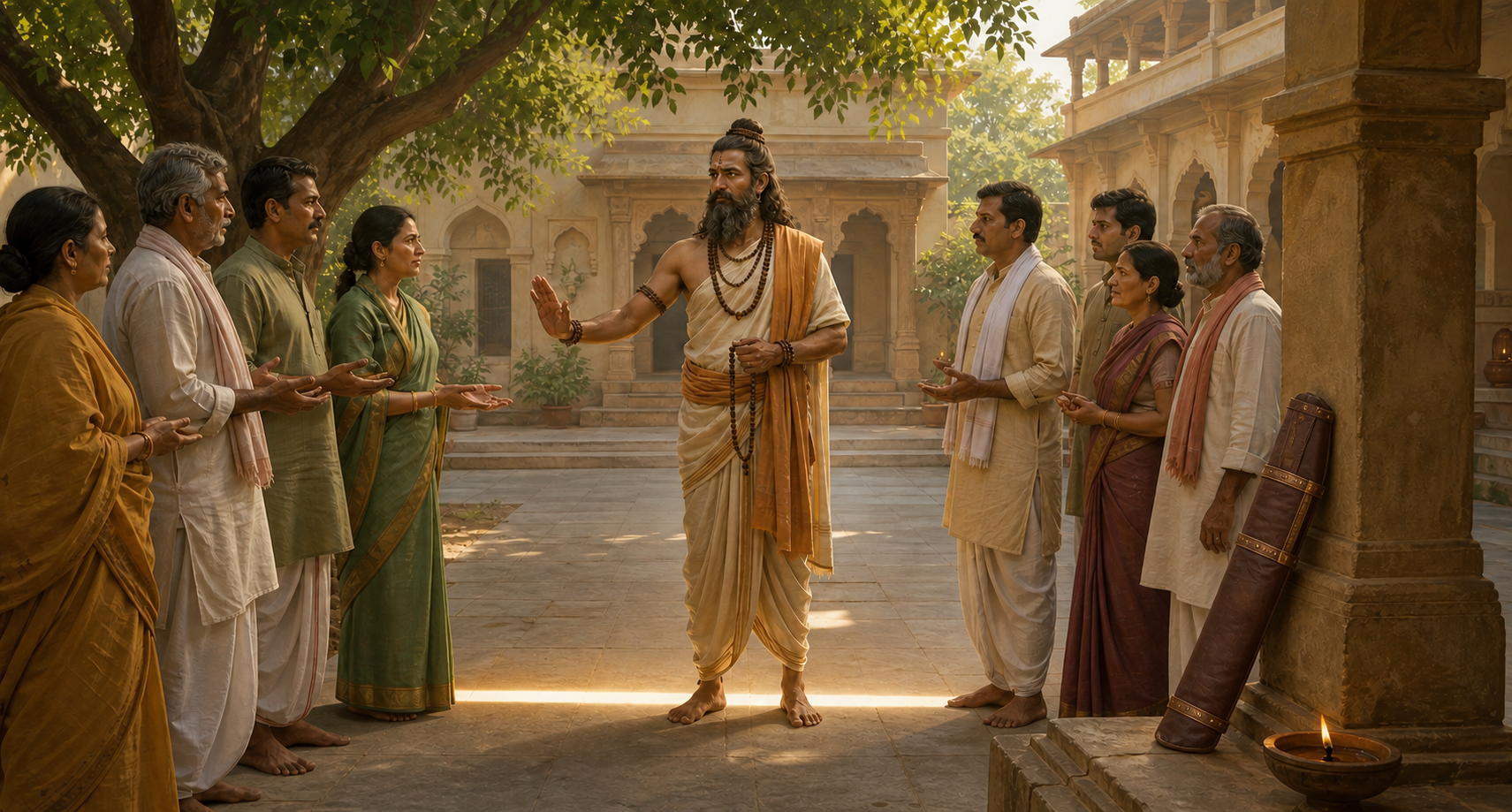
Most encounters with this archetype will not concern physical combat. The discipline becomes more useful when translated into ordinary decisions, where ego and duty are often harder to separate.
In a personal conflict
Do not begin by deciding how to defeat the other person. Begin by identifying the boundary that permits a relationship, workplace, or household to remain just. State that boundary plainly, describe the consequence you control, and avoid threats you cannot or should not carry out.
Here the parashu may mean ending a recurring pattern rather than attacking a person. You might refuse abusive communication, stop participating in a dishonest arrangement, or leave a conversation until it can continue without contempt. The bow’s lesson is to prepare the words before the moment of tension, so anger does not choose them for you.
In cultural or community advocacy
Protecting Dharmic institutions requires courage, but it also requires accuracy. Verify the claim you intend to challenge. Preserve records. Separate criticism of conduct from contempt for a population. Ask for a remedy proportionate to the wrong. These habits are the public form of tapas because they deny anger the power to edit facts.
Online provocation is a particularly revealing test. A corrective statement, documented complaint, refusal to amplify abuse, or organized lawful response may serve dharma. Harassment, rumor, threats, and collective blame do not become protective because they are performed in the name of Hindu dignity. They reproduce the disorder they claim to oppose.
In leadership
A leader should be capable of decisive action without making personal fierceness the culture of the group. Pair every power with a visible assurance: a rule with an appeal process, discipline with a path to restoration, security with protection for the innocent, and authority with an account of how it will be reviewed.
This is the organizational meaning of weapon and abhaya appearing together. The people protected by authority should experience greater steadiness, not merely witness a dramatic display of power.
In spiritual practice
You can use the image as a compact examination of conscience. Look first at the axe and identify what must be severed. Look at the bow and identify where attention has scattered. Look at the ascetic signs and choose what can be simplified. Look at the stance and notice whether your body is settled enough for a serious decision.
End by turning to the protective gesture or purpose of the form. Ask who becomes safer, freer, or more able to pursue dharma if you act well. This last question prevents self-discipline from shrinking into a private project. In the warrior-sage ideal, inward mastery and responsibility for the world belong to one practice.
A shared Dharmic pattern does not erase real differences

Parashurama belongs to a specifically Hindu and Vaishnava framework, but the moral ordering of strength has recognizable resonances across the Dharmic family. Buddhist traditions value vigilance directed toward the mind. Jain dharma gives self-mastery and ahimsa a defining place. Sikh tradition articulates the sant-sipahi, the saint-soldier whose courage remains accountable to spiritual discipline.
These are not interchangeable doctrines, and you do them no service by flattening their different teachings into a generic spirituality. The productive comparison is narrower: each challenges the idea that courage is merely aggression, and each refuses to treat mastery over others as a substitute for mastery over oneself.
When discussing Parashurama with Buddhists, Jains, Sikhs, or Hindus of different sampradayas, begin with the ethical question rather than a claim of sameness: what must govern power so that it serves life and spiritual freedom? That approach creates room for genuine agreement, honest difference, and mutual correction.
It also clarifies the relation between ahimsa and protection. The warrior-sage symbolism does not mock restraint as weakness, nor does it use restraint as an excuse for indifference. It asks you to preserve compassion while becoming capable of opposing what destroys the conditions in which compassion, learning, worship, and plural paths toward liberation can survive.
Key takeaways
- Read Parashurama’s weapon together with his ascetic markers. His strength is meaningful because it is placed under inward discipline.
- Let the parashu ask two questions: what harmful pattern must be cut, and what living good will that clearing protect?
- Let the bow remind you that preparation and vigilance do not require impulsive action.
- Test any claimed defence of dharma by its motive, proportionality, lawful means, accountability, and capacity to restore order.
- Treat abhaya and varada as measures of authority: rightful strength should reassure the protected and make constructive life possible.
- Use parallels with Buddhist, Jain, and Sikh ethics to begin dialogue, not to erase the traditions’ distinct teachings.
The next time you encounter Parashurama, do not stop at the question, “How formidable is this figure?” Ask instead, “What governs this strength, what does it protect, and when does it stop?” Then carry those questions into your next consequential decision. That is where the warrior-sage ceases to be a distant image and becomes a discipline of dharmic action.
References
