
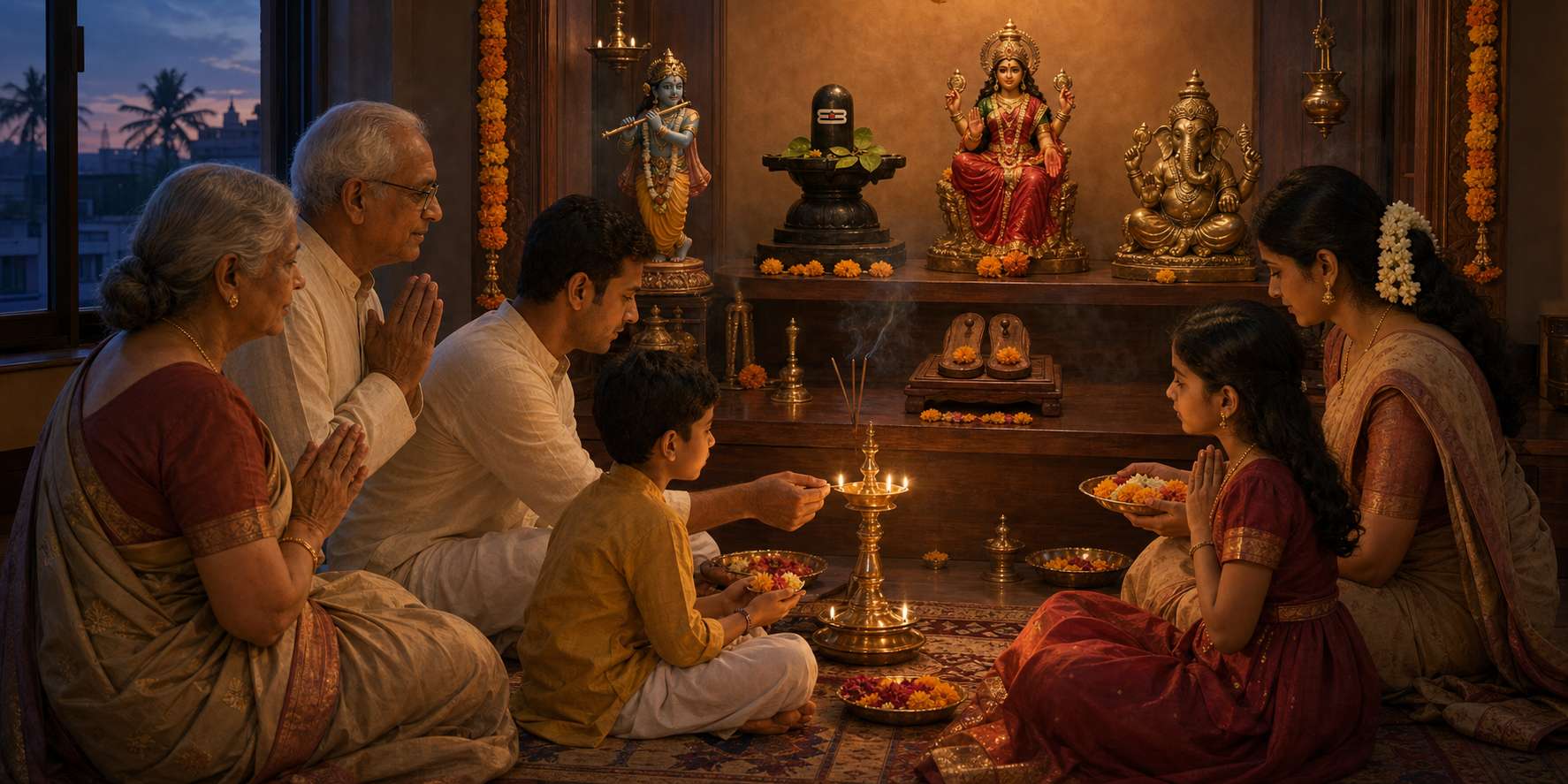
Your family shrine may hold Krishna beside Shiva, Devi beside Ganesha, and a photograph from the guru-parampara. Then a child, spouse, or visitor asks the question adults often dodge: If the Divine is one, why do we worship so many forms, and if one form is supreme, what becomes of the others?
You don’t have to choose between rivalry and a vague claim that every form is interchangeable. Hindu unity becomes workable when you keep four things in their proper places: shared dharma, a serious personal practice, inherited family relationships, and respect for genuine differences among sampradayas.
Unity begins with a theological grammar, not a winner
The Rig Veda’s insight that reality is one while sages speak of it through many names supplies an important grammar for Hindu plurality. It does not reduce the devas to aliases with no character of their own. It tells you that plurality need not mean a universe divided among unrelated divine powers.
The distinction between nirguna Brahman and saguna Brahman helps explain why. Nirguna points to the Absolute beyond limiting attributes. Saguna refers to the Divine encountered through qualities, names, forms, relationships, and sacred narratives. The distinction is not between a real formless God and false divine images. It describes different ways the mind, heart, and disciplined practitioner approach what cannot be exhausted by any single concept.
The Bhagavad Gita treats contemplation of the unmanifest as profound but difficult, while presenting devotion to the manifest Lord as a direct and accessible discipline. It also affirms that the Divine meets devotees through their chosen approaches. This is why a beloved form can concentrate devotion without placing an absolute boundary around the Divine.
Hindu schools do not explain this relationship identically. Advaita Vedanta emphasizes non-duality. Vishishtadvaita and Dvaita describe other real relationships among the Supreme, individual selves, and the world. Vaishnava, Shaiva, and Shakta sampradayas may each make strong claims about the supremacy of their adored form. Those differences should be understood, not erased with the slogan that everything is simply the same.
A form also does practical work. Nama gives the mind something to remember. Rupa gives the senses a focus. Sacred narrative gives moral imagination a pattern. Ritual trains attention, gratitude, surrender, and responsibility. Even the Vedas can be represented as Veda Murtis, where sacred sound becomes visible without ceasing to be something that must be heard and studied. Form, in this setting, is a disciplined doorway rather than a claim that the Infinite fits inside an object.
When you encounter an unfamiliar devata, replace the ranking question with three better questions:
- What relationship is expressed here? The form may be approached as mother, teacher, protector, sovereign, child, friend, or the indwelling Lord.
- What discipline does this worship cultivate? Look for the vrata, mantra, festival, ethical duty, or form of seva connected with it.
- What tradition gives the practice its meaning? A murti should be understood through its temple, lineage, Agamic discipline, family history, or sampradaya rather than through appearance alone.
These questions let you recognize difference without turning difference into hostility.
Ishta-devata and kuldevi answer different spiritual needs
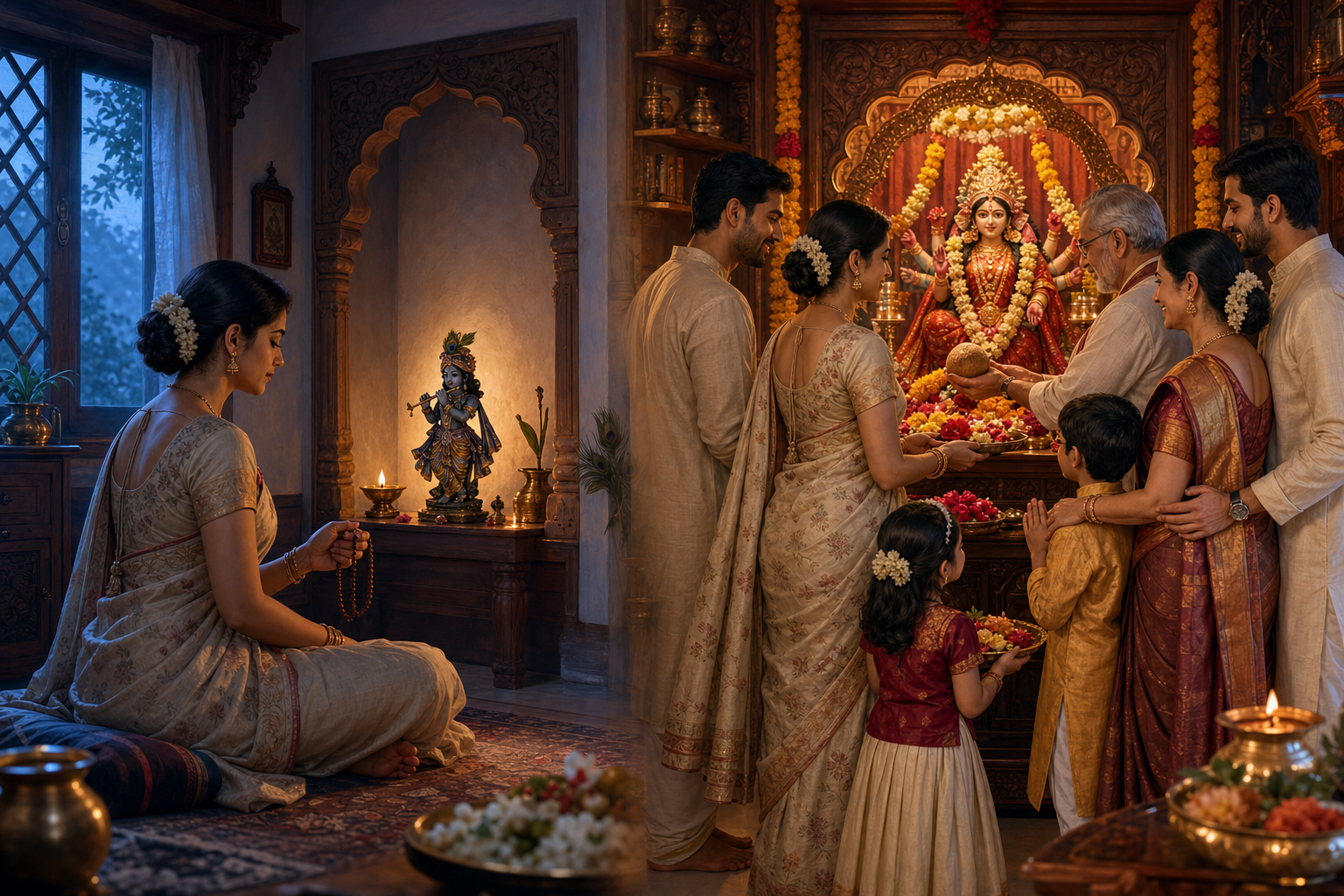
Your Ishta-devata is the form through whom sustained personal devotion becomes intimate and steady. This is not a deity selected for novelty and replaced whenever another image becomes attractive. Ishta makes depth possible: one name returns to your lips, one form steadies meditation, and one body of teaching gradually shapes your conduct.
A kuldevi or kuladevata belongs to another kind of relationship. The connection is inherited through family or community memory. It carries gratitude, guardianship, vows, rites of passage, and a sense that your life did not begin with your individual preferences. Your Ishta may express where your heart concentrates; your kuladevata remembers where your family stands in a longer chain of belonging.
Maa Modheshwari, for example, is revered as kuldevi among Modh Brahmin, Modh Vaishya, and Modh Kshatriya lineages. Community practice connects Her darshan with Navratri, weddings, thread ceremonies, housewarmings, and the beginning of business activity. The tradition is sustained through pilgrimage, oral memory, vows, prasad, and intergenerational teaching. It shows why kuldevi worship is a living family obligation rather than a decorative ancestry label.
The sacred landscape at Modhera also holds both Shakti devotion and the solar symbolism of the historic Sun Temple. Their proximity offers a useful lesson: the presence of one divine form does not require the cultural disappearance of another. Distinct sacred relationships can inhabit the same geography and strengthen the same community.
If your household contains several devotional inheritances, make a simple family map before changing the shrine or ritual routine:
- Lineage relationship: Record the exact name and location of the kuldevi or kuladevata, the side of the family through which the relationship comes, and the elder or community custodian who can explain it.
- Personal axis: Identify each person’s Ishta-devata and the practice actually followed, not merely the image each person likes.
- Sampradaya relationship: Note any guru-parampara, temple tradition, vrata, initiation, or inherited liturgical rule that should not be casually altered.
- Shared household practice: Decide what everyone can sincerely join: a lamp, a familiar public prayer, a common stotra, nama-japa, festival observance, prasad, or seva.
Verify the lineage entry with elders, family records, the relevant temple, or knowledgeable community members. If the information is uncertain, mark it as uncertain. A matching surname or an online claim is not enough reason to invent a kuladevata relationship or undertake a vow.
In a marriage joining different family traditions, don’t assume that one history must erase the other. Ask both families which observances continue after marriage, which visits are expected around major samskaras, and whether any vows already exist. Then establish one manageable household routine while preserving the verified lineage duties. Unity here comes from coordination and honesty, not forced merger.
Build a shared puja without inventing a synthetic religion
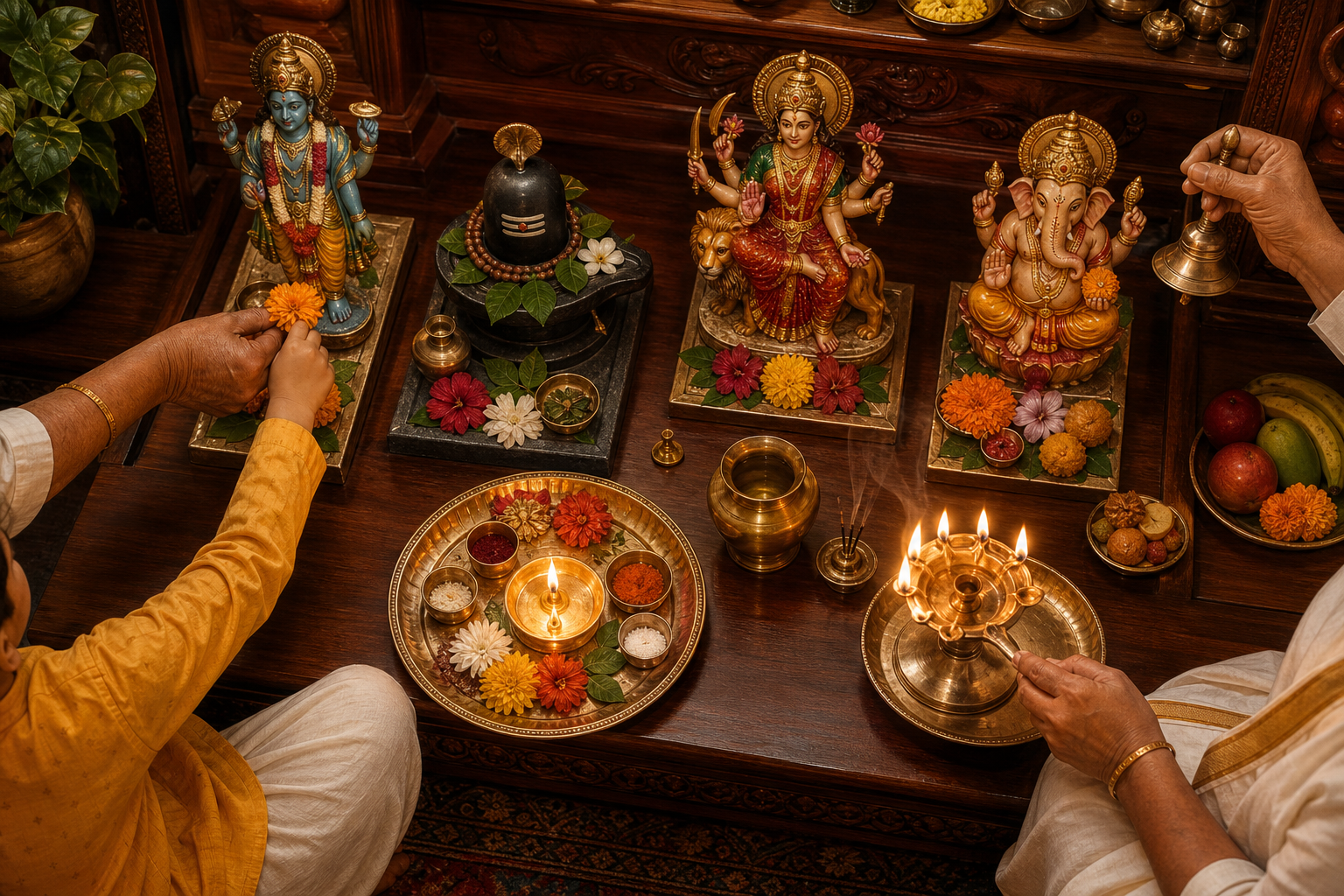
A common family puja does not need to contain every mantra, deity, and festival represented in the household. Trying to include everything usually produces a crowded ritual that nobody understands or maintains. A better routine has a stable center and respectful room around it.
- Begin in the household’s established way. Follow the normal purification, lamp-lighting, achamana, or opening prayer taught in your tradition. If the family has no established routine, begin with quiet attention, Om, and a prayer for the welfare of all beings rather than pretending to perform an initiation-based ritual.
- State a shared sankalpa. Name the purpose in dharmic terms: clarity, truthful conduct, family harmony, courage in difficulty, gratitude, or service. This gives everyone a reason to participate beyond devotional preference.
- Give the central form an intact practice. Use a known name, hymn, or prayer belonging to that form. Don’t create a verbal mixture that changes mantras merely to make every name appear in every line.
- Acknowledge the household’s other sacred relationships. A short namaskara to the kuladevata, guru-parampara, or another family member’s Ishta can express respect without pretending that every person follows the same sadhana.
- Complete worship in shared conduct. Receive prasad respectfully and connect the sankalpa to one real action: help a relative, feed someone, support a temple duty, study together, or correct a conflict without humiliation.
A simple shared prayer can carry the intention without making a new doctrinal formula: May the Divine, adored in our family through these honored forms, make this home truthful, courageous, compassionate, and ready to serve.
Keep consecration distinct from decoration. Prana-pratishtha, nyasa, and formal temple worship have ritual disciplines and qualified custodians. Don’t improvise a consecration because you have acquired a new murti, and don’t casually discard or relocate a form that has been ritually installed. Ask the responsible priest, guru, or temple tradition what is required.
The lesson of Veda Murtis and Vedic recitation is especially useful here: seeing, hearing, studying, and practicing should reinforce one another. If a child knows a deity only by appearance, add the relevant story, name, festival, and expected virtue. If an adult can recite a hymn but routinely insults another family’s devata, the recitation has not yet formed conduct.
Let children participate in one concrete role at a time. They can prepare flowers, learn a short public prayer, listen to the family account of the kuldevi, distribute prasad, or help with the act of service chosen for that observance. This teaches unity as shared responsibility. Merely displaying many images teaches very little.
Handle sampradaya disagreement without erasing conviction
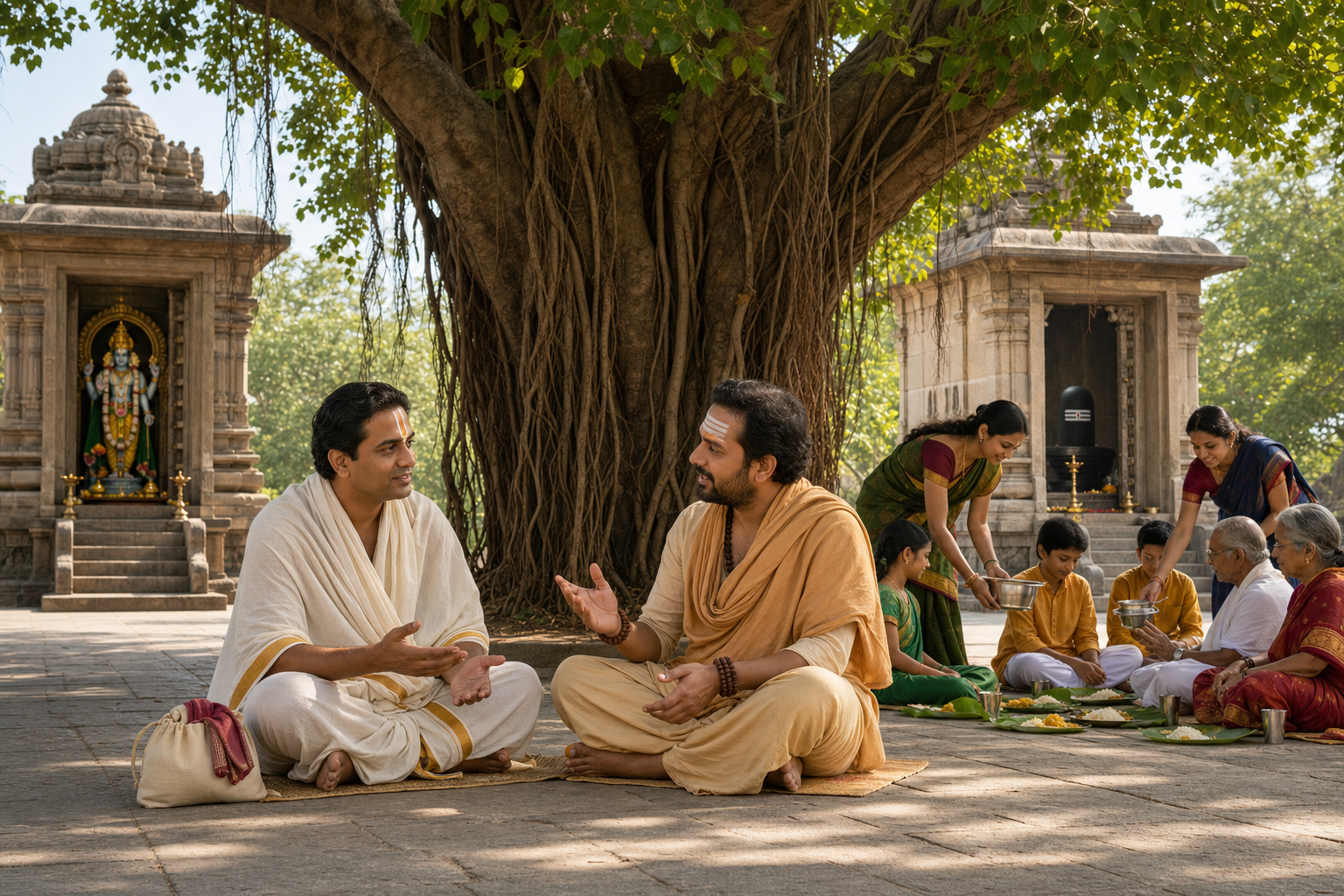
Devotional conviction is not the enemy of Hindu unity. Contempt is. A Vaishnava should not have to dilute Vaishnava siddhanta to respect a Shaiva relative. A Shakta should not have to treat Devi as a poetic afterthought to be accepted at a shared event. At the same time, no claim of doctrinal loyalty gives someone a license to mock another devata, obstruct family worship, or turn every festival meal into a supremacy debate.
When disagreement appears, identify what kind of disagreement it is before answering:
- Preference: One person feels closer to Krishna and another to Shiva. No resolution is required; each needs room for consistent practice.
- Ritual discipline: A lineage follows particular food, purity, mantra, or festival rules. Ask what participants must observe and what only initiated practitioners perform.
- Doctrinal claim: A sampradaya identifies a particular form as Supreme. State the claim precisely as belonging to that siddhanta and discuss it through its recognized teachers and texts.
- Disrespect: Someone ridicules a murti, lineage, community, or practice. Set a behavioral boundary immediately. This is not a sophisticated theological dispute.
Precision lowers the temperature. The wording our sampradaya teaches identifies a real doctrinal home. The wording your worship is false attacks the other person and usually conceals more than it explains. After the claim is stated accurately, ask what conduct follows from it. Hindu practice repeatedly returns realization to discernment, humility, truthfulness, non-harm, devotion, and service. Ethical transformation is the test that keeps pluralism from becoming an empty slogan.
For a temple committee, student association, or community festival, apply the same distinction:
- Name the hosting temple or sampradaya honestly rather than advertising a false neutrality.
- Let each invited tradition present its own hymn or practice with integrity.
- Give unfamiliar participants a short explanation of expected conduct before worship begins.
- Keep doctrinal debate outside the puja sequence unless a discussion has been deliberately organized for that purpose.
- End with something the gathering can genuinely share, such as prasad, a welfare prayer, heritage teaching, or seva.
The same care matters in a wider Dharmic gathering. Hindu, Buddhist, Jain, and Sikh traditions share civilizational patterns around disciplined practice, living wisdom, compassion, guardianship, and sacred sound, but their metaphysical teachings and modes of reverence are not identical. Respect kinship without annexing another tradition’s figures or scripture into a theology its practitioners do not hold.
Key takeaways
- Many divine forms do not require many disconnected ultimate realities, but Hindu schools explain the relationship between the One and the many differently.
- Your Ishta-devata supports personal depth; your kuldevi or kuladevata carries an inherited family relationship. One does not automatically replace the other.
- A shared puja needs a stable center, an honest sankalpa, respectful acknowledgment of other sacred relationships, and conduct that carries worship into daily life.
- Doctrinal conviction can coexist with unity. Ridicule, obstruction, and careless alteration of another tradition’s practice cannot.
- Verify family traditions through elders, community records, temples, and qualified custodians before changing rituals or undertaking vows.
Before your next family festival, fill in the four parts of the family map: lineage deity, personal Ishta, sampradaya commitments, and shared practice. Resolve one uncertainty with an elder or temple, put one neglected observance on the calendar, and choose one act of seva everyone can perform. Hindu unity becomes credible when different forms lead us into dependable duty together.
References
- DharmaRenaissance Blog – Modhera’s Maa Modheshwari: Origins, Kuldevi Traditions, and the Living Shakti Heritage of Gujarat
- DharmaRenaissance Blog – Veda Murtis Demystified: Living Forms that Illuminate Vedic Wisdom, Ritual, and Iconography
- Dandavats – Seeking the Supreme: An Academic Exploration of Hindu Pluralism, Ishta, and One Reality