
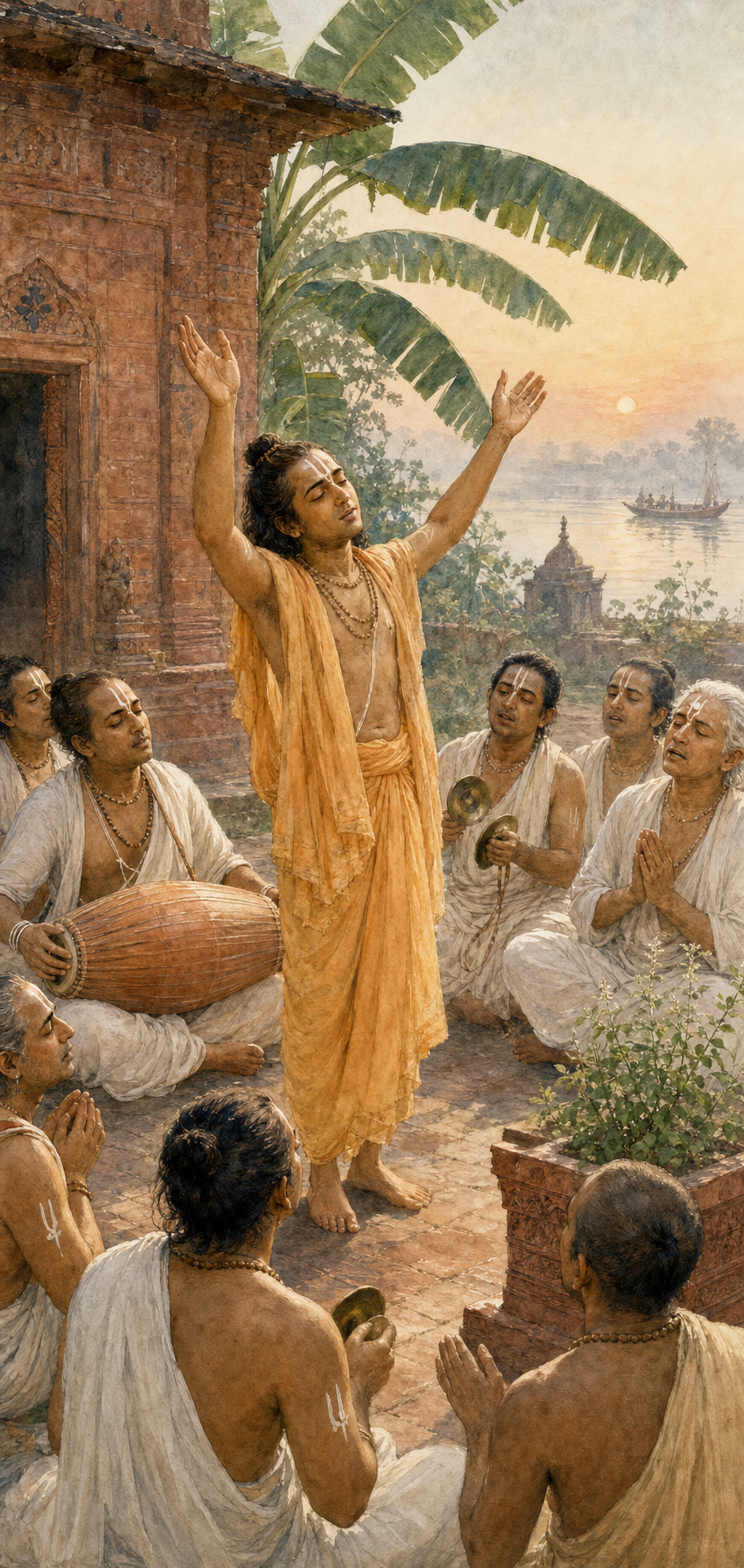
If you have heard mahabhava used for a moving kirtan, an overwhelming moment of prayer, or any unusually intense spiritual feeling, pause before adopting the label. Bengali Vaishnavism gives the word a far narrower meaning: it points to the unsurpassed height of emotional devotion to God, not simply to a powerful mood.
That distinction changes how you should read devotional lives, understand emotional worship, and speak about your own experiences. Mahabhava is most useful when it deepens humility and discrimination. It becomes misleading when it is reduced to religious excitement or treated as a spiritual status you can award yourself.
A technical term, not a synonym for intense feeling

The simplest translation of mahabhava is great emotion. That translation is a starting point, but English can make it sound more ordinary than it is. A person can feel great emotion at a wedding, a funeral, a performance, or a religious festival. Mahabhava belongs to a specific devotional vocabulary and cannot be identified merely by measuring how strongly someone seems to feel.
Bhava ordinarily indicates devotional feeling or joy. The addition of maha does not merely turn up the emotional volume. Within Bengali Vaishnavism, mahabhava names the pinnacle of that devotional reality. A pinnacle has meaning precisely because it is not interchangeable with every sincere experience below it.
Three distinctions will keep your understanding clear:
- Strong feeling is an experience; mahabhava is a technical theological category.
- An emotional episode may arise and pass quickly; the word mahabhava points to devotion at its supreme height.
- Outward expression can accompany sincere devotion, but expression alone does not establish the inward condition.
This is why the safest question is not, “Was that person emotional enough?” Ask instead, “How is this term being used within its own devotional tradition?” That shift prevents you from mistaking intensity for attainment.
Chaitanya’s setting determines how the word should be read
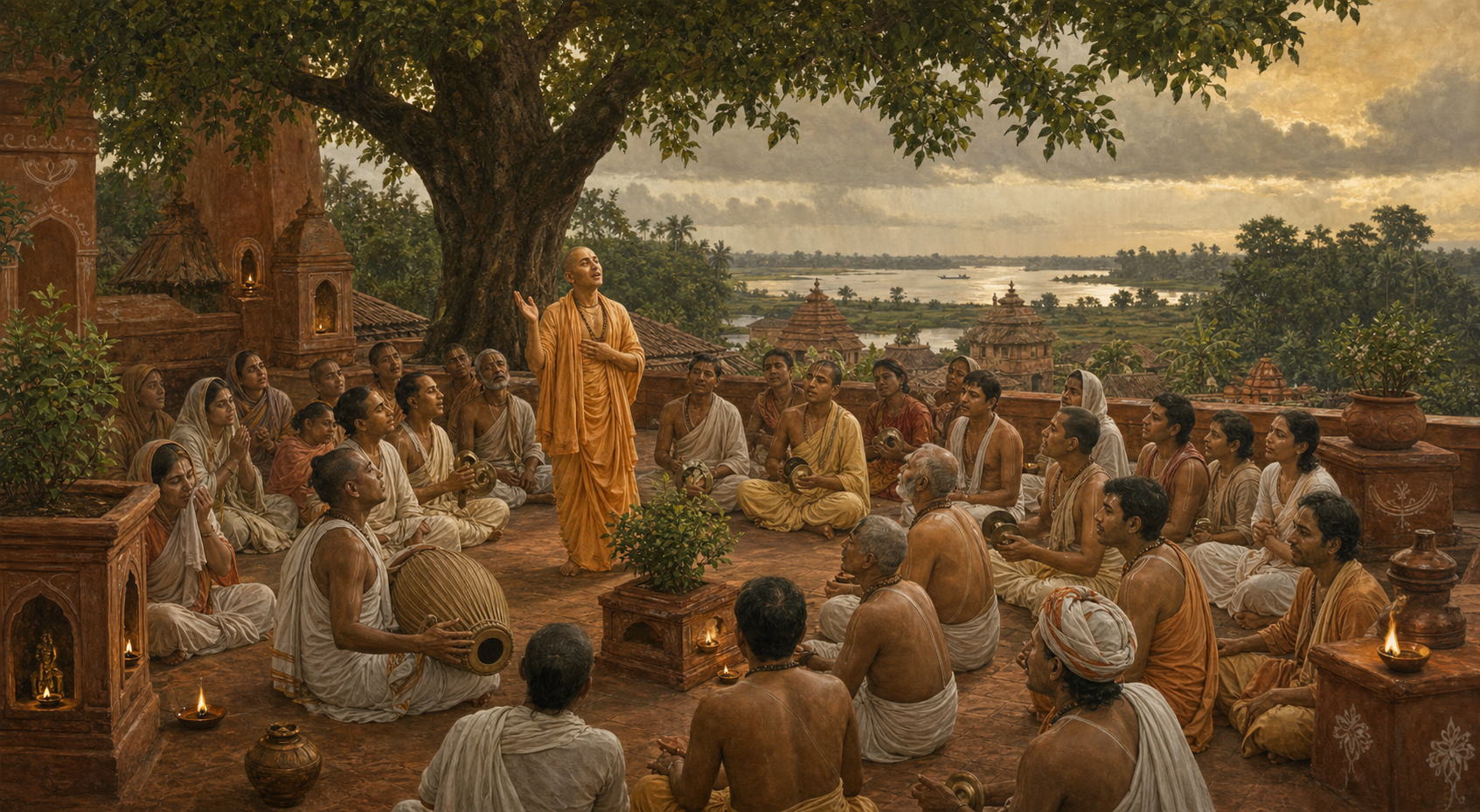
Mahabhava acquired its special technical significance in the Bengal school of Vaishnavism nurtured by Sri Krishna Chaitanya, who lived from 1485 to 1533 CE, and by his disciples. The historical setting matters because a technical word carries the meaning given to it by the tradition that developed and preserved it.
You therefore lose something essential when you detach mahabhava from Chaitanya’s devotional world and use it as a decorative Sanskrit term for being deeply moved. The word is not just praise for emotional temperament. It expresses a theological conviction: love of God can possess heights and depths that ordinary emotional language does not adequately describe.
Two opposite misreadings commonly follow. The first turns mahabhava into an abstract idea to be defined but never allowed to challenge the heart. The second turns it into unrestricted emotionalism, as though the strongest visible reaction must represent the greatest devotion. Neither reading respects the term. Bengali Vaishnavism uses emotional language seriously, but seriousness requires precision.
When you encounter mahabhava in a discourse, translation, or devotional biography, keep the full expression Bengali Vaishnava mahabhava in mind. Do not assume that every use of bhava elsewhere in Hindu thought belongs to the same technical hierarchy. Shared vocabulary does not always mean identical doctrine.
How to recognize careless uses of mahabhava
You do not need to judge another devotee’s inner life to notice when the word is being used carelessly. Look at the logic of the claim rather than trying to inspect a state that only the person and God can know fully.
- Intensity is treated as proof. Crying, singing forcefully, or becoming absorbed may be meaningful, but no visible response by itself proves the highest state of devotion.
- A temporary event is converted into a permanent rank. A profound moment can be honoured without turning it into a declaration of supreme attainment.
- Imitation is confused with realization. Reproducing the mannerisms associated with an exalted devotee cannot manufacture the devotee’s inward condition.
- The term becomes self-advertisement. A vocabulary intended to describe the summit of devotion is distorted when it is used to establish personal importance.
- People are ranked from a distance. Quietness does not prove spiritual poverty, just as dramatic expression does not prove mahabhava.
A precise correction need not be hostile. You can say that the experience appears devotional or deeply moving while reserving mahabhava for its technical meaning. This lets you honour sincere feeling without claiming knowledge you do not possess.
Apply the same restraint to your own inner life. If prayer or kirtan moves you intensely, receive the experience gratefully. Do not rush to classify it. The pressure to name an experience can pull your attention away from God and toward an image of yourself as an advanced devotee.
How a sincere seeker can approach the teaching
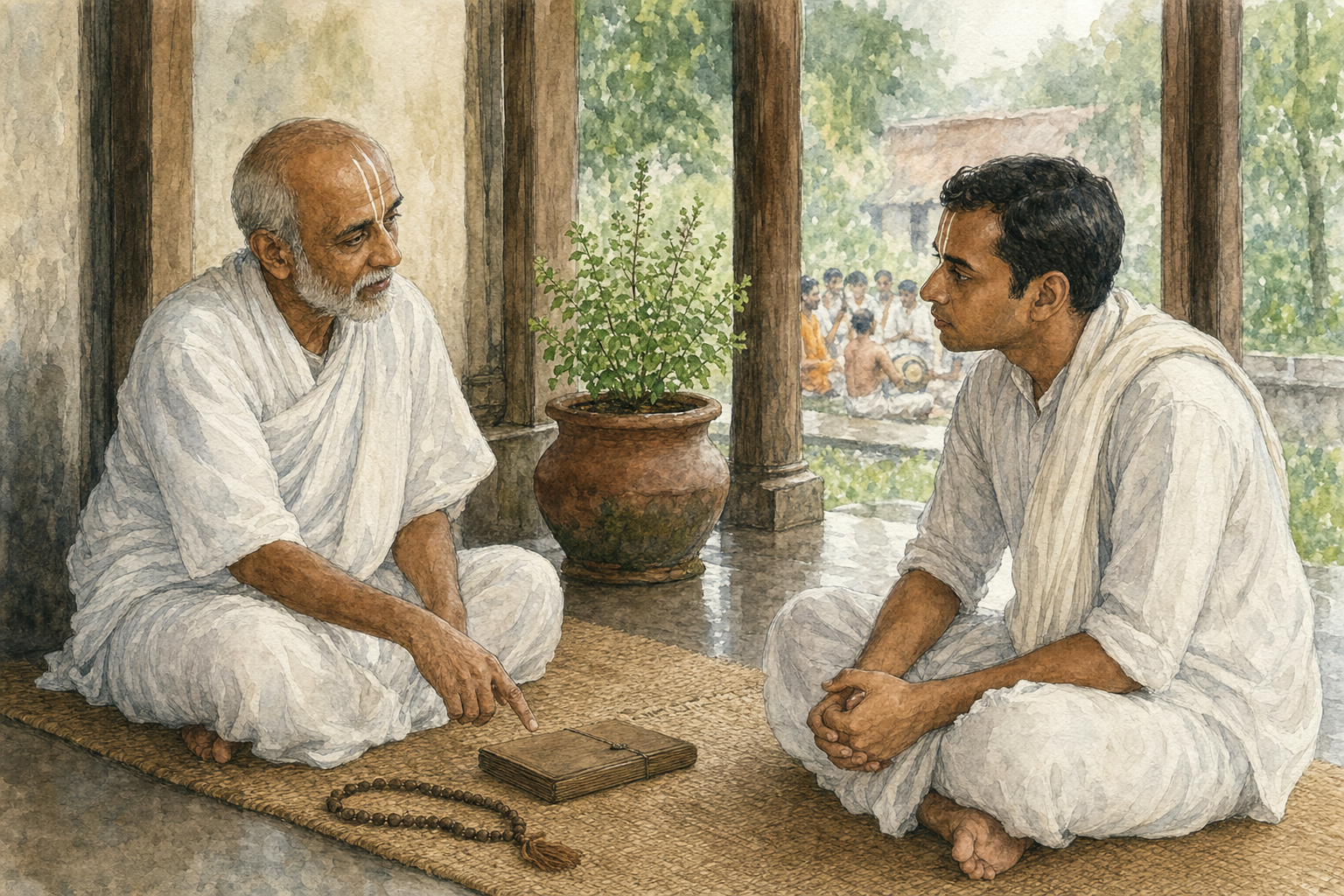
Mahabhava is not a technique for producing an altered state. It is better approached as a theological summit that gives direction to devotion. You can let that summit shape your practice without pretending that you already occupy it.
- Fix the definition before interpreting an experience. Keep a simple working distinction: bhava concerns devotional feeling or joy, while mahabhava denotes its supreme height in Bengali Vaishnavism.
- Keep the historical context attached. When the term appears, remember Sri Krishna Chaitanya and the devotional school nurtured by him and his disciples. This prevents a specialized teaching from becoming a vague slogan.
- Continue the ordinary disciplines of devotion. Prayer, remembrance, worship, singing, study, and service do not become inferior because they seem less dramatic. They are where sincerity can be tested without theatrical pressure.
- Allow emotion without staging it. You do not have to suppress a genuine response, and you do not have to reproduce one. Let feeling come and go without turning it into a performance for yourself or others.
- Examine direction rather than volume. Ask whether an experience returns your attention to God, strengthens service, and reduces the need to be admired. These questions do not certify mahabhava; they help expose self-deception in ordinary practice.
- Use qualified guidance for finer distinctions. Ask how the term functions in the Bengali Vaishnava lineage being taught, whether a statement is technical or poetic, and whether it describes an ideal rather than an experience practitioners should claim.
The practical discipline here is honesty. Devotional emotion need not be denied, but it should not be inflated. If you are moved, be moved. If you are uncertain, remain uncertain. Reverence does not require exaggeration.
Key takeaways for reading and practice
- Mahabhava means great emotion, but in Bengali Vaishnavism it is a precise name for the pinnacle of emotional devotion to God.
- It is not a general label for every powerful experience during prayer, worship, or kirtan.
- Sri Krishna Chaitanya and his disciples provide the historical devotional setting in which the term gained its special significance.
- Visible intensity neither proves nor disproves an exalted inward state.
- A sincere practitioner should receive devotional feeling gratefully, avoid self-certification, and let the concept encourage deeper honesty and service.
The next time you meet the word mahabhava, resist the urge to translate it and move on. First locate it within Bengali Vaishnavism; then ask whether it is being used technically, poetically, or carelessly. In your own practice, seek greater truthfulness rather than a greater title. That is a concrete way to honour a teaching about devotion’s highest reach without pretending to possess it.
References
