

Perhaps the trigger is a headline about nuclear weapons, a technology moving faster than public judgment, or a decision by powerful people you cannot influence. You put the screen down, but the argument continues in your mind: if human beings can unleash forces this large, how can anyone live without dread?
A Vedic response begins with a deeper question than “How do I calm down?” It asks what kind of reality your fear is occurring within. If human power is the highest power and events are finally random, vigilance can feel like your only protection. If existence rests within a moral and intelligible order, your responsibilities remain serious, but you no longer have to carry the entire universe in your mind. The aim is not to feel safe on command. It is to act without granting fear ultimate authority.
Name the claim hidden inside your fear
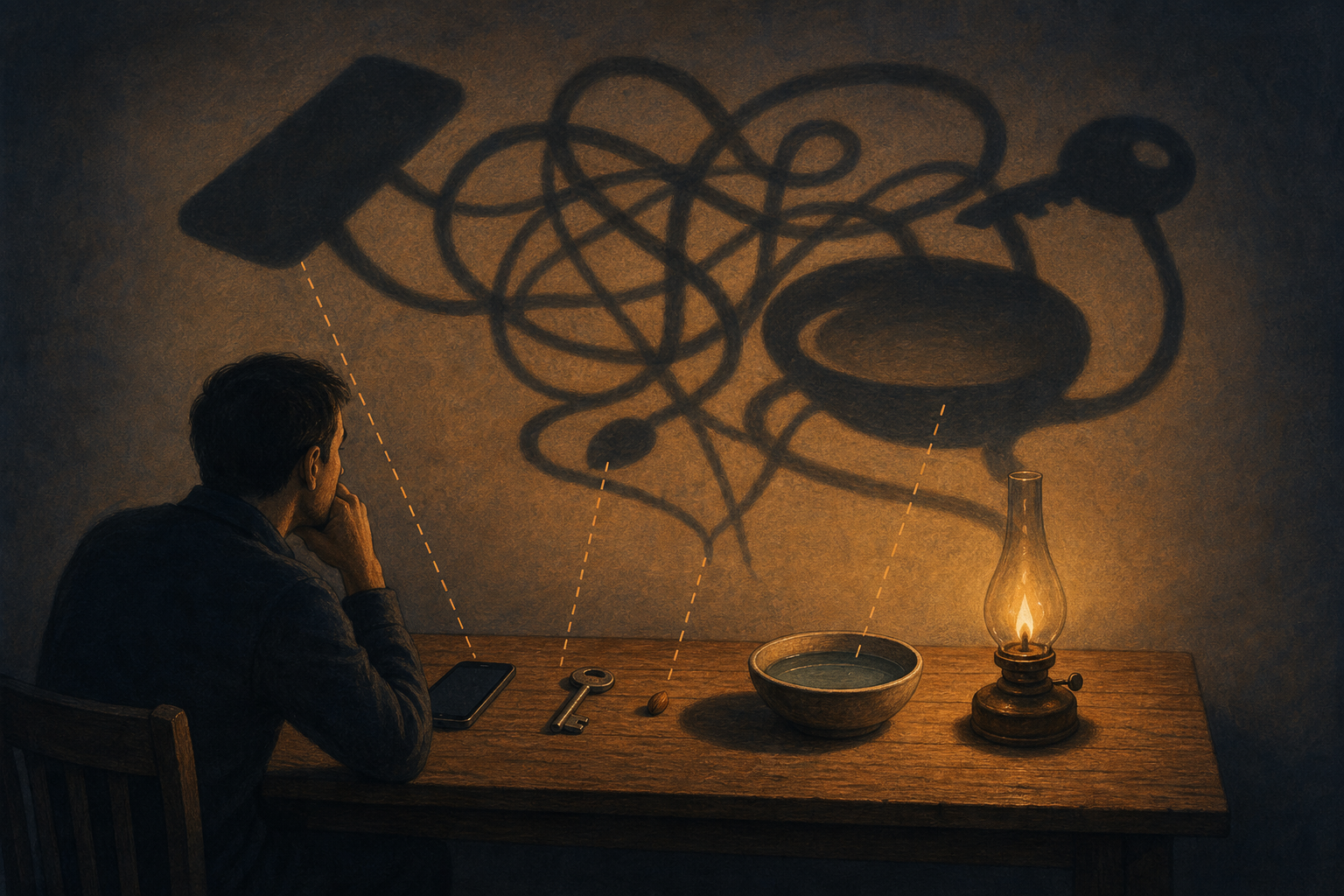
An anxious thought often moves through several claims so quickly that they appear to be one. Something harmful could happen. Therefore, everything is uncontrolled. Therefore, you must keep rehearsing every possible outcome. The first statement may be reasonable. The next two do not necessarily follow.
Vedic cosmology places material existence within vast cycles of creation and dissolution governed by an order that precedes material manifestation. Its immediate practical value is not a timetable for current events. It is a correction of scale. A weapon may exceed your power. A government may exceed your reach. Neither thereby becomes the final authority over existence.
When fear begins expanding from a real danger into a total theory of reality, separate three things:
- What is known: State the fact without prediction or dramatic language. “This capability exists” is a fact-shaped statement. “Nothing can stop the worst outcome” is a conclusion.
- What dharma requires: Identify the action available to you that serves truth, non-harm, restraint, protection, or service. That may mean learning carefully, preparing sensibly, speaking honestly, helping someone, or refusing to circulate an unverified claim.
- What is not yours to command: Name the outcome you cannot produce through responsible action. This is what must be surrendered, not endlessly simulated.
This distinction prevents two opposite mistakes. You do not dismiss a genuine threat as “mere illusion,” and you do not treat repeated worry as though it were useful work. You give the danger the action it deserves, then refuse to give it the worship it demands.
Divine order changes responsibility; it does not cancel it

The assurance of divine order is easily misheard as fatalism. Fatalism says that action is pointless because the result is fixed. Dharmic surrender says almost the reverse: action matters morally, even though the result is not wholly yours. You remain answerable for intention, judgment, effort, and conduct. You are not the sovereign of consequences.
Within a theistic Vedic understanding, even humanity’s most destructive power cannot overrule the higher order in which existence unfolds. That belief does not make a destructive act righteous, erase suffering, or release anyone from the duty to prevent harm. A moral cosmos is not one in which every human choice is good. It is one in which human choice never becomes the ultimate law merely because it has become technologically powerful.
Use a simple decision rule when you cannot tell whether you are surrendering or avoiding responsibility: if a reasonable action can reduce harm without violating truth, compassion, or duty, take it. If no decision changes when you repeat the same frightening scenario, the repetition is no longer preparation. Return to your practice and reassess when a new fact appears.
This also corrects a common spiritual bargain: “If the Divine governs reality, nothing painful should happen to me.” Vedic serenity does not require that promise. It rests on a different assurance—that pain, danger, and human wrongdoing do not make adharma supreme. You can oppose what is harmful without believing the fate of the cosmos depends upon your personal state of alarm.
Outcome is surrendered after sincere effort, not instead of it. That order matters. Surrender before duty can become passivity; duty without surrender can become the fantasy that you control everything.
Give the worldview a daily form
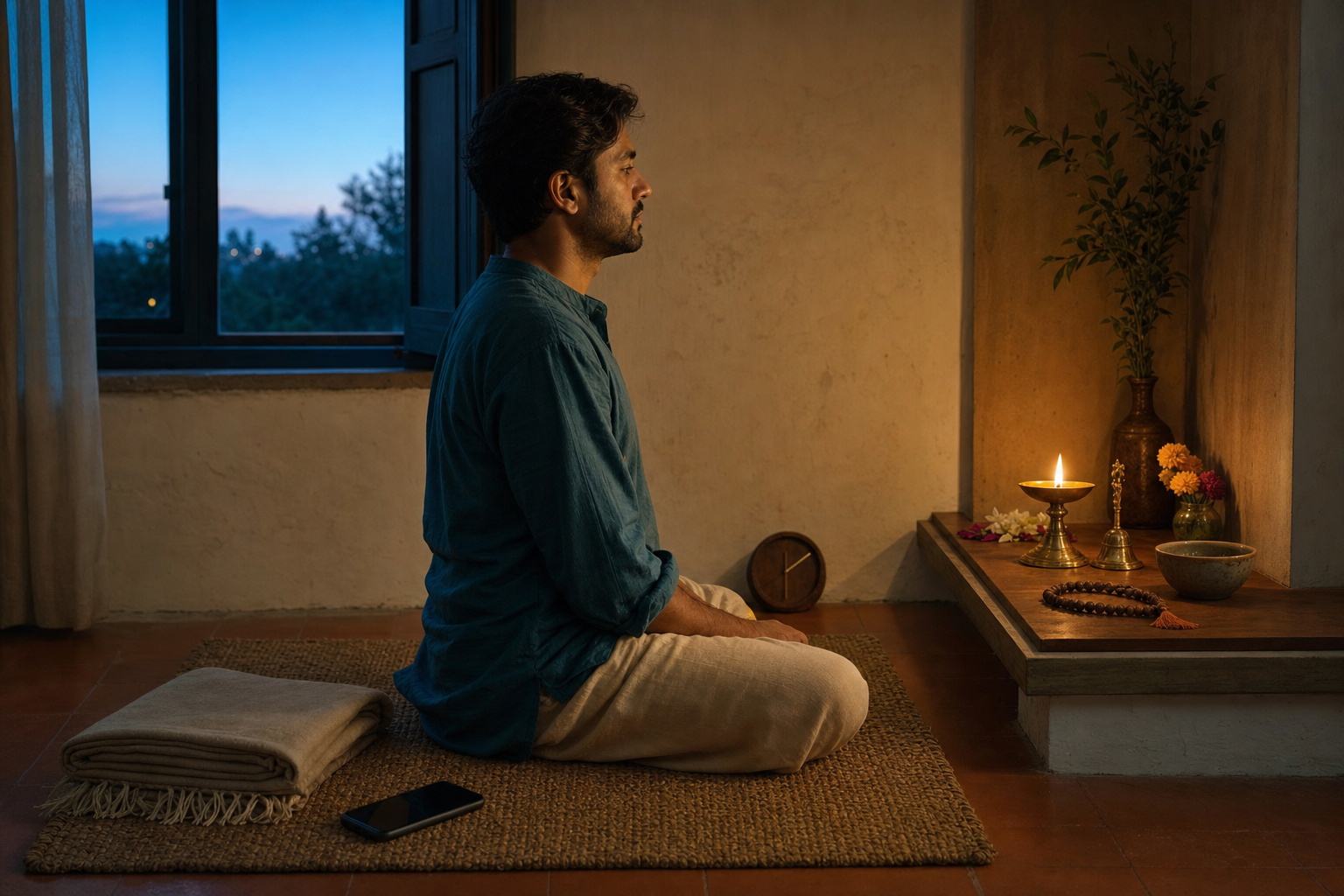
A cosmology remembered only during debate will rarely steady you during fear. The mind needs a repeated form through which the principle becomes conduct. In this setting, mantra chanting and deity worship are not decorative customs or emergency techniques. They join thought, attention, reverence, and action within a daily discipline.
For a Krishna devotee, the Hare Krishna mantra provides a direct practice. Its purpose is not to force an instant mood change or to prove that a frightening event will not occur. Chanting trains attention, emotional balance, and moral resolve by repeatedly turning awareness toward the Divine rather than allowing every imagined outcome to occupy the center.
- Attach chanting to a stable daily cue. Do not wait until anxiety is intense. A practice established in ordinary moments is easier to return to when the mind is agitated.
- Remove the immediate trigger. Put aside the news feed, message thread, or device that has been renewing the worry. Chanting while continuing to consume the trigger divides the attention you are trying to discipline.
- Listen to the mantra as you chant. When the mind returns to the feared scenario, notice the movement and bring attention back to the sound. The return is part of the practice; distraction is not proof that the session failed.
- End with a dharmic decision. Name the next responsible act available to you, then name the result you cannot command. Carry the duty forward and leave the remainder where it belongs.
Measure the practice by what follows it. Are you less likely to pass along an alarming claim before checking it? Can you speak firmly without cruelty? Can you complete the duty in front of you instead of repeatedly imagining distant outcomes? Immediate calm may come or it may not. A steadier return to truthful and non-harmful action is the more reliable measure.
Deity worship gives the same orientation a visible structure. A clean place, a regular act of reverence, prayer received through your tradition, and gratitude for what has been given all interrupt the assumption that the anxious ego is the center of reality. Close the worship by carrying reverence into service: care for a person, keep a promise, correct a falsehood, protect what is vulnerable, or perform neglected work attentively.
Do not turn worship into a transaction with fear. “If I perform this perfectly, the feared event cannot happen” is an attempt to recover total control through ritual. Worship has a different movement. It places control, gratitude, and service in their proper relation: you offer attention, fulfill duty, and entrust the outcome to an order larger than yourself.
Keep the shared dharma without flattening distinct paths

Hinduism, Buddhism, Jainism, and Sikhism do not make identical metaphysical claims. A theistic Vedic account of a benevolent supreme controller should not be imposed upon every Dharmic tradition as though the differences were merely vocabulary. Genuine unity does not require that erasure.
There is still substantial ethical ground on which practitioners can meet. Non-harm, truthfulness, inner discipline, and service form a shared practical horizon, even as each tradition explains ultimate reality, liberation, devotion, and spiritual authority in its own way.
If your home practice is Krishna bhakti, let mantra and deity worship form your response to fear. If you follow another Dharmic path, do not borrow a sacred form merely as a generic relaxation device. Use the discipline your own tradition gives you—prayer, meditation, remembrance, recitation, ethical vows, or service—and apply the same test: does the practice make your conduct more truthful, less harmful, less ego-driven, and more capable of serving others?
This distinction is especially important in a time of collective anxiety. Communities can cooperate in protecting life, resisting falsehood, practicing restraint, and serving those at risk without pretending that every doctrine is interchangeable. Shared dharma is strongest when it permits principled solidarity and honest difference at the same time.
Key takeaways—and the boundary of spiritual practice
- Separate a real danger from the larger claim that reality is therefore uncontrolled.
- Ask what duty is yours now and what outcome was never yours to command.
- Treat divine order as a reason for ethical steadiness, not as permission for passivity.
- Use mantra chanting to practice returning attention; use deity worship to restore reverence, gratitude, and service.
- Judge spiritual discipline by conduct and moral steadiness, not by a guarantee that nothing painful will happen.
- Honor the shared Dharmic values of truth, non-harm, discipline, and service without erasing doctrinal differences.
Spiritual discipline can accompany professional care, but it should not be presented as a substitute for medical or psychological help. If anxiety is repeatedly disrupting sleep, work, relationships, or ordinary responsibilities, seek help from a qualified mental-health professional. If you might harm yourself or cannot stay safe, contact local emergency or crisis support immediately and remain with a trusted person rather than trying to manage the danger through spiritual practice alone.
At the next stable point in your day, step away from the stream of alarming information. Chant or practice within your own tradition, identify the duty actually before you, and release the outcome you cannot govern. Then do the duty. That is how cosmic confidence becomes steadiness in the life you are living.
References
- Dandavats — From Doubt to Serenity: Vedic Wisdom, Mantra Chanting, and the Assurance of Divine Order
