
You may understand a sacred verse while the book is open and still lose it when irritation, distraction, or uncertainty arrives. The problem is usually not a lack of reading. The teaching has not yet become available at the moment when you need to see through an old reaction.
Vedantic contemplation closes that gap. You receive the words accurately, understand what they claim, examine the claim in your own experience, and carry the resulting clarity into conduct. Sacred learning then becomes more than information about dharma. It becomes a disciplined way of seeing.
Treat sacred learning as a change in how you see
A verse can be recited beautifully without being understood. It can also be explained fluently without changing the person who explains it. Neither problem is solved by collecting more verses. You need to know which part of the learning process is incomplete.
A useful Vedantic sequence has three traditional movements: śravaṇa, receiving the teaching; manana, reasoning through it; and nididhyāsana, sustained contemplation through which its meaning becomes inwardly clear. For daily practice, add conduct as a practical test. If the teaching never reaches your speech, choices, duties, and relationships, some part of it remains unassimilated.
- Receive the words carefully. Learn the passage from a dependable text, teacher, or established recitation. Attend to pronunciation, pauses, key terms, and context.
- State the meaning plainly. If you cannot paraphrase the teaching without hiding behind Sanskrit terminology, you do not yet know exactly what you are contemplating.
- Examine the claim. Ask what it refers to in present experience, what objection arises, and whether you are mistaking a poetic impression for philosophical understanding.
- Test it in conduct. Identify the reaction, attachment, or decision that should look different if the teaching has genuinely become clear.
Memorization belongs inside this sequence rather than outside it. A memorized shloka remains mentally available after the page has disappeared, so its cadence and meaning can interrupt habitual mental chatter during ordinary activity. Slow chanting, marked pauses, attention to sandhi, and repetition tied to a familiar routine make memory a vehicle for contemplation rather than a recital performed from habit.
Choose the doorway that matches your actual obstruction

Do not begin by trying to master Vedanta as an entire system. Begin with the obstruction directly in front of you. One well-chosen contemplation, worked honestly, is more useful than a wide reading plan that never reaches experience.
- If attention keeps scattering, learn one shloka by heart and connect it to a stable daily cue. Your first need is reliable recollection.
- If an emotion, bodily condition, role, or opinion seems to define you completely, work with Drik and Drishya, the seer and the seen. Your first need is discrimination between awareness and what appears in awareness.
- If life feels like a collection of disconnected parts, contemplate the sixteen kalas of Purusha. Your first need is to see dependence, coordination, and the whole expressed through its functions.
- If you can explain the doctrine but still act impulsively, stop adding concepts. Choose one situation in which the teaching must govern speech or action.
- If the wording or meaning remains uncertain, do not try to compensate by meditating harder. Return to recitation, grammar, context, and qualified instruction.
This diagnosis prevents a common error: using the practice you enjoy for every difficulty. Recitation cannot settle a doctrinal confusion by itself. Intellectual analysis cannot replace repeated recollection. Witnessing that produces indifference to duty has not completed its ethical work.
Readers rooted in other Dharmic traditions may recognize genuine family resemblances without erasing doctrinal differences. Buddhist attention to conditioned and changing phenomena, Jain practices of non-attachment and stable observation, and Sikh remembrance through Naam and sahaj can illuminate comparable disciplines of attention and conduct. These resonances are bridges for practice, not proof that every tradition makes the same metaphysical claim. Atman as witness-consciousness belongs specifically to the Advaita inquiry being undertaken; it should not be silently inserted into traditions that frame selfhood differently.
Use one repeatable study-to-contemplation sequence

Keep the session narrow enough that you can tell what has changed. Use one shloka, one Upanishadic statement, or one clearly defined teaching. Stay with it until you can retrieve it, explain it, examine it, and apply it.
- Name the question. Write the difficulty the passage is meant to address: identification with anger, fear of change, scattered attention, pride in achievement, or confusion about the witness.
- Recite accurately. Speak slowly, divide the line into meaningful phrases, mark pauses and sandhi junctions, and let the meter guide the breath. Correct a doubtful word before repetition fixes the mistake in memory.
- Give a plain-language account. Write what the passage asserts, what it does not assert, and which word carries the central distinction.
- Expose the doubt. Formulate the strongest honest objection you can. Manana is not repeating an approved explanation; it is removing confusion through careful reasoning.
- Turn to experience. Close the book and look for the distinction or dependency being taught. Do not manufacture an image of what you think you should discover.
- Recall without the page. Recite the words and recover the meaning from memory. If the sound returns but the meaning does not, the next task is comprehension rather than additional chanting.
- Attach the teaching to ordinary life. Recall it while waiting for water to boil, preparing food, washing utensils, walking, or pausing during a commute. A stable cue teaches the mind when to retrieve the verse.
- Choose a conduct test. Decide which forthcoming response will reveal whether the contemplation has become usable: listening before replying, loosening a rigid self-description, completing a duty without self-display, or acknowledging dependence on others.
A small notebook can keep the work precise. Use four labels: words, plain meaning, unresolved doubt, and application. When practice stalls, inspect the labels. If the words are unstable, return to recitation. If the meaning is vague, return to study. If the reasoning is clear but nothing is recognized inwardly, remain with contemplation. If clarity appears in silence but vanishes during conflict, strengthen the recall cue and the conduct test.
Do not hurry to replace a passage merely because it has become familiar. Familiar sound is often the point at which deeper work can begin. Move on when you can explain the teaching without jargon, identify the relevant experience without suggestion, and recognize what it asks of your behaviour.
Deepen the practice through seer–seen and part–whole inquiry

Use Drik–Drishya when an experience seems to be your whole identity
Drik is the seer or knower. Drishya is whatever is seen or known. The exercise begins with an ordinary fact: an object that you perceive cannot be the perceiving subject in that same relation. Advaita extends this discrimination from external objects to the body, sensations, emotions, memories, intentions, and thoughts.
- Notice a visible object. It is known and therefore belongs to Drishya.
- Shift attention to a bodily sensation. It also appears, changes, and is known.
- Notice a thought or emotion. Instead of following its story, recognize that its arrival, movement, and disappearance are known.
- Notice the inner claim, “I am observing.” That sentence and the mental image attached to it are also known.
- Ask whether the knower can be presented as another object. Any picture, sensation, location, or concept offered as an answer has already appeared on the side of the seen.
- Rest in the bare fact of knowing without trying to turn awareness into something visible.
The witness is not a tiny spectator located inside the head. Nor does “seen” mean worthless, imaginary, or undeserving of care. The distinction loosens absolute identification with changing experience; it does not cancel the body, relationships, or dharmic obligations.
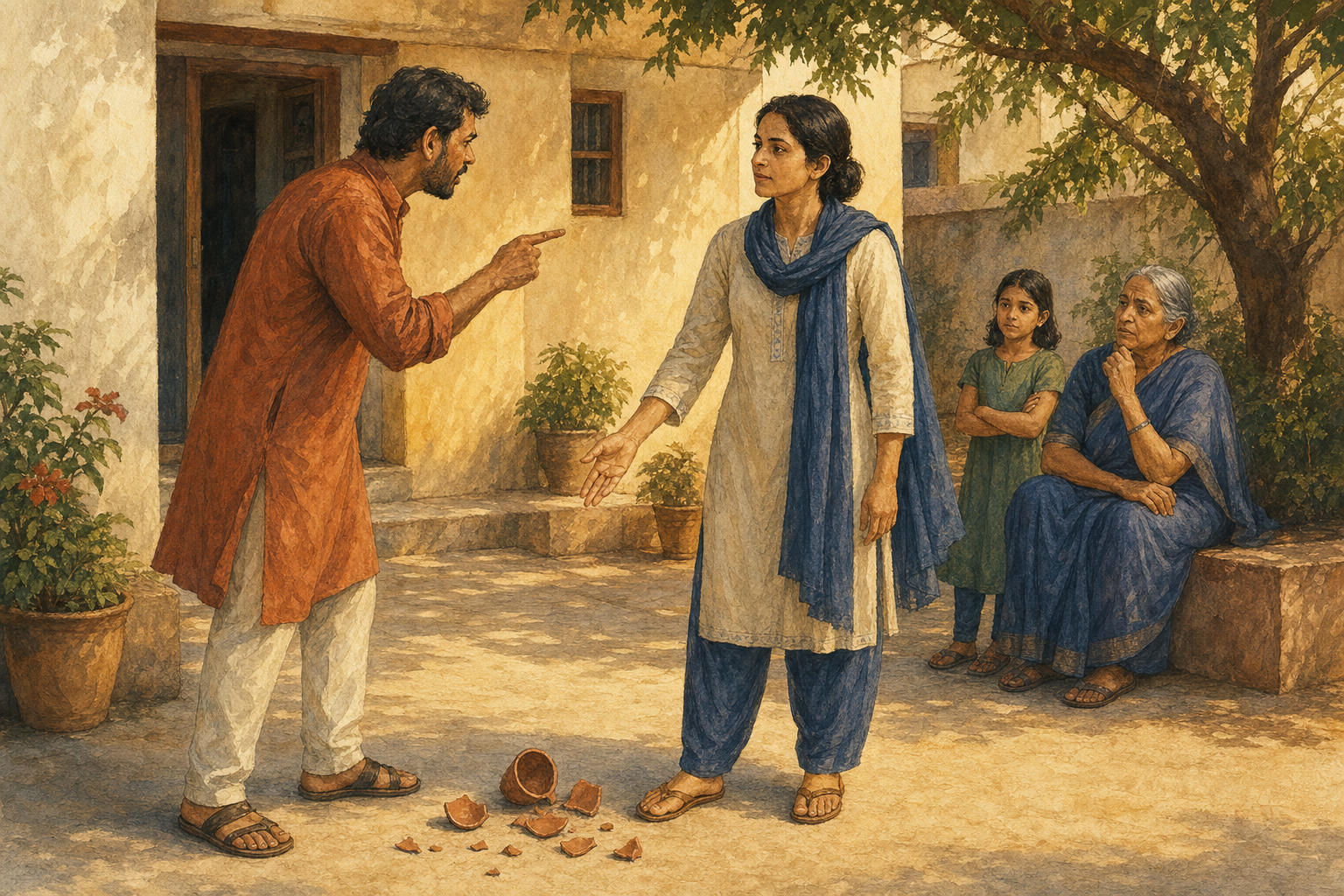
Use the inquiry during a real reaction. Replace “I am anger” with the more exact recognition that anger is present and known. This does not suppress anger or excuse the conduct that produced it. It creates enough discrimination to ask what truthfulness, restraint, courage, or responsibility requires next. The practical fruit of seer–seen inquiry is reduced over-identification and more responsible action, not withdrawal from life.
Use the sixteen kalas when the parts obscure the whole
The sixth question of the Prashna Upanishad presents a sixteen-fold expression of Purusha: prāṇa, śraddhā, ākāśa, vāyu, agni, āpaḥ, pṛthivī, the senses, manas, food, potency, tapas, mantra, karma, worlds, and name. These kalas are functional facets of a whole, not sixteen independent absolutes. Their arising accounts for differentiated experience; their resolution directs contemplation back toward Purusha.
For practice, you can arrange the kalas into working groups without mistaking that arrangement for the Upanishad’s own division:
- Vital orientation: prāṇa and śraddhā.
- Elemental field: space, air, fire, water, and earth.
- Embodied experience: senses, mind, food, and potency.
- Transformative discipline: tapas, mantra, and karma.
- Manifest order: worlds and name.
Choose one ordinary event, such as eating a meal, reciting a mantra, making a decision, or carrying out a duty. Identify which kalas are active. A meal involves food, elements, senses, mind, vitality, strength, action, and the names by which the experience is organized. What initially looked like “my” isolated act now appears as a coordinated event dependent on many conditions.
Then reverse the movement. Let attention travel from name and action through mind, senses, nourishment, elements, vitality, and faith toward their ground. Ask which facet stands alone, which one remains unchanged, and whether any function can truthfully claim to be the whole. This movement from differentiated parts toward their source turns cosmology into a discipline of humility and non-attachment.
Finish with an ethical consequence. Awareness of food and elements can deepen gratitude and ecological care. Awareness of mantra, tapas, and karma can expose the gap between admired knowledge and disciplined action. Awareness of worlds and names can soften the demand that one social identity exhaust the truth of a person. The contemplation becomes useful when interdependence alters how you consume, speak, claim credit, or fulfil responsibility.
Judge the practice by availability, clarity, and conduct
Do not judge contemplation mainly by unusual states, the number of verses memorized, or the ability to win a philosophical argument. Better signs are quieter. The teaching comes to mind before a reaction has fully taken over. You can explain it without borrowed phrases. Your doubts become more precise. You recover from identification sooner. Insight produces greater care rather than a new reason to feel superior.
Difficulty is not automatically failure. A memorized verse may reveal that its meaning is still unclear. Seer–seen inquiry may expose how strongly you depend on a role or opinion. Contemplating the kalas may unsettle a cherished image of self-sufficiency. These are useful findings because they tell you exactly where study must continue.
Key takeaways
- Begin with one living question and one passage that directly addresses it.
- Keep accurate reception, plain understanding, reasoning, contemplation, and conduct distinct enough to diagnose what is missing.
- Use Drik–Drishya when you are over-identified with a changing experience; use the sixteen kalas when fragmentation hides dependence and wholeness.
- Memorize so the teaching is available away from the page, then connect recall to a dependable daily cue.
- Respect parallels among Dharmic disciplines without pretending their doctrines are interchangeable.
- Look for the fruit in clearer perception, reduced reactivity, humility, and dharmic action.
At your next study period, place one shloka or teaching at the top of a page. Under it, write four headings: words, meaning, seeing, and action. Fill each heading honestly, choose one ordinary cue for recall, and stay with the passage until it can accompany you into an actual decision. When sacred learning arrives before the old reaction rather than after it, contemplation has begun to do its work.
References
- DharmaRenaissance Blog — Sixteen Kalas of Purusha in Prashna Upanishad: Awe-Inspiring Insights on Unity and Creation
- DharmaRenaissance Blog — Drik and Drishya in Advaita Vedanta: Master the Seer–Seen Insight for Inner Clarity
- Dandavats — Why Memorizing Shlokas Transforms the Mind: Daily Practices, Focus, and Inner Joy
