
You may be preparing for Tiruvannamalai and wondering whether Shaiva philosophy will deepen the pilgrimage or merely burden it with concepts. Take one distinction with you: Arunachala is not a place where you must find an absent Shiva. The pilgrimage trains you to recognize how that which exceeds every form can still be encountered through form.
This changes how you look at the hill, enter the temple, and undertake Giripradakshina. You are not trying to manufacture a mystical experience. You are bringing understanding, bodily action, and attention into a single practice.
Begin with the distinction between form and limitation
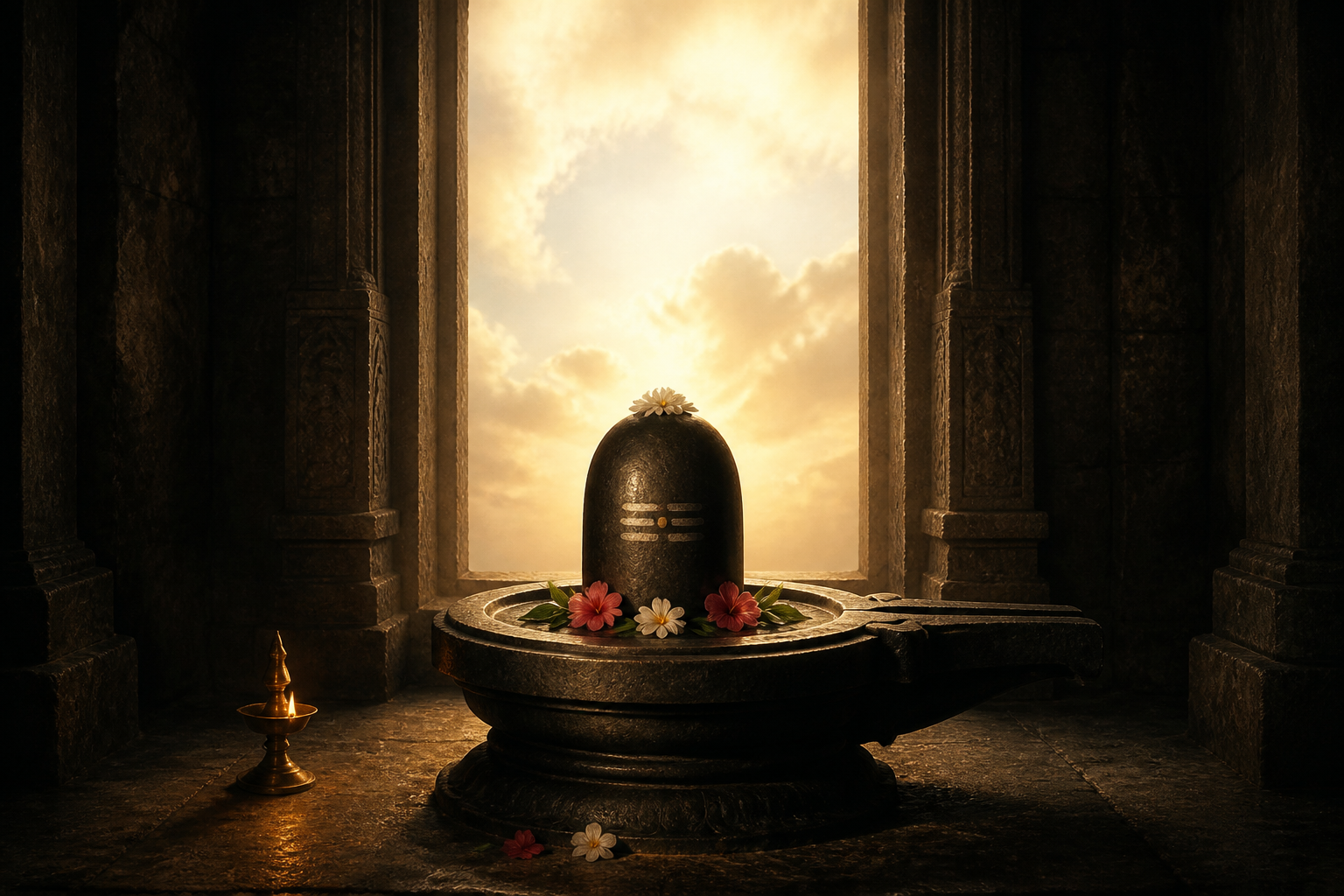
Shaiva traditions contain different schools, scriptures, ritual systems, and accounts of manifestation. They should not be compressed into one uniform doctrine. Yet a central insight gives this pilgrimage a clear orientation: Shiva can be understood not only as a deity with a recognizable form, but as the unmanifest, infinite, and eternal reality.
That insight contains three closely related claims:
- Shiva is beyond form. No image, temple, hill, name, doctrine, or experience can exhaust the Supreme.
- Shiva pervades existence. The forms of the world are not situated in a territory from which Shiva is absent.
- Shiva is not altered by cosmic change. Creation, preservation, dissolution, and the movements of individual experience do not enlarge or diminish transcendent Consciousness.
Beyond form therefore does not mean opposed to form. If Shiva were merely one finite object within the universe, a stone hill could compete with other objects for the title of divine. If Shiva is the reality that pervades existence without being confined by it, a form can disclose Shiva without containing the whole of Shiva.
This is the distinction to remember at Arunachala. Do not reduce the hill to a visual aid for an abstract idea. Do not imagine that the Infinite has been compressed into a geographical object either. Approach the form reverently while allowing it to direct your attention beyond every boundary you place around the Divine.
Kriya Shakti, the power of action, gives this metaphysical understanding a practical expression. Your intention remains incomplete until it enters conduct. Looking, bowing, walking, chanting, remaining silent, and restraining distraction are not attempts to produce Shiva. They are ways of aligning your limited activity with a presence that does not depend on your recognition.
Before travelling, write a one-sentence sankalpa. Keep it observational rather than theatrical. You might resolve: Whenever I become hurried or self-absorbed, I will return my attention to Shiva without arguing with the distraction. A precise resolve will serve you better than a long list of experiences you hope to obtain.
Read Arunachala as Agni without reducing it to a symbol
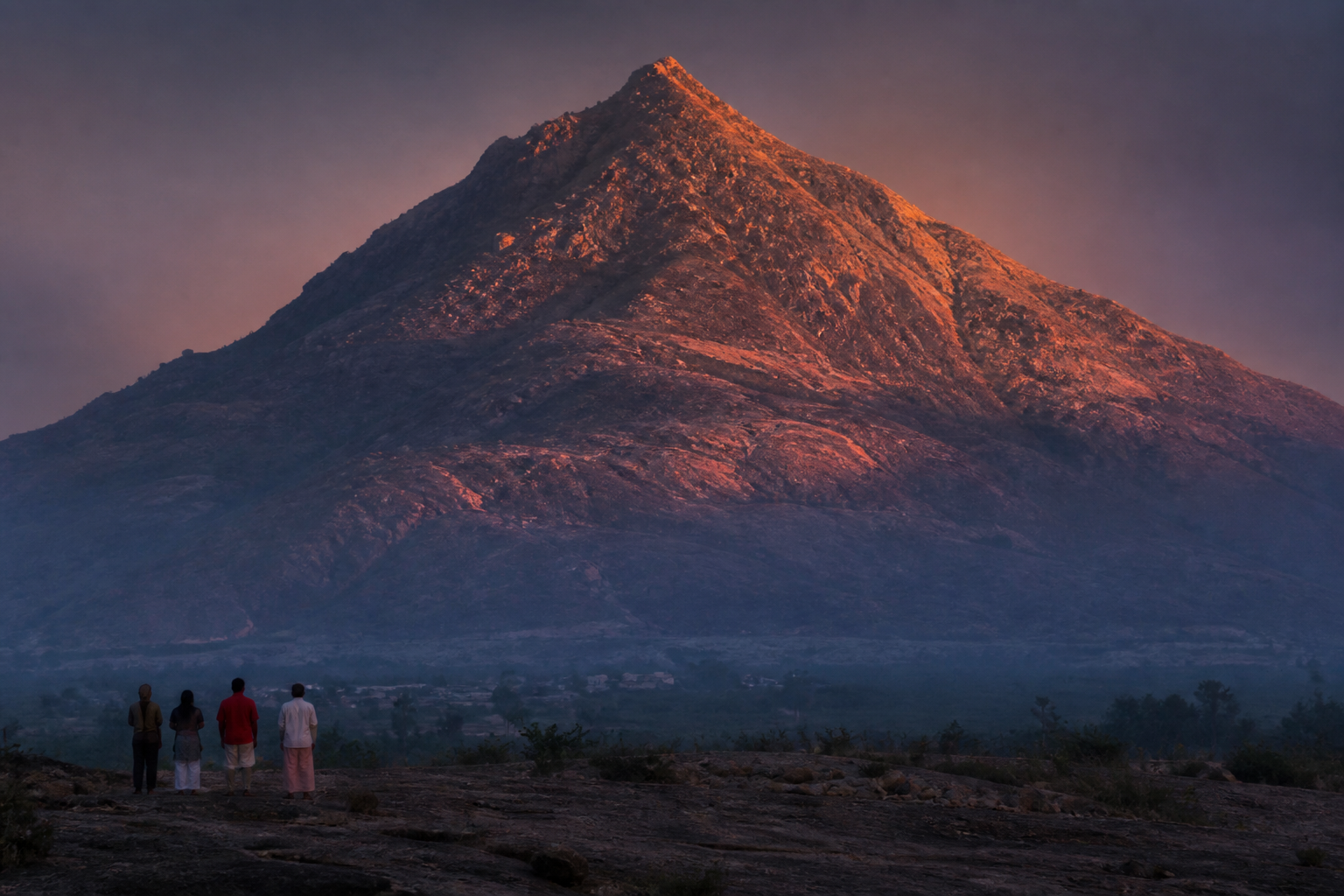
Arunachala belongs to the sacred geography of the Pancha Bhuta Sthalams, where Shiva is worshipped through the five primordial elements. The traditional correspondences are earth at Ekambareswarar in Kanchipuram, water at Jambukeswarar, air at Kalahasti, space at Chidambaram, and fire at Arunachala. At Tiruvannamalai, Shiva is worshipped as Annamalaiyar in the Arunachaleswarar Temple.
The decisive feature of the kshetra is that the hill itself is revered as the visible form of Shiva. This is not simply a poetic comparison between divinity and an impressive landscape. The devotional claim is stronger: you approach the hill as Shiva manifest before you.
You can hold that claim in three registers at once:
- Devotional: offer reverence to Arunachala rather than treating the hill as scenery to be consumed and photographed.
- Metaphysical: recognize that a visible form can disclose the formless without placing a limit around it.
- Contemplative: let Agni become a discipline of attention. Ask what awareness reveals, what restless desire keeps feeding, and what attachment you are prepared to stop sustaining.
The fire principle should sharpen your attention, not encourage vague claims about spiritual energy. Fire illuminates, but it also makes concealment difficult. If you arrive preoccupied with recognition, comfort, photographs, or signs of personal advancement, Agni gives you a question: what remains when you stop feeding that demand?
The temple and the hill need not compete for primacy. The temple concentrates attention through sacred form, worship, and the presence of Annamalaiyar. The hill extends the encounter beyond temple walls. One teaches you to approach the Divine through a consecrated center; the other challenges you to recognize that divine presence cannot be enclosed by that center.
Make temple darshan and Giripradakshina one practice
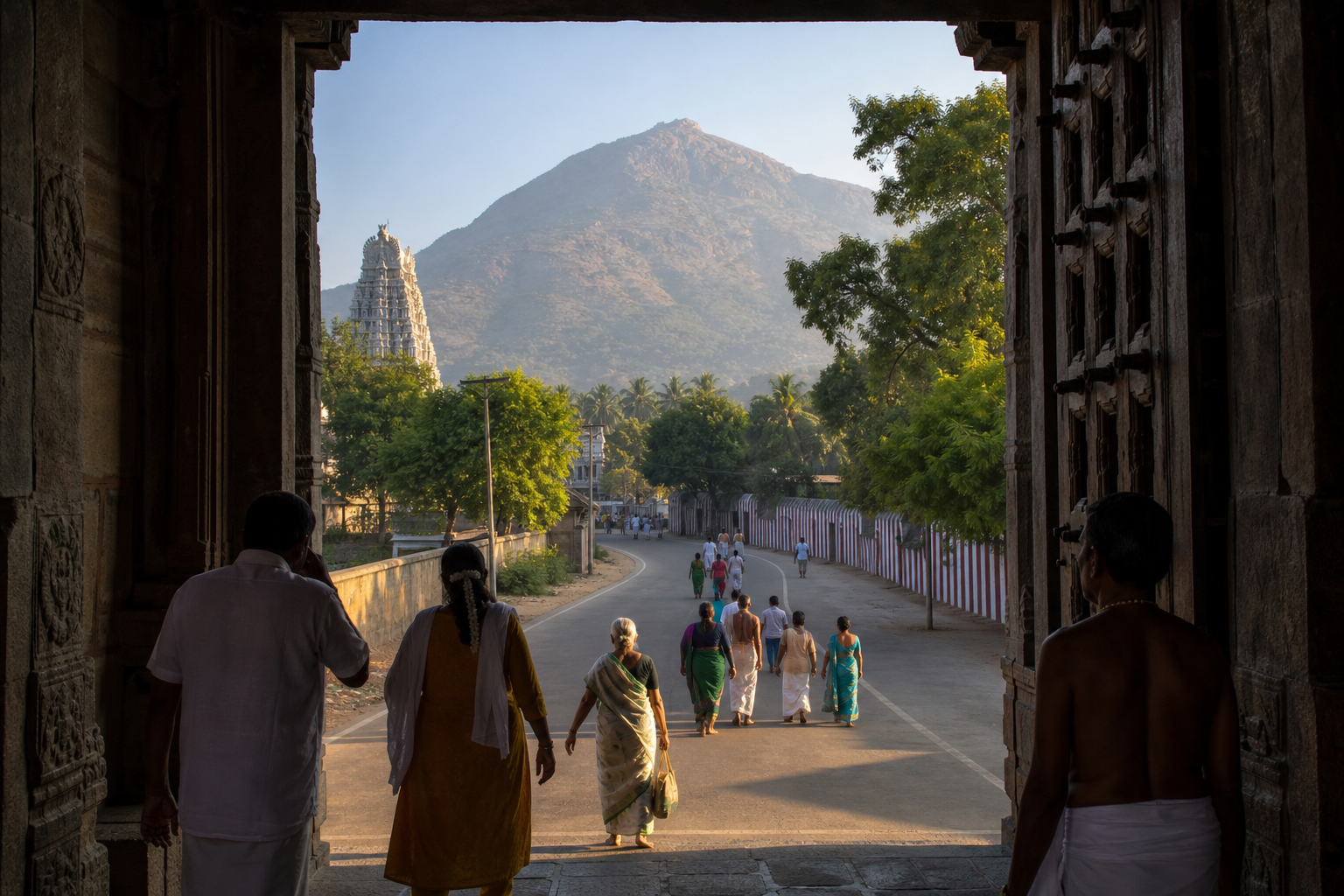
A fragmented pilgrimage produces fragmented attention: travel is logistics, the temple is religion, the walk is exercise, and the return home is ordinary life. Shaiva metaphysics asks you to see one movement. Consciousness, form, and action are distinguishable, but your practice should not pull them apart.
- Choose one tendency to observe. Select haste, distraction, resentment, self-display, or the need to interpret every event as a sign. Do not promise to eliminate it during the journey. Resolve to notice when it takes possession of your attention.
- Receive your first clear sight of the hill deliberately. Put the phone away and allow visual attention to settle. Do not rush to explain what the sight means. The first discipline is to look without immediately turning the encounter into content, proof, or personal narrative.
- Enter the temple as an act of concentration. Approach Annamalaiyar as the concentrated sacred form of the same Shiva whom the hill manifests. Receive darshan before analyzing your response. A quiet mind, an emotional mind, and an apparently unmoved mind can all stand before the deity; none gives you grounds for measuring Shiva’s presence.
- Let Giripradakshina embody Kriya Shakti. Circumambulation turns an inward intention into bodily action. Keep returning to one anchor: the hill, a mantra already established in your practice, or silent awareness of walking. When the mind wanders, return without building another story around the wandering.
- Respect physical conditions. Check current temple guidance, route conditions, weather, and local instructions before setting out. Do not treat exhaustion, unsafe weather, fasting, or walking barefoot beyond your capacity as proof of devotion. Adapting or deferring an austerity is wiser than turning avoidable harm into a spiritual test.
- Close the pilgrimage deliberately. Before leaving, sit without trying to recreate a special moment. Ask what became clearer, which habit repeatedly captured your attention, and what single action will carry the pilgrimage into daily life.
During the walk, a simple cycle can keep the metaphysics from becoming abstract: notice the hill, notice awareness, notice the next action. The hill is the sacred form before you. Awareness is that by which the form is known. The next step is Kriya, the immediate action through which your intention becomes real.
When conversation, traffic, fatigue, or planning takes over, you have not ruined the practice. You have found the exact place where practice is needed. Return to the anchor. The repeated return matters more than preserving an artificial mood of solemnity.
Avoid the mistakes that turn pilgrimage into consumption
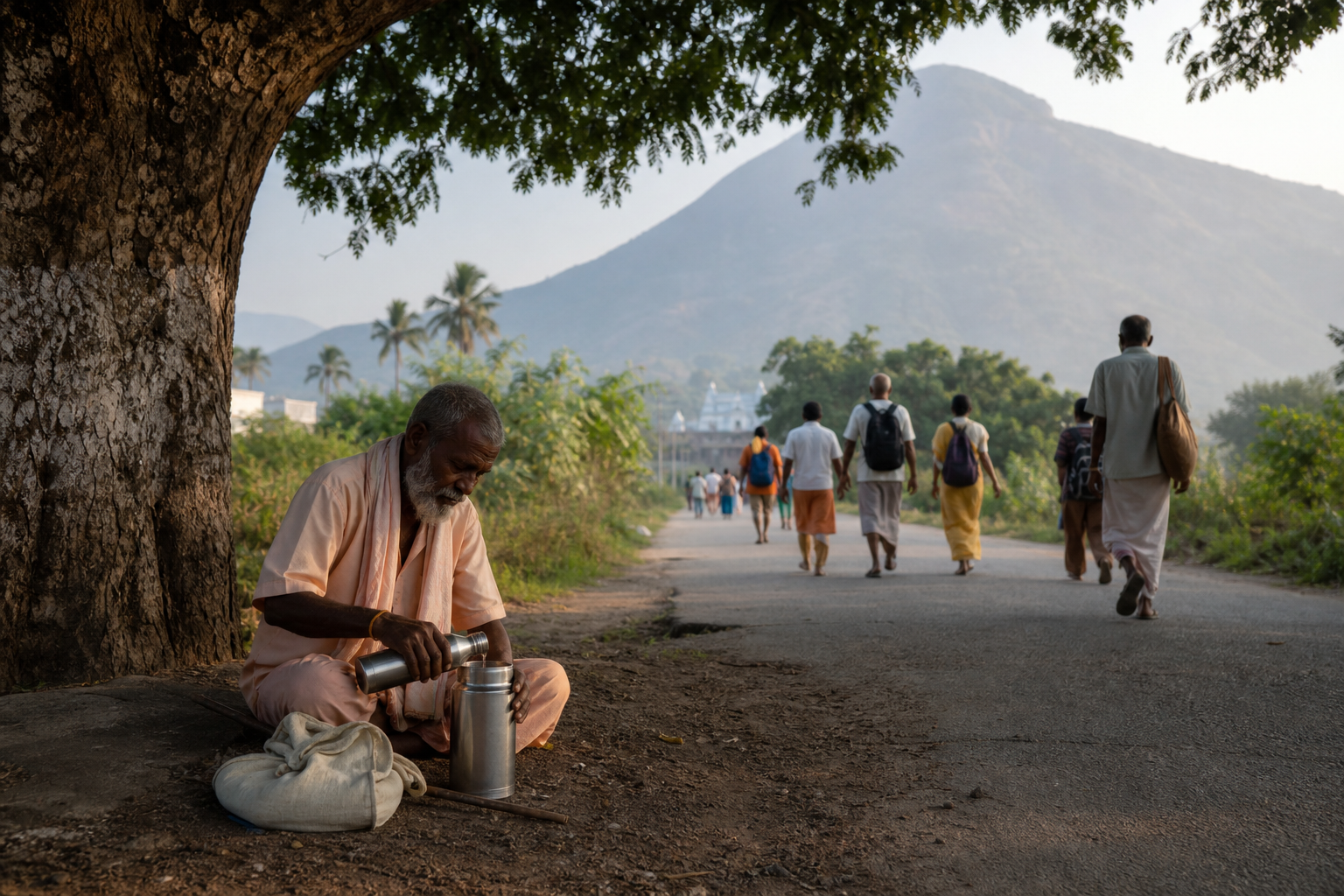
The greatest obstacles are not always disbelief or lack of knowledge. Devotional enthusiasm can also become a distraction when it makes you chase someone else’s experience.
- Do not wait for a dramatic summons. Some pilgrims interpret repeated encounters with names such as Annamalai or Tiruvannamalai as coincidence, destiny, or daiva iccha, the will of the Divine. Such a summons is necessarily a matter of personal interpretation, not an admission requirement for the kshetra. A sincere decision to undertake the pilgrimage is sufficient ground on which to begin.
- Do not call the hill merely metaphorical. A metaphor points from one thing to another; the devotional understanding of Arunachala identifies the hill itself as Shiva’s visible form. You may still reflect philosophically on fire, consciousness, and manifestation, but that reflection should deepen reverence rather than explain it away.
- Do not confine Shiva to the hill. Revering Arunachala does not mean that divine presence stops at the edge of the kshetra. If Shiva pervades existence, the hill discloses what ordinary distraction prevents you from recognizing elsewhere.
- Do not grade the journey by intensity. Tears, silence, wonder, fatigue, irritation, and apparent ordinariness are changing states. The transcendent principle of Shiva is untouched by the fluctuations of manifestation. A pilgrimage without a dramatic inner event is not therefore an encounter without Shiva.
- Do not leave the practice inside the temple. If darshan has no effect on how you speak, work, restrain anger, or attend to another person, form and action have separated again. Choose one ordinary situation in which you will make the return to awareness consciously.
These corrections protect both sides of the pilgrimage. They preserve devotion from being dissolved into detached philosophy, and they preserve philosophy from becoming a collection of ideas that never enters conduct.
Key takeaways for your Arunachala pilgrimage
- Shiva beyond form does not mean Shiva absent from form; it means no single form exhausts the Supreme.
- Approach Arunachala as the visible form of Shiva, not simply as scenery or an illustration of a doctrine.
- Use Agni as a practical question: what does clear awareness reveal, and what restless demand are you continuing to feed?
- Join temple darshan, Giripradakshina, and inward attention into one movement from understanding to action.
- Do not imitate another pilgrim’s mystical call, emotional response, or austerity. Sincerity is not measured by spectacle or physical risk.
- Carry home one repeatable act of attention so that the pilgrimage changes ordinary conduct rather than remaining a sacred memory.
Before you leave for Tiruvannamalai, decide on one anchor and one boundary. Your anchor may be the hill, a mantra, or silent awareness. Your boundary is the point at which weather, fatigue, crowd pressure, or imitation would turn devotion into avoidable harm.
When you return, preserve one expression of Kriya Shakti. Pause before a habitual angry reply, perform one ordinary task with undivided attention, or return to your mantra when self-absorption takes over. Choose one, then keep returning to it. The pilgrimage continues whenever the insight that Shiva is not absent becomes visible in your next action.
References
- Hindu Blog – From Shiva to Kriya Shakti – The Long Road
- Hindu Post – When Arunachala Calls: A Pilgrimage Through Faith, Floods and Grace
