

If something in your life has broken – your work, health, relationship, confidence, or carefully made plan – Hindu teaching does not require you to pretend that it does not hurt. Nor must you force an instant explanation onto what happened. The useful question is simpler: what is the next dharmic action available to you while the outcome remains uncertain?
That question turns adversity from a verdict on your worth into a field of practice. It does not promise a painless result. It helps you keep pain, fear, and anger from taking command of your judgment.
Do not confuse adversity with punishment
When life turns against your expectations, the mind wants a complete explanation. You may ask, “Why is this happening to me?” or “What did I do to deserve this?” Hindu ideas about karma can then be misused to produce a harsh answer: every misfortune must be a punishment, and the person suffering must somehow be at fault.
That conclusion is neither necessary nor useful. Karma describes moral causation across a web of intentions, actions, consequences, circumstances, and other beings. You do not possess the knowledge required to reconstruct that entire web. Declaring why another person suffers is usually speculation disguised as spiritual certainty. When someone else is in pain, compassion and practical help are safer duties than metaphysical judgment.
Apply the same restraint to yourself. Before asking what cosmic cause produced your difficulty, ask three answerable questions: What has actually happened? What needs protection now? What right action is still possible?
Difficulty is not automatically sacred. Abuse, exploitation, injustice, untreated illness, and preventable harm are not spiritual examinations that you are obliged to endure silently. Dharma may require a boundary, an exit, medical care, legal guidance, or intervention by trustworthy people. If you are in immediate danger, protecting life and seeking competent help take priority over proving your endurance.
The more careful Hindu claim is that hard conditions can become the pressure under which endurance and excellence are formed. The hardship itself is not the virtue. The virtue lies in how truthfully, steadily, and compassionately you meet it.
Begin with the nearest dharma, not the grandest answer

Dharma is often discussed as though it were a single grand purpose waiting to be discovered. During adversity, it is more helpful to understand it as the right responsibility in the situation immediately before you. Your nearest dharma may be to tell the truth, feed your family, keep an appointment, apologise, refuse an unethical demand, care for a dependent, or ask for help before matters worsen.
This approach prevents the mind from trying to solve your whole life while it is frightened. Work through the situation in this order:
- State the event without interpretation. Say, “The application was rejected,” rather than, “My future is over.” Say, “This person has not replied,” rather than, “No one values me.” The first statement is a fact; the second is a frightened forecast.
- Name what must be protected. This might be physical safety, health, integrity, a child’s welfare, essential resources, or a promise that remains yours to honour.
- Identify your role. Ask what is required of you as a parent, child, spouse, colleague, citizen, devotee, or friend. Roles do not answer every moral question, but they narrow the field.
- Choose the smallest complete action. Make the call, write the truthful message, prepare the necessary document, attend the appointment, or decline the improper request. A complete action is better than an impressive intention.
- Release what the action cannot command. You can prepare carefully and still be refused. You can apologise sincerely and still not be forgiven. Your duty concerns the quality of your action; another person’s response is not yours to possess.
This is not a formula for always getting the result you want. It is a method for remaining morally coherent when the result is outside your control. That coherence matters because adversity often creates a second problem: in trying to escape the first one, you act against your own values and must later repair the damage.
Use four disciplines to turn pressure into practice
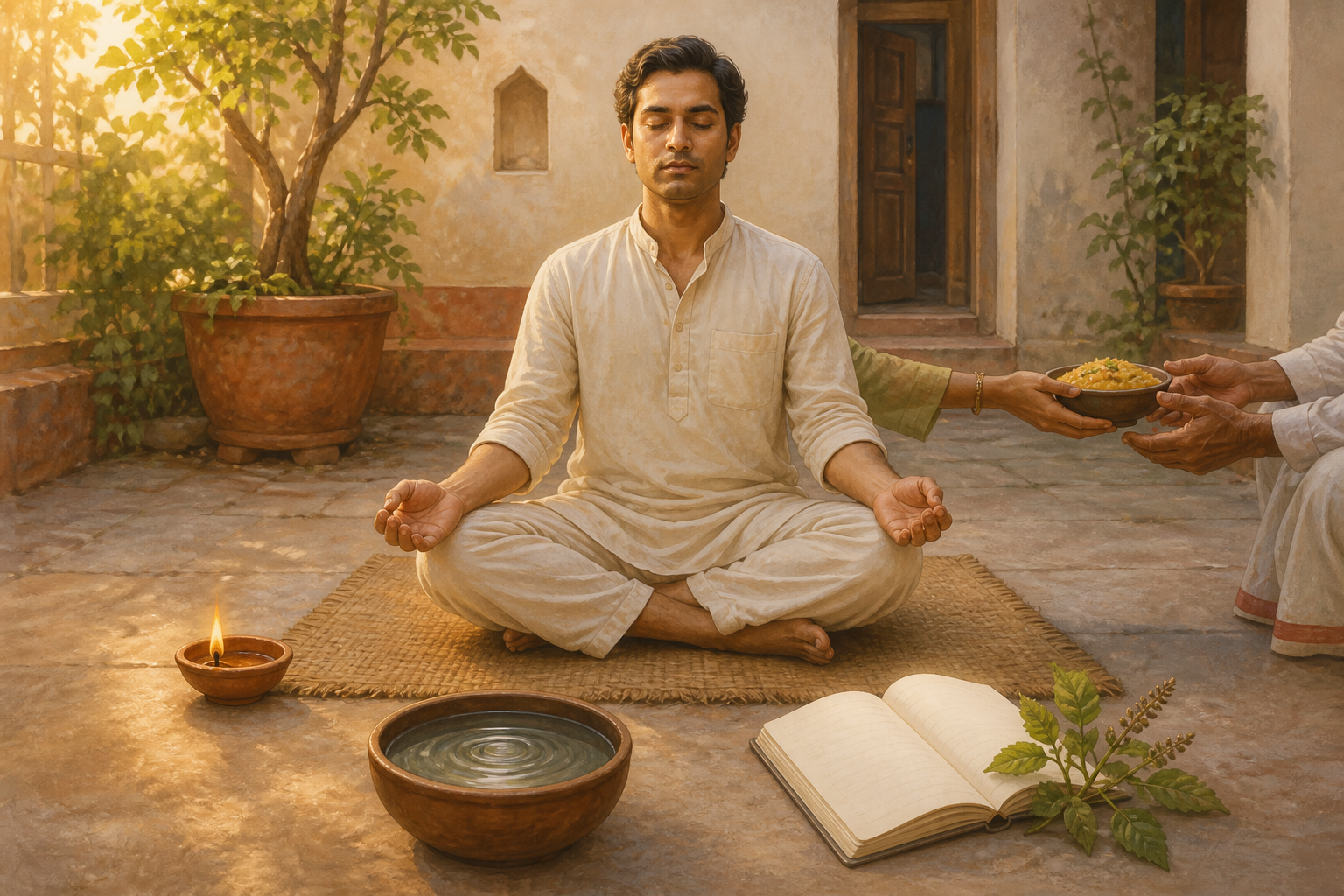
Hindu traditions offer more than a command to “be strong.” They provide distinct disciplines for action, endurance, repetition, and release. Each answers a different problem created by adversity.
Karma yoga: act fully without demanding ownership of the result
Karma yoga is disciplined action without clinging to its fruits. Non-attachment does not mean that you stop caring. It means that you refuse to make your integrity conditional on success.
Use a two-part sentence: “I will do this action well; I cannot command that outcome.” The first half prevents passivity. The second prevents anxiety from pretending to be control. If the result is disappointing, review the action honestly: correct what was careless, learn what can be learned, and do not manufacture guilt for forces that were never yours to govern.
Tapas: keep the necessary discipline when comfort disappears
Tapas is disciplined heat: the friction of doing what is necessary despite resistance. During an already difficult season, tapas does not require you to create additional suffering. It may be as ordinary as getting out of bed, completing an obligation, keeping your speech honest, observing a chosen restraint, or returning to prayer when your emotions offer no encouragement.
Healthy tapas makes you clearer and more dependable. Self-punishment makes you depleted, secretive, or proud of how much pain you can tolerate. If a discipline is damaging your health, feeding contempt for the body, or preventing necessary help, examine it rather than romanticising it.
Abhyasa: repeat a small stabilising practice
Abhyasa is sustained practice. Under stress, ambitious routines often collapse because they ask for energy you do not have. Choose a modest anchor you can repeat: a familiar mantra after waking, a brief period of silent sitting, prayer before sleep, a page of reflective writing, or a deliberate pause before replying in anger.
Keep the anchor simple enough to survive a bad day. Its purpose is not to produce a special experience. Its purpose is to bring you back to deliberate action before agitation, resentment, or despair chooses for you.
Vairagya: loosen the demand that life obey your preferred form
Vairagya is often translated as dispassion or non-attachment. It is not indifference to people, justice, or consequences. It is the willingness to release the belief that peace is possible only if one particular outcome occurs.
Notice the sentence beginning with “I cannot be all right unless…” The words after “unless” reveal what fear has made absolute. You may still work hard for that outcome. Vairagya asks you not to place your entire identity inside it. A role can end without ending your worth. A plan can fail without making all action futile. A person can reject you without acquiring the authority to define you.
Use this practice on a difficult day
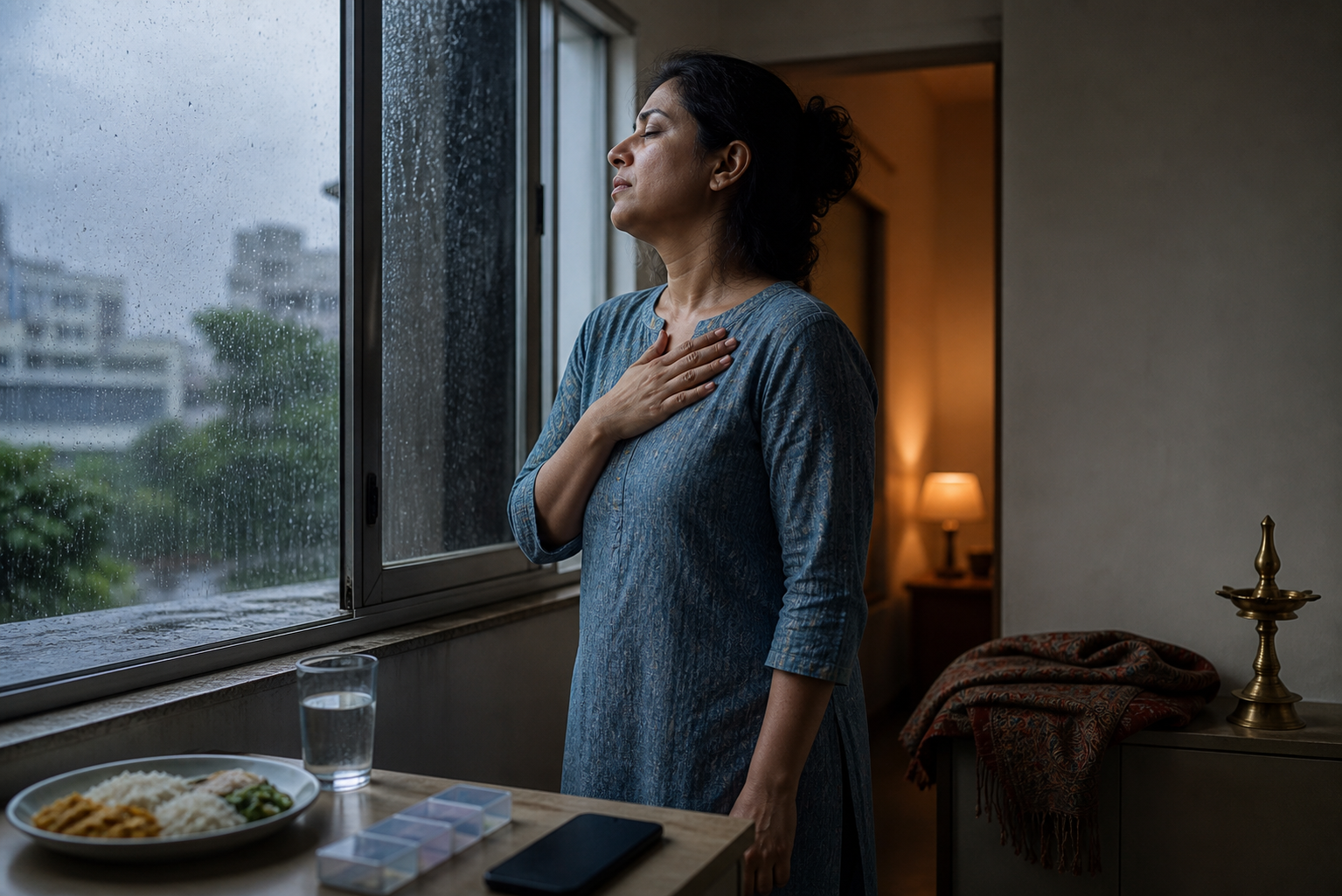
When thought is racing, a compact sequence is more useful than a large philosophy. Write these four headings on paper and answer each in plain language:
- Fact: What do I know directly, without prediction or mind-reading?
- Dharma: What responsibility is genuinely mine in this situation?
- Release: Which result, reaction, or timing cannot be commanded by me?
- Support: Who can provide the specific help I need?
Make the request for support concrete. “Please listen while I explain this” is different from “Please help me decide.” “Can you accompany me?” is different from “Tell me everything will be fine.” Clear requests allow family, sangha, friends, or professionals to serve without having to guess what service means.
Then complete one action named under dharma before returning to speculation. If no action is possible yet, make waiting intentional: gather information, pray, rest, or set the condition that will trigger the next decision. Intentional waiting is not helplessness. It is restraint from acting merely to discharge anxiety.
Watch for two distortions. The first is collapse: “Nothing is in my control, so nothing is required of me.” The second is spiritual pride: “If I were truly strong, I would need no one.” Both protect ahankara, the constructed sense of self. One identifies with powerlessness; the other with invulnerability. Dharma usually lies between them: exercise the agency you have, admit the limits you have, and accept rightful support.
Prayer, japa, meditation, satsanga, and seva can support this work, but they should not be used to avoid necessary care. Spiritual discipline does not replace medical, psychological, legal, or financial expertise when the problem requires it. Seeking competent assistance can itself be the responsible action.
Key takeaways
- Do not begin by treating suffering as proof of punishment or personal failure.
- Separate the fact that occurred from the fearful story forming around it.
- Find the nearest dharma: the truthful, protective, responsible action available now.
- Practise karma yoga by acting carefully without claiming control over the result.
- Use tapas for necessary discipline, abhyasa for steady repetition, and vairagya for releasing demands that cannot be enforced.
- Do not confuse endurance with remaining in danger, tolerating injustice, or refusing qualified help.
You do not need to solve the meaning of your adversity before you can meet it well. Name the fact, choose the nearest duty, ask for the support the situation requires, and perform the next action without bargaining away your character. Let tomorrow’s dharma become visible after today’s has been done.
References
