

You have just seen a video of a damaged temple or a procession turning confrontational. One person demands an immediate counter-mobilisation. Another insists that pluralism requires silence. You know that rumours can inflame a neighbourhood, but you also know that dismissing anti-Hindu intimidation invites more of it.
You do not have to choose between passivity and collective rage. Hindu pluralism offers a firmer discipline: defend sacred spaces and civic rights, establish what happened, identify the responsible actors, and refuse to turn their conduct into an indictment of an entire community. That approach protects both truth and people when sectarian pressure is highest.
Pluralism is a discipline, not a claim that every act is equal
Sri Aurobindo’s warning was that sectarianism and fanaticism grow when a limited understanding of spiritual truth presents itself as the whole. The practical lesson is not that convictions must be weakened. It is that no person or faction should confuse confidence in a path with permission to erase every other path.
Pluralism does not require you to say that all doctrines are identical, all interpretations are equally persuasive, or all conduct is morally equivalent. You may affirm a Hindu conviction without apology. You may argue that another claim is mistaken. You may defend a temple, challenge discriminatory treatment, and seek lawful accountability. What pluralism forbids is using disagreement as a licence for coercion, humiliation, inherited guilt, or revenge against uninvolved people.
When you are unsure whether a response is firm or sectarian, test it with three questions:
- Have you named the exact act? Damaging a shrine, issuing a threat, spreading a falsehood, disputing a doctrine, and holding an unpopular belief are different things. Do not blur them into a general accusation.
- Have you identified the responsible actor? Name the individual, organiser, institution, or public authority whose conduct is at issue. Do not replace evidence with a religious label.
- Would you accept the same rule if the identities were reversed? A rule against intimidation, encroachment, desecration, or collective punishment must not change with the victim or accused.
A response that passes those tests is not weak. It can be uncompromising about the wrong while remaining disciplined about who is responsible and what remedy is justified. Firmness draws a boundary around conduct. Fanaticism turns identity itself into the offence.
Make three distinctions before you speak publicly

Sectarian conflict accelerates when separate questions are compressed into one emotional verdict. Before forwarding a claim, drafting a statement, or joining a protest, separate belief from coercion, occurrence from responsibility, and an actor from the community around that actor.
Conviction is not coercion
A person may believe that one teaching is true and another is mistaken. That is conviction. It becomes a civic problem when someone uses threats, violence, property damage, forced obstruction, or official discrimination to impose that judgement on others.
Match the response to the category. Answer a theological claim with reasoning. Address an institutional decision through the institution’s rules. Treat an alleged crime as a question of evidence, safety, and law. Calling every disagreement persecution trivialises real persecution; treating coercion as mere disagreement abandons its victims.
An occurrence is not yet a complete account of cause or guilt
In Pakistan’s Punjab, campaigners alleged that a 125-year-old Hindu temple was demolished and its land encroached upon to expand an adjacent madrasa, while local officials attributed the collapse to heavy rain. The loss of the temple warrants serious attention. The competing explanations must still be labelled as competing explanations.
You do not have to suppress concern until every dispute is resolved. An allegation can justify protecting a threatened site, preserving records, seeking an independent inspection, and demanding a timely official response. It cannot by itself justify declaring guilt, mobilising retaliation, or presenting a contested motive as settled fact.
Use a three-part ledger whenever the facts are disputed:
- Established: Record only what verifiable images, ownership documents, official records, or direct testimony actually establish.
- Attributed: State who alleges deliberate action, who disputes it, and where their accounts conflict. Attribution is especially important when motive has not been independently established.
- Needed: Specify the evidence or action required next, such as site protection, preservation of records, an inspection, publication of findings, or a lawful restoration process.
This structure keeps you from making certainty perform the work that evidence has not yet done. It also prevents officials from using uncertainty about motive as an excuse to ignore the physical loss or continuing risk.
A responsible actor is not an entire religious community
A procession organiser, public official, religious institution, or individual can be investigated. An entire faith cannot be treated as a single defendant. Collective language may feel forceful, but it weakens a legitimate complaint by making it easier to dismiss as prejudice.
Before publishing, circle every use of they, them, or a plural religious label. Replace it with the narrowest accurate subject: the identified participants, the organisers named in the complaint, the local authority, or the institution controlling the property. If the actor is not yet known, say so. Precision is not a concession to the wrongdoer. It protects innocent people and makes accountability harder to evade.
Use one civic standard outside and within Hindu society
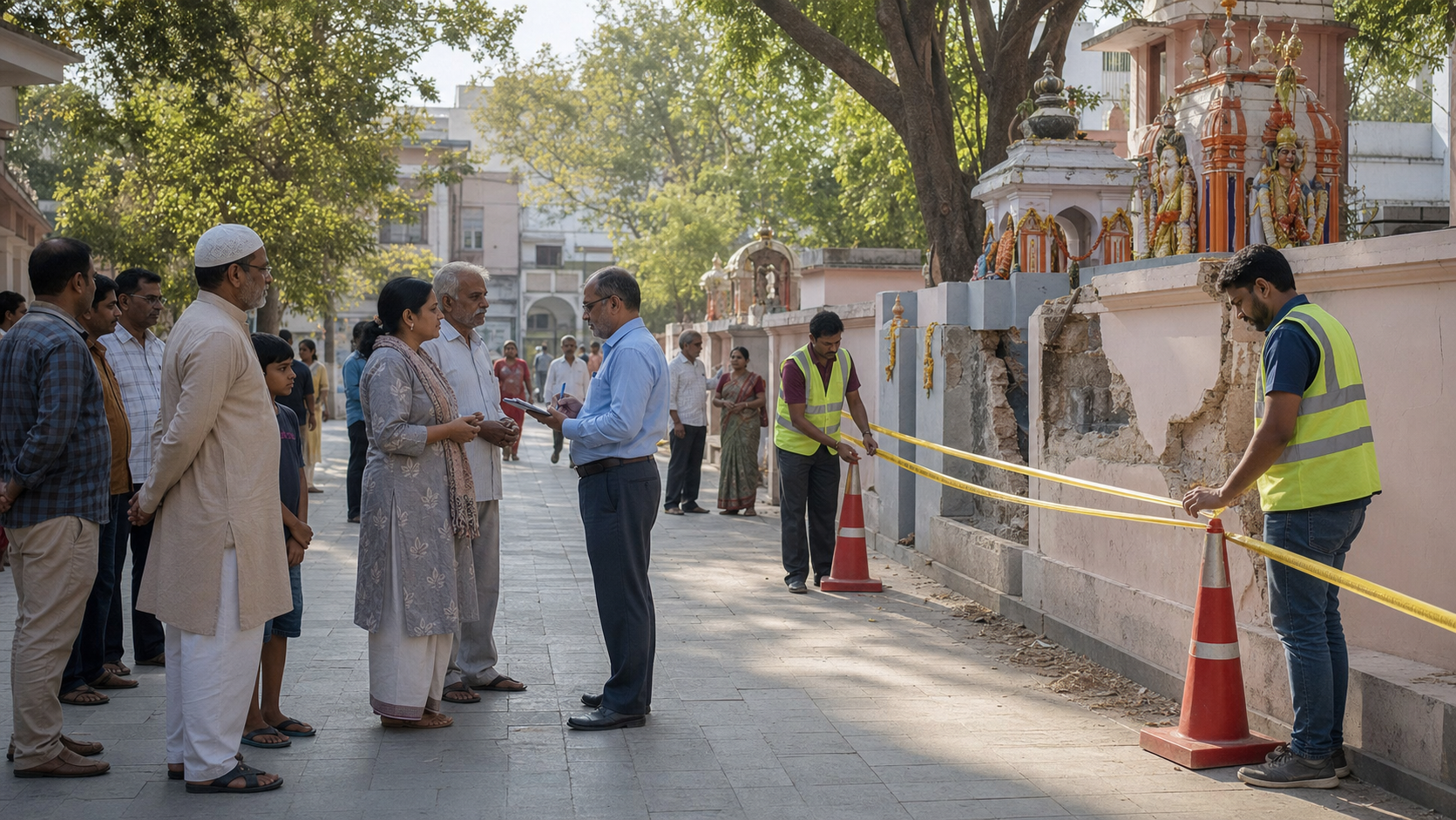
Do not minimise hostility directed at Hindus
During Eid processions across several Indian cities, violent clashes, provocative sloganeering near a Hindutva leader’s office, the covering of a Hanuman temple, and street confrontations were reported. Such allegations should be investigated rather than euphemised merely because the alleged perpetrators belong to a minority community. Minority status is not immunity from ordinary civic standards.
At the same time, an incident involving identifiable participants does not establish the guilt of everyone who shares their religion. Your response has two simultaneous duties: name targeted anti-Hindu conduct plainly when the evidence supports that description, and keep responsibility tied to the people and institutions connected to the conduct.
A consistent civic standard is straightforward:
- Sacred spaces must not be damaged, encroached upon, obscured, or turned into stages for intimidation.
- A religious procession may express faith but may not threaten people, damage property, or use proximity to another community’s sacred site as a provocation.
- Public authorities should protect potential victims, preserve evidence, and apply the same rules without changing the threshold according to religious identity.
- The identity of a victim must not be used to discount the harm, and the identity of an accused person must not be treated as proof of guilt.
- Verified facts, attributed allegations, and unresolved questions must remain visibly distinct in public communication.
Consistency does not mean inventing equal blame. Evidence may show that one side initiated an incident or that a particular institution bears responsibility. Equal standards can produce unequal conclusions when the facts warrant them. Pluralism requires fairness in the test, not artificial symmetry in the result.
Apply the same restraint to disputes among Hindus
Pluralism becomes opportunism if it only means asking other communities to tolerate Hindus. It must also govern disagreements among Hindus. Differences over teaching, ritual, authority, custom, or institutional control should not automatically become struggles over who has the right to exist within the Hindu fold.
Classify the dispute before choosing a remedy:
- A doctrinal disagreement calls for argument, interpretation, and patient listening.
- A ritual or customary disagreement calls for clarity about the community, temple, or lineage whose practice is being discussed.
- An institutional dispute calls for transparent rules, records, and accountable governance.
- An allegation of abuse, threat, or unlawful conduct calls for victim protection, evidence, and the appropriate lawful process. It should not be hidden behind theological language.
Try completing this sentence before joining an internal controversy: I oppose this specific claim, practice, decision, or act because of this reason, and I seek this particular remedy. If the sentence can only be completed by declaring every dissenter impure, traitorous, or beyond human concern, the dispute has stopped being an argument and become an exclusion campaign.
This does not eliminate legitimate boundaries. A temple, school, or spiritual community may define its teachings and practices. The pluralist requirement is narrower and more demanding: explain the relevant boundary, apply it through a known process, and do not convert institutional disagreement into hatred of persons.
A five-step response when a sectarian incident breaks

The first public version of an incident often becomes the version everyone defends, even after contrary details emerge. Build a procedure that slows only the claim, not the protection of people or sacred places.
- Freeze the original claim. Save the original link or file, the claimed location and time, and the identity claimed by the uploader. Note whether the material is direct testimony or a repost. Do not crop away context, and do not republish identifying images of private victims merely to prove urgency.
- Sort known, claimed, and unknown facts. Put each assertion into one of those three categories. If you cannot identify the basis for a detail, it belongs under unknown. Attach a name to every disputed allegation rather than allowing passive wording to make it sound established.
- Protect before confronting. If people or a site face immediate danger, contact the relevant emergency service, local authority, and temple or community management. Do not travel to a volatile scene merely to gather content or form a retaliatory crowd. For a property or filing dispute, preserve the records and seek qualified local legal help rather than attempting a physical takeover.
- Make a narrow, measurable demand. Ask for a protected perimeter, preservation of recordings and records, an impartial investigation, publication of findings, or restoration where the established facts and applicable law justify it. A demand that officials can perform and the public can verify is stronger than a slogan aimed at an entire community.
- Close the loop. Update the same channels that carried the original claim. Mark what was confirmed, corrected, or left unresolved. Keep a private incident file containing statements, evidence, correspondence, and outcomes. Publicly correcting an error protects your credibility for the next case.
A useful public statement can be only four sentences: We can confirm [established fact]. [Disputed claim] has been alleged by [named party] and remains contested. We ask the responsible authorities to [specific protective or investigative action], and we oppose threats or retaliation against uninvolved people. We will update this statement if the evidence changes.
Prepare the method before a crisis. Assign responsibility for three functions: evidence verification, safety and official liaison, and public communication. One person may perform more than one function in a small organisation, but the functions should remain separate. The person trying to secure a site should not also feel pressured to compose an instant verdict for social media.
Keep property records, authorised contacts, prior correspondence, and a blank version of the statement template where responsible community members can reach them. Then rehearse a fictional case involving a disputed temple incident or provocative procession. Ask what can be said, who must be contacted, what should remain private, and what evidence is still missing. Readiness allows you to act quickly without allowing anger to decide what is true.
Key takeaways
- Hindu pluralism permits strong convictions and firm boundaries; it rejects coercion, collective guilt, and hatred.
- Treat belief, institutional disagreement, and unlawful conduct as different categories requiring different responses.
- Separate established facts, attributed allegations, and unanswered questions before making a communal claim public.
- Apply one civic rule to every group while allowing the evidence, rather than false balance, to determine responsibility.
- Protect people and sacred sites immediately, but pursue accountability through verified evidence, precise demands, and lawful remedies.
The next time a provocation reaches you, pause before forwarding it and write three lines: what is known, what is disputed, and what protection or remedy is needed now. Act from those lines. Defend what must be defended, tell the truth about uncertainty, and refuse to conscript innocent people into someone else’s wrongdoing. That is how Hindu pluralism remains strong enough to confront sectarianism without imitating it.
References
- Hindu Jagruti Samiti – 125-year-old Hindu Temple demolished for Madrasa expansion in Pakistan’s Punjab
- Hindu Jagruti Samiti – Eid celebrations across multiple cities marked by unrest and violence by fanatics
- Hindu Blog – Why All sectarianism and fanaticism should be shunned? – Sri Aurobindo answers
