

You can chant every day and still feel that Gaudiya theology lives in one compartment while work, family duties, community life, and conflict occupy another. The problem is rarely a shortage of doctrine. More often, the missing piece is a clear connection between what you believe about Krishna and how you listen, serve, lead, and respond when your ego is crossed.
A coherent practice should help you hold divine majesty and intimacy together, receive rather than perform the holy name, turn remembrance into seva, and act with both courage and compassion. Those connections make theology usable. They also give you a way to notice when devotional activity is becoming mechanical, self-centred, or detached from conduct.
Hold Krishna’s majesty and intimacy together

Srimad Bhagavatam 1.8.31 brings you to a paradox at the heart of bhakti: the Supreme remains sovereign while voluntarily becoming intimate and approachable in relation to a pure devotee. Krishna does not cease to be Supreme when affection appears to place Him in a subordinate position. His willingness to reciprocate reveals freedom and tenderness rather than diminished power.
You need both sides of that paradox. If you retain majesty but lose intimacy, practice can become anxious and transactional: you perform the ritual correctly, yet approach Krishna mainly as a distant dispenser of protection or results. If you retain intimacy but lose majesty, Krishna can become a projection of your preferences. Devotion then starts to resemble self-expression with sacred vocabulary.
Gaudiya Vaishnavism names the deeper logic acintya-bheda-abheda: Krishna and His energies are inconceivably one and different. In practice, this protects relationship from two opposite mistakes. You can belong to Krishna without imagining that you are Krishna, and you can seek closeness without erasing reverence, dependence, or service.
Radharani makes this relational vision more precise. She is understood as Krishna’s chief internal potency and the embodiment of His pleasure potency. The material domain is associated with the external energy, while the internal potency reveals the realm of pure devotion, spiritual joy, and liberating knowledge. The practical question is not whether you can discuss these energies correctly. It is which influence governs your attention and choices.
The external pull is recognisable whenever practice becomes another project of possession: my achievement, my purity, my recognition, my experience. Receptivity to the internal potency moves in the other direction. It softens the demand to control spiritual results and strengthens truthful speech, restraint, tenderness, and service. This is why grace and disciplined sadhana are not rivals. Discipline prepares your attention; grace is never manufactured by that discipline.
Before you begin chanting, pause long enough to establish three intentions:
- Relationship: Krishna is not an object you are trying to master through technique.
- Receptivity: Your immediate task is to hear and respond, not to force a particular emotion.
- Service: Something in this practice should affect how you treat another person before the day is over.
This short preparation prevents a common inversion. The method is meant to serve remembrance and loving relationship; remembrance and relationship are not meant to serve your desire to feel accomplished.
Build one repeatable cycle of hearing, chanting, and seva

Gaudiya practice works best as a connected cycle. Katha gives the mind something true to remember. Japa and kirtan bring attention to the divine name. Seva gives remembrance an ethical and relational form. Reflection exposes the gap between aspiration and conduct. Sacred places and community can deepen the cycle, but they do not replace any of its parts. The combination of katha, kirtan, and attentive presence in sacred space shows how study, practice, and environment can reinforce one another.
Use the following sequence as a practical diagnostic, not as a replacement for disciplines you have received from guru or community:
- Prepare the field. Put away avoidable distractions, choose the text or mantra before you begin, and sit where you can hear yourself clearly. Removing one predictable interruption is more useful than making a dramatic promise about perfect concentration.
- Hear before accumulating. Read or hear a manageable passage of katha. Ask one question: What does this reveal about Krishna, the devotee, or the nature of service? Carry one answer into chanting rather than collecting many disconnected ideas.
- Chant as an act of reception. In japa, attend to the mantra that is being sounded now. In kirtan, hear the full lead before giving the response. When attention wanders, return to the next audible syllable instead of turning the lapse into a debate with yourself.
- Give remembrance a recipient. Choose one concrete act of seva. Complete a neglected duty, help someone without advertising it, repair unnecessarily harsh speech, or make another person’s burden lighter. A vague intention to be compassionate is difficult to test; a completed service is not.
- Review without theatre. At the close of the day, identify one moment when remembrance changed your response and one moment when pride, irritation, or control took over. Carry one correction into the next practice period.
If your available time contracts, reduce the length without discarding the connections. Hear a small amount, chant attentively, perform a definite service, and review honestly. A shorter intact cycle can teach you more than a longer session that never crosses into conduct.
The cycle also helps you locate specific imbalances. Study without prayerful hearing can make you skilled at analysing devotion while remaining personally untouched. Chanting without attention can preserve sound while losing encounter. Emotion without seva remains private consumption. Service without remembrance can become ownership, resentment, or exhaustion. When one of these patterns appears, do not condemn the entire practice. Restore the missing link.
Let listening govern both japa and kirtan

Listening is not a preliminary skill that you graduate from once you know the melody or mantra. It is the devotional posture inside the technique. At an early morning gathering, Srila Prabhupada invited several devotees to lead Gurvastakam and stopped them after two lines. Yamuna Devi listened closely enough to continue without interruption. His explanation condensed a theology of receptivity into a rule for sacred leadership.
Learn to listen. You cannot follow nicely unless you hear nicely, and you cannot lead nicely unless you have learned to follow nicely.
Srila Prabhupada
In japa, this means that the sound of the mantra is not background music for planning, worrying, or evaluating your spiritual condition. Begin at a pace at which the words can actually be heard. Let each mantra be a present address rather than one more unit completed. When the mind wanders, the useful event is not the wandering but the return. Come back audibly and without self-punishment.
- Keep the pronunciation clear enough that your ear has something definite to follow.
- Notice whether haste appears when you become uncomfortable, bored, or eager to finish.
- When attention leaves, return to sound before analysing why it left.
- After chanting, ask whether you listened more than you monitored your performance.
In congregational kirtan, listening becomes a form of seva to the whole assembly. The leader offers a phrase; the congregation receives and returns it. Mrdanga, kartals, melody, volume, and tempo support that exchange. When any participant treats the kirtan as a place to display complexity, the shared response can fracture even if the individual contribution is technically impressive.
- Hear the leader’s complete phrase before entering with the response.
- Match the melodic shape and tempo before adding a harmony or variation.
- Let instruments support the mantra rather than compete with the voices.
- Adjust volume so that the congregation can hear itself responding.
- If you are leading and the response begins to fray, simplify the melody and restore the common pulse.
A reliable diagnostic is simple: if you are planning your variation while someone else is chanting, you are preparing a performance rather than receiving a lead. Return to the phrase in front of you. Leadership becomes devotional when your first concern is the congregation’s ability to remember and respond, not the congregation’s opinion of your voice.
The same sequence applies beyond music. Hear before directing. Follow a sound discipline before revising it. Learn what a community is trying to protect before asserting your preferred method. This does not require passive agreement. It ensures that correction arises from understanding and service rather than the appetite to control.
Test devotion where power, conflict, and character meet
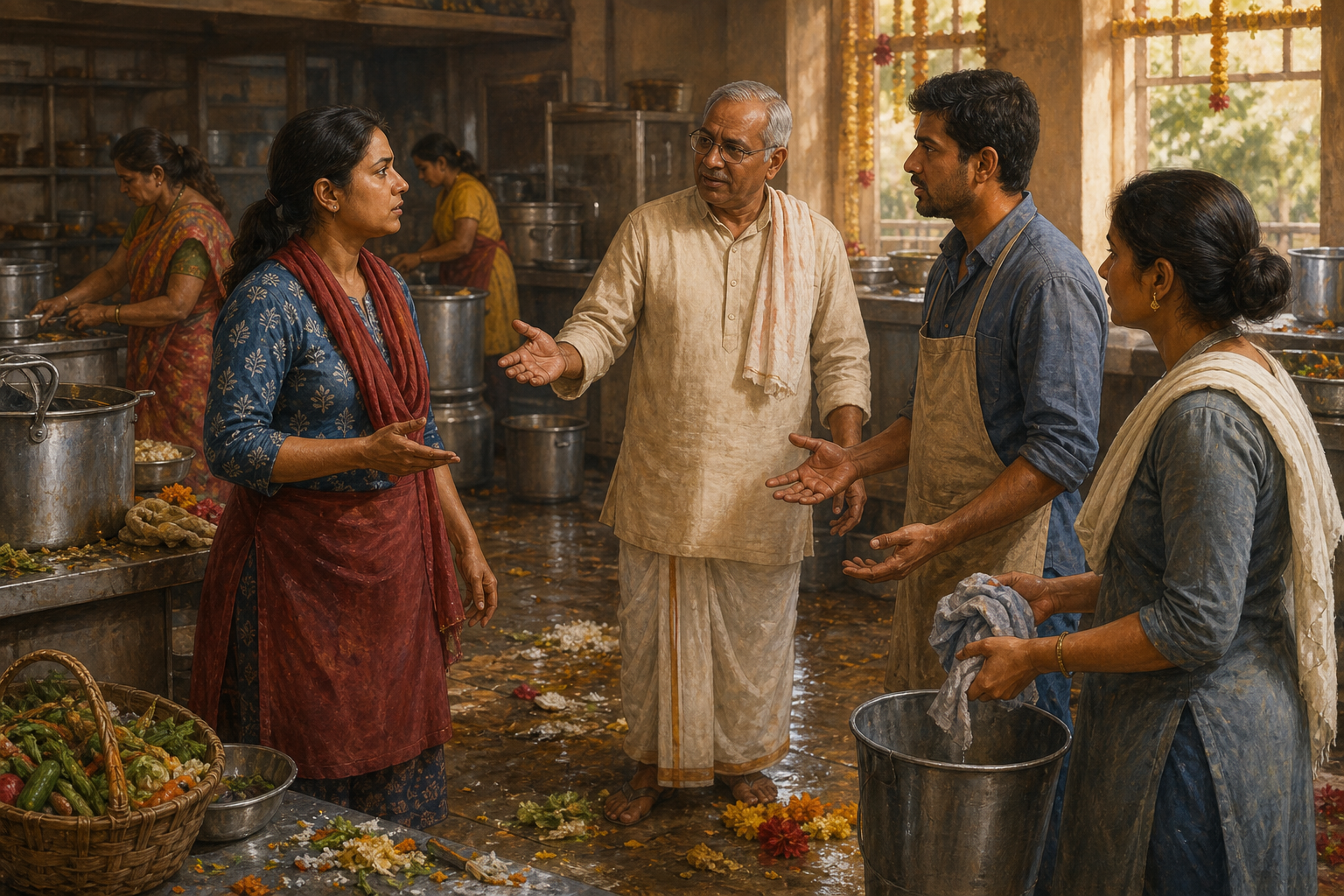
Devotional feeling matters, but intensity alone cannot tell you whether practice is maturing. The qualities associated with receptivity to Radharani’s internal potency include tenderness, truthful speech, restraint, humility, and service. These qualities give you observable tests. They do not reduce bhakti to respectable behaviour; they show whether remembrance is reaching the parts of life where self-interest normally rules.
- If chanting increases while your speech becomes harsher, stop using devotional quantity as your main measure. Repair the speech and bring that failure honestly into the next practice.
- If theological knowledge makes you impatient with sincere people from other Dharmic paths, preserve doctrinal clarity but remove contempt. Precision does not require caricature.
- If visible service comes easily but unrecognised service produces resentment, choose a useful task that offers little social credit.
- If devotional emotion repeatedly becomes a way to avoid an ordinary duty, complete the duty as seva before seeking another elevated experience.
- If you feel responsible for manufacturing every spiritual result, return to the distinction between disciplined receptivity and grace.
The Nrsimha tradition adds an essential edge to this examination. Bhakti is not passive niceness. Protection of the vulnerable, justice, compassion, courage, and ahimsa must be held together. At Nrsimha Palli, the sacred memory of Lord Nrsimhadeva washing His hands after slaying Hiranyakasipu places decisive protection beside purification and restraint. For a practitioner, that juxtaposition is a warning against confusing righteous action with enjoyment of anger.
When conflict calls for a response, move through four questions before you act:
- Who is actually vulnerable? Centre the person exposed to harm rather than your desire to appear forceful.
- What action will protect rather than merely punish? Choose a response that reduces harm without indulging humiliation.
- What is happening to your motive? Courage can coexist with compassion; revenge seeks emotional payment.
- What must be examined afterward? Once the immediate duty is complete, look for exaggeration, cruelty, vanity, or collateral harm and repair what you can.
Ahimsa does not require indifference to a victim, and courage does not grant a licence for rage. The devotional task is to protect without becoming inwardly devoted to the enemy image. That is difficult precisely because it demands strength and self-scrutiny at the same time.
Harihara Kshetra offers a related discipline through the harmony of Hari and Hara. Unity across the Dharmic family does not require pretending that Hindu, Buddhist, Jain, and Sikh doctrines are interchangeable. It asks whether conviction can coexist with respect. Compassion, ahimsa, seva, humility, and self-mastery create real grounds for cooperation while differences remain visible.
Ask yourself a demanding question: Has my devotion made me safer for vulnerable people, more truthful when truth costs me, less hungry for recognition, and more capable of hearing before reacting? If the answer is no, you do not need a theatrical rejection of bhakti. You need to reconnect chanting, theology, seva, and conduct.
Key takeaways for a coherent Gaudiya practice
- Hold Krishna’s supremacy and intimacy together. Awe without relationship becomes remote; familiarity without reverence becomes self-projection.
- Understand acintya-bheda-abheda as a guide to relationship: closeness does not erase distinction, and distinction does not make loving reciprocity impossible.
- Approach Radharani’s internal potency through receptivity, truthful conduct, restraint, tenderness, and seva rather than through the pursuit of spiritual sensation.
- Keep hearing, chanting, service, and review connected. When practice becomes dry or distorted, identify the missing link before adding more activity.
- In japa and kirtan, listen before evaluating or embellishing. The ability to follow is part of the qualification to lead.
- Test devotion during conflict. Protect the vulnerable, act with moral clarity, refuse revenge as a devotional mood, and examine your conduct afterward.
At your next practice, do not add another ambitious vow. Keep the discipline you already have and restore one missing connection: hear something meaningful before chanting, carry one remembered truth into a concrete act of seva, and examine the result at the end of the day. Once that cycle becomes honest and stable, deepen it.
References
- Dandavats – Essential Insights from a Transformative Visit to Harihara Kshetra and Nrsimha Palli
- Dandavats – Essential Insights on SB 1.8.31: Discover the Lord’s Majesty and the Devotee’s Transforming Love
- Dandavats – Discover the Ultimate Secret of Radhastami: Radharani’s Potency That Conducts the Spiritual World
- Dandavats – Master the Art of Kirtan: Srila Prabhupada’s Proven Lesson on Listening and Leadership
