
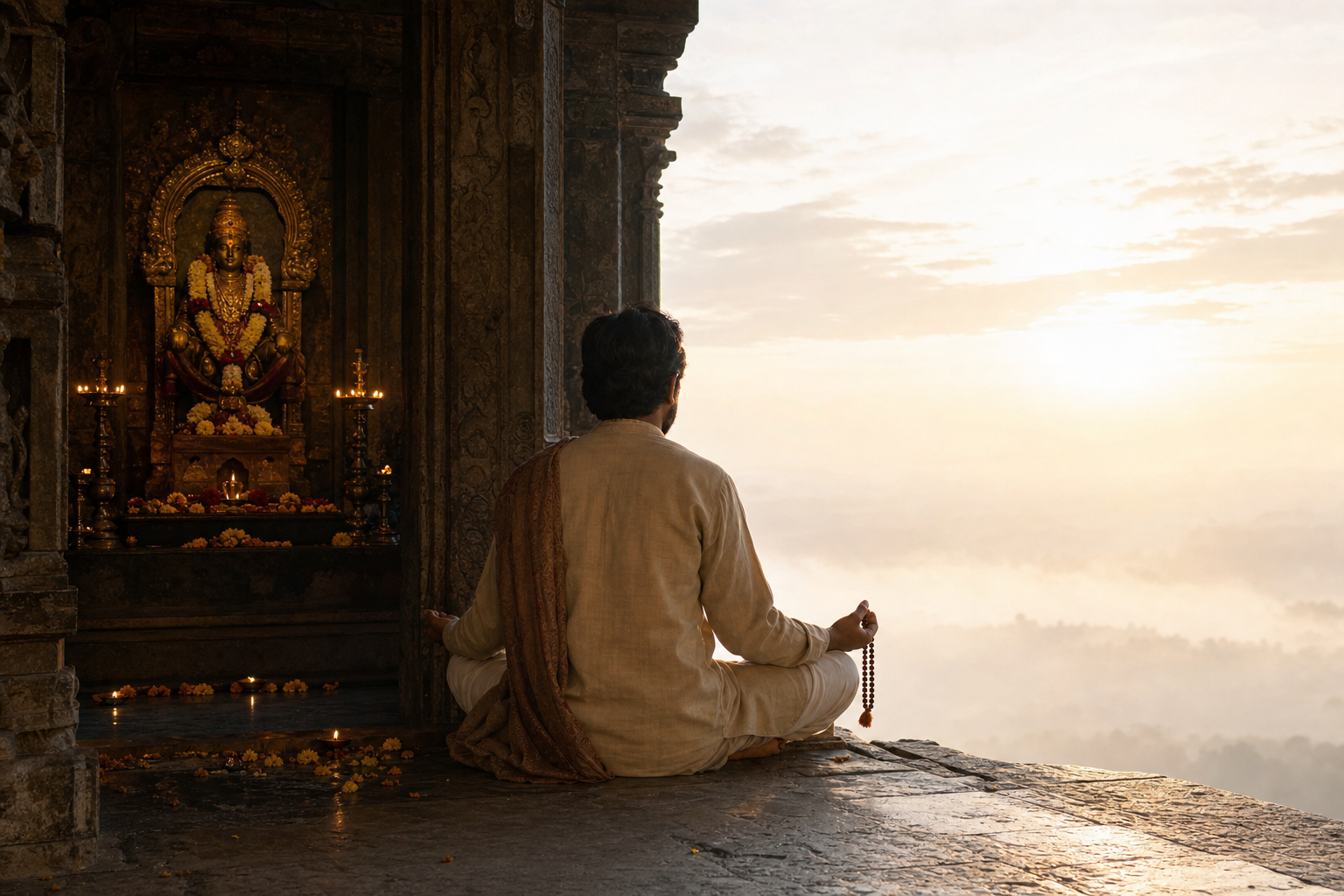
You may feel deeply present before a murti, during kirtan, or while repeating a divine name, yet still wonder whether dependence on form keeps you from the highest truth. Or perhaps silent inquiry attracts you, but its abstractions leave the heart untouched. That tension can make an honest seeker think a permanent philosophical choice must come before serious practice.
You don’t need to settle every debate before beginning. You do need to know what each path asks of you, which weakness in your present sadhana it addresses, and how to tell whether it is producing freedom rather than a more spiritual-looking ego.
Name the choice correctly before you make it
Two distinctions are often compressed into one. Nirguna refers to reality beyond limiting qualities and the three gunas, while Nirakar means without spatial form. Saguna refers to the Divine approached through qualities such as compassion, grace, and bliss; Sakar refers to meaningful form. The pairs overlap in ordinary discussion, but they answer different questions: Does the Divine have describable attributes, and can the Divine be approached through form?
This matters because a murti does not imply that infinity has been reduced to an object. Form gives attention, emotion, memory, and reverence a disciplined center. The form points beyond itself without becoming disposable. In the other direction, formless contemplation is not an attempt to imagine an empty space. It releases the mind’s habit of treating every concept, image, mood, and identity as the final reality.
The Upanishadic movement of neti neti, “not this, not this,” removes false limits. It need not deny the sacredness of manifestation. Temple darshan, nama-japa, and loving worship make the transcendent intimate. They need not claim that one visible form exhausts the Divine. The contradiction appears only when either method is mistaken for a complete definition of Brahman.
| Orientation | Usual practices | What the practice trains | Main correction to remember |
|---|---|---|---|
| Nirguna-Nirakar | Silence, inquiry, meditation, witness-consciousness | Disidentification from passing thoughts, qualities, and roles | Conceptual negation is not realization; look for equanimity and non-attachment |
| Saguna-Sakar | Nama-japa, kirtan, murti-puja, darshan, contemplation of an Ishta Devata | Concentrated attention, reverence, surrender, gratitude, and loving relationship | The chosen form reveals the Divine; it does not confine the Divine |
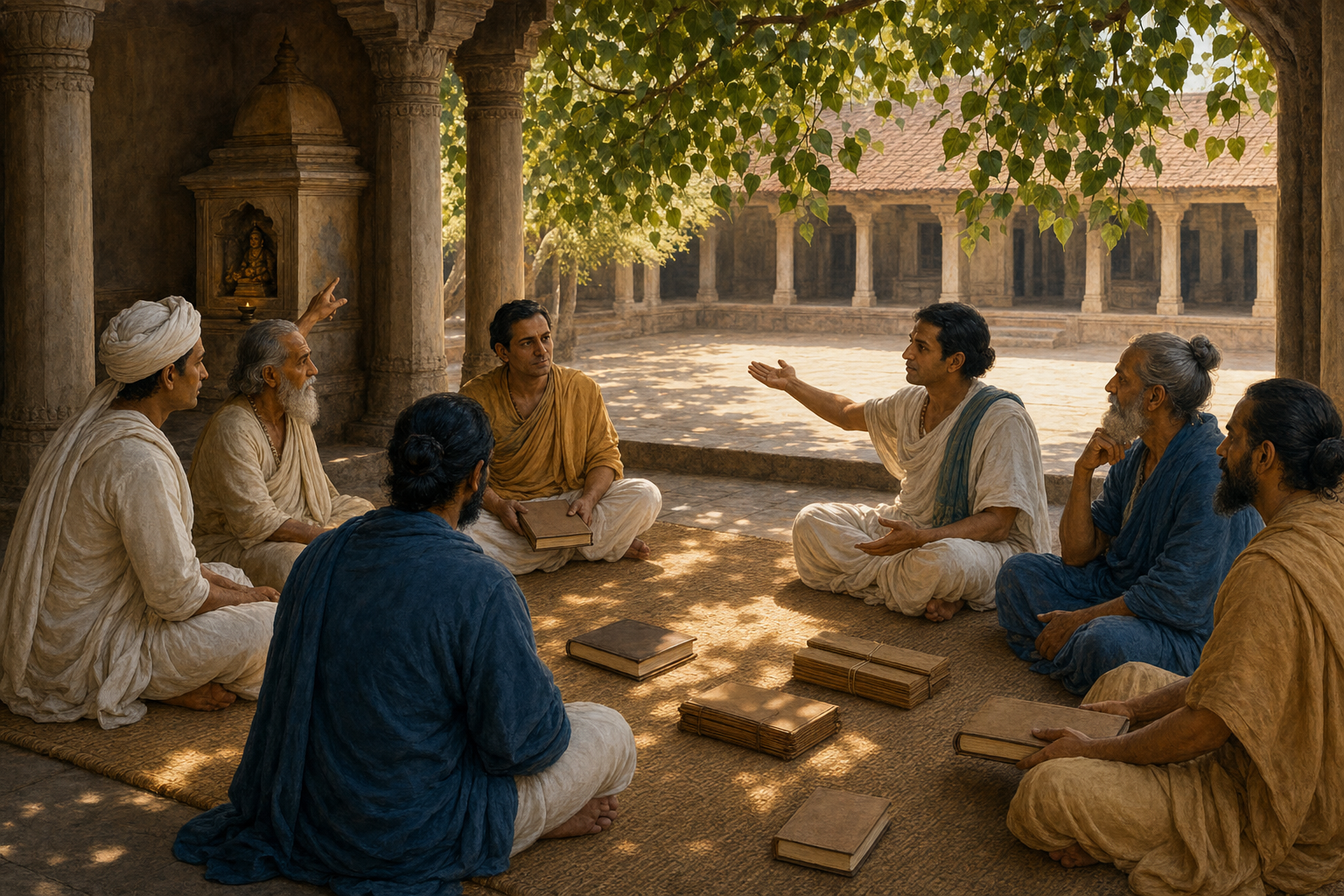
You should also be cautious whenever someone calls one side “merely preliminary” without naming a philosophical school. Advaita Vedanta treats Nirguna Brahman as ultimate and Saguna Ishvara as the Divine encountered within empirical experience. Vishishtadvaita and Dvaita place the reality of divine qualities at the center while maintaining that the Divine exceeds finite human description. These are genuine differences, not vocabulary problems that disappear under a slogan.
Before accepting advice about the “higher” path, ask which lineage’s understanding of liberation is being used. A practice can be fruitful outside your inherited sampradaya, but borrowing its technique while ignoring its account of the Divine often creates confusion later.
Choose the path that addresses your recurring obstacle
Temperament matters, but preference alone is a weak guide. People naturally prefer practices that preserve their existing habits. An intellectual person may choose inquiry because it avoids surrender. An emotional person may choose devotional intensity because it avoids stillness. The more useful question is not “Which path resembles me?” but “Which discipline exposes what presently governs me?”
Begin with a manifest center if your attention scatters as soon as meditation loses an object. A divine name gives the mind something exact to return to. A murti coordinates sight, posture, memory, and feeling. An Ishta Devata lets devotion become a sustained relationship rather than an occasional emotion. This is especially useful when abstract reflection produces many ideas but little steadiness.
Begin with formless contemplation if devotional practice has become possessive, performative, or mechanically transactional. Silence can reveal whether you love the Divine or mainly love the reassurance, identity, and reward associated with worship. Inquiry can loosen the assumption that one image, one mood, or one theological description captures the unlimited reality toward which the practice points.
If neither description fits cleanly, use these questions to select a primary orientation:
- When you sit without an object, does attention become clear or merely vague? Vague drifting calls for a firmer anchor, not grander metaphysics.
- When you repeat a name or stand before a murti, does reverence deepen or does the action run automatically? Mechanical repetition calls for renewed meaning and deliberate attention.
- Does inquiry make you less attached to praise, status, and certainty, or simply better at arguing? If pride is growing, intellectual fluency is disguising the original problem.
- Does devotion make you more patient and responsible toward people, or more concerned with displaying religious identity? If conduct is hardening, emotion has not yet matured into bhakti.
- Can you explain how your practice understands moksha? If not, learn that from a qualified teacher in the lineage before combining techniques whose aims may differ.
Steadiness is more important than novelty. Once you choose a primary discipline, stop renegotiating the choice whenever a different practice produces a stronger mood. A path becomes revealing when it remains present after its initial freshness has passed.
Combine form and formlessness without muddling them
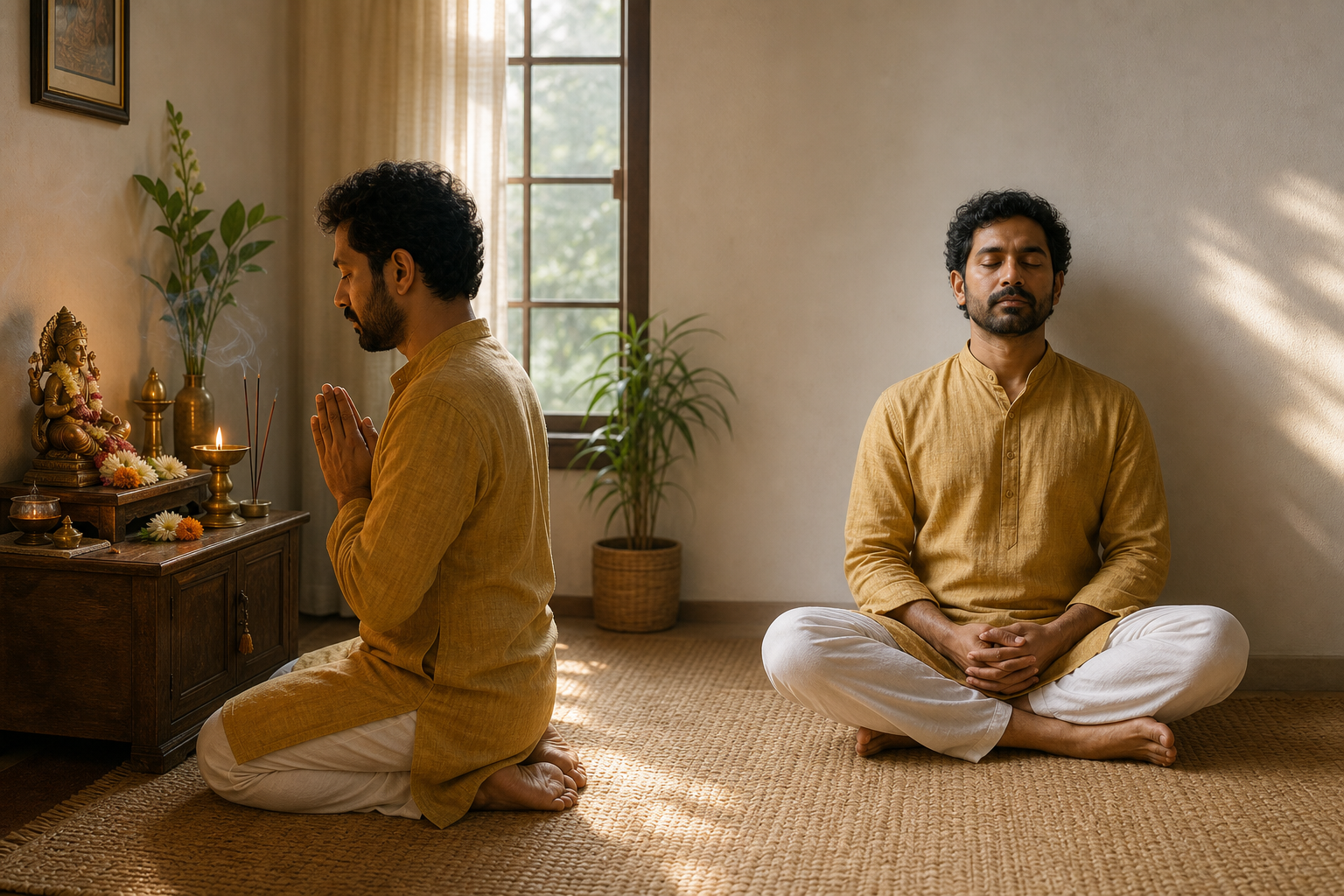
You can honor both approaches without turning daily sadhana into an improvised collection of techniques. Keep one path primary and let the other correct its predictable imbalance. The supporting practice should deepen the center, not provide an escape whenever the central discipline becomes demanding.
A manifest-first rhythm
- Approach one chosen form or name deliberately. Recall the divine quality you intend to receive and embody, rather than beginning by habit.
- Perform nama-japa, kirtan, puja, or contemplation with full attention. When the mind wanders, return to the same name or form instead of searching for a more stimulating one.
- After the active devotion, remain silent. Do not discard the form or mentally argue against it. Notice the awareness in which the name, image, affection, and silence are all known.
- Carry one quality of the Ishta Devata into conduct. Compassion should become a concrete act of care; steadiness should become restraint under pressure; grace received should become generosity offered.
This movement from devotion toward knowledge has a clear model in Dattatreya practice. Dattatreya is approached as a manifestation of Narayana while also serving as a living symbol of Brahman. Form gathers devotion; contemplation discloses what the form has been teaching. Knowledge then protects devotion from becoming narrow or merely sentimental.
A formless-first rhythm
- Settle attention and observe thoughts, sensations, roles, and self-descriptions as objects appearing in awareness.
- Use inquiry to reject each limited object as the whole Self. Do not replace one object with a mental picture of featureless blankness.
- Notice the temptation to turn “formless” into a new identity: detached, superior, beyond ritual, or beyond devotion. That identity is another appearance to examine.
- Close with gratitude, remembrance of a divine name, or seva. This gives insight an ethical and relational expression rather than leaving it as a private mental achievement.
The two rhythms are not identical, and they need not be forced into a single doctrinal formula. Their practical convergence lies in purification of attention, weakening of egoic attachment, ethical steadiness, and a less fragmented relation to reality.
Judge the practice by its fruit, not its atmosphere
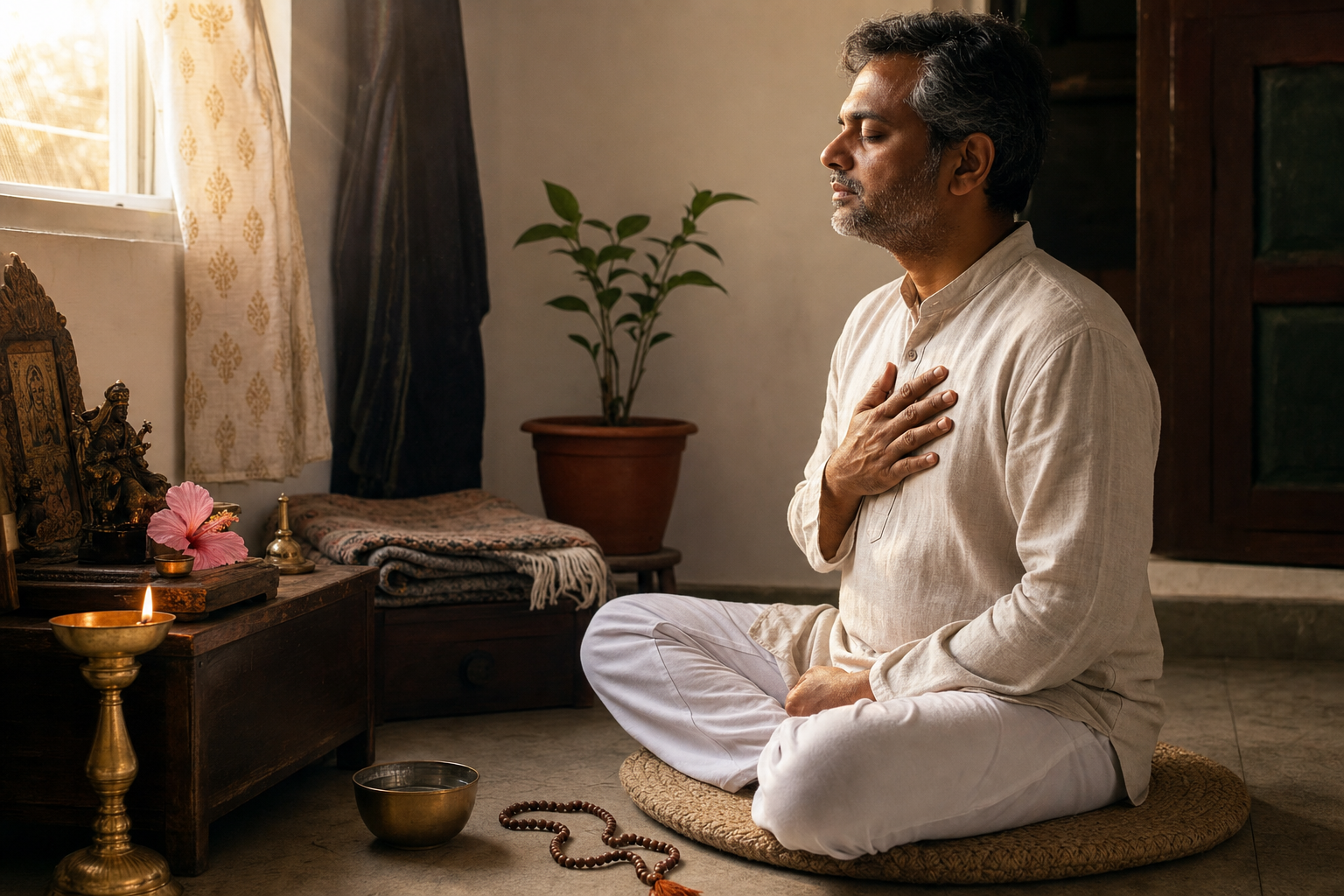
A peaceful sitting, an intense kirtan, or a powerful darshan may encourage you, but an experience is not yet liberation. Philosophical certainty is not liberation either. The dependable test appears when ordinary life presses against your preferences.
Nirguna practice should make it easier to notice anger, fear, praise, and blame without being completely possessed by them. If “everything is Brahman” becomes a reason to neglect duties or dismiss another person’s suffering, abstraction is being used to avoid dharma. Return to ethical responsibility and ask whether non-attachment has quietly become indifference.
Saguna practice should turn reverence into service, humility, and care. If love for your chosen deity produces contempt for another authentic form of worship, the ego has annexed bhakti. Return to the qualities represented by the deity and enact them toward someone from whom you expect no religious agreement or personal reward.
Both paths therefore require ethical verification. Formless insight without compassion is incomplete in practice. Devotional warmth without self-restraint is unstable. A useful personal review is simple: identify one recent moment of conflict, temptation, or wounded pride and ask what your sadhana changed in your response. If nothing changed, adjust the way you are practising before collecting additional teachings.
Dharmic traditions offer related disciplines without becoming interchangeable. Sikh thought holds Nirgun and Sargun together and centers remembrance of Naam. Buddhist mindfulness and insight resonate with the discipline of attending beyond fixed concepts. Jain anekantavada encourages humility before the many-sidedness of truth, while ahimsa and tapas keep realization accountable to conduct. These resonances reveal a shared civilizational grammar, but they do not erase real differences in how Hindu, Buddhist, Jain, and Sikh traditions understand the self, ultimate reality, and liberation.
That distinction gives you a sound rule for learning across traditions: receive a practice in its own vocabulary before translating it into yours. Respect grows from precision, not from declaring every teaching identical.
Key takeaways
- Nirguna and Nirakar concern freedom from limiting qualities and form; Saguna and Sakar concern the Divine made accessible through qualities and meaningful forms.
- You do not have to reject murti, mantra, or devotion to contemplate the formless. You also do not have to treat manifest worship as a temporary mistake.
- Choose a primary path by the obstacle it addresses: scattered attention may need form, while possessiveness or excessive conceptualization may need silence and inquiry.
- When combining paths, keep one central. Let silence deepen devotion, or let remembrance and seva keep inquiry humble and embodied.
- Measure progress through non-attachment, steadiness, compassion, humility, and responsible conduct, not through intensity of feeling or sophistication of language.
For your next practice, make one clear decision. If attention needs gathering, return to one name or form and stay with it. If devotion needs widening, remain in silence after worship and notice the awareness that no image can contain. Then carry the result into one ordinary act of restraint, service, or compassion. Liberation becomes credible when the path changes how you meet the next person and the next difficulty.

References
- DharmaRenaissance Blog — Dattatreya Upanishad: Timeless Vaishnava Wisdom on Jnana, Bhakti, and Inner Liberation
- DharmaRenaissance Blog — Nirguna Nirakar and Sagun Sakar: Unlocking Hinduism’s Divine Paradox for Inner Unity
