
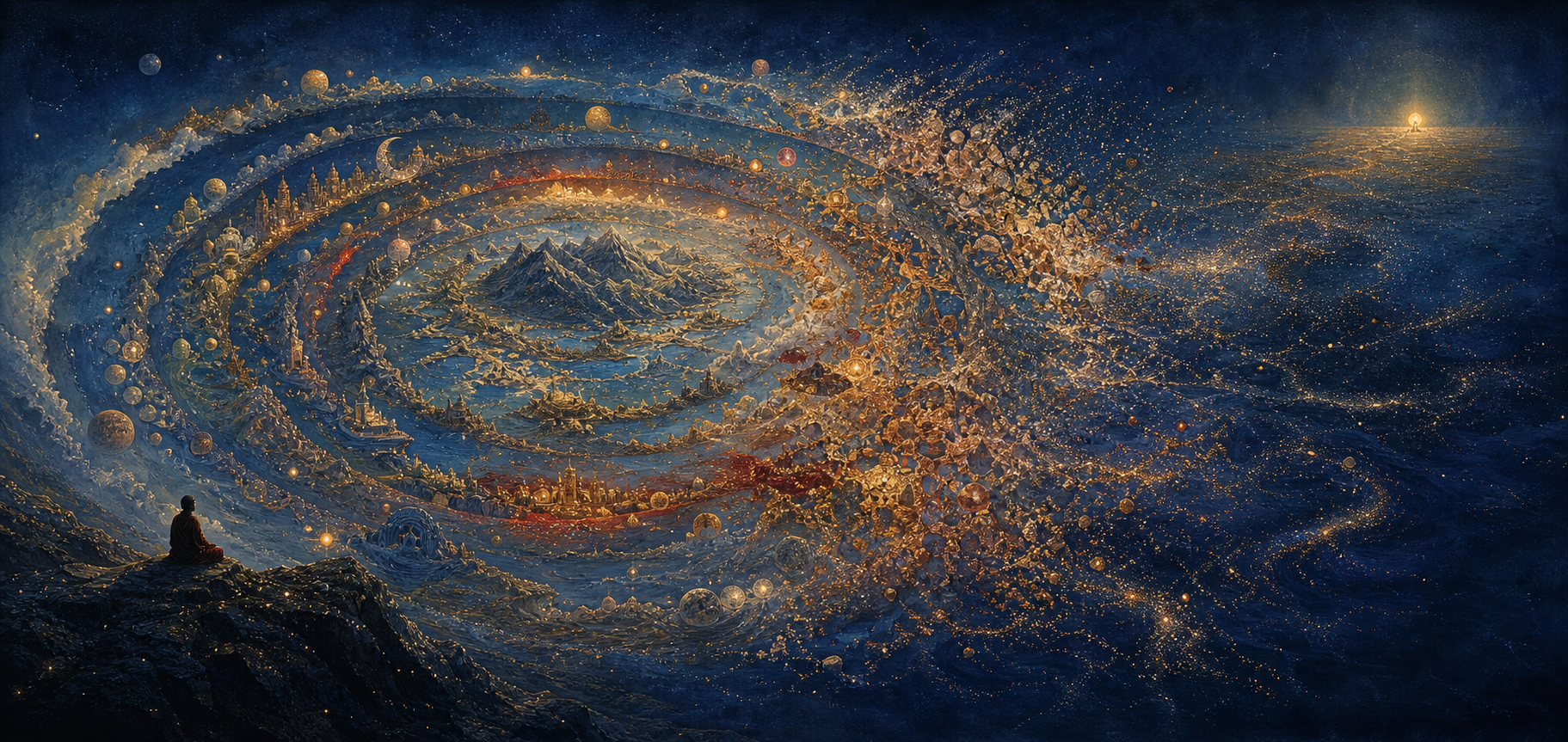
You encounter pralaya in a Purana, see Shiva dancing amid flames, and then hear someone identify both with the Big Crunch. Three different questions have just been folded into one word. Unless you separate them, cosmic dissolution can sound either frighteningly nihilistic or suspiciously like a scientific claim it was never meant to be.
The useful question is not simply, Does the universe end? Ask what ends, at what level, what remains, and what the teaching expects you to do now. Those four questions reveal both the shared Dharmic intuition of impermanence and the real doctrinal differences among Hindu, Buddhist, Jain, and Sikh traditions.
First ask what, exactly, is being dissolved
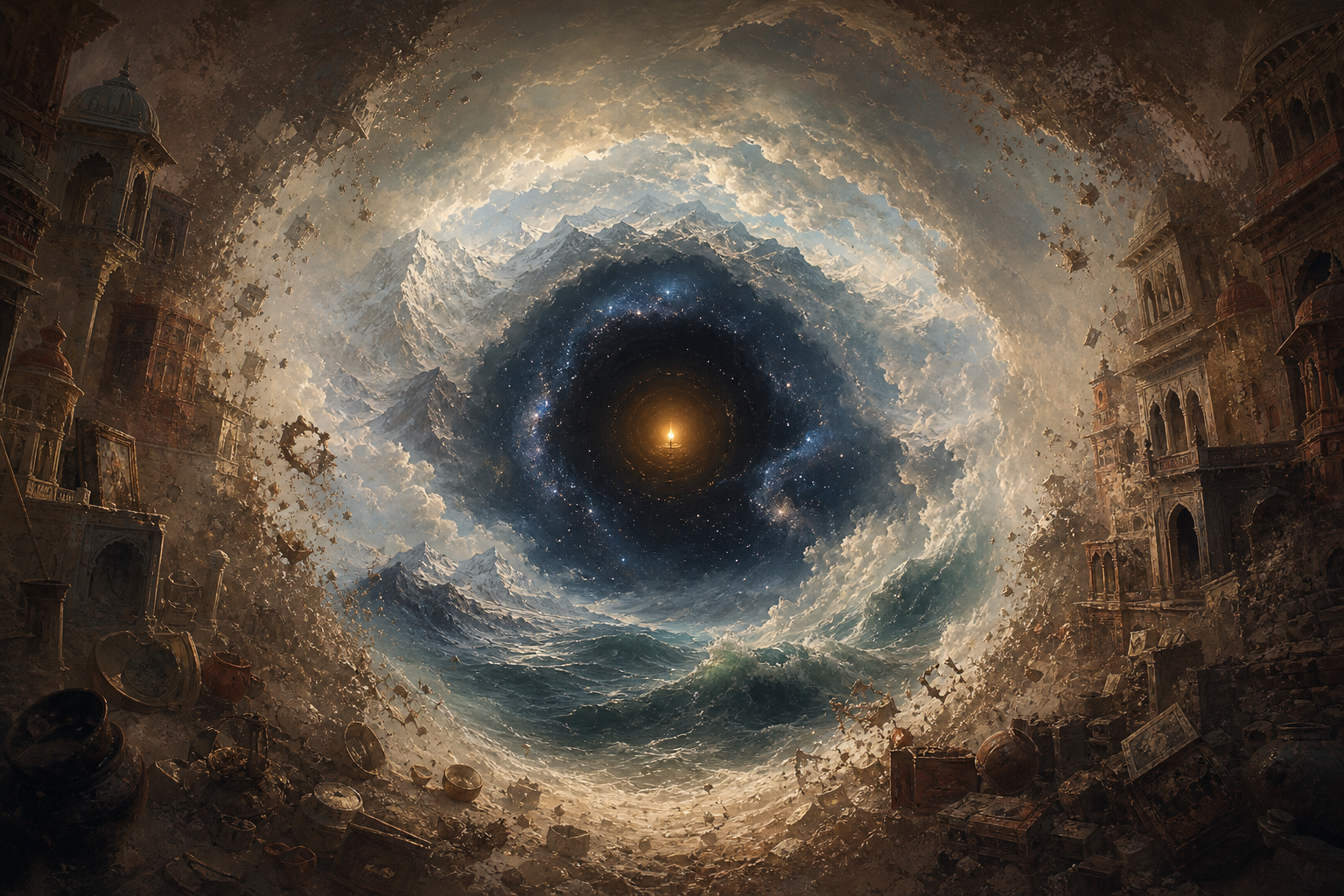
Cosmic dissolution is not automatically absolute non-being. In many Hindu settings, laya means absorption or resolution: differentiated forms cease to operate as separate forms and return to a subtler condition. Saṁhāra emphasizes destruction or withdrawal. Pralaya commonly names a dissolution within a larger cosmic cycle. The precise scope varies with the text and school, so translating every occurrence as the end of everything erases the teaching you are trying to understand.
Use this four-part check whenever you meet the language of an ending:
- Name the object. Is the text discussing a body, an identity, a social order, a world-system, manifest nature, or all differentiated existence?
- Name the process. Does the object burn, disintegrate, become inactive, return to equilibrium, lose its apparent separateness, or merely pass out of human perception?
- Name what remains. Is there an unmanifest causal condition, pure awareness, karmic continuity, a beginningless cosmos, divine order, or no permanent substrate at all?
- Name the human consequence. Is the teaching asking for devotion, insight into impermanence, freedom from karmic bondage, humility, or more responsible conduct?
The Hindu sequence sṛṣṭi–sthiti–laya—manifestation, maintenance, and dissolution—places endings inside a rhythm. Śaiva traditions make the analysis still finer through the five divine acts: creation, maintenance, dissolution, concealment, and grace. Dissolution, veiling, and liberation therefore cannot be treated as interchangeable words. A form may be withdrawn without ignorance being removed; ignorance may be exposed before bondage is finally released.
That distinction changes how you read fierce imagery. Fire may signify physical destruction, the exhaustion of a condition, the exposure of illusion, or the purification of attachment. Before deciding which meaning applies, finish this sentence in the margin: The thing being dissolved here is… If you cannot name it, you are not yet ready to interpret the image.
The Dharmic traditions share scale, not one identical cosmology

Hinduism, Buddhism, Jainism, and Sikhism all dislodge the human ego from the center of existence. They speak of immense durations, many realms, recurring conditions, or innumerable worlds. That family resemblance matters, but it does not turn four traditions into variations of a single doctrine.
| Tradition or framework | How dissolution is framed | Misreading to avoid | Question to carry into the text |
|---|---|---|---|
| Purāṇic Hindu cosmology | Manifestation, maintenance, and withdrawal occur cyclically; creation can be imagined through the breathing of Mahāviṣṇu. | Treating every pralaya as absolute nothingness or as one final event after which nothing can manifest. | Which cosmic level is being withdrawn, and into what condition? |
| Śaiva theology | Saṁhāra belongs to a fivefold divine activity that also includes concealment and grace. | Assuming Shiva destroys from rage, or that destruction by itself is liberation. | How does the withdrawal of form prepare recognition or grace? |
| Buddhist cosmology | World-dissolution unfolds across vast saṃvarta-kalpas, while impermanence governs conditioned existence. | Importing an eternal creator or permanent cosmic Self into a framework that does not require one. | What attachment becomes untenable when even world-systems are impermanent? |
| Jain cosmology | Lokākāśa is beginningless and endless; ascending and descending time-waves order recurring cosmic history. | Saying the cosmos is created from nothing and later annihilated by an external deity. | Which conditions change within the enduring cosmic order? |
| Sikh vision | Countless realms and universes exist within the order of Ik Onkar, from whom multiplicity arises and into whom it resolves. | Reducing scriptural wonder to a mechanical timetable copied from another tradition. | How does immeasurable plurality deepen humility before the One? |
The Bhāgavata vision of cosmic breathing and vast kalpas trains the mind to think beyond a single human lifetime. A kalpa of 4.32 billion years is spiritually and imaginatively significant within that framework. It should not be presented as though it were obtained through telescopes, radioactive decay, or a modern cosmological calculation.
Buddhist world-cycles sharpen a different insight: anything dependent upon conditions is impermanent, even if its duration overwhelms ordinary imagination. Jain cosmology blocks another easy generalization because its universe is beginningless and endless rather than a manufactured object awaiting final erasure. Sikh references to countless khaṇḍ and brahmāṇḍ place multiplicity within divine order without requiring you to convert Gurbani into a Purāṇic chronology.
You can therefore affirm a Dharmic kinship without manufacturing a false consensus. The shared lesson is that reality exceeds the scale of personal anxiety and possession. The disputed question is what ultimately exists, what continues, and how liberation is understood. Preserve both levels: civilizational kinship and doctrinal precision.
Tripura Tandava turns dissolution into an inner diagnostic
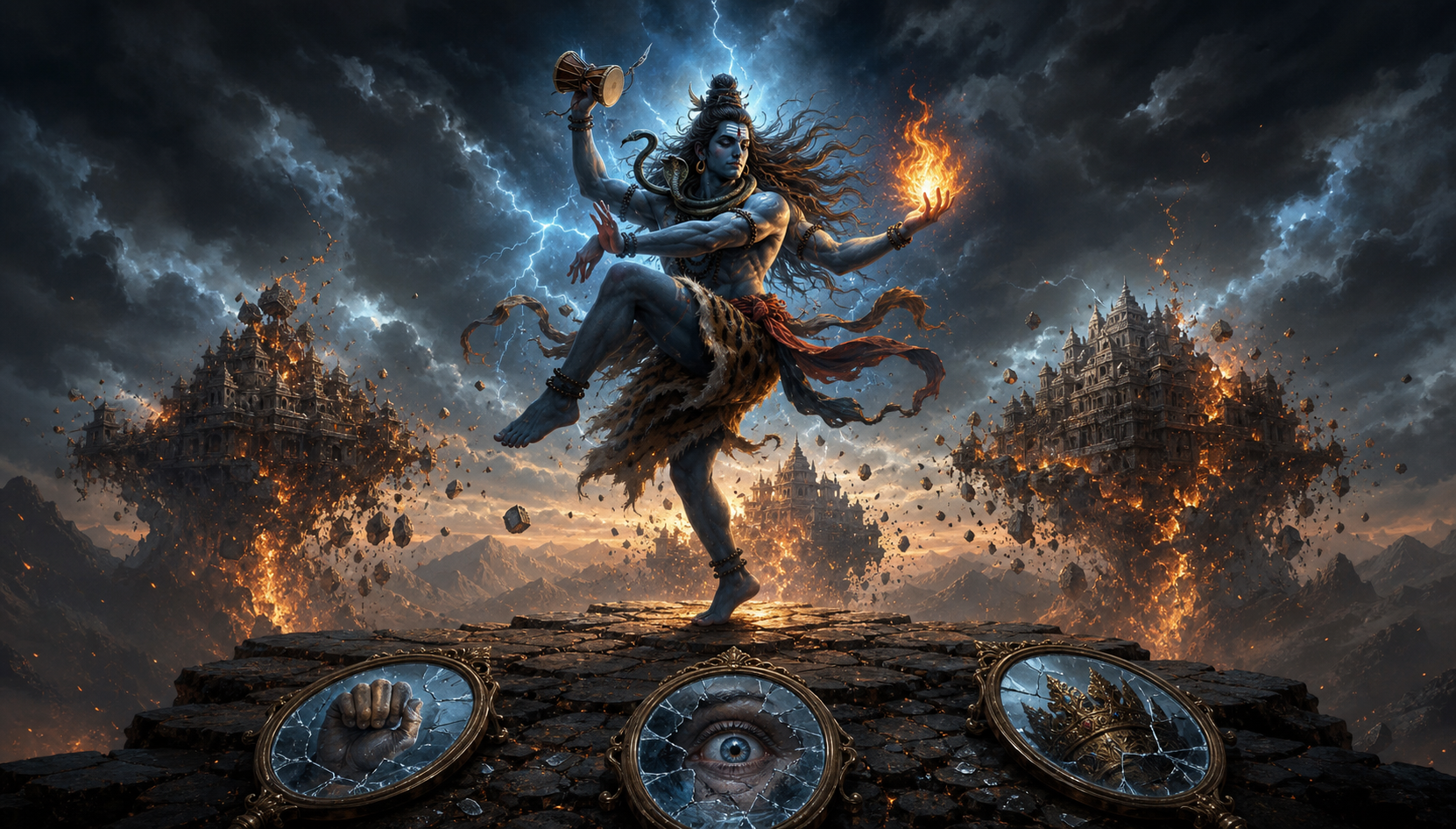
Tripura Tandava gives cosmic dissolution a body, a rhythm, and a target. In the Purāṇic narrative, the three fortified cities of the asuras become vulnerable only when they align. Shiva acts as Tripurāntaka with one decisive arrow. The cosmic chariot gathers Earth, the Sun and Moon, Meru, Vāsuki, Viṣṇu, Agni, and Vāyu into a single coordinated act. The point is not indiscriminate devastation. Scattered powers become effective through exact alignment.
The mythic destruction of three cities is not, by itself, a claim that the entire cosmos has reached pralaya. Its Śaiva symbolism expands the event into a map of dissolution. Tripura can represent the three guṇas; the gross, subtle, and causal bodies; waking, dream, and deep sleep; or the three impurities of smallness, differentiation, and accumulated karma. These are several interpretive lenses, not ingredients to mix indiscriminately.
Choose one triad at a time:
- If you choose the three guṇas, dissolution means the dynamic qualities of nature becoming quiescent in equilibrium. The question concerns cosmic manifestation.
- If you choose the three states, waking, dreaming, and deep sleep are witnessed from the standpoint of turīya, the fourth. The question concerns awareness.
- If you choose the three bodies, the inquiry moves from physical identity through subtle experience to deep causal tendencies. The question concerns what you mistake for the whole self.
- If you choose the three impurities, the target is bondage: felt limitation, the field of differentiation, and karmic accretion. The question concerns insight and grace.
This method prevents a common error. A symbol can carry several valid meanings without meaning all of them in the same sentence. State your chosen lens, follow it consistently, and then ask what its dissolution discloses.
The distinction among saṁhāra, tirodhāna, and anugraha is especially important. Saṁhāra withdraws a manifested order. Tirodhāna names concealment or veiling. Anugraha is grace, through which recognition becomes possible. In contemplative interpretation they can form a sequence: the apparent order loses its grip, the mechanism of concealment is recognized, and what was obscured becomes evident. Yet the terms should not be collapsed. Losing something is not automatically awakening.
The iconography reinforces the same discipline. A many-armed Shiva distributes agency across weapons, emblems, and gestures. The ḍamaru marks rhythm and measured time; the trident pierces triplicity; the deer evokes the restless mind; the sword cuts; the noose binds or gathers; abhaya offers protection. Sixteen-armed depictions occur, but the attributes vary across regional āgamic and artistic traditions. Do not decode a sculpture from a generic checklist. First identify what is actually present, then interpret its relationship to the whole posture.
You can use Tripura as a sober self-examination without pretending to perform an initiation-only practice:
- Name one attachment or habit whose apparent strength depends on several parts of your life remaining misaligned and unexamined.
- Examine it at three levels: bodily behavior, emotion and thought, and the deeper assumption that keeps recreating it.
- Write one sentence each for right understanding, right action, and devotional or contemplative support. This is your bow, string, and arrow.
- Choose one action that all three support. Do it without turning Shiva’s imagery into permission for aggression toward yourself or anyone else.
If Om Namaḥ Śivāya already belongs to your practice, steady repetition can accompany the inquiry. Detailed mantra, breath, and visualization methods should come through a qualified lineage. The transferable principle is alignment: attention, conduct, and devotion must point in the same direction before release becomes more than an idea.
Science can refine wonder without proving scripture

Modern cosmology and Dharmic cosmology can be placed in conversation, but they do not use the same instruments or answer every question in the same way. The hot, dense early state called the Big Bang is supported by converging empirical evidence: cosmic expansion, the cosmic microwave background, primordial nucleosynthesis, and large-scale galactic structure. Within the prevailing ΛCDM model, roughly 5 percent of the cosmic energy budget is ordinary baryonic matter, about 25–30 percent is dark matter, and about 65–70 percent is dark energy.
Those findings do not establish a Purāṇic cycle, Mahāviṣṇu’s breathing, Buddhist impermanence, Jain cosmic eternity, or Sikh divine order. They describe measurable physical behavior. Conversely, metaphysical teachings do not replace redshift surveys, mathematical models, or observations of the microwave background.
The numbers make the distinction particularly clear. The scientific age of the observable universe is about 13.8 billion years, while Earth is about 4.54 billion years old. A Purāṇic kalpa is 4.32 billion years. The proximity of the latter two figures can awaken a legitimate sense of wonder, but similarity of scale is not identity of method. One is part of a scriptural cosmological framework; the other comes from independent physical measurements. Treating the resemblance as proof weakens both forms of inquiry.
The same caution applies to cosmic endings. Continued accelerated expansion toward heat death is favored under present observations and an equation-of-state near w ≈ −1. A Big Rip would require different dark-energy behavior, while a future recollapse or Big Crunch would require conditions to reverse. None should be announced as the scientific confirmation of pralaya. Cosmology retains open questions about dark energy and physics at inaccessible extremes; Dharmic teachings address meanings that a physical equation is not designed to settle.
Apply this test before sharing a science-and-scripture comparison:
- Same referent? Are both claims actually about measurable spacetime, or is one about consciousness, divine action, karma, or liberation?
- Same method? Was the claim reached through observation and inference, reliable testimony, contemplative realization, or symbolic exegesis?
- Same predictive burden? Does either claim specify an observation that could count against it, or is it supplying orientation and meaning?
- Same conclusion? A shared image or large timescale may support dialogue without establishing doctrinal or scientific equivalence.
Classical pramāṇa language helps here. Pratyakṣa concerns perception, anumāna inference, and śabda reliable testimony. Scientific cosmology disciplines perception and inference through instruments, mathematics, prediction, and correction. Scripture and lineage speak through testimony toward metaphysical orientation, ethical formation, and liberation. These means of knowledge may challenge and enrich one another, but one should not impersonate the other.
Say, for example, that the scriptural image of cosmic oceans and island-like worlds resonates with galaxies, clusters, filaments, and immense voids in the cosmic web. Do not say that an ancient metaphor predicted ΛCDM. The first statement invites wonder with intellectual honesty. The second converts resemblance into evidence without doing the required work.
Key takeaways
- Add a noun after dissolution. Specify whether a body, world-system, manifested order, identity, or form of bondage is ending.
- Ask what remains. Absorption into an unmanifest condition, Buddhist impermanence, Jain cosmic continuity, and Sikh resolution within the One are not interchangeable claims.
- Keep Tripurasamhara and universal pralaya distinct. The fall of the three cities becomes a powerful symbol of cosmic and inner resolution, but its narrative event has a specific target.
- Use one Tripura triad at a time. Guṇas, bodies, states of consciousness, and impurities lead to different analyses.
- Do not confuse destruction with liberation. Śaiva thought distinguishes withdrawal, concealment, and grace for a reason.
- Compare science and scripture by method as well as imagery. A suggestive parallel can deepen contemplation without becoming proof.
At your next encounter with pralaya, draw three short lines in the margin: level, remainder, demand. Name the level at which dissolution occurs, what the tradition says remains, and what conduct or insight it demands from you. Cosmic scale then stops being an escape from ordinary life. It becomes a way to release what cannot last while acting carefully within what has been entrusted to you.
References
- Dandavats — From Cosmic Ocean to Cosmic Web: How Scientific Cosmology Can Enrich Dharmic Faith
- DharmaRenaissance Blog — Tripura Tandava of Shiva: Decoding the Sixteen-Armed Dance of Cosmic Dissolution