

You may serve in a temple, care for your family, support a community, or keep a steady practice of japa – and still notice a quiet demand underneath it all. You want appreciation, a peaceful mood, a solved problem, or some assurance that Bhagavan has noticed. Does that make your seva false?
No. It shows you where the practice begins. Desireless devotion does not require you to claim a purity you do not yet possess. It asks you to recognize the bargain in your devotion, loosen it, and direct desire toward one governing aim: loving service to Vishnu.
The desire that remains when bargaining ends
Vaikuntha offers a striking picture of reordered desire. Its residents travel in celestial aircraft past lotus ponds, yet even the exquisite fragrance of madhavi flowers does not divert them from seva. The point is not that the flowers are ugly, that pleasure is sinful, or that a devotee must become numb. Beauty is simply no longer the highest value in the room.
This distinction matters. Desirelessness in Vaikuntha bhakti is not the destruction of all intention. The Vaikuntha-vasis retain an intense aspiration: to serve the Lord eternally. What falls away is the attempt to use devotion as a method of acquisition.
The practical shift is from asking, “What will devotion give me?” to asking, “What can be offered here?” That change does not make you passive. It gives your choices a stable center. Pleasure, discomfort, success, and delay can still occur, but none of them has to become the price you charge for remaining devoted.
- Pleasure is not failure. Enjoy kirtan, beauty, good company, and the satisfaction of useful work. Then notice whether you remain willing to serve when the pleasant feeling fades.
- Detachment is not neglect. A meal offered in service should still be nourishing, timely, and prepared with care. Releasing your claim on a reward does not release you from competence.
- Humility is not self-contempt. You do not purify seva by declaring yourself worthless. You purify it by reducing the amount of praise, control, and repayment you demand.
- Single-minded devotion does not eliminate practical plans. It puts them in order. A plan becomes subordinate to dharma and service rather than a vehicle for self-importance.
The test is therefore not whether an action feels good. The test is whether feeling good has become a condition you impose on the action.
Expose the hidden payment you expect from seva
Three traditional aims help identify the bargains that can hide inside spiritual practice: bhukti, material enjoyment; siddhi, extraordinary or mystic power; and mukti, liberation. Within the Vaikuntha ideal, none of these replaces loving service as the devotee’s final aim.
Mukti is the most revealing of the three. Material pleasure and power are relatively easy to recognize as rewards. Liberation can appear completely spiritual. Yet if freedom is sought as something to possess apart from the Lord, the old structure remains: devotion is still being performed to obtain a separate prize. Vaikuntha bhakti makes seva both the path and the fulfillment.
You can find your own hidden payment with a short audit before beginning an act of service:
- Name the actual need. Do not begin with your identity as a helpful, religious, or generous person. Begin with what another person, a community, a sacred space, or a legitimate duty requires.
- Complete the sentence, “I will count this as worthwhile only if…” Your answer may be gratitude, recognition, obedience, visible success, emotional peace, or a preferred response from Bhagavan.
- Separate the result from your private payment. The person being helped still matters, and the work should still be effective. What you release is the demand that the result must validate you.
- State a clean intention in one sentence: “May this be useful, dharmic, and pleasing to the Lord, whether or not I am noticed.”
Then ask three harder questions. Would you do the necessary part if nobody knew? Would you continue a modest form of service if the expected result were delayed? Could you be content if someone else completed the work and received the appreciation?
A hesitant answer is not a reason to abandon seva. It is a reason to make the offering more honest. Reduce the performance, not the service. Choose a smaller commitment you can keep without resentment, and let repeated action train the intention that is still immature.
Desireless does not mean outcome-less. If you distribute food, teach a child, clean a temple, or support someone in difficulty, you must still check whether the act actually helped. Effectiveness belongs to the duty. Praise, superiority, and emotional repayment do not.
A seven-day practice for turning ordinary duty into seva
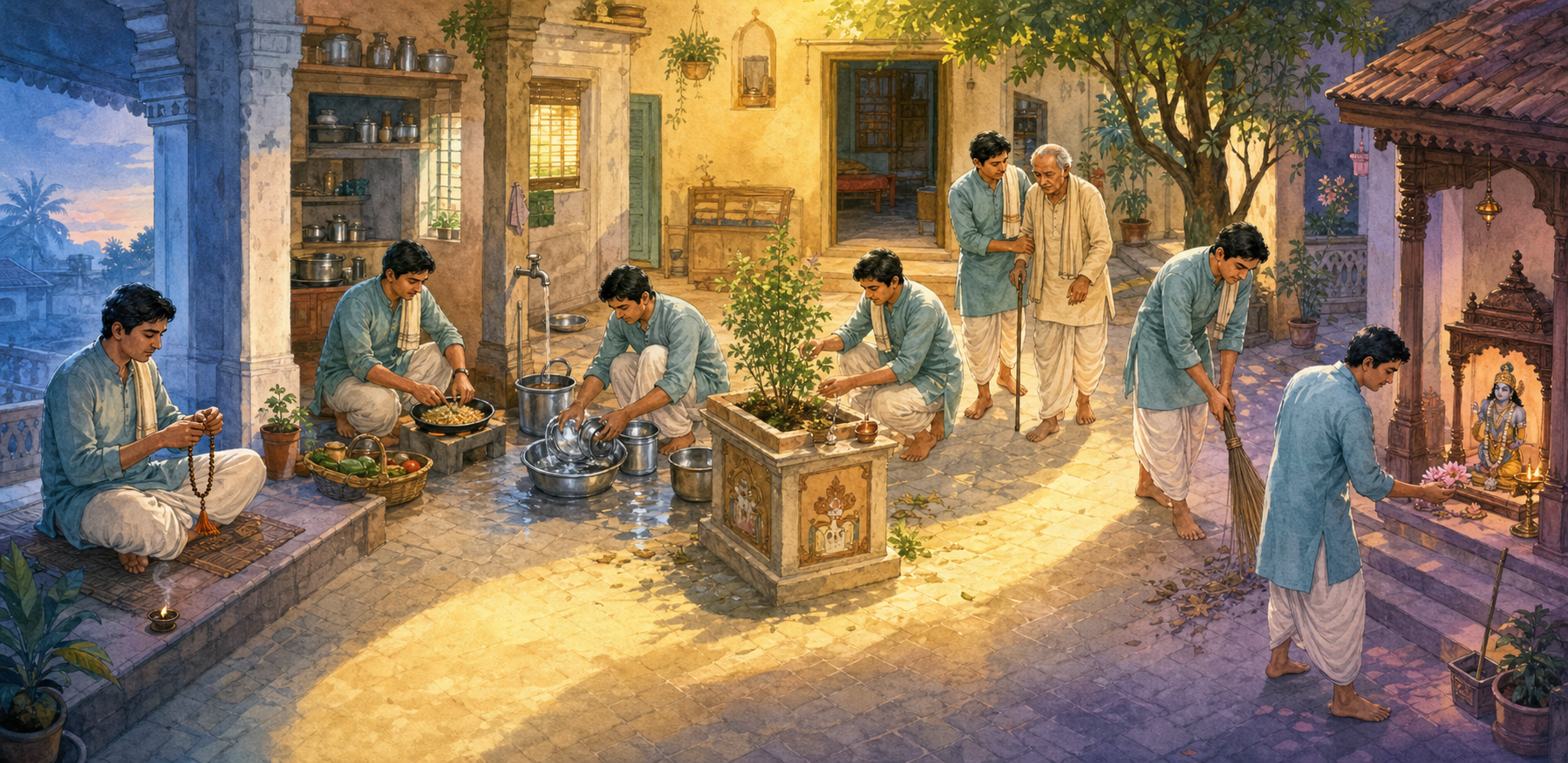
Do not wait for a grand opportunity or a perfectly pure motive. For the next seven days, use one bounded responsibility as a field of practice. It may be preparing a meal, cleaning a shared space, helping with a community task, listening carefully to someone who depends on you, or completing an unglamorous duty you usually postpone.
- Choose one identifiable act. “Be more selfless” is too vague. “Clean the prayer area before evening worship” or “prepare tomorrow’s meal without waiting to be asked” can actually be done.
- Set a limit. Decide what you can offer without neglecting work, health, dependants, or another legitimate duty. A clear boundary protects seva from turning into resentment.
- Begin with remembrance. Pause for a brief prayer or a period of japa before starting. Connect the physical action to Vishnu instead of assuming that a useful action automatically carries a devotional intention.
- Notice the demand as it arises. If you begin imagining praise, controlling how others respond, or feeling insulted that nobody helped, name it plainly: “I am seeking payment.” Do not dramatize it. Return to the task.
- Finish the work well. Do not use detachment as an excuse for carelessness. Clean what was missed, communicate what another person needs to know, and correct avoidable errors.
- Close without a scoreboard. Offer both the clean and mixed parts of the action. You do not need to pretend the motive was perfect in order to surrender it.
Keep a three-line record at the end of each day: the act you completed, the reward you caught yourself seeking, and one correction for the next attempt. This makes progress behavioral rather than theatrical. You are looking for less resentment, quicker recovery from disappointment, steadier remembrance, and better care in the work itself – not for a dramatic feeling of spiritual advancement.
After seven days, retain the act only if it is genuinely useful and sustainable. Otherwise, choose a better field of service. Fidelity to an unsuitable task is not the same as fidelity to seva.
Selflessness also requires discernment. Seva is not permission for another person to manipulate you, demand unsafe conduct, or push you into neglecting essential responsibilities. Nor does it require silence in the presence of deception or harm. Refusing an adharmic demand can protect both genuine service and the person being pressured to comply. Offer your ego, not your moral judgment.
Shared dharmic disciplines without erasing their differences
The movement from craving toward service appears across the dharmic family, although the traditions do not describe its final aim in identical terms. Buddhist upekkha and metta, Jain aparigraha and ahimsa, and Sikh seva joined with nam-simran each illuminate a practical part of the discipline.
- Upekkha, or equanimity, asks whether your goodwill can remain steady when conditions are pleasant, unpleasant, or simply disappointing.
- Metta, or loving-kindness, prevents detachment from hardening into coldness. A calm heart should become more available to the good of others, not less concerned about them.
- Aparigraha, or non-possessiveness, exposes subtler forms of ownership: “my project,” “my devotees,” “my contribution,” and “my recognition.”
- Ahimsa asks whether your chosen service actually reduces harm, including the harm caused by pride, coercion, careless speech, or indifference.
- Seva and nam-simran show why action and remembrance belong together. Service without remembrance can become self-display; remembrance without service can remain insulated from another person’s need.
Vaikuntha bhakti retains its distinctive center: a personal and loving orientation toward Vishnu. Reduced craving and inner peace may accompany the path, but they are not invoices presented to the Lord. Social usefulness matters, but seva is not exhausted by usefulness. The relationship with the Supreme gives the action its devotional direction.
Use these dharmic resonances as practical checks, not as a claim that every path is interchangeable. Equanimity tests your dependence on mood. Non-possession tests your need to own the service. Loving-kindness and non-violence test whether detachment has made you careless. Remembrance tests whether the act still points beyond your public identity.
Questions practitioners often face
Is it wrong to ask Vishnu for help?
No. Speaking honestly about a need is different from making continued devotion conditional on receiving a particular answer. You can state what you seek and add a deeper intention: “Whatever comes, keep me able to remember and serve.” The discipline is not artificial silence about your needs. It is refusing to reduce your relationship with Bhagavan to an exchange.
What if seva makes me happy?
Receive the happiness without making it your wage. A serene residue after japa, kirtan, caregiving, or community service is not a spiritual defect. Apply the fragrance test: when the pleasant experience passes, can you continue toward the service that remains?
Does not seeking mukti mean choosing suffering?
No. The Vaikuntha ideal does not require you to manufacture hardship, reject legitimate relief, or romanticize pain. It means that freedom is not imagined as a private possession superior to loving communion with the Lord. This is a particular bhakti valuation, not a dismissal of every way other Hindu schools discuss liberation.
How can you tell whether the practice is changing you?
Look for ordinary signs. You can accept an unnoticed task without immediately advertising it. Another person’s praise no longer determines whether you continue. You recover more quickly when an offering is misunderstood. You care more about whether the service helped than whether it displayed your virtue. Most importantly, remembrance of Vishnu returns sooner after pride, disappointment, or distraction appears.
Tomorrow, choose one useful act that is modest and unlikely to earn much notice. Offer it before you begin, complete it carefully, and assess whether it helped without using praise or mood as its score. Keep doing that until the question slowly changes from “What did I receive?” to “What remains to be offered?”

References
