
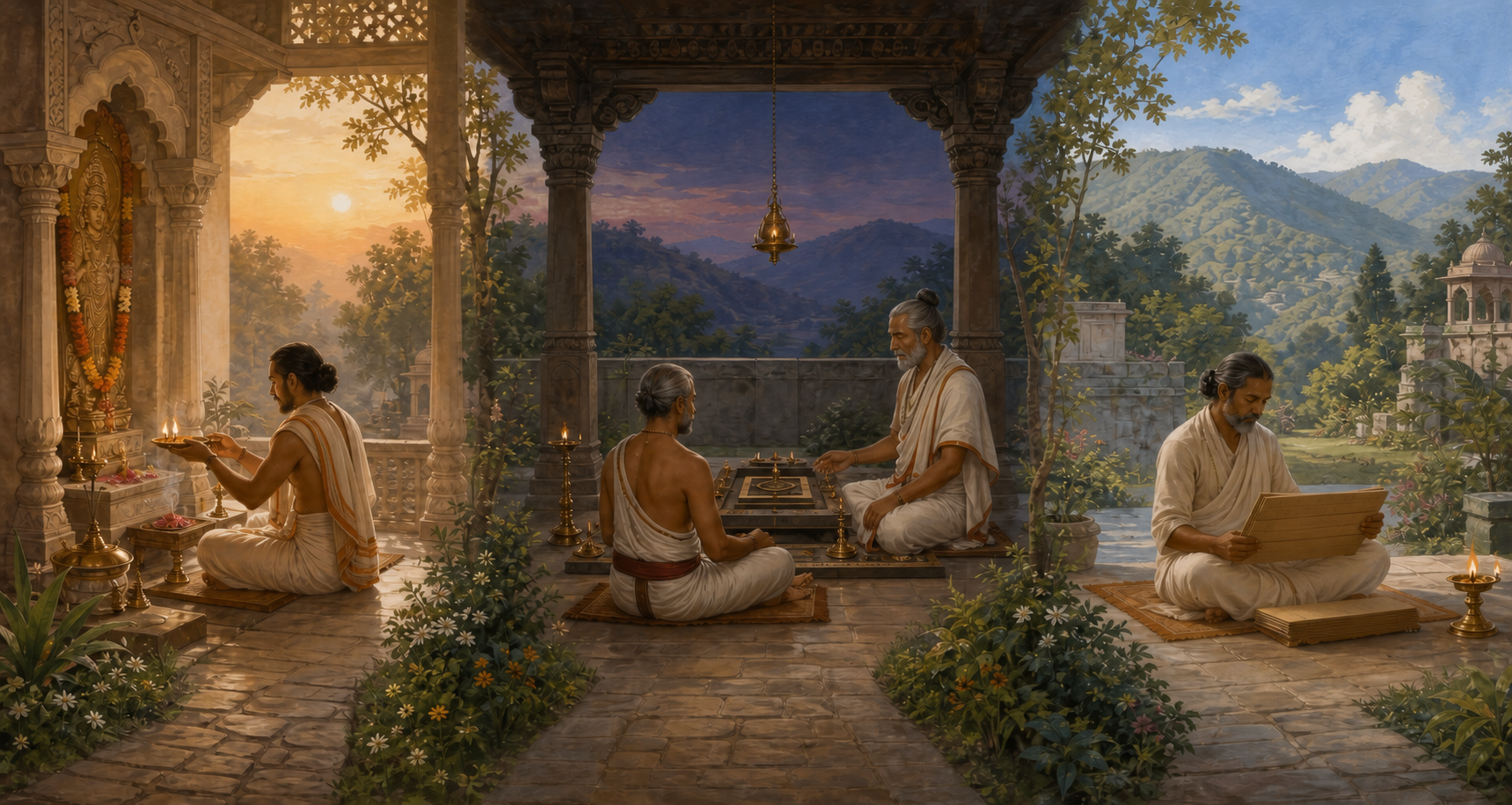
You may be wondering whether your familiar puja is too conventional, whether Tantra offers a deeper transformation, or whether study and meditation are the most direct route to realization. That question becomes confusing when the three paths are treated as ranks, with one supposedly meant for ordinary devotees and another reserved for advanced seekers.
A better question is practical: which discipline can you follow steadily, ethically, and under the conditions it actually requires? Dakshina, Vama, and Uttara are different centers of spiritual gravity. They can support one another, but they are not interchangeable packages of techniques.
The three names identify different centers of gravity

Start with an important caution. These terms do not carry one rigid definition in every Hindu text or sampradaya. The meanings of Dakshina and Vama can change across Tantric, Agamic, ritual, symbolic, and doctrinal settings. Uttara also takes different forms in Vedanta and yoga. Use the following map to orient yourself, but ask any prospective teacher what the terms mean within that particular lineage. Textual and lineage context matters.
| Path | Center of gravity | Characteristic disciplines | Essential safeguard |
|---|---|---|---|
| Dakshina Marga | Dharma-centered worship, devotion, and ethical formation | Puja, vrata, yajna, japa, stotra, seva, and established Vedic or Agamic observances | Consistency, moral discipline, and guidance from family, temple, guru, or sampradaya |
| Vama Marga | Tantric transformation of embodied energy, attention, and perceived duality | Initiated mantra-sadhana, mudra, nyasa, mandala, pranayama, and transmitted ritual frameworks | Initiation, niyama, and close supervision within a living lineage |
| Uttara Marga | Contemplation, discriminative knowledge, and direct realization | Shravana, manana, nididhyasana, shastra study, dhyana, pratyahara, and related disciplines of jnana-yoga and raja-yoga | Faithful interpretation within a school, ethical grounding, and practice beyond intellectual discussion |
Dakshina Marga is often called the right-hand path. Its strength is integration. Worship is not isolated from work, family, conduct, or community. Daily puja, japa, temple participation, vrata, and seva gradually align ordinary life with dharma. This makes Dakshina especially workable for householders, although it is not limited to them. Its apparent simplicity should not be mistaken for spiritual inferiority. A practice that steadily cultivates devotion, truthfulness, restraint, gratitude, and service is already transforming the practitioner.
Vama Marga is called the left-hand path and belongs to disciplined Tantric settings. Its purpose is not rebellion for its own sake. It works through precisely transmitted methods intended to transform prana, attention, embodiment, and the seeker’s relation to duality. Authentic practice therefore depends on initiation and niyama. Mantra, mudra, nyasa, mandala, and related disciplines cannot safely be reduced to intriguing instructions collected from disconnected places. Vama is not permission to ignore dharma, consent, responsibility, or self-restraint.
Uttara Marga is the upward or contemplative path. It emphasizes hearing or studying the teaching, reasoning about it carefully, internalizing it through sustained contemplation, and stabilizing insight in meditation. The Upanishads, Vedanta, and raja-yoga provide major settings for this orientation. Advaita, Vishishtadvaita, and Dvaita do not explain the ultimate relationship among self, world, and the Divine in identical ways, so Uttara cannot be reduced to a generic slogan about oneness. Nor is it merely the accumulation of philosophical vocabulary.
Choose by capacity, life stage, and available guidance
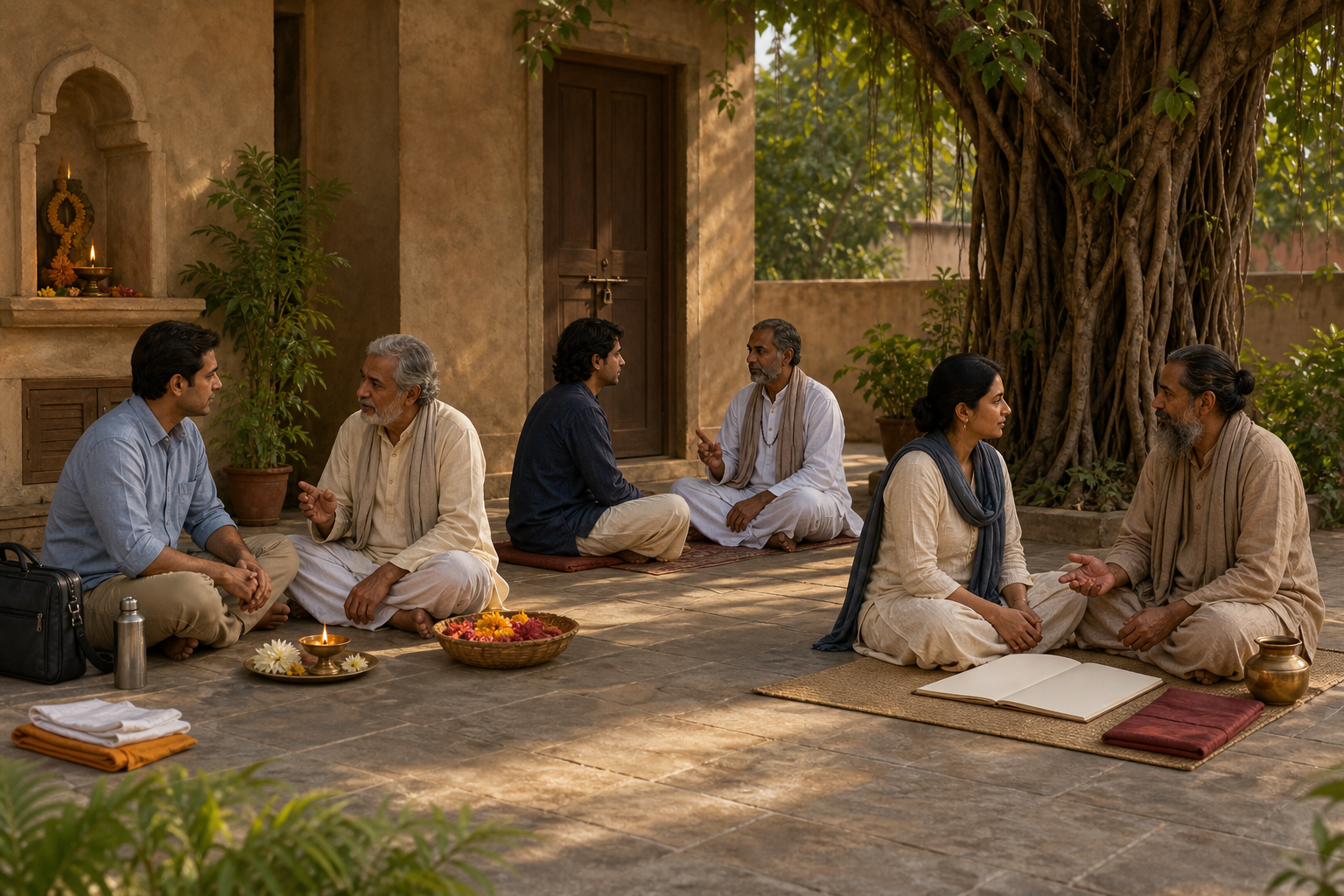
Your attraction to a path is worth noticing, but attraction alone does not establish readiness. A seeker may be fascinated by esoteric ritual yet lack access to a trustworthy lineage. Another may enjoy discussing non-duality but avoid the patient meditation and self-examination that contemplative realization requires. Someone drawn to temple worship may maintain elaborate external observances while neglecting the ethical habits those observances are meant to nourish.
Make the decision concrete by completing these statements honestly:
- The practice I already return to without being pushed is… Name what you actually do, not the identity you admire.
- My present obligations require me to… Include family, livelihood, health, study, and community duties. Your ashrama is part of discernment, not an obstacle to it.
- The competent guidance genuinely available to me is… Distinguish a living teacher and accountable lineage from anonymous instructions or charismatic claims.
- The discipline I am prepared to maintain is… Choose the practice you can repeat when enthusiasm is absent.
- The ethical weakness my sadhana most needs to correct is… A path should confront your habits rather than decorate them.
Temperament, sometimes discussed through the gunas, is a lens rather than a permanent label. Your condition can change. A period of restlessness may call for orderly worship and service. A strong contemplative disposition may later ripen through study and meditation. Deep devotion may open into inquiry. Do not turn a useful diagnosis into a spiritual caste system.
The availability of guidance can settle the decision. If you do not have initiation and accountable lineage support, Vama Marga is not presently available as a self-directed project. Interest in Tantra does not replace transmission. You can still cultivate the ethical stability, devotion, japa, and attentiveness that would prepare you to recognize sound guidance later.
Your Ishta, the chosen form or ideal through which spiritual life becomes intimate, can keep this discernment from becoming a contest among labels. Ask which path helps you remember, serve, understand, and approach the sacred more faithfully. The Ishta can give warmth to inquiry, direction to worship, and coherence to disciplines that might otherwise feel like unrelated techniques.
Begin with a practice that matches the path’s demands
You do not need to assemble an impressive collection of practices. You need a stable center. Begin according to the path’s actual conditions:
- If Dakshina is your center: Establish a daily act of worship connected to your Ishta and tradition. This may be puja, authorized japa, stotra recitation, or sandhyavandana where it belongs to your received practice. Add seva that answers a real need rather than remaining an inspiring intention. Let vrata, temple worship, and yajna enter through proper family, community, or priestly guidance instead of treating them as isolated performances.
- If Vama draws you: Begin with the search for a legitimate sampradaya, not with advanced ritual. Ask how initiation works, which niyamas precede practice, who is accountable for instruction, and what daily discipline is expected. Until those conditions exist, do not reconstruct nyasa, mandala work, forceful pranayama, or specialized rituals from fragments. Maintain ordinary ethical observances, simple devotion, and practices you have already received.
- If Uttara is your center: Work through the contemplative sequence instead of stopping at reading. Shravana receives the teaching within its proper framework. Manana examines doubts and apparent contradictions. Nididhyasana repeatedly internalizes what has been understood. Dhyana steadies attention so insight is not confined to discussion. Stay within a coherent school long enough to understand its claims before mixing incompatible conclusions.
- If your inclination is mixed: Choose one primary discipline and let the others support it. A devotee may study and meditate. A contemplative may use japa and puja to soften pride and steady attention. A properly initiated Tantric practitioner may retain strong devotional and philosophical foundations. Complementarity works when the center remains clear.
If you remain uncertain and do not yet have a qualified teacher, the prudent default is a simple Dakshina-style foundation: ethical conduct, devotion to your Ishta, established japa or stotra, and seva. This does not prejudge where your path will lead. It develops the steadiness needed for any later direction.
Judge the path by its ethical fruit, not its mystique
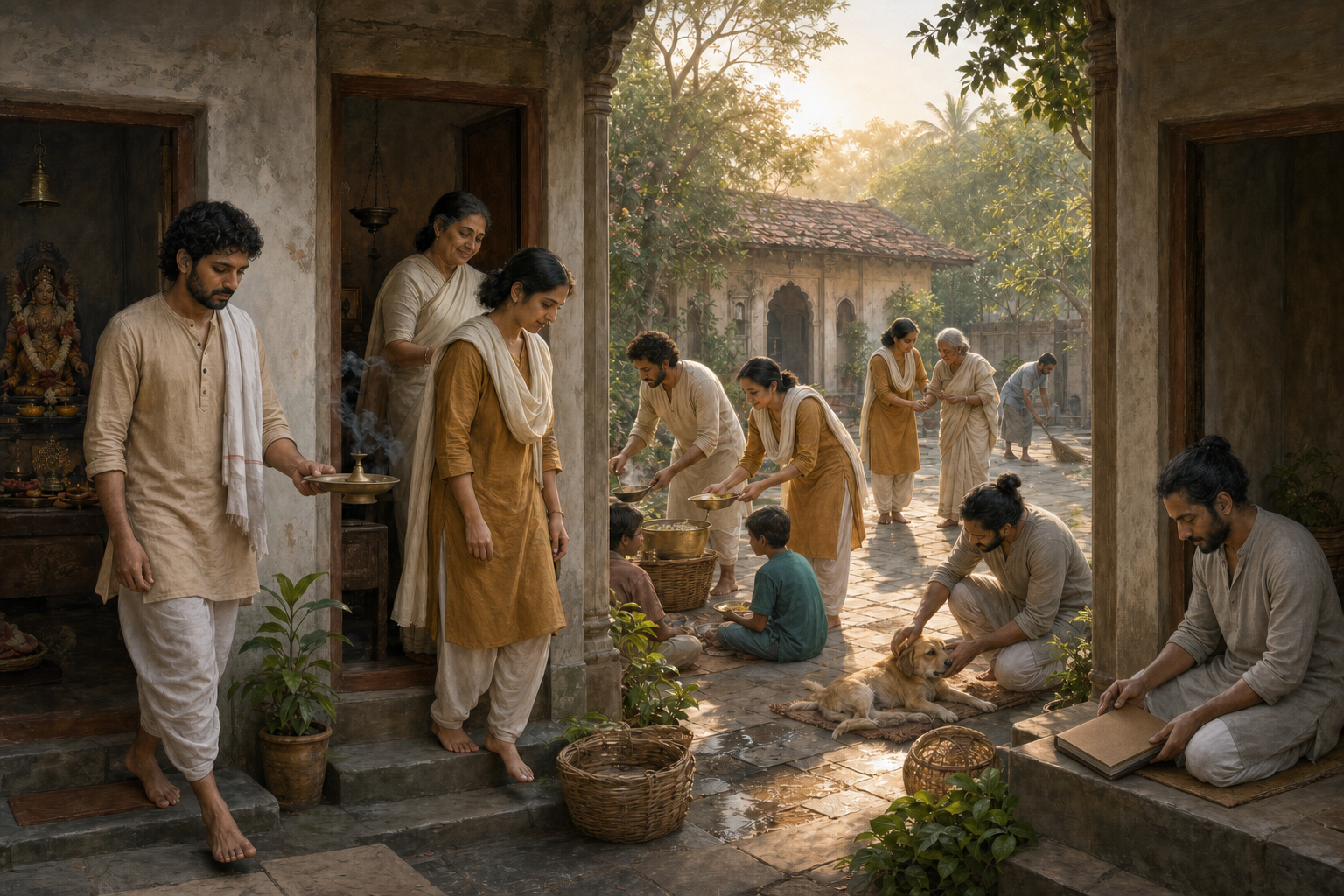
Intensity, unusual experiences, ritual complexity, and philosophical fluency do not by themselves show spiritual maturity. Look at conduct where life is inconvenient. The shared ethical ground of ahimsa, satya, asteya, shauca, and daya gives you a more reliable test.
- Ahimsa: Is your practice reducing needless harm in speech, action, and relationships?
- Satya: Are you becoming more truthful, including about your motives and level of attainment?
- Asteya: Are you less willing to take another person’s time, trust, labor, credit, or resources unfairly?
- Shauca: Is greater order appearing in your habits, surroundings, attention, and intentions?
- Daya: Is discipline making compassion more dependable rather than merely sentimental?
Each path has a characteristic way of going wrong. Dakshina can become mechanical when ritual is separated from attention and character. Vama can become rationalization when fascination overrides initiation, restraint, or accountability. Uttara can become intellectual vanity when refined language substitutes for meditation, humility, and duty. Notice the distortion early and strengthen the missing element.
A teacher’s title does not cancel your responsibility to discern. Step away from any setting that uses sacred authority to pressure you into unsafe, illegal, sexual, or financial acts; demands that you abandon consent or ordinary moral judgement; or isolates you from every trustworthy relationship. None of the three margas suspends dharma. Secrecy around a transmitted practice is not the same as secrecy that protects exploitation.
Review your practice through observable questions: Are you more reliable in your duties? Can you admit error more readily? Is your attention steadier? Has devotion become less dependent on mood? Are study and ritual changing how you respond to conflict? If the answer remains no, do not immediately add techniques. Examine consistency, interpretation, conduct, and guidance first.
Honor Dharmic parallels without erasing differences

The three-path framework also helps you recognize family resemblances across Dharmic traditions. Ahimsa, service, disciplined conduct, compassion, and moral clarity have important places in Hindu, Buddhist, Jain, and Sikh life. Vama’s tradition-bound transformation of embodied experience has careful parallels with methods found in Vajrayana Buddhism. Uttara’s contemplative emphasis can be placed in respectful conversation with Buddhist prajna, the Jain ideal of kevalajnana, and Sikh teachings that join gyaan with naam.
Parallels are not identities. These traditions do not teach the same metaphysics, use identical initiations, or assign the same meaning to similar-looking practices. Use comparison to deepen respect and sharpen questions. Do not use it as permission to lift a ritual from one lineage and install it inside another without context or authorization. Unity in spiritual diversity becomes meaningful only when real differences are allowed to remain real.
Key takeaways
- Dakshina centers dharmic worship, devotion, ethical conduct, and service; it is a complete path, not a preliminary consolation.
- Vama centers initiated Tantric transformation and should not be attempted as an unguided collection of esoteric techniques.
- Uttara centers study, reasoning, contemplation, and meditation; reading alone does not complete its discipline.
- Temperament, ashrama, available guidance, and devotion to your Ishta matter more than the prestige of a label.
- The clearest measure of progress is ethical and practical: less harm, greater truthfulness, steadier attention, cleaner conduct, compassion, and better fidelity to duty.
Choose the next practice you can keep without pretending. If devotion and ordered worship are already alive in you, deepen them. If Vama calls to you, find the lineage before seeking the technique. If contemplation is your strength, join study to meditation and test insight in conduct. Let sustained practice earn the right to become more complex.
References
