
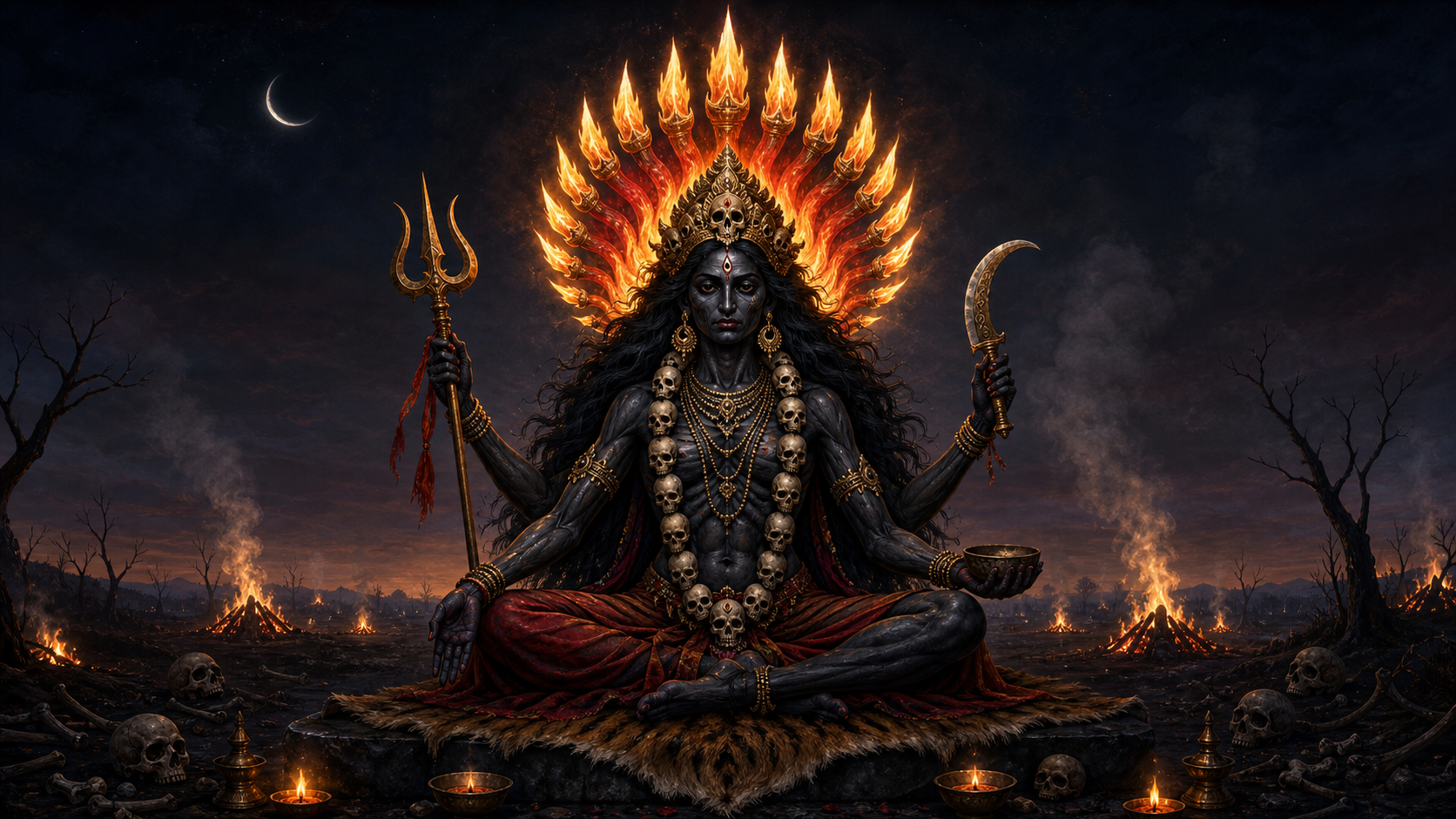
You may have paused before a murti or painting of Chamunda and wondered why a form of the Divine Mother appears amid flames, skulls, weapons, and the cremation ground. The imagery can look like fury made visible. Stop there, however, and you miss its most exacting instruction: Chamunda’s power is fierce because it is governed.
The fire above her head is not anger escaping control. It is Shakti disciplined by awareness – a purifying force directed against adharma, fear, delusion, and the impulses that make power cruel. Once you see that distinction, the image becomes more than a frightening spectacle. It becomes a practical test of how you handle your own intensity.
Read the crown before you read the weapons
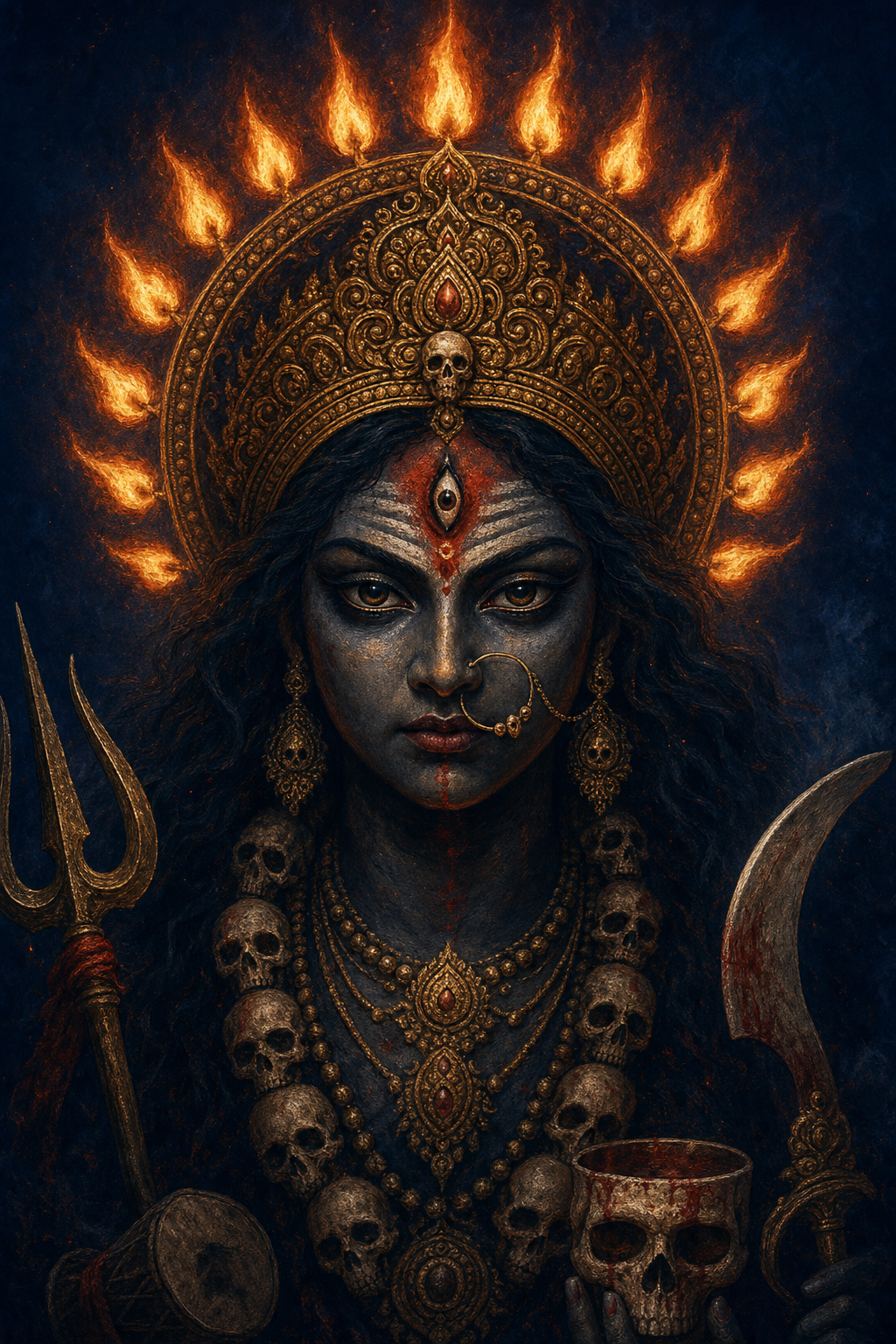
In depictions that give Chamunda a crown of flame, the motif may be described as a jvālāmukuṭa. Its location is crucial. The fire rises from or surrounds the head, the seat of awareness and judgment, while remaining visibly ordered rather than spreading across the scene. It is therefore not merely an ornament or a general sign of supernatural energy. It tells you what governs everything else in the image.
Read the icon from the ground upward, because each level changes the meaning of the next:
- Begin with the setting. The cremation ground, corpse, ash, or seat of skulls places Chamunda where ordinary securities have ended. The scene confronts mortality instead of hiding it.
- Notice the body. Her emaciated yet unconquered form breaks the easy association between outward abundance and real strength. Nothing ornamental is needed to establish her sovereignty.
- Take in the skulls, kapāla, and jackals. These signs bring death, decay, and instinctive fear into the sacred field. They are not outside divine awareness and cannot overwhelm it.
- Only then look at the crown. Radiance remains above the landscape of endings. Conscious light presides over death, fear, appetite, and every instrument of force.
This order prevents a common misreading. The skull garland, or muṇḍamālā, does not make the flames a celebration of destruction. The surrounding signs establish the conditions over which awareness must remain sovereign. The crown answers the cremation ground: change and death are real, but panic need not rule the mind that faces them.
Do not insist that every regional image must reproduce one precise outline. Some representations emphasize sharply ascending tongues of flame; others let the fire radiate outward or appear more like a concentrated glow. These variations preserve the same relationship between fire and awakened agency. When identifying the motif, ask what the fire is doing in the composition: Does it crown awareness, remain bounded, and direct the meaning of the fiercer signs below it?
Chanda and Munda set the ethical boundary of the flames
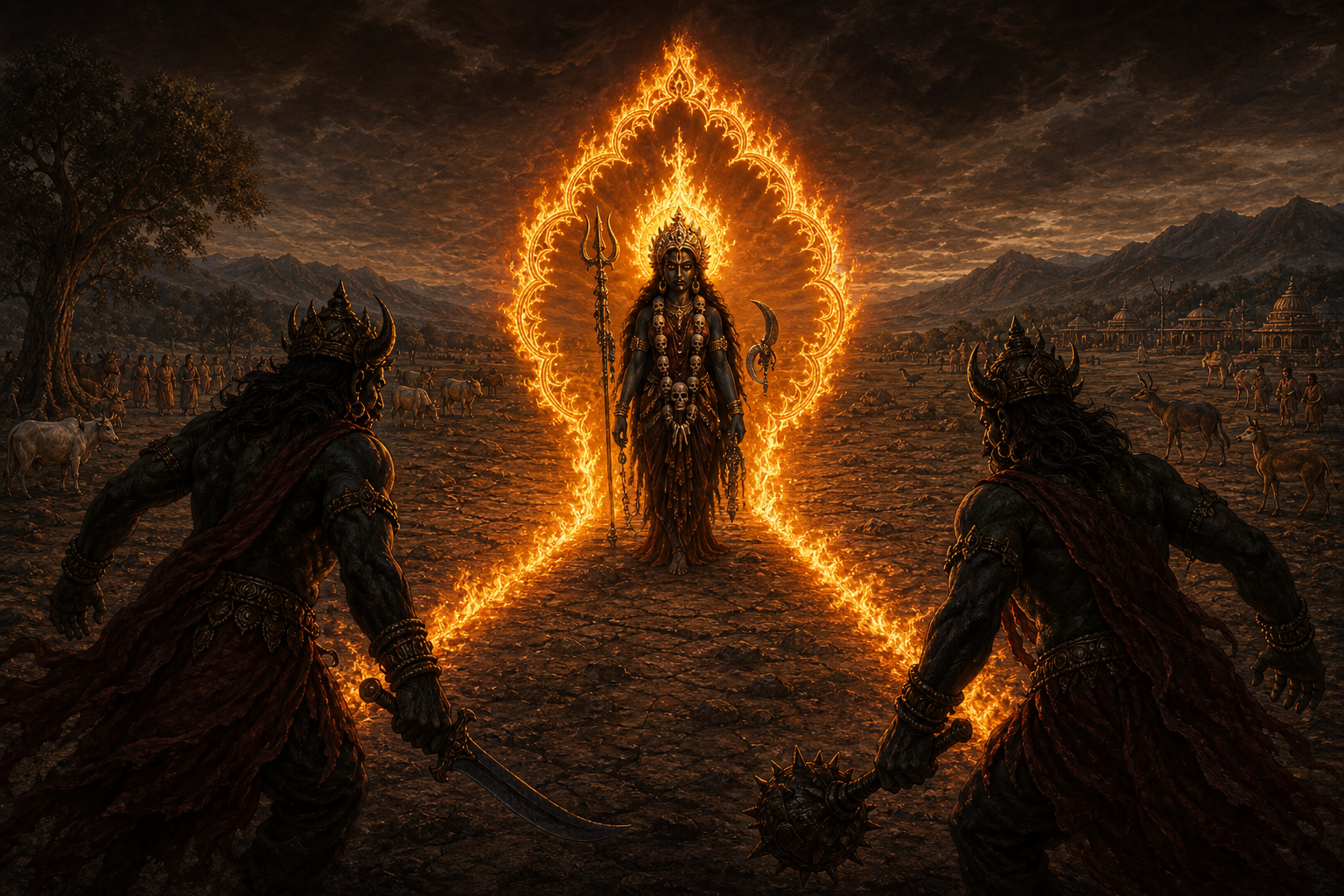
The Devi Mahatmya, contained within the Markandeya Purana, provides the narrative key to Chamunda’s name. The Goddess’s fierce power defeats Chanda and Munda, and the name Chamunda memorializes that victory. The flames therefore belong to a world of conflict, but their purpose is the defeat of demonic disorder and the restoration of dharma.
That purpose matters. Fire directed by dharma is not the same as violence driven by appetite. Chamunda’s blaze can be read as viveka made visible: the discrimination that identifies what must be opposed, burns through deception, and refuses to confuse severity with cruelty. The image presents force held within the requirements of protection, proportion, and restored order.
This is also why the icon cannot honestly be used to sanctify every personal quarrel. Calling another person an asura does not make your anger dharmic. Before invoking Chamunda as a model of righteous fierceness, submit the intended action to four questions:
- Can you name the adharma as conduct? Identify cruelty, avarice, deceit, exploitation, or another actual wrong. Do not replace evidence with a hated identity.
- Whom will the action protect? Dharmic force has a protective object beyond the gratification of the person using it.
- Is the response proportionate? Use the least forceful action adequate to stop the wrong. Excess is not made sacred by religious language.
- What is the intended end? Restoration of a boundary is different from humiliation, spectacle, or revenge.
The same test works inwardly. Anger may reveal that a boundary has been violated, while fear may reveal danger that deserves attention. Neither feeling should automatically take command. Under Chamunda’s crown, anger is refined into principled firmness, fear into alert courage, and agitation into a precise next action. If the heat spills into contempt or indiscriminate harm, it resembles a wildfire, not the disciplined flame of the Goddess.
Agni transforms what is offered to it
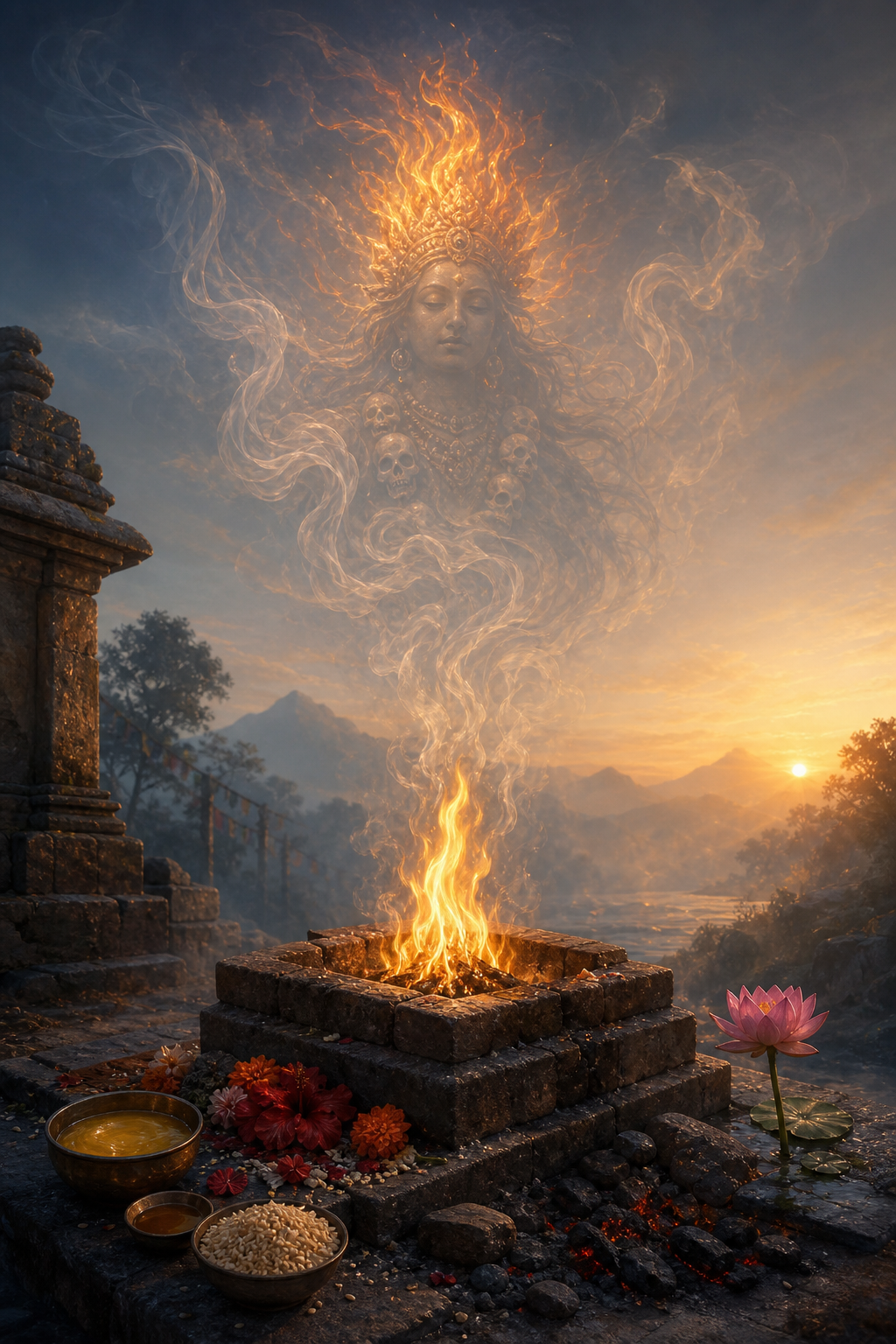
Agni carries a rich spiritual grammar across Vedic and later Dharmic thought. Fire purifies, conveys an offering, and transforms the state of whatever enters it. The Bhagavad Gita’s image of jñānāgni – the fire of knowledge that reduces karma to ash – helps explain why Chamunda bears fire at the crown. Her blaze is not heat without intelligence. It is knowledge acting upon bondage.
You can therefore read the crown as an interior altar. In an outward homa, offerings enter a fire whose location, sequence, and purpose have been defined. In Chamunda’s icon, awakened awareness becomes the altar, while ignorance, timidity, delusion, cruelty, and compulsive fear become the offerings. The flames remain bounded because transformation requires direction. A fire that consumes everything without distinction has ceased to serve the sacrifice.
This relationship between head and hand is one of the image’s most useful details. Chamunda may carry a sword, trident, skull-bowl, or another fierce implement, but the fire is borne above them. Power is subordinate to lucid awareness. A weapon governed by wisdom may defend; even mild words governed by vanity may wound. The crown asks you to examine the consciousness directing an action, not merely the outward form of the action.
A yogic reading adds another layer. The fire principle is associated with maṇipūra, where disciplined practice refines heat into tejas. Esoteric interpretations describe kuṇḍalinī ascending through suṣumṇā toward the sahasrāra, where radiance is stable rather than driven by craving or fear. Chamunda’s head-borne flame can echo that perfected ascent: energy has risen, but it has also become governable.
Use this as an interpretive layer, not as a claim that every sculptor intended a literal subtle-body diagram. Iconography, yogic anatomy, and contemplative experience illuminate one another without becoming interchangeable. The dependable connection is disciplined transformation: raw intensity becomes luminous agency when it is directed by practice and dharma.
Related images across the Dharmic world reinforce that principle without erasing doctrinal differences. Vajrayāna protectors and vidyārājas may stand within wisdom flames that consume the kleśas. Jain descriptions of kevala-jñāna emphasize a pure illumination free of karmic bondage, though not the same fierce theology. Sikh language of the eternal jyot places divine light at the heart of freedom from duality. The responsible comparison is resemblance, not identity: luminosity serves truth, compassion, and liberation in distinct Dharmic frameworks.
Use the image as a discipline, not a licence for rage
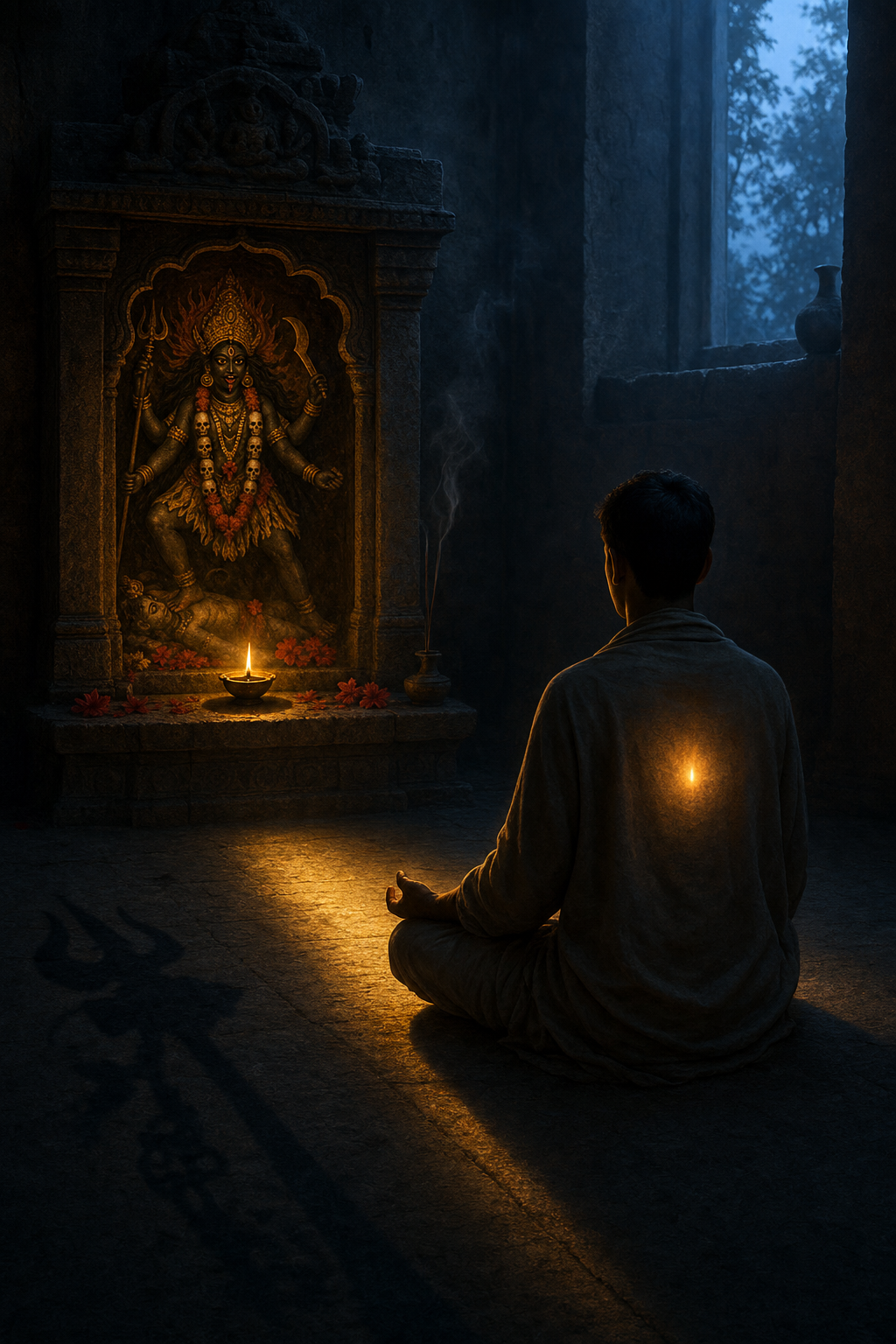
You do not honour Chamunda’s fierceness by copying its exterior drama. You honour it by interiorizing its structure: heat below, clarity above, and a firm boundary around action. A short written reflection can make that structure concrete before a confrontation, public response, or difficult decision.
- Name the heat. Write the actual feeling: anger, fear, agitation, or the urge to retaliate. Naming it keeps intensity from disguising itself as certainty.
- Locate the fuel. Separate the present wrong from wounded pride, imagined motives, collective blame, and the desire to be seen defeating someone.
- Choose the offering. Identify what must enter the inner fire: deceit, timidity, cruelty, confusion, or attachment to revenge.
- Draw the perimeter. State what your response may do and what it may not do. It may tell the truth, protect someone, refuse cooperation, or establish a boundary. It may not humiliate, threaten indiscriminately, or treat anger as evidence.
- Write the crowned action. Reduce your next step to one clear sentence. If you cannot describe it without exaggeration or contempt, return to the previous steps.
This is transmutation rather than repression. You are not pretending the heat is absent. You are refusing to let it determine its own target and scale. Chamunda’s icon makes room for intense moral energy, but it denies that intensity alone is a sign of truth.
Formal practice requires the same respect for boundaries. Chamunda upāsanā, mantra-japa, recitation of the Chandi Pāṭha, and homa depend upon disciplined attention to mantra, sequence, metre, and measure. If you have received a practice within a lineage, follow its instructions rather than inventing an esoteric rite from a visual interpretation. The geometry and discipline of ritual fire are part of the teaching, not disposable formalities.
Trāṭaka and prāṇāyāma can also be contemplated in relation to steadiness and inner heat, but they should not become endurance contests. Do not stare through eye pain, improvise forceful breath retention, or treat discomfort as proof of spiritual progress. If you use a lamp, observe ordinary fire safety and never leave it unattended. More intensive breath, kuṇḍalinī, or Tantric practices call for qualified guidance.
The cremation-ground setting adds one final discipline. It does not tell you to deny fear of change or death. It asks you to witness that fear without surrendering judgment to it. When an ending cannot be prevented, the crown’s lesson is to remain lucid enough to release what has ended and protect what still carries dharmic value.
Key takeaways when you encounter Chamunda’s image
- The crown’s location matters: fire borne at the head signifies intensity governed by awareness.
- Its containment matters: Chamunda represents purifying and protective force, not destruction without measure.
- The Chanda-Munda narrative gives the flames an ethical target – adharma – and an ethical purpose – the restoration of order.
- The skulls, cremation ground, and emaciated body confront mortality and fear; the radiance above them shows that these conditions need not master consciousness.
- Yogic and cross-Dharmic parallels can deepen the image, but they should not be used to collapse distinct traditions into a single doctrine.
- In practice, the symbol asks you to convert anger, fear, and agitation into a proportionate action that protects without becoming cruel.
The next time Chamunda’s flames unsettle you, do not look away and do not romanticize them. Look for the perimeter. Ask what the fire is transforming, what it is protecting, and what wisdom keeps it from spreading.
Then apply the same questions to the heat you carry. Chamunda does not ask you to become less intense. She asks you to become responsible for where that intensity goes.
References
