

You may be drawn to simple living because your home, schedule, and mind feel crowded. Yet clearing a room can become another project of self-improvement: a new identity to display, measure, and defend. Advaita offers a more searching test. Does a choice reduce dependence and clarify what you are, or does it merely rearrange what you hope will complete you?
A simpler life can steady attention, expose unnecessary cravings, and leave more energy for dharma. It cannot manufacture the freedom that Advaita understands as the nature of the Self. The practical aim is therefore not to own as little as possible. It is to use possessions, work, and relationships without asking them to supply an identity they cannot provide.
Let “enough” begin with identity, not inventory

Most attempts at simplicity begin with an inventory: fewer clothes, fewer purchases, fewer appointments, fewer distractions. This can be useful, but it begins downstream. Advaita moves the inquiry upstream by asking who feels incomplete and what, exactly, another object or achievement is expected to repair.
The four mahavakyas – Prajnanam Brahma, Tat tvam asi, Aham Brahmasmi, and Ayam Atma Brahma – are treated as direct means of knowledge for recognizing the identity of Atman and Brahman. Their purpose is not to give the personality a grander label. They remove the mistaken conclusion that the Self is confined to a changing body, mood, role, history, or social position.
This does not make the body irrelevant, relationships imaginary in the casual sense, or duties optional. Your body still needs care. A promise still creates a responsibility. Another person’s pain is not cancelled by a metaphysical slogan. The point is narrower and more demanding: none of these changing conditions is the complete definition of the awareness to which they appear.
That distinction changes the meaning of “enough.” If completeness must be delivered by an object, there can never be a final object. Each acquisition may settle one desire while leaving the underlying assumption untouched: “I am incomplete now, and I will become whole when this condition changes.” If completeness belongs to the Self rather than to a condition, an object can return to its proper role. It may be useful, beautiful, necessary, or pleasant, but it no longer has to save you.
Advaita is precise about the limit of lifestyle reform. Knowledge, rather than action, is the direct means to moksha. Selling possessions, wearing plain clothes, or living with fewer conveniences may support a quieter mind, but no quantity of renunciation mechanically produces Self-knowledge. Simplicity prepares the room; it does not replace the seeing.
Use four dharmic disciplines to keep simplicity humane

Simple living becomes reliable when it is governed by dharma rather than mood. Four disciplines are especially useful: santosha, aparigraha, nishkama karma, and ahimsa. Together they prevent simplicity from collapsing into deprivation, passivity, neglect, or moral display.
| Discipline | Common misreading | Practical use |
|---|---|---|
| Santosha, contentment | Stop improving anything | Act from sufficiency instead of making your peace conditional on the next result. |
| Aparigraha, non-hoarding | Possessions are inherently impure | Keep what serves a real function, and loosen the impulse to accumulate for security, novelty, or status. |
| Nishkama karma, action without attachment to results | Do not care how work turns out | Give full attention to the action you can perform while refusing to make a particular outcome the price of inner balance. |
| Ahimsa, non-harm | A private feeling of harmlessness is enough | Check whether your austerity transfers cost, labour, anxiety, or deprivation to someone else. |
Santosha and aparigraha address the restless cycle of craving and accumulation, while nishkama karma keeps contentment from becoming an excuse for careless work. Ahimsa supplies a necessary boundary. If removing a household convenience saves you money but creates substantially more labour for another family member, the decision is not simple merely because the room looks cleaner.
Santosha also needs a careful reading. Contentment does not require you to abandon a worthy ambition, accept injustice, or perform a duty badly. It changes the inner contract attached to action. You can seek a better result without saying, “Unless I obtain this, I cannot be at peace.” You can correct a problem without turning the problem into a verdict on your being.
Aparigraha is similarly more subtle than counting objects. A small collection can be held with fierce possessiveness, while an extensive set of tools may be appropriate for a person’s work and freely used in service. The relevant questions are functional and inward: What does this serve? What does it demand to store and maintain? What fear or self-image makes release feel impossible?
This approach also avoids wasteful purging. Repairing, reusing, and purchasing thoughtfully are practical expressions of non-hoarding and ecological responsibility. Throwing out usable belongings merely to achieve a minimalist appearance can preserve the same appetite for novelty in a different costume.
Run a five-question inquiry before adding or removing
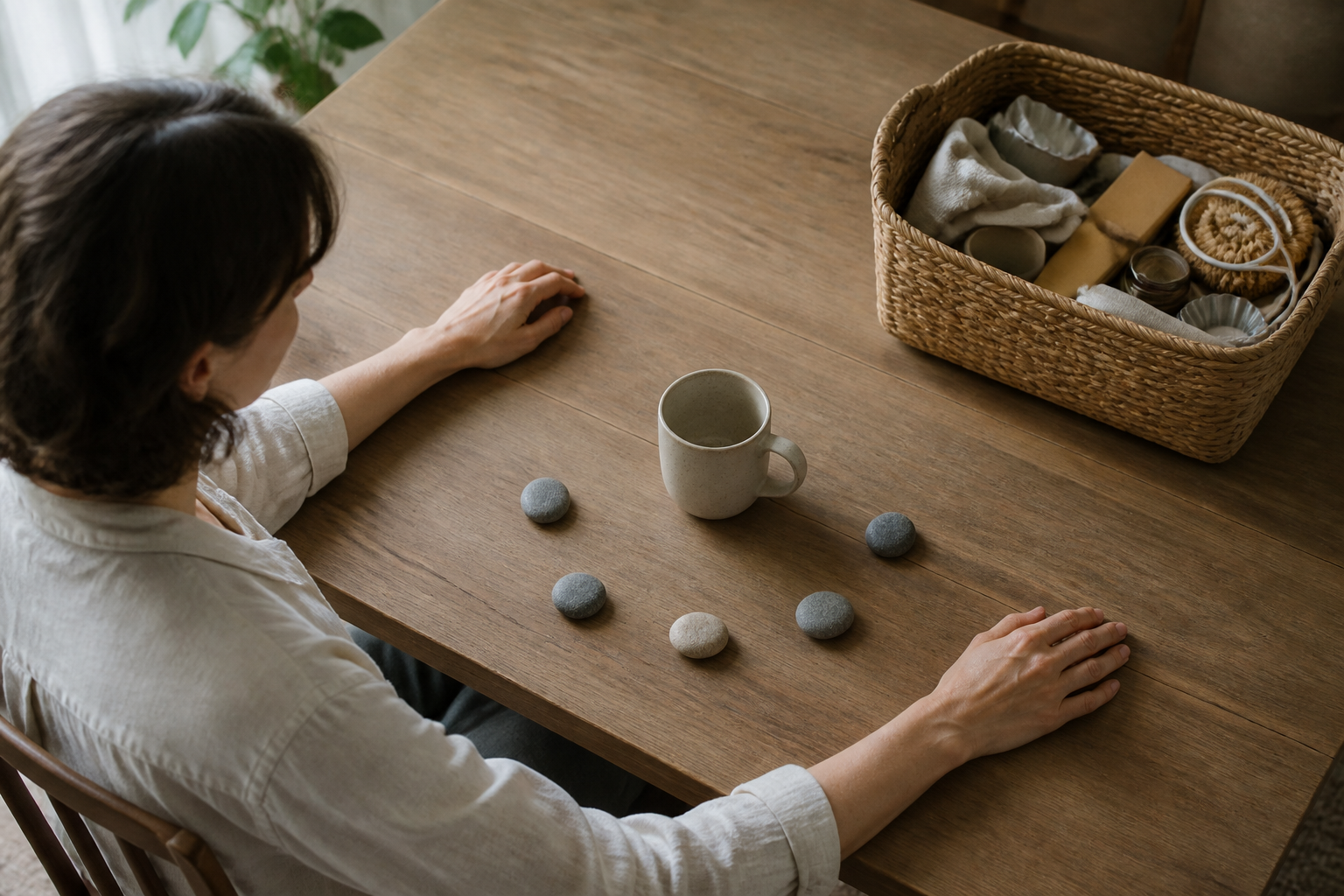
You do not need to debate every ordinary purchase. Use this inquiry when desire carries pressure, when you are about to make an avoidable acquisition, or when an abrupt purge feels emotionally urgent.
- What function is actually needed? Name the task in plain language. Avoid vague answers such as “a better life” or “a fresh start.” A real need is usually describable: replacing something unusable, fulfilling a responsibility, or obtaining the right tool for work.
- What is the object being asked to prove? Look for the additional promise beneath its function: importance, belonging, control, novelty, superiority, or relief from an uncomfortable mood. The promise may be present even when the object is genuinely useful.
- Does the awareness of this desire share its lack? Notice that the urge, the bodily tension, the imagined future, and the argument for acting are all known. Do not force the desire away. Ask whether the knowing presence itself becomes larger when the urge is satisfied or smaller when it is not.
- What is the least possessive adequate response? The answer may be to use what you have, repair it, reuse something, borrow, buy an appropriate item, or decline. Aparigraha does not predetermine the answer; it removes excess from the answer.
- Can you choose without making the outcome your identity? Make the decision carefully, then release the inner demand that it validate you. This is nishkama karma applied at the point where consumption and action meet.
Suppose you want to replace a device that still performs its required function. The inquiry may reveal that comparison, rather than utility, is creating urgency. Keeping the present device then becomes a concrete exercise in freedom from comparison. If the present device cannot support a genuine duty, buying a suitable replacement is not a spiritual failure. Buy it without guilt, care for it, and stop asking the purchase to say something about your worth.
The same method works when removing possessions. An urgent wish to discard everything may come from exhaustion, resentment, or attraction to the image of being austere. Retain the valid aim – less maintenance, less waste, clearer use of space – while dropping the fantasy that a purified room will create a purified Self. This resembles the logic of bhaga-tyaga-lakshana: retain what is essential and discard the limiting element that creates contradiction. A household decision is not itself an interpretation of a mahavakya, but the structure can train discernment.
You can also apply the questions to commitments. A crowded calendar may be sustained by the desire to appear indispensable, while an empty calendar may be sustained by avoidance. Ask what the commitment serves, whom it affects, and whether accepting or declining it is consistent with your actual duties. Simplicity is not the smallest schedule. It is a schedule with less vanity, compulsion, and evasion hidden inside it.
Do not turn this inquiry into an excuse to postpone necessities or make dependants absorb the cost of your experiment. When function, care, or safety clearly requires action, act. Non-attachment concerns the identity and emotional demand attached to the choice; it is not indifference to foreseeable consequences.
Build a daily rhythm of hearing, reflection, and assimilation

Occasional decluttering cannot carry the full weight of Advaita practice. The traditional movement is sravana, manana, and nididhyasana: systematic hearing of the teaching, reasoned reflection that resolves doubts, and contemplative assimilation. Give each a recognizable place in ordinary life.
- Settle attention before adding input. At the first dependable quiet point in your day, allow the breath to become your immediate object of attention, or use steady japa. The purpose is not to manufacture a special state. It is to notice distraction before it directs the day.
- Practise sravana coherently. Study a small, connected portion of Advaita teaching under competent guidance. Avoid collecting isolated spiritual sentences merely because they sound elevated. Mahavakyas require exact interpretation; their apparent contradictions are resolved through distinctions such as primary meaning, implied meaning, and the removal of limiting adjuncts.
- Turn confusion into manana. Write the actual doubt in your own words. For example: “If I am not confined to the mind, why do its changes disturb me?” Examine the reasoning instead of replacing the doubt with affirmation. Reflection is doing its work when the contradiction becomes clearer, not when you can repeat more terminology.
- Make room for nididhyasana. Return quietly to the teaching that awareness is self-revealing and ever present. Sensations, thoughts, roles, and desires change and are known. Attend to the fact of their being known without trying to turn awareness into another object you can observe.
- Carry nishkama karma into one live duty. Identify the next action that belongs to you, perform it carefully, and notice the demand that reality reward you in a particular way. Release that demand without reducing the quality of the work.
- Review one moment of grasping. At the end of the day, recall where a possession, outcome, or opinion seemed necessary for completeness. Decide on one practical correction: delay an avoidable purchase, repair something, release an unused item responsibly, decline a vanity commitment, or fulfil a neglected duty.
Each element has a different job. Breath awareness and japa help gather attention. Ethical restraint reduces agitation and unnecessary entanglement. Nishkama karma changes how you act amid uncertain results. None of these should be confused with the direct knowledge conveyed by the mahavakyas. Their value is that they make sustained listening, reasoning, and assimilation more available.
Guidance matters because the teaching does not equate the everyday personality with an enlarged cosmic personality. The method discards incompatible limiting conditions associated with the individual and the cosmic while retaining consciousness as the non-dual reality. A competent teacher should be able to unfold that reasoning, distinguish literal from implied meaning, and make room for sincere questions rather than asking you to hide confusion behind belief.
Judge your simple-living practice by changes in relationship, not by an impressive inventory. Useful signs include less urgency around non-essential acquisition, less resentment when outcomes differ from preference, greater willingness to repair and reuse, steadier performance of duty, and more consideration for the people affected by your choices. Equanimity, compassion, and inner freedom are understood as the natural maturation of clear knowledge, not as decorations added to a severe lifestyle. These signs do not certify realization, but they can reveal whether simplicity is reducing confusion or feeding a subtler ego.
Key takeaways
- Simple living supports Advaita when it frees attention for inquiry and duty; it does not produce moksha by itself.
- Define “enough” by function, dharma, and non-dependence, not by a fixed number of possessions.
- Use santosha to act from sufficiency, aparigraha to reduce possessiveness, nishkama karma to release demands on results, and ahimsa to protect others from the cost of your austerity.
- Before a pressured purchase or purge, separate the practical function from the promise that an external condition will complete you.
- Keep sravana, manana, and nididhyasana distinct: hear the teaching accurately, resolve doubts through reasoning, and assimilate what has become clear.
Begin with one live pressure rather than a total life redesign. Before your next avoidable acquisition or abrupt purge, write down its function, its hidden promise, and the duty affected by your decision. Choose the least possessive adequate response. Then sit quietly and notice that the desire, the decision, and the result are all known.
Let simplicity earn its place by making truth easier to hear, duties easier to perform, and possessions easier to use without asking them to tell you who you are.
References
- DharmaRenaissance Blog – Mahavakya Viveka Explained: The Essential Guide to Mastering Advaita’s Ultimate Truths
- DharmaRenaissance Blog – The Proven Art of Simple Living: Discover Inner Peace Through Dharmic Wisdom and Practice
