

You may know the language of dharma and still lose your footing when a promotion rewards concealment, a family dispute invites a cruel reply, or an online argument turns strangers into enemies. The difficulty is rarely finding another inspiring idea. It is carrying spiritual discipline into the moment when desire, fear, anger, or status has something to gain.
A shared Dharmic approach gives you a workable sequence: steady attention, examine the consequences of your conduct, repair harm, share what you have, serve without self-display, and loosen the ego that keeps claiming every action as its possession. That sequence can guide daily life without pretending that Hinduism, Buddhism, Jainism, and Sikhism are doctrinally identical.
Shared ground does not require identical beliefs
Hindu, Buddhist, Jain, and Sikh paths meet most clearly in practice. Each asks whether your attention is disciplined, your conduct reduces harm, your livelihood is honest, your attachments are weakening, and your life contributes to more than private advantage. These are substantial points of kinship. They are not permission to blend every teaching into a vague universal spirituality.
The traditions do not offer identical accounts of the self, the Divine, karma, rebirth, grace, or final freedom. Moksha, nirvana, Jain liberation, and Sikh freedom from ego and the cycle of birth and death should not be treated as interchangeable labels. Their philosophies and methods matter. What can be shared is a practical arc in which ethical responsibility and inner transformation orient life toward liberation.
Guru Nanak’s teachings give this arc an especially concise social form: Naam Japna steadies awareness through remembrance; Kirat Karo demands honest work; Vand Chhako turns possession into sharing; seva makes compassion concrete; and Sarbat da Bhala widens concern to the welfare of all. These practices have recognizable kinship with japa, right livelihood, dana, karma yoga, ahimsa, maitri, and karuna, while remaining rooted in Sikh teaching.
Use that kinship as a map, not a blender. If you belong to a tradition, let its scriptures, vows, Guru, teachers, and community determine the full form of your practice. If you are still discerning your path, begin with practices that make no false claim of initiation: attentive breathing, truthful speech, honest work, restraint from avoidable harm, generosity, service, and a daily review of conduct.
Begin with attention before testing your opinions

An unethical act often starts before the visible decision. Attention has already narrowed around a desired outcome. The mind edits inconvenient facts, exaggerates an insult, or treats another person’s burden as irrelevant. By the time you begin defending your choice, craving or aversion may already have selected the conclusion.
This is why contemplative practice belongs at the beginning of ethical life. It does not replace moral judgment. It creates enough interior space for judgment to operate. Breath awareness, dhyana, japa, simran, samayik, and reflective pratikraman differ in form and context, but each can interrupt the assumption that every thought deserves obedience.
Use a simple practice at the start of the day:
- Sit without opening messages or news.
- For two to five minutes, attend gently to the breath or use the remembrance practice proper to your tradition.
- Notice the desire, fear, resentment, or unfinished duty most likely to govern your conduct that day.
- Choose a concrete intention tied to it: disclose the uncomfortable fact, listen before answering, refuse humiliating speech, complete the neglected duty, or make the needed repair.
Do not judge the practice by whether it produces a special mood. Calm can be pleasant and still leave selfish habits untouched. The more revealing question is whether you can remember your intention when there is a cost attached to it.
Before sending a heated reply, approving a questionable transaction, repeating a damaging claim, or making a purchase whose consequences trouble you, pause through a complete breath. Then ask:
- What part of the situation am I tempted not to see?
- Who may bear the cost of the choice I prefer?
- Would I describe my motive the same way if the affected person were present?
- What would truthfulness and the least avoidable harm require now?
At the end of the day, review conduct without turning the review into either self-praise or self-condemnation. Locate the moment attention contracted. Name the harm or dishonesty precisely. Decide whether the repair requires an apology, a correction, restitution, a changed procedure, or firmer restraint tomorrow. Guilt that never becomes repair merely keeps attention fixed on the self.
Test dharma where your choices have consequences

Dharma becomes visible at points of friction. It is easy to affirm truth when truth costs nothing, equality when no privilege is questioned, and generosity when only leftovers are offered. A useful ethical audit therefore looks at the places where your comfort and someone else’s welfare pull in different directions.
| Area of life | Questions that expose the real choice | Action that makes the principle concrete |
|---|---|---|
| Speech | Is it accurate? Am I omitting context to control the impression? Does the manner preserve dignity? | Remove exaggeration, address the right person, and correct a harmful error in the same arena where it spread. |
| Livelihood | What am I being asked to conceal? Who carries the risk? Are compensation, credit, and expectations fair? | Document the concern, disclose material limits, and do not take the benefit of a claim you know is deceptive. |
| Harm and equality | Who absorbs the cost of my convenience? Whose voice is missing because of caste, gender, creed, rank, or dependence? | Bring affected people into the decision, choose the less harmful workable course, and examine the result rather than the intention alone. |
| Time and possessions | Do I share by prior commitment or only when nothing desirable must be surrendered? | Place giving, mentoring, food-sharing, or service into the calendar or household plan before discretionary use consumes the remainder. |
Honest livelihood deserves particular attention because work organizes so much of adult life. Kirat Karo and Buddhist right livelihood reject the convenient division between a spiritual private self and a morally neutral professional self. Hindu and Jain ethics likewise make responsibility and restraint relevant to ordinary transactions. If your income depends on misleading a buyer, hiding a foreseeable burden, exploiting weak bargaining power, or shifting risk onto people who cannot refuse it, more meditation does not make the arrangement clean.
Ahimsa also requires more than a harmless self-image. Ordinary life rarely permits the elimination of every form of harm. The practical task is to distinguish necessary burdens from avoidable ones, compare available alternatives, avoid indifference, and repair damage when it occurs. A renunciant vow, a householder’s discipline, and a workplace decision do not carry identical obligations, so follow the commitments of your path rather than borrowing the most demanding language for appearance.
Truth and non-harm must correct one another. Truthfulness without humility can become an excuse for aggression. Kindness without truth can become concealment. Before speaking a hard truth, remove the pleasure of humiliating the listener. Before withholding it, ask whether your silence protects the other person or merely protects you from discomfort.
Equality must be audited in arrangements, not merely affirmed in prayer. Look at who is welcomed, who eats with whom, who performs unrecognized labor, who receives credit, who can speak without retaliation, and who participates in decisions. The test is whether equal dignity across caste, gender, and creed becomes a lived practice.
Use sharing and service to expose the ego
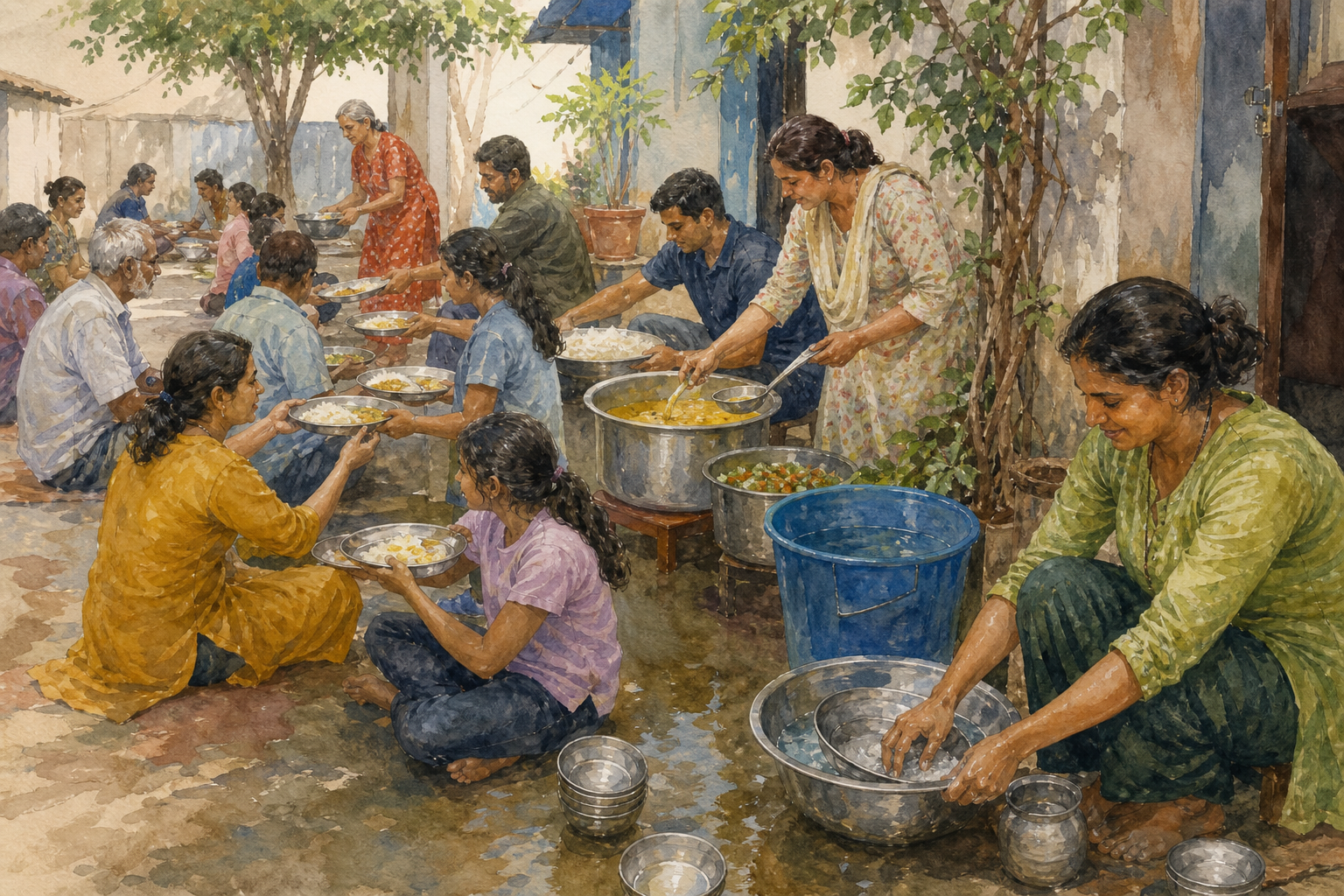
Generosity moves something you control toward someone else’s well-being. Service goes further: it asks you to give attention and effort without making your importance the center of the act. Both weaken possessiveness, but only when the recipient’s dignity matters more than the helper’s self-image.
Vand Chhako and dana keep prosperity from ending at the boundary of the household. Seva and karma yoga turn compassion into work. Langar shows how something as ordinary as preparing and sharing food can become a disciplined social practice. Sarbat da Bhala then widens the horizon beyond family, faction, and congregation toward universal welfare.
Before beginning a service activity, ask questions that prevent good intention from becoming control:
- Is this help wanted, and is it useful to the people receiving it?
- Can they help define the need and the form of the response?
- Does the activity preserve privacy and dignity?
- Am I neglecting a genuine duty at home or work in order to perform a more visible act of service?
- Would I still do this if no name, photograph, praise, or influence came back to me?
Choose a recurring need close enough for you to observe consequences: food security, mentoring, care for elders, neighborhood upkeep, environmental stewardship, or support for people facing exclusion. Regular contact teaches what distant sentiment cannot. You see whether your help transfers power, creates dependence, misses the actual need, or quietly relieves suffering.
Watch what happens after the work. Irritation when nobody thanks you, insistence on controlling every decision, resentment toward less visible volunteers, and eagerness to publicize the act are not reasons to abandon service. They are evidence that service has reached the ahankara it is meant to expose. Notice the reaction, release the claim to recognition, and return to the work that is actually needed.
Build a rule of life that points beyond the ego

Ethical living and liberation are not separate projects, with morality assigned to ordinary life and freedom postponed to a distant spiritual future. Actions and intentions strengthen tendencies. Repeated grasping makes grasping easier; repeated truthfulness, restraint, remembrance, generosity, and service cultivate a different direction. Across Dharmic paths, karma, disciplined practice, and release from attachment belong to the movement beyond samsara, even though each tradition explains that movement in its own way.
A sustainable rule of life can be modest:
- At the beginning of the day: spend two to five minutes with the breath, silence, or the remembrance practice of your tradition. Name the ethical pressure you expect to face.
- During consequential moments: pause before acting. Test the choice for truth, avoidable harm, fairness, attachment, and the welfare of people who have less power in the situation.
- At the end of the day: review speech, work, consumption, and relationships. Select a repair instead of settling for regret.
- On a repeating schedule: share resources, perform useful seva, examine how your livelihood affects others, and return to satsang, sangat, a trusted teacher, or a serious community of practice.
Keep the structure stable long enough to reveal patterns. Constantly changing methods can conceal the very habits practice is supposed to uncover. Once the rhythm is reliable, deepen it through the discipline of your own tradition rather than accumulating techniques for novelty.
Measure progress by conduct, not spiritual drama. A quieter baseline of mind, more spontaneous compassion, greater ease in forgiveness, and a stronger preference for truth are meaningful signs because they change how you meet other beings. Visions, intense emotions, or temporary serenity do not excuse exploitation, dishonesty, or contempt. If an experience enlarges your claim to superiority, treat that enlargement as something to examine rather than proof of attainment.
Failure need not become either despair or permission. Repetition becomes refinement only when each return includes clearer attention, concrete repair, and a changed response. The liberating question is not whether you have maintained a flawless self-image. It is whether greed, aversion, delusion, possessiveness, and ego have less authority over what you do next.
Key takeaways
- The shared Dharmic path runs through disciplined attention, ethical conduct, generosity, service, and freedom from ego, but its traditions retain distinct doctrines and goals.
- Use contemplation to create space for moral judgment; do not use it to escape difficult duties.
- Test dharma in speech, livelihood, power, consumption, and repair, especially when truth or fairness carries a cost.
- Make sharing and seva regular enough to challenge possessiveness, while letting the people served define what is genuinely useful.
- Judge spiritual progress by reduced reactivity, greater truthfulness, wider compassion, quicker repair, and less hunger for recognition.
Begin tonight with one repair you already know is due. Tomorrow, give the first two to five minutes of the day to steady attention and name the choice that will test your dharma. When that choice arrives, let the practice leave the meditation seat and enter your conduct.
References
- DharmaRenaissance Blog – Guru Nanak’s Timeless Guidance: Seven Life-Changing Teachings for a Fractured World
- DharmaRenaissance Blog – Why Souls Reincarnate: A Profound Look at Karma, Play, and Purpose in Birth and Death
- DharmaRenaissance Blog – Does God Really Exist? Experiential Practices to Sense the Divine Within Every Day
