

You want your home to carry dharma forward, but the pressure rarely arrives as a clean choice between faithfulness and abandonment. It arrives when worship collides with school, a spouse follows a different practice, an elder treats a custom as untouchable, or a child asks why your family cannot simply do what everyone else does.
The useful question is not, “How do we keep every inherited form unchanged?” It is, “How do we preserve what is sacred while acting truthfully, responsibly, and without contempt for our neighbours?” You can answer that question by separating principles from practices, building a household rhythm that survives ordinary life, and setting clear boundaries before a conflict forces the decision.
Separate dharmic principles from practices and preferences
Many family disputes become needlessly bitter because three different things are treated as one. A timeless ethical commitment, a valuable spiritual discipline, and a familiar cultural preference may all be described as “our dharma.” Once that happens, changing the hour of worship can sound like rejecting worship itself.
Dharma is broader than a private belief or a single ritual form. It joins inward discipline to conduct: truthfulness, self-restraint, non-harm, service, responsibility, and care for the wider order of life. Bhakti adds loving devotion and service to Bhagavan. Different dharmic sampradayas give these commitments distinct theological and practical expressions, so common ethical ground should never be mistaken for doctrinal sameness.
When your family faces a decision, classify what is at stake:
- Principle: the value or obligation that must govern the choice, such as satya, ahimsa, seva, fidelity to your tradition, responsibility toward dependants, or respect between family members.
- Practice: a repeated discipline that embodies the principle, such as puja, japa, kirtan, meditation, scriptural learning, dietary observance, charitable service, or festival worship.
- Preference: a customary form that may carry affection and cultural memory but can sometimes change without betraying the principle, such as the language of an explanation, the arrangement of a gathering, or the particular hour at which a household practice occurs.
This distinction does not make every form optional. Some practices derive their meaning from a particular lineage, vow, or discipline and cannot be redesigned at will. The point is to identify the real obligation before arguing about its outer arrangement. Consult the relevant guru, acharya, community authority, or established teaching when you are unsure whether a form is essential.
Suppose one person insists that family worship must happen in the morning while another leaves early for work. Ask what the morning schedule protects. If it protects consistent remembrance and shared worship, a different reliable household anchor may preserve the principle. If the timing belongs to a specific observance, the answer may be different. You cannot decide intelligently until the family has named the duty rather than merely defending a habit.
Write a short household dharma statement using this form: “In this home, we practise [discipline] because it cultivates [principle]. We will preserve [non-negotiable element], while adapting [flexible element] when work, school, health, or care duties require it.” If family members cannot complete that sentence together, the disagreement is still too vague.
Build a household rhythm that can survive ordinary life
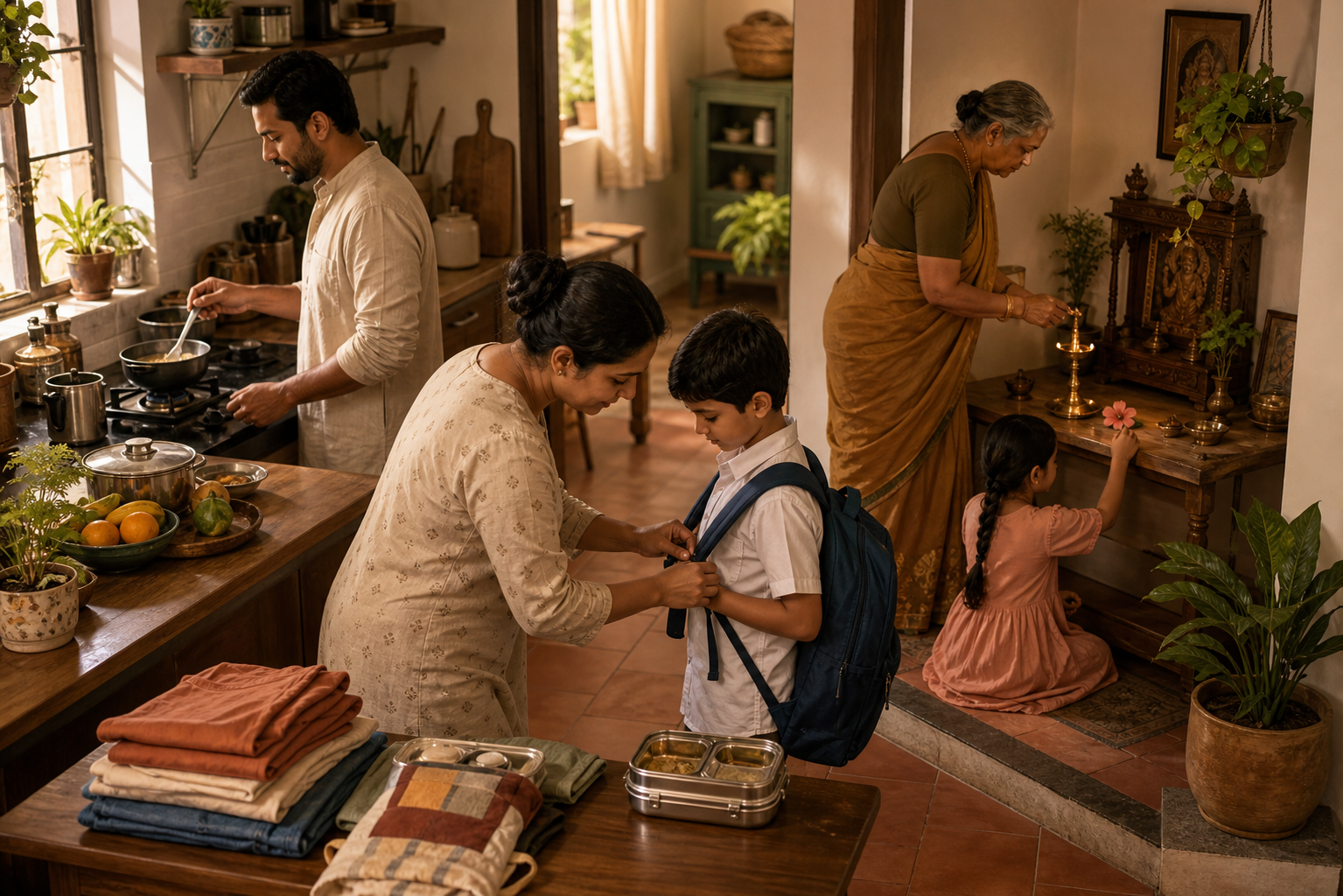
A family practice that functions only on quiet days will soon become a source of guilt. Your normal week, not an imagined ideal week, must provide the structure. Work, study, caregiving, rest, and spiritual discipline all belong inside grihastha responsibility.
Build the rhythm in this order:
- Choose an existing household anchor. Waking, the first shared meal, returning from school or work, and preparing for sleep already organize family attention. Attach a practice to an anchor that regularly occurs.
- Name the smallest complete version of the practice. It should still carry its spiritual purpose on a demanding day. A fuller observance may remain the norm, but the family should know what faithful continuity looks like when circumstances tighten.
- Give everyone a real role. One person may prepare the sacred space, another lead a prayer or reading, another arrange prasada, and another choose the act of service. Participation should not depend on one exhausted family member carrying the entire tradition.
- Connect inward practice to outward conduct. Pair prayer, study, or meditation with a visible family duty: truthful speech, care for an elder, hospitality, restraint in consumption, or service beyond the household.
- Plan festivals around their devotional centre. Identify the worship, remembrance, teaching, vow, or seva that gives the occasion its meaning. Add local foods, music, clothing, and social customs around that centre rather than allowing the programme to obscure it.
- Adopt a recovery rule. When the routine is missed, resume at the next anchor. Do not turn spiritual discipline into a backlog, a punishment, or evidence that the household has failed.
This is adaptation with a purpose. In Krishna-conscious family life, for example, japa, kirtan, festivals, diet, work, and schooling can be arranged around actual household conditions while devotion remains central. Adaptation becomes dilution only when convenience quietly replaces the principle rather than serving it.
Review the rhythm whenever a major responsibility changes. Do not wait for resentment to reveal that the arrangement no longer works. Ask which practice is being sustained, who is carrying it, what repeatedly disrupts it, and which flexible element can change without sacrificing the purpose.
Give children an identity they can understand and inhabit

Children need more than rules and more than cultural entertainment. They need to see how a practice forms character, why the family has chosen it, and how to speak about it without shame or hostility.
For a young child, connect the teaching to an action the child can see: we speak truth even when an excuse would be easier; we handle living beings gently; we offer gratitude before taking food; we help because seva is part of worship. As children mature, explain the theological and philosophical commitments behind the action. Do not leave them with a list of prohibitions after they have become capable of asking for reasons.
Use language that builds conviction without teaching contempt:
- Say, “This is what our family practises and why,” rather than, “Only bad people do otherwise.”
- Say, “Other families follow their conscience differently,” rather than pretending that every belief means the same thing.
- Say, “You may ask an honest question respectfully,” rather than treating uncertainty as disloyalty.
- Say, “Belonging to this family does not depend on performing for relatives,” while still expecting age-appropriate participation and respectful conduct.
A child living in a plural society also needs distinctions that adults often leave unspoken. Respect does not require agreement. Attendance is not always participation. Learning about another tradition is not the same as performing its rites. Declining a rite is not permission to insult the people who practise it.
Before a school event, neighbourhood celebration, or visit to another place of worship, tell the child what the family is comfortable doing. You may decide that the child can attend as a guest, listen, observe, and offer ordinary courtesy but should not make a declaration or perform a religious act that conflicts with the family’s commitments. Give the child a simple sentence to use: “Thank you for including me. My family does not perform this part, but I am glad to learn respectfully.”
The same standard must work in reverse. If you expect others to respect a dharmic boundary, your household should not pressure a guest into worship, prasada, sacred markings, or speech that violates the guest’s conscience. Invitation preserves dignity; compulsion corrupts hospitality.
Use a dharmic protocol when relatives or spouses disagree

Shared identity does not guarantee a shared interpretation. A couple may differ over ritual strictness. Grandparents and parents may disagree about what children should observe. Members of different dharmic traditions may share a home while retaining distinct vows and forms of worship. Goodwill helps, but a repeatable decision process is more reliable than waiting for everyone to feel the same.
- Describe the disagreement without assigning motives. Say, “We disagree about whether the child should participate in this rite,” not, “You do not respect our family.”
- Name the duty each person is trying to protect. One may be protecting fidelity to a vow; another may be protecting family peace, a child’s conscience, or an obligation to work or study.
- Classify each disputed element. Mark it as principle, practice, or preference. If you disagree about the classification, seek guidance from a trusted authority in the relevant tradition.
- Test the available choices. Ask which choice is truthful, which reduces avoidable harm, which fulfils real duties, and which preserves trust without pretending that a disagreement has disappeared.
- Choose the least coercive arrangement that preserves the principle. A boundary can be firm without humiliating the person who encounters it.
- Present the decision together. Extended family should hear a clear household decision, not be invited to recruit one spouse against the other or a child against a parent.
- Review what actually happened. After the event, ask whether the principle was preserved, whether anyone was unnecessarily burdened, and whether the arrangement should be refined.
When food becomes the point of tension
If your household follows a dietary discipline, do not arrive at a mixed gathering hoping that everyone will improvise correctly. Explain the boundary in advance, ask what will be served, and offer to bring something shareable. At the gathering, state your practice without judging the host’s character. If the boundary cannot be respected, decline the meal or invitation courteously rather than accepting it and expressing resentment later.
When a festival collides with school or work
Identify the observance’s essential devotional act first. Then communicate any needed accommodation early and specifically: what time or activity is affected, what you are requesting, and how you will meet the underlying responsibility. If the full family programme is impossible, preserve the central worship or remembrance and move flexible social elements. This protects both religious integrity and the dharmic duty to deal responsibly with others.
When different dharmic traditions share a home
Hindu, Buddhist, Jain, and Sikh traditions possess recognizable ethical resonances, including disciplined conduct, compassion, truthfulness, and service. Those resonances can support family cooperation, but they do not erase different teachings, authorities, vows, or ritual boundaries.
Create three clear spaces: practices the household can share, practices each person follows individually, and acts no one will be pressured to perform. A common act of seva may be shared. Distinct meditation, puja, recitation, or congregational commitments may remain individual. The agreement should protect each person’s conscience while giving the household enough common discipline to function as a family.
Practise pluralism without hiding dharma or dominating others

Pluralism does not require you to say that all religions are interchangeable. It requires a civic discipline: people with different convictions must be able to live, speak, worship, disagree, and cooperate without coercion or dehumanization. A dharmic family can hold a definite view of truth while refusing falsehood, cruelty, and collective contempt.
Before taking a public position, apply these tests:
- Truth: Can you describe the other person’s actual claim, or are you reacting to a caricature?
- Ahimsa: Are you preventing genuine harm, or using moral language to justify humiliation and hostility?
- Duty: Does your position fulfil a real responsibility toward family, community, or society, or merely reward anger?
- Reciprocity: Would you accept the same civic rule if another community used it to protect its own conscience?
- Seva: Does your action leave the shared neighbourhood, school, workplace, or institution more capable of serving people fairly?
These tests do not demand passivity. You can request religious accommodation, challenge misrepresentation, defend temples and community institutions, teach Hindu history accurately, and refuse practices that violate your convictions. Be precise about the action, policy, or claim you oppose. Turning an entire religious or social group into a single moral category abandons truth at the moment truth is most needed.
In a workplace or school, ask for accommodation rather than undefined special treatment. State the religious obligation, the concrete adjustment required, and the responsible alternative you can offer. In neighbourhood life, make service available without requiring religious conformity. In inter-community dialogue, do not conceal disagreement merely to appear agreeable; describe it accurately and without insult.
There is also a boundary within your own home. Pluralism should not become an excuse for relatives, institutions, or peers to ridicule a child’s name, sacred symbols, food, worship, or community belonging. Correct mockery calmly and directly. At the same time, teach the child that experiencing difference, answering a question, or seeing another tradition in public is not itself persecution. Clarity is stronger than either fear or denial.
Key takeaways
- Classify a disputed expectation as a principle, a practice, or a preference before deciding whether it can change.
- Attach household practice to routines that already survive work, school, and caregiving.
- Teach children the reason for an observance and give them respectful words for explaining a boundary.
- Choose the least coercive arrangement that still protects the relevant dharmic commitment.
- Treat pluralism as reciprocal freedom and disciplined disagreement, not as a claim that every tradition is identical.
- Judge public action by truth, non-harm, duty, reciprocity, and service.
At your next family meal, choose one principle you want the home to embody, one repeated practice that expresses it, and one inherited custom you are willing to adapt if circumstances require. Put the practice on a real household anchor and agree on what you will do when it is disrupted. Dharma becomes durable when the family can recognise it not only in the shrine room, but also in its speech, decisions, hospitality, and courage.
References
- Dandavats — Timeless Principles for Krishna Conscious Family Life: Culture-Sensitive, Dharmic Harmony
- Hindu Pad — Dharma and Spiritual Elevation: Timeless Ethics for Unity and Inner Transformation
