
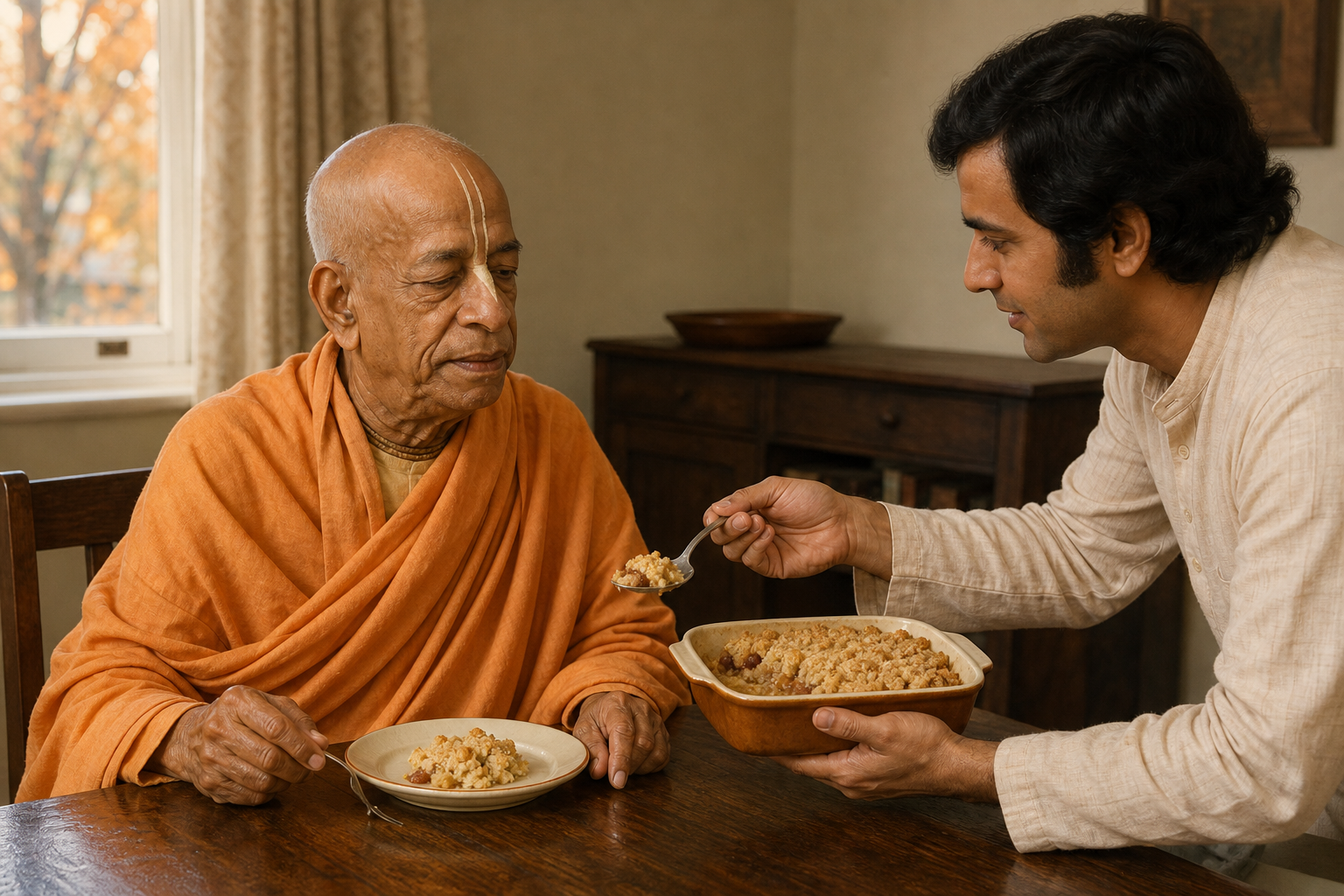
If you have been told that rolled oats are unfit to offer because they are "horse food," the Melbourne apple-crumble episode gives you a concrete fact to work with. On 20 May 1975 in Melbourne, Srila Prabhupada ate an apple crumble whose topping contained oats and then asked for more.
That fact answers a narrow practical objection, but it is often made to carry more doctrinal weight than the reported exchange can bear. You can use the incident responsibly by separating what happened, what can reasonably be inferred, and what still has to be decided by the standards of the offering context in front of you.
The dispute was about the status of oats
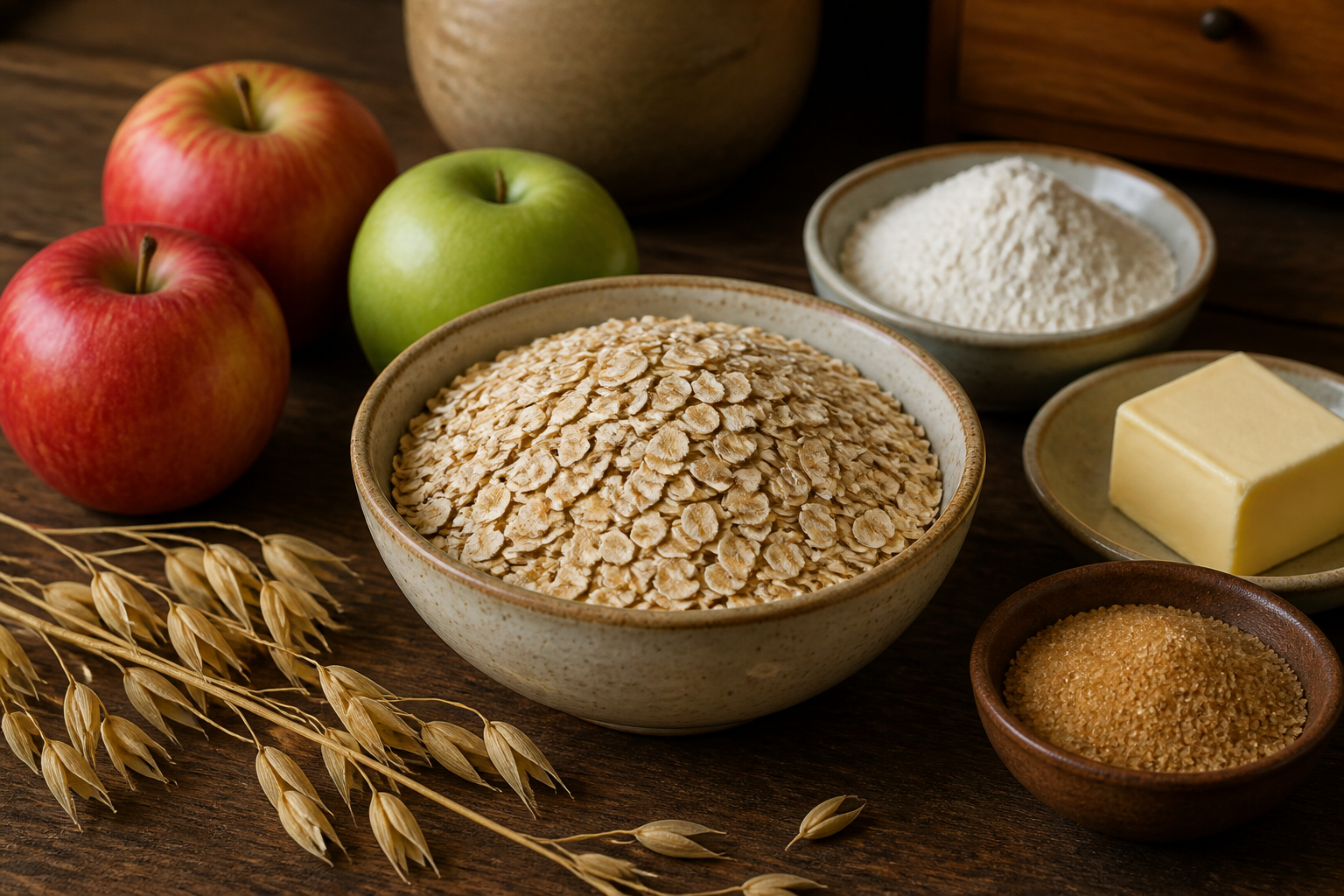
After the evening program at Melbourne Mahaprabhu Mandir, devotees gathered for a feast in Parampara Hall. Dwaipayana’s apple crumble had already become a point of disagreement. Thinly sliced apples, cinnamon and raisins sat beneath a crisp topping made from roughly equal parts oats and brown sugar combined with melted butter.
The criticism was not that the crumble had been badly cooked. Some devotees regarded oats as food for horses and therefore as a low-class grain, unfit for either the Deity or Srila Prabhupada. Dwaipayana continued to prepare the dessert despite that objection.
On the evening in question, he set aside portions of the feast preparations for Srila Prabhupada, who was sometimes hungry after delivering his discourse. Srutakirti carried the food upstairs with hot milk. He soon returned to the kitchen with a request for another serving.
Bring me more of that "crispy apples."
Srila Prabhupada, as relayed by Srutakirti
Within this remembered Melbourne episode, that request ended the practical force of the rolled-oats objection. No abstract argument was needed. The preparation that had been dismissed as unsuitable was eaten, appreciated and requested again.
Key takeaways
- The historical claim is specific: Srila Prabhupada ate one apple crumble containing rolled oats in Melbourne on 20 May 1975 and asked for more.
- The recorded objection rested on oats being classified as horse food and low-class, not on a cited scriptural prohibition.
- The request for more strongly undermines the claim that this oat-topped preparation was inherently unsuitable for Srila Prabhupada.
- No ingredient-by-ingredient discussion appears in the remembered exchange, so the incident should not be inflated into a formal ruling about every oat product or every offering context.
- The commonly circulated large-tray recipe is a later reconstruction, not Dwaipayana’s authenticated original formula.
What the incident settles, and what it does not
The strongest reasonable conclusion is that oats cannot be rejected merely by attaching a low-status label to them. A dish containing rolled oats was served to Srila Prabhupada, and his response was not reluctant tolerance but a request for another helping. The categorical claim that oats were beneath him does not fit the documented action.
There is also an important limit. Nothing in the reported exchange shows Srila Prabhupada inspecting the recipe or discussing oats as an ingredient. You therefore should not claim that he issued a comprehensive dietary decree, approved every commercially processed oat product, or prescribed apple crumble as a devotional standard. Those conclusions reach beyond the event.
You should also keep two questions distinct. The original criticism concerned suitability for both the Deity and Srila Prabhupada, but the action described directly concerns food served to Srila Prabhupada. It does not reproduce a separate formal instruction addressing every circumstance of Deity offering. The episode is powerful precisely when its claim remains exact.
When a similar argument arises over an unfamiliar ingredient, ask four questions before turning a preference into a prohibition:
- What is the exact claim: that the ingredient is forbidden, locally discouraged, unfamiliar or simply disliked?
- Is the concern about the ingredient itself, the way it was processed, or the complete preparation?
- What identifiable standard supports the objection: a textual rule, an instruction from the responsible authority, or only a social label?
- Does documented practice at the same level contradict an absolute claim?
This method prevents two opposite mistakes. You do not turn cultural unfamiliarity into dharma, and you do not turn one accepted dish into permission for every superficially similar product.
How to recount the story without enlarging it
If you need to cite the incident in a class, kitchen discussion or online conversation, a defensible formulation is: "On 20 May 1975 in Melbourne, Kurma Dasa remembered Srila Prabhupada being served Dwaipayana’s oat-topped apple crumble and asking for more, calling it ‘crispy apples.’"
That wording supplies the date, place, preparation, response and evidentiary status. It avoids several common shortcuts:
- Do not say Srila Prabhupada formally declared every kind of oat suitable for every offering.
- Do not call apple crumble Srila Prabhupada’s recipe. Dwaipayana cooked the remembered dish.
- Do not describe the later published recipe as an exact copy of the 1975 preparation.
- Do not present the remembered wording as though it were an independently verified transcript. The request was relayed to the kitchen by Srutakirti and later recorded as a recollection.
These qualifications do not weaken the story. They protect it. An inflated claim gives a critic an easy target; the dated event itself is already sufficient to answer the claim that Srila Prabhupada necessarily rejected oats as low-class food.
Recreate the crumble while preserving its provenance
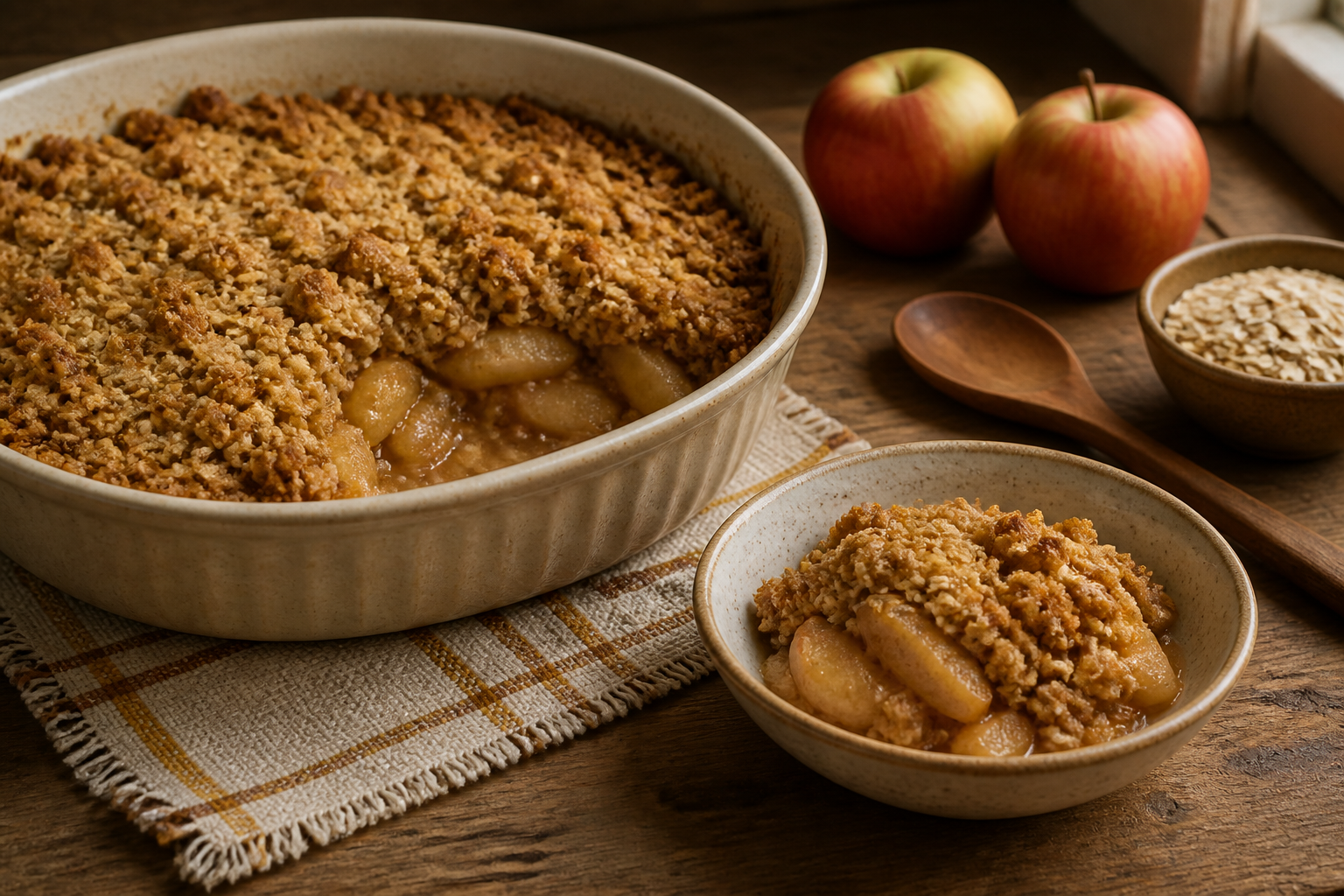
A practical large-tray version
Kurma Dasa later answered a request for the old Melbourne Sunday-feast dessert with his own large-tray recipe, while clearly stating that he did not have Dwaipayana’s actual formula in front of him. If you want to cook that reconstruction, use the following proportions:
- Thinly slice about twelve large green apples, adjusting the number to the size of your tray. Add a little sugar, lemon juice, cinnamon and raisins.
- For the topping, combine 1.5 cups of whole rolled oats, not the quick-cooking variety, with 1 cup plain flour, 1 cup whole-wheat flour, 1 cup raw sugar and 1 cup brown sugar.
- Add at least 1 cup melted butter and rub the topping ingredients together.
- Spread the apples across the bottom of a heavy baking tray and distribute the topping evenly over them.
- Bake in a hot oven for about 40 minutes, or until the apples are cooked and the topping is golden and aromatic.
Do not attach false precision where none was supplied. The recipe says "hot oven" but gives no numerical temperature, and the number of apples varies with the tray. If you are preparing the crumble repeatedly for a community meal, test one tray first, record the oven setting and tray dimensions that worked, and scale only after that result is consistent.
Label this version honestly as a later reconstruction. The 1975 description used a simpler topping of oats, brown sugar and melted butter, while the later recipe adds plain flour, whole-wheat flour, raw sugar and brown sugar. That difference is exactly why the recreation should not be passed off as Dwaipayana’s lost original.
When the same kind of disagreement reaches your kitchen
If you are cooking in a temple, follow the ingredient and offering standards set by the people responsible for that seva. The Melbourne incident can correct an unsupported status prejudice, but it is not permission to bypass an established kitchen responsibility or make a unilateral rule for everyone else.
For the narrower question at home, the dated action is enough: a crumble containing rolled oats was eaten and requested again. If someone still objects, ask for the actual basis of the objection rather than trading labels such as "Vedic," "Western," "high-class" or "horse food." A precise rule can be examined; a prestige label only repeats itself.
The next time this controversy surfaces, cite the exact Melbourne event and stop where its evidence stops. If you cook the dessert, identify it as a reconstruction, test the unspecified oven setting before serving a crowd, and preserve the distinction between Dwaipayana’s remembered crumble and the later written recipe. That combination of accuracy and practical care is the most useful way to carry the story forward.
References
- Dandavats – The happy end of the rolled oats controversy! The Story of Apple Crumble
- Dandavats – The happy end of the rolled oats controversy! The Story of Apple Crumble
