

You know what you want to offer His Holiness Jayapataka Swami: prayer, gratitude and respect. The difficulty is putting those feelings into words without sounding formal for the sake of formality, claiming a closeness you do not have, or repeating uncertain information about his well-being.
You do not need a long message. A sincere prayer, one truthful reason for your gratitude and a respectful closing are enough. The examples below can be adapted for a private letter, a community message or a short public comment.
What makes a message genuinely prayerful
A prayerful message is more than praise. It joins your words to an actual prayer while keeping the recipient free from any obligation to reassure you, answer you or provide an update.
- Direct the prayer clearly. Say what you are praying for: strength, comfort, protection or well-being.
- Keep the gratitude truthful. Mention a real teaching, act of kindness, letter, blessing or moment of association. If you have no personal memory, do not manufacture one.
- Respect what is private. Do not repeat a diagnosis, medical detail or supposed development unless it has been publicly confirmed and belongs in the message.
- Avoid guaranteed outcomes. Prayer is an offering, not a prediction. Express hope without declaring what Sri Krishna must do or what will certainly happen.
- Ask for nothing in return. A person receiving many messages should not be made to feel that a reply is expected.
This restraint does not make a message cold. It makes the affection easier to receive. Instead of writing, “Please answer when you can because we are worried,” write, “No reply is needed; please accept this small offering of prayer.”
A four-part structure you can use every time

When the right words are not coming, use this order. Each part has a distinct purpose, so the message remains warm without becoming repetitive.
- Use an accurate address. “Dear Guru Maharaja” is appropriate when that describes your actual relationship. Otherwise, “Dear Maharaja” or “Dear His Holiness Jayapataka Swami Maharaja” is respectful and does not claim discipleship.
- State one direct prayer. For example: “We are praying to Sri Krishna for your strength and well-being.” One clear sentence is stronger than several ornate wishes.
- Give one truthful reason for your gratitude. Name what his kindness, guidance, service or personal association has meant to you. A concrete memory is especially valuable, but only when it is yours.
- Close without creating a duty. Use “With prayers,” “With gratitude and respect,” or “Your servant” if that final expression is natural and sincere within your devotional practice.
Fill-in template:
Dear [accurate form of address],
Please accept my respectful obeisances. I am praying to Sri Krishna for your [strength, comfort and well-being]. I remain grateful for [one true teaching, kindness, blessing or form of service]. Please accept this message as a small offering of prayer; no reply is needed.
With [prayers, gratitude or respect],
[Your name and community]
Match the message to the relationship you actually have
The most common mistake is not poor wording. It is writing from a relationship that does not exist. Reverence does not require borrowed intimacy.
- If you are a disciple: you may use the form of address and devotional closing customary in your relationship. A brief, specific remembrance can make the message personal.
- If you have met him: identify the occasion simply, then describe what stayed with you. Do not enlarge a brief meeting into a close association.
- If you know him through his service: thank him for that service and offer your prayer. You can be sincere without implying a personal history.
- If you are writing for a temple or community: name the group, state what the community is genuinely offering and let one person sign on its behalf. Avoid making every participant sound as though they have the same relationship with him.
- If you are posting publicly: keep private details out. A prayer and one sentence of gratitude are usually sufficient.
Personal words can remain spiritually important long after the moment has passed. One devotee remembers Jayapataka Swami answering letters personally and still treasures several replies written nearly twenty-four years earlier. What endured was not elaborate language but the warmth, kindness and blessing conveyed through it.
That remembrance also gives you a useful test: could the recipient understand why these words came from you rather than from anyone else? If so, the message is personal enough. If not, replace one general compliment with one true detail.
Prayerful messages you can adapt
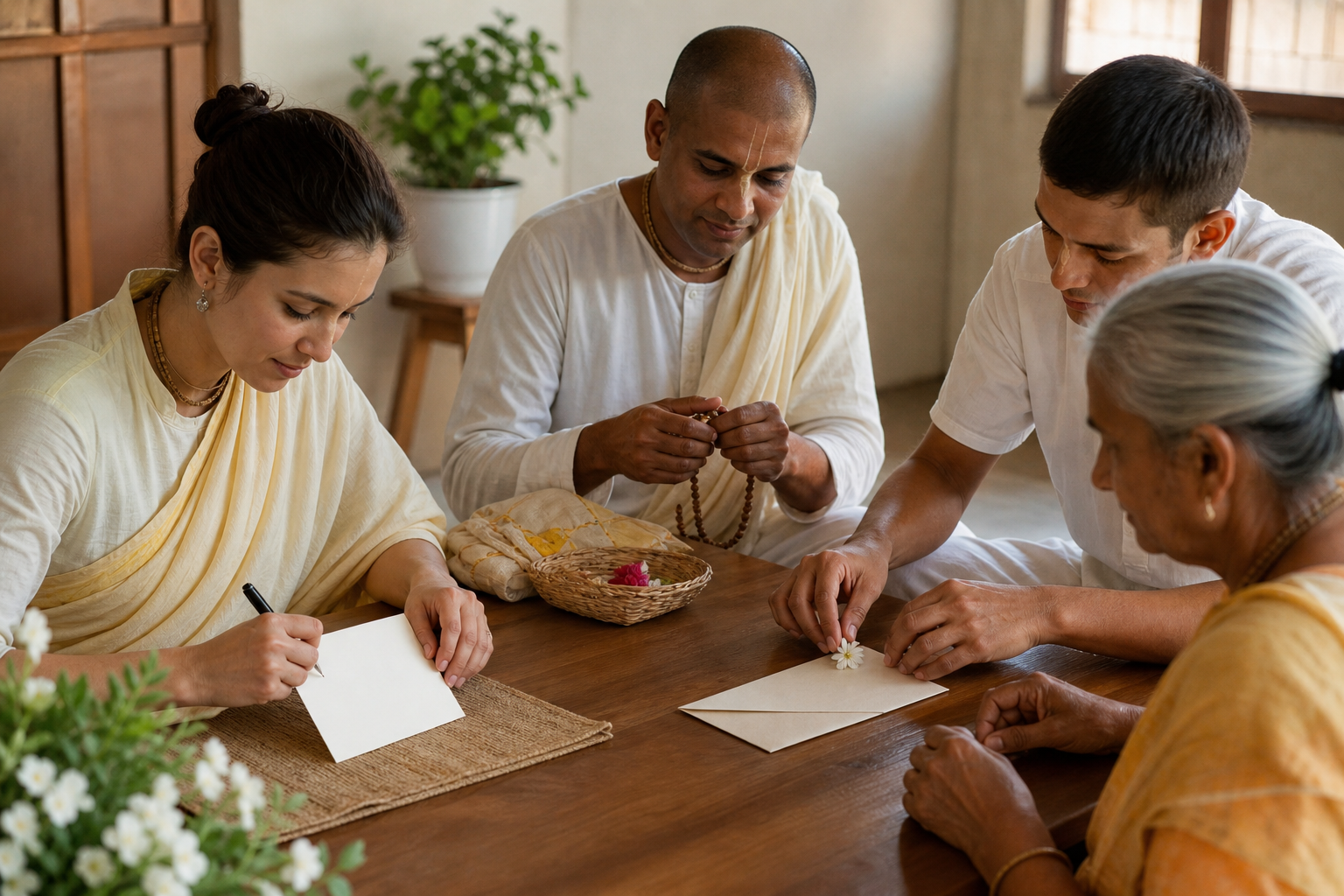
A concise message for his well-being
Dear His Holiness Jayapataka Swami Maharaja,
Please accept my respectful obeisances. We are praying to Sri Krishna for your strength, comfort and well-being. Your kindness and service to the devotees remain a source of gratitude. Please accept our respectful prayers.
With gratitude,
[Name]
This version is suitable when you want to express concern without discussing the reason for that concern. It is also brief enough for a public comment.
A message built around a personal remembrance
Dear Maharaja,
Please accept my respectful obeisances. I still remember when you [describe the real occasion in one sentence]. Your [words, kindness or blessing] helped me [state the honest effect]. I remember that gift with gratitude and pray to Sri Krishna for your strength and well-being. No reply is needed; please accept this small offering of prayer.
With respect and gratitude,
[Name]
Keep the memory precise. “When you visited our community, you encouraged me to remain steady in service” is useful if it is true. “You transformed every part of my life” should be used only if you can honestly stand behind it.
A collective message from a temple or community
Dear His Holiness Jayapataka Swami Maharaja,
Please accept our respectful obeisances. The devotees of [temple or community name] are remembering you in prayer and praying to Sri Krishna for your strength and well-being. On [date or occasion], we offered [name only an offering that was actually made] with gratitude for your service and care for devotees. Please accept the prayers of our community.
With respectful regards,
[Name], on behalf of [community]
Do not promise a collective observance before the people responsible for it have agreed. If the offering is planned but not yet completed, say, “We intend to offer,” and give the confirmed occasion. If it has already happened, use the past tense.
A message when you have had no personal association
Dear His Holiness Jayapataka Swami Maharaja,
Please accept my respectful obeisances. Although I have not had the blessing of personal association with you, I wish to offer my respectful prayers. I am praying to Sri Krishna for your strength, comfort and well-being, and I remain grateful for your service to the devotees.
With prayers and respect,
[Name]
This wording is honest about distance without making the message impersonal. There is no need to compensate with exaggerated praise.
Key takeaways: five checks before you send
- Is the address accurate? Use “Guru Maharaja” only when it reflects your genuine relationship.
- Is there one unmistakable prayer? Name the intention rather than relying only on praise.
- Is every personal detail true? Use your own memory, not another devotee’s experience as though it were yours.
- Have you removed speculation? Delete unconfirmed medical details, private information and claims of a guaranteed outcome.
- Is the message free of demands? Do not request a response, blessing, update or acknowledgement in a message meant to support him.
Read your message aloud once. Remove any line that exists mainly to display the intensity of your emotion. Then make the prayer you have named and send the message as its quiet extension.
References
