
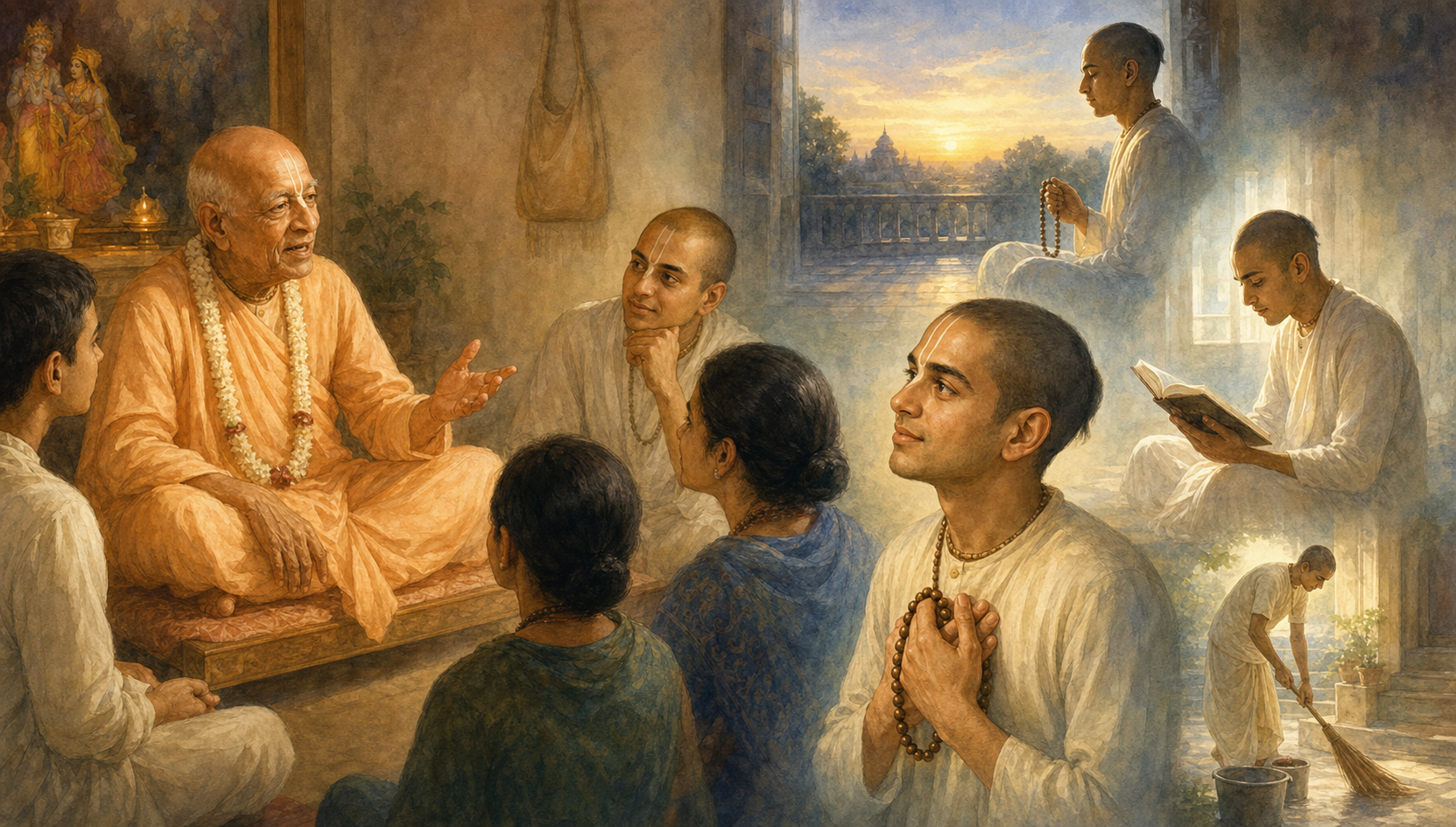
You hear a moving memory of Srila Prabhupada, feel newly determined, and leave the katha wanting to change. Then ordinary duties return. The story remains vivid, but the determination does not become a stable practice.
The missing step is translation. A remembrance must move from event to principle and from principle to practice. When you learn to make that movement carefully, oral history becomes more than devotional nostalgia. It helps you chant with greater attention, read with a clearer purpose, serve without separating devotion from responsibility, and understand how an acharya embodied the teachings he transmitted.
Treat remembrance as a bridge, not a substitute

Katha carries more than biographical information. Tone, choice, discipline, humor, patience, correction, and daily priorities reveal how a teaching was lived. This human texture matters because formal doctrine alone cannot show you what fidelity looks like when travel, illness, management, conflict, teaching, and pastoral care all demand attention.
Srutakirti Prabhu’s vantage point is especially useful because he served Srila Prabhupada closely during the early to mid-1970s and accompanied him across continents. Such proximity can preserve small but consequential details: how sadhana fitted into a demanding day, how an instruction was delivered, what received immediate attention, and what was never allowed to displace the philosophical center.
But proximity does not turn every recollection into scripture, and affection does not make every anecdote a universal instruction. Within Gaudiya Vaishnavism, sabda-pramana as received through guru-shishya parampara remains foundational. Oral testimony serves that foundation when it illuminates siddhanta, clarifies conduct, or shows a teaching operating under real conditions. It should not replace Bhagavad-gita As It Is, Srimad-Bhagavatam, Chaitanya-caritamrita, or the established teachings of the lineage.
This distinction protects you from two opposite errors. One is hagiographic overreach: treating a remembered preference, a context-specific decision, or a personal instruction as a rule for everyone. The other is sterile skepticism: discarding lived testimony because it is not a canonical text. A mature reader does neither. You receive the memory respectfully, identify what kind of claim it contains, and test the meaning before building your practice around it.
Listen for the movement from event to principle to practice
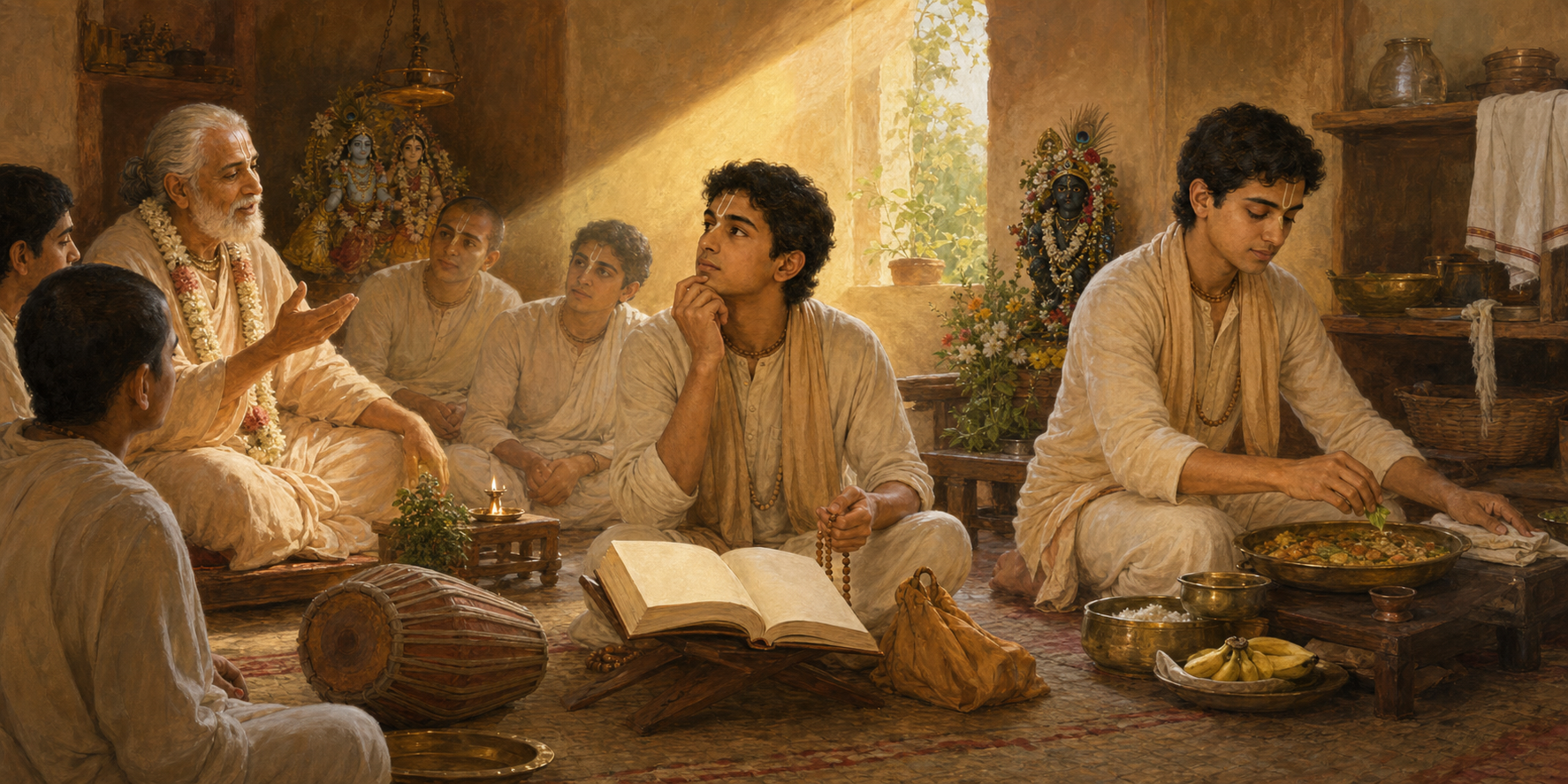
Before the next katha begins, divide a page under three headings: Observation, Principle, and Application. This simple structure prevents inspiration from dissolving into admiration.
- Record what was actually observed. Note the action, setting, words, and people involved. Keep the remembered event separate from your explanation of it. If the speaker describes an action but assigns no motive, do not invent one.
- Name the devotional principle. Ask which teaching the event makes visible: attentive chanting, obedience to parampara, compassion, steadiness, accountability, service, scriptural fidelity, or another clearly identifiable principle.
- Choose an application within your present duties. Ask what you can begin, stop, protect, or improve. The action should be repeatable and proportionate. A dramatic vow made in the emotional atmosphere of a katha is less useful than a commitment you can honor when the atmosphere is gone.
Consider the remembered pattern of Srila Prabhupada’s day. Early worship, focused japa, study, writing, teaching, pastoral care, management, and outreach belonged to one devotional rhythm. The lesson is not that every householder, student, monk, or professional must reproduce the same timetable. The deeper principle is that internal absorption and outward service should support each other rather than compete for whatever time remains.
Your application might therefore be to protect japa before opening work messages, to read a passage of scripture before making an important community decision, or to treat administration as seva while refusing to let administration consume every devotional anchor. That is a faithful translation of the pattern. Copying another person’s external schedule without regard for your ashrama, health, family, and duties would be imitation rather than intelligent following.
Pay attention to the grammar of a remembrance as well. “He said” is different from “I understood him to mean.” A repeated routine is different from an exceptional response to a crisis. A personal instruction is different from a public teaching. Write those distinctions into your notes. They matter when someone later tries to use the same story to establish doctrine, criticize another devotee, or prescribe conduct for an entire community.
When the claim carries doctrinal or historical weight, compare it with published letters, recorded lectures, travel diaries, and the relevant passages of the foundational texts. Corroboration does not drain a katha of devotion. It gives the memory a secure place within the lineage and protects both the speaker and the subject from claims they did not make.
Build a practice you can actually repeat

The most useful remembrance is not necessarily the most dramatic one. It is often the detail that exposes a neglected habit. Use the following map to convert recurring themes in Srila Prabhupada katha into concrete decisions.
| What you notice in the katha | Principle to carry forward | Action you can take | Misreading to avoid |
|---|---|---|---|
| Early-morning devotional discipline | Give Krishna conscious attention a protected place | Prepare what you need beforehand and begin japa at a stable daily cue | Assuming that a particular clock time is spiritually sufficient without attentive chanting |
| Focused japa | The holy name is a relationship of attention, not background sound | Hear each part of the maha-mantra and notice when the mind has left it | Reducing practice to completion while ignoring the quality of attention |
| Regular study and writing | Service should remain answerable to sabda | Read a manageable passage, note its instruction, and carry one question into sat-sanga | Collecting information without allowing it to examine your conduct |
| Teaching and pastoral care amid heavy responsibilities | Inner practice should become service to others | Choose a recurring form of seva that fits your actual capacity | Using service to avoid your own sadhana or family duties |
| Systems for worship, education, publication, and community | Devotional intention needs dependable structures | Improve one recurring process in your temple, home, team, or study circle | Confusing constant activity with accountable service |
For japa, use the maha-mantra as transmitted in the practice: Hare Krishna Hare Krishna Krishna Krishna Hare Hare, Hare Rama Hare Rama Rama Rama Hare Hare. Begin by making the conditions of attention visible. Where will you sit? What usually interrupts you? What will you prepare before beginning? Which distraction can be placed out of reach?
At the end of the sitting, do not judge the whole practice by whether it felt elevated. Ask more useful questions: Did you begin when intended? Did you hear the mantra when attention was present? When the mind wandered, did you return without turning the lapse into an excuse to stop? This gives you something concrete to correct at the next sitting.
For scriptural study, avoid reading only until you encounter a sentence that confirms what you already believe. Note an instruction that challenges your habit, a philosophical point you cannot yet explain, and an implication for service. Take the unresolved point to a qualified teacher or a mature practitioner. Sat-sanga becomes much more useful when you bring a precise question rather than a general request for inspiration.
For seva, choose a form that joins devotion to a real need. Teaching, organizing, mentoring, cleaning, preparing prasada, supporting worship, maintaining records, caring for people, or improving a community process can all become meaningful when performed with the right consciousness and accountability. Define what completion looks like, tell the responsible person what you can reliably do, and do not promise beyond your capacity merely because the service sounds important.
This service-first outlook is also a practical leadership test. Srila Prabhupada’s example joined spiritual gravity with systems for education, worship, publication, and community life. If you lead a family, temple team, cultural initiative, or workplace group, ask whether your arrangements protect the purpose they are supposed to serve. A schedule, role, or reporting system is useful when it makes responsibility clearer. It becomes a burden when it rewards busyness, hides neglected duties, or pushes sadhana permanently to the margins.
Dharmic parallels can sharpen this practice without erasing real differences. Congregational kirtan has a resonance with Sikh shabad-kirtan; disciplined attention in japa can be discussed alongside Buddhist cultivation of concentration; truthfulness and nonviolence are central ethical concerns in Jain dharma; and reverence for the teacher appears across the dharmic family. Use the language of resemblance, not equivalence. “This helps me understand a shared discipline” is more accurate and respectful than “all these practices are the same.” Fidelity to your lineage and generosity toward another tradition do not require philosophical vagueness.
Know when a memory deserves historical or spiritual weight

For historical use, preserve the context
An oral account becomes more useful when its setting can be recovered. Keep the speaker’s name, relationship to the event, venue, date of the katha, approximate date of the remembered event when supplied, and whether you possess audio, video, a transcript, or only personal notes. The Srila Prabhupada katha at ISKCON NVCC Pune took place on 29 May 2026; retaining details of that kind allows future listeners to locate a testimony rather than repeat it as an untraceable community story.
Then label each statement accurately. A direct quotation should be preserved only when the wording is known. A paraphrase should not acquire quotation marks during retelling. An interpretation should be identified as interpretation. If another witness or contemporaneous record confirms the event, record that separately. Corroboration strengthens historical confidence; lack of corroboration does not automatically make a memory false, but it should limit how confidently you use it.
- Proximity: Was the speaker present, or repeating something heard from another person?
- Specificity: Are the place, participants, sequence, and wording clear, or has the account become generalized?
- Corroboration: Do letters, recordings, diaries, or other eyewitnesses support the central claim?
- Context: Was this a standing teaching, a personal instruction, a management decision, or a response to unusual circumstances?
For spiritual use, test the application
A recollection may be historically credible yet still be misapplied. Ask whether your proposed lesson accords with siddhanta and with Srila Prabhupada’s established teachings. Ask whether it concerns a universal principle or a contingent detail. Finally, examine what the application is producing in you. Does it increase attentive practice, humility, responsibility, compassion, and useful service? Or does it give you an anecdote with which to claim status, dismiss another devotee, or escape an inconvenient duty?
This test is especially important with leadership stories. Decisiveness does not authorize harshness. Compassion does not remove accountability. Institutional skill does not make spiritual practice optional. Srila Prabhupada’s example is instructive precisely because sadhana, philosophical fidelity, communication, pastoral care, management, and mission were not treated as unrelated compartments.
If two recollections appear to conflict, slow down before choosing the version you prefer. Check whether the speakers describe different moments, different audiences, or different types of instruction. Separate disagreement about wording from disagreement about meaning. Where the evidence remains incomplete, say that it remains incomplete. Devotional loyalty is not served by greater certainty than the record can bear.
Key takeaways
- Listen for what was observed, which bhakti principle it reveals, and what repeatable action follows for you.
- Let oral history illuminate scripture and parampara; do not use an anecdote as a replacement for them.
- Translate Srila Prabhupada’s integrated rhythm into protected japa, purposeful study, accountable seva, and precise questions in sat-sanga.
- Distinguish a universal teaching from a personal instruction, preference, exceptional decision, or later interpretation.
- Preserve names, dates, venues, wording, and degrees of corroboration when a remembrance will be used as history.
- Recognize shared dharmic disciplines without flattening the distinct siddhanta and aims of each tradition.
Before your next katha, prepare the headings Observation, Principle, and Application. Afterward, choose the application that can survive an ordinary morning, not merely the emotion of the gathering. Put it into your japa, study, seva, or sat-sanga before consuming another remembrance. That is how hearing becomes responsibility and remembrance begins to shape character.