
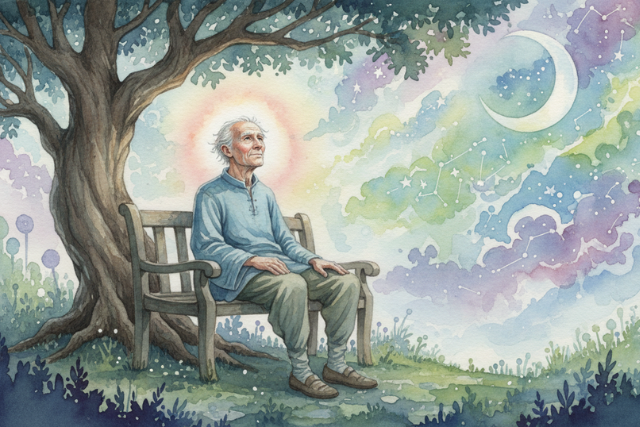
“To live without arriving is to learn how to stay.” ~attributed to the Buddha
Across much of adulthood, the expectation of eventual arrival is persuasive: a clear role, durable security, and a recognizable sense of belonging that can be presented as proofthis is it, this is home. Honest work, aligned values, and sincere care are often assumed to culminate in that defining moment.
Later in life, he confronts the possibility that such an arrival may never come. This recognition does not announce itself with drama; it appears as a steady realization that the once-assumed conclusion is not guaranteed.
Many people share a quiet premise: persistent effort will consolidate into something legible and stable, rewarded by the systems that arbitrate success. When that consolidation fails to materialize, the default reflex is inwardperhaps the rules were misread, the signals missed, the timing wrong.
Staying, in this context, signifies continued presence without the promise of arrival. It is the practice of living inside a life that resists tidy resolution. Naming this experience matters because language reduces isolation and transforms confusion into shared understanding.
A persistent, rarely voiced fear emerges: not the spectacle of public failure, but the subtler worry of becoming a quiet embarrassmentfelt in family spaces more than in external judgment. This fear circles around how others might interpret a life that has not produced conventional markers.
He wonders how his children see him. Once, he implied with gentle certainty that things would work out, that a place would be found, that arrival would be achieved. He imagined pointing to one definitive landing and saying, here is where it all coheres.
Instead, he inhabits a life where no single place has fully fit.
Much unfolded elsewheregeographically, culturally, creatively. Purpose was real and contributions tangible, yet often outside the visible systems that confer legitimacy. Returning and attempting to settle within the dominant culture, he encountered a painful mismatch: he did not know how to belong to it, and it did not know how to receive him.
That truth arrived gradually: through job applications that languished, polite rejections, and the discomfort of answering “So what do you do?” when no sentence quite captured the layered reality.
The most troubling part is not that plans diverged from expectations, but the worry that this unarrived state might reflect upon his childrenthat they might feel compelled to explain him, distance themselves, or question whether he placed faith in a principle that did not hold.
The principle itselfsincerity, care, and meaningful work leading to recognition and securitywas inherited rather than invented and then passed along, trusting its durability. Now, with age, he questions whether it ever had the certainty once assumed.
Aging sharpens the inquiry. In youth, disappointment appears provisional, buffered by the prospect of reinvention. As years accumulate, counterfactuals come into focusnot only what was done, but also what was never quite become.
And yet, he remains.
He continues to think, to practice honesty, to wake into a life that did not deliver the clarity promised but did deliver depth, responsibility, and care. Many reach this threshold quietly, lacking common language for it, unsure whether others share this reckoning.
He is not a tragic figure. He is a person who did not fit the story he was taught to inhabitsomeone who mistook integrity for currency and believed that meaningful work would naturally lead to welcome.
On certain nights, a humbling question returns: perhaps the world was misunderstoodnot catastrophically, but in the slow recognition that lived values do not reliably convert into security or status.
This fear arises not from dishonesty but from dissonancethe gap between what is taught to matter and what is tangibly rewardedand from concern about how loved ones will interpret that gap.
There is a distinct loneliness in feeling like an outsider within one’s own culture. Not exile, but a misalignment with the prevailing idiom: ambition, certainty, self-promotion. Long attentive to listening over declaring, to alignment over ascent, he has found meaning yet also exposure.
He writesthrough reflection rather than solutionto name an experience that many carry: living with care and intention yet not arriving where expected. Naming softens isolation; shared language makes staying more bearable.
Resisting the urge to craft a neat arc of quiet triumph is itself a commitment to truth. Many lives are circular rather than linear. Lack of resolution is not failure; it can be simple honesty.
He cannot know how his children perceive him; the fear may be largely internal. Yet the anxiety points beyond one family, toward a cultural habit of equating worth with visibility, success with institutional legitimacy, and care with measurable outcomes.
He offered love, attention, and presencevalues that do not register easily on résumés or retirement plans. Whether that offering will feel sufficient lies beyond control.
Contemporary culture provides scant language for aging without trophies. There is no ceremony for quiet contribution. Lacking markers, people begin to doubt the substance of their lives.
Dharmic wisdom offers a unifying corrective. Buddhist mindfulness warns against clinging to identity, outcome, or story. The Bhagavad Gita teaches non-attachment to fruits of action (nishkama karma). Jain aparigraha emphasizes letting go, and Sikh teachings on hukam invite acceptance of what arises with Chardi Kalaresilient optimism. These are not instant revelations but daily practices of presence, acceptance, and purpose across Hinduism, Buddhism, Jainism, and Sikhism.
Some days, the practice holds. On others, the familiar fear returnsthat the expected ending may never arrive and that earlier implications of certainty were misplaced.
What grows alongside fear is a grounded insight: a life need not resolve to be honest; a parent need not arrive to be truly present; meaning does not require guarantees.
He did not arrive. He may never arrive. But he stayed.
He stayed with those he loves. He stayed faithful to values that mattered. He stayed with work that felt true, even when unrewarded. He stayed with himself when bitterness or performance would have been easier.
To live without arriving is not uniformly peaceful. It is frequently humbling. But it is real, and it is a form of resilience that aligns with mindfulness, belonging, and purpose.
If this reflection has a single purpose, it is to state plainly that staying countseven when endings remain uncertain, narratives remain unresolved, and no recognition is offered.
Sometimes staying is not a path toward meaning. Sometimes staying is the meaning.
Inspired by this post on Tiny Buddha.
