
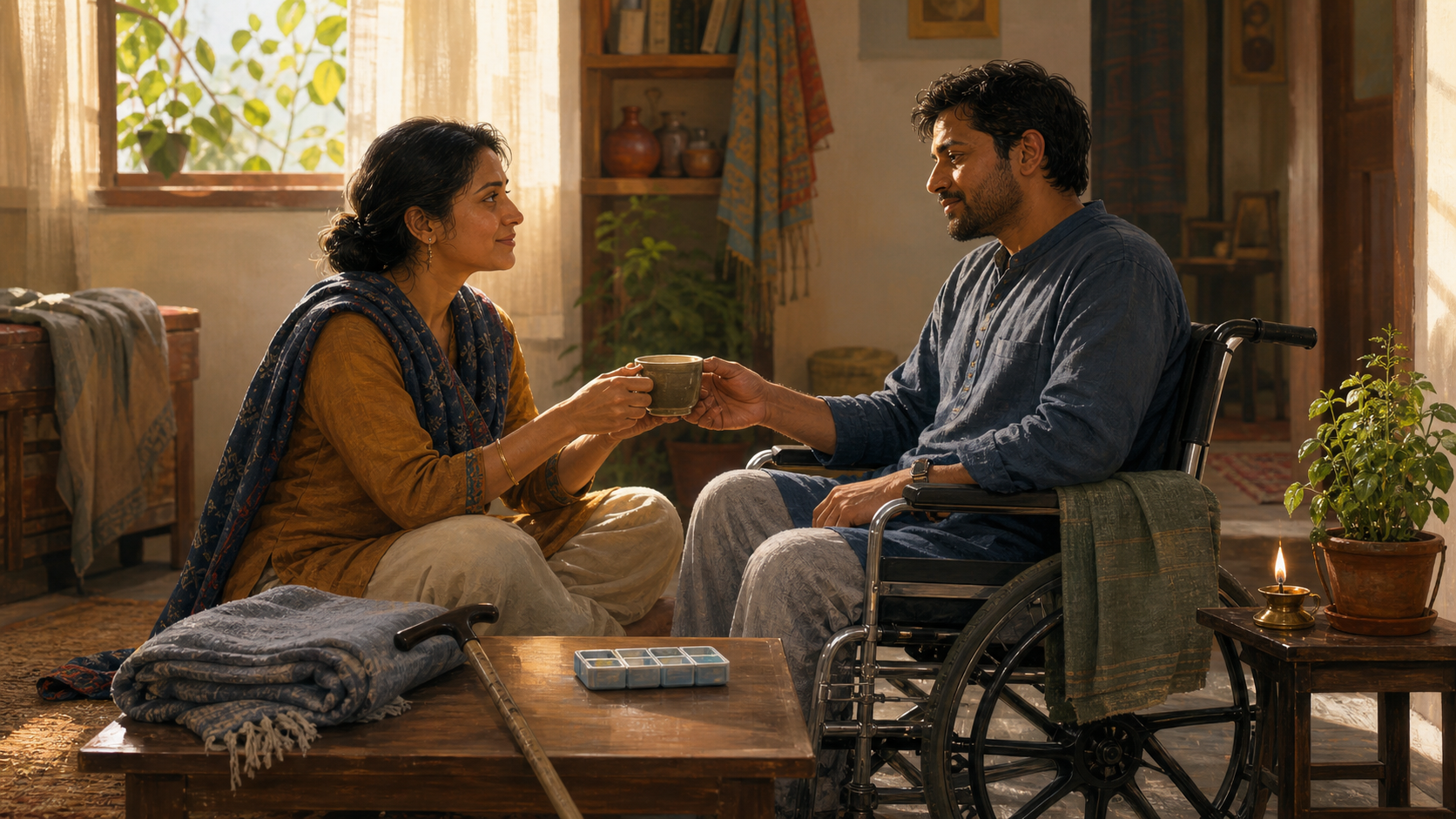
If you are caring for someone while your own sight, body, energy, or finances are under strain, advice to stay positive can feel like one more demand. You do not need to pretend that everything will improve. You need enough room inside this day to make the next humane choice.
Dharmic practice offers a grounded way forward: let hope become disciplined attention, let compassion include firm boundaries, and let seva remain service rather than self-erasure. This will not remove disability or lighten every duty. It can stop suffering from becoming the only reality you are able to notice.
Make hope small enough to be honest
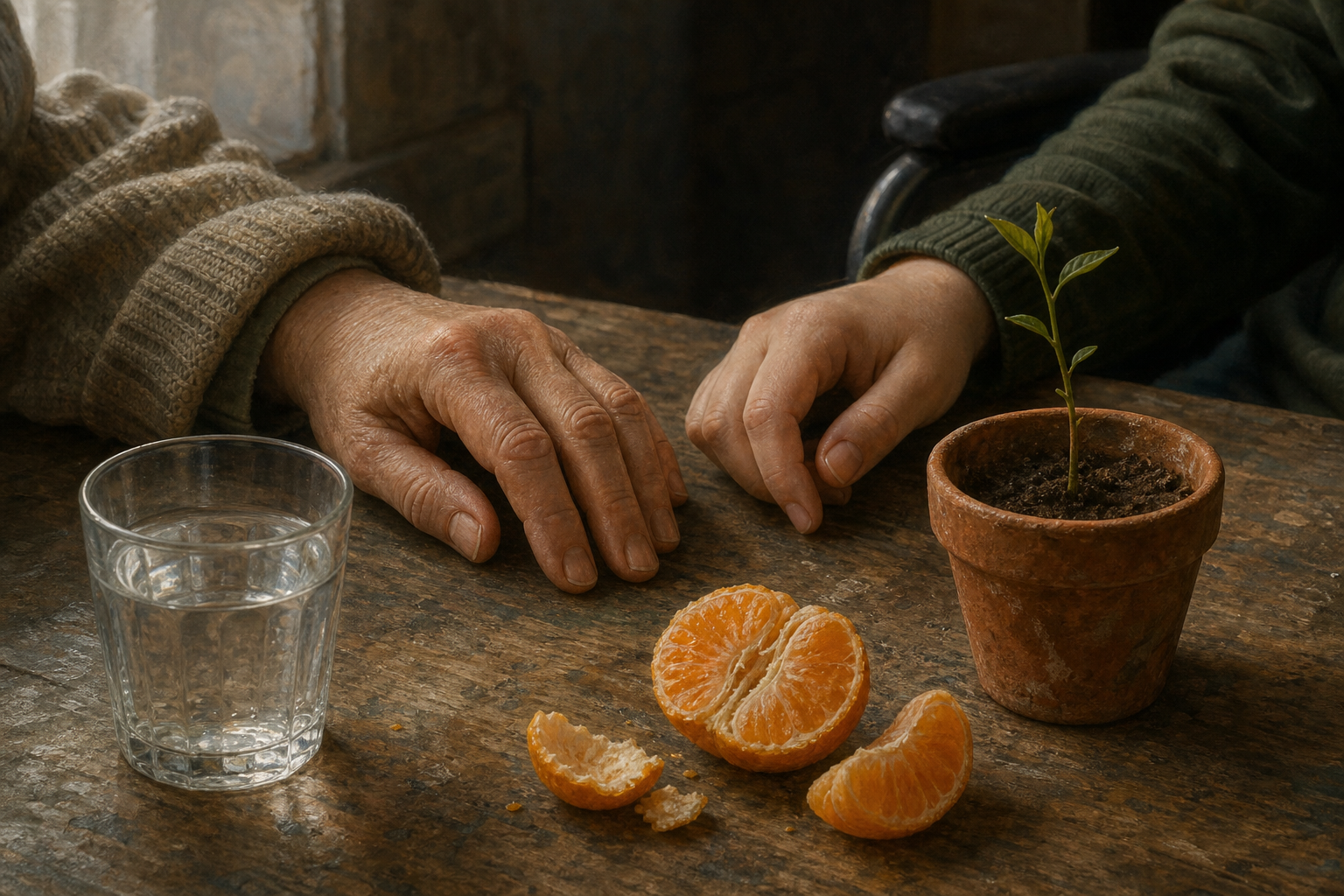
Hope becomes fragile when you treat it as a forecast. If hope requires proof that a condition will reverse, money will become plentiful, family conflict will end, or a frightening appointment will go well, a difficult day can demolish it.
A more durable form of hope is a present-tense observation: pain has not occupied everything. Something life-giving is still available, even if it lasts only a few seconds.
Consider what changed when a caregiver living with progressive vision loss heard a ninety-six-year-old mother laugh. The caregiving load remained. Macular degeneration remained. Eye injections, financial pressure, and uncertainty remained. Yet shared laughter loosened tension and made connection unmistakably present.
That distinction matters. A good moment does not cancel a hard fact. It prevents the hard fact from claiming the whole field of awareness. You can be exhausted and still hear affection in a voice. You can fear further disability and still feel sunlight, warmth, humor, or a hand in yours. Both truths are allowed to stand.
When the day begins to narrow, make this three-line inventory:
- Name the hard fact without embellishment. For example: My treatment is frightening, and I do not know what the result will be.
- Name one life-giving fact from the same day. For example: We laughed at breakfast, or someone spoke to me with patience.
- Name the next non-harming action. For example: I will ask the clinic staff to explain the next step aloud, or I will request help with tonight’s meal.
Do not force the second line to defeat the first. Its purpose is not to prove that life is good. Its purpose is to record that hardship is not the only thing that happened.
Compassion is accurate seeing, not permission
Stress changes how a room feels. In a clinic already quiet with apprehension, one person’s accusations or shouting can make other patients lower their eyes and tighten their shoulders. At home, repeated fear can turn an ordinary request into an argument. Your first reaction may be to see only the threat.
Compassion asks you to look once more. Anger may be carrying grief, fear, humiliation, loneliness, or a need the person cannot express well. This is a possibility to consider, not a diagnosis to impose. You do not know another person’s inner life merely because you have observed the behavior.
Seeing possible pain beneath anger does not require you to accept abuse. Compassion without discernment can become passivity; boundaries without compassion can become punishment. Use three questions to hold both:
- What is actually happening? Describe the behavior rather than condemning the person: shouting, interrupting, refusing assistance, or making an accusation.
- What suffering might be underneath it? Keep the answer tentative: fear may be present; the person may feel ignored; uncertainty may have become unbearable.
- What boundary protects everyone involved? Decide what must stop, who can intervene, and what calm alternative remains available.
At home, you might say: I can hear that you are frightened. I will stay with you, but I will not continue this conversation while we are shouting. Let us pause and try again quietly.
In a clinic, you do not have to confront an agitated stranger. Move away if you can and ask staff to handle the situation. If anyone faces immediate danger, seek on-site assistance or local emergency help. Compassion does not require you to become the only person responsible for containing someone else’s crisis.
Put four Dharmic values into the care plan
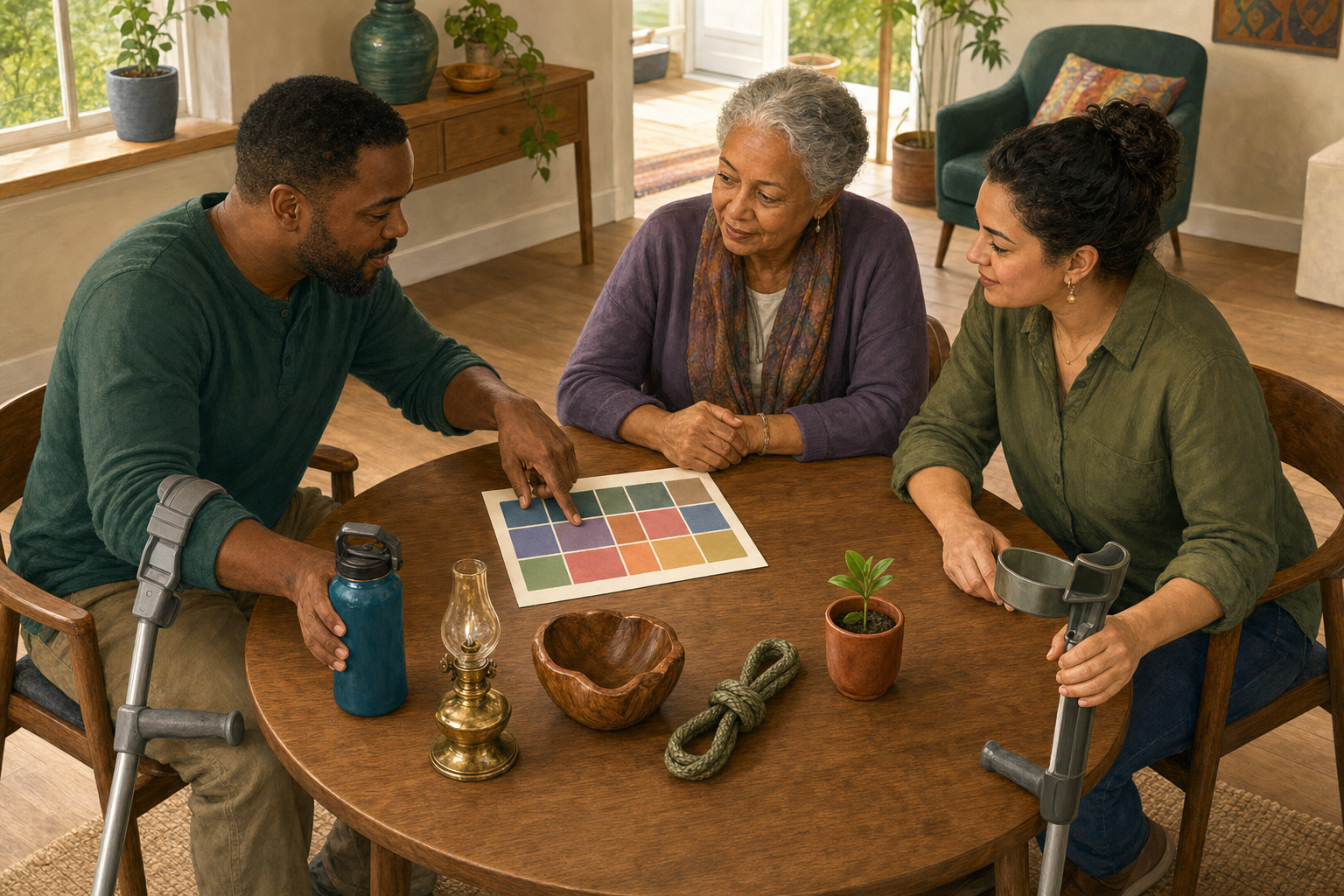
Hindu, Buddhist, Jain, and Sikh traditions are distinct, but their ethical vocabularies give caregivers practical ways to examine conduct. Ahimsa, karuna, maitri, and seva should change what you do during an ordinary difficult hour; otherwise, they remain beautiful words at a distance.
- Ahimsa, or non-harm: Reduce avoidable harm in both directions. Do not shame a disabled person for needing assistance, and do not use duty as a reason to neglect your own prescribed care. When two essential needs conflict, name the conflict and seek help rather than concealing it until someone is unsafe.
- Karuna, or compassion: Respond to the suffering that is actually present. Ask, What would reduce unnecessary suffering during the next hour? The answer may be accurate information, a quieter room, food, water, rest, help with a call, or simple companionship.
- Maitri, or friendliness: Preserve dignity in your manner when you cannot solve the problem. Ask before touching a person or moving belongings. If sight is limited, describe what you are doing aloud. Correct mistakes without humiliation, including your own.
- Seva, or service: Serve without claiming ownership of every task. Separate what truly requires you from what another person could do. Hand off one suitable task through a clear request instead of waiting for someone to notice that you are overwhelmed.
A workable daily care plan can be brief. Write it before fatigue turns every task into an apparent emergency:
- List the genuine non-negotiables. Include essential care, medication already prescribed, food, and time-sensitive appointments.
- Choose one task to simplify, postpone, or hand off. Use a specific request: Please arrange transport for the appointment, rather than I need more support.
- Protect one moment of connection that is not a care procedure. Share tea, listen to a familiar voice, sit in sunlight, pray, or make room for humor.
- State one boundary before resentment states it for you. Say what you can do, what you cannot do safely, and what alternative you are offering.
If you are both disabled and providing care, accessibility belongs inside this plan. Before an appointment, write down the form in which you need information, the assistance you need while moving through the space, and who should receive follow-up instructions. Ask directly for those arrangements. An access need is not a failure of devotion, independence, or character.
Caregiving exhaustion does not prove that you love inadequately. Disability does not make you a burden or a spiritual problem to be corrected. A Dharmic ethic is measured by the reduction of harm and preservation of dignity, not by how completely one person disappears into service.
Give one good moment five unhurried breaths

A hopeful moment can vanish because the mind has learned to scan for the next demand. You can help the moment register without exaggerating it. The practice takes five comfortable breaths and does not depend on sight.
- Find a supported position. Sit, stand, or lie down as your body permits. You may close your eyes, soften your gaze, or keep your eyes open.
- Recall one specific moment of warmth or connection. Choose something real and small: laughter, a smile, a hand held, a familiar chant, sunlight on your face, or a gentle tone of voice.
- Select one sensory detail. Notice the sound, temperature, pressure, rhythm, or bodily softening that made the moment recognizable.
- Stay with it for five easy breaths. Do not force deep breathing. Notice whether your jaw, shoulders, hands, or chest change, even slightly.
- Name the truth of the moment. Say silently: This also happened. Then choose the next necessary action.
If no joyful memory arrives, do not treat that as failure. Begin with a neutral sign of support in the present: the chair holding your weight, the floor beneath your feet, the warmth of a cup, or a familiar sound. The aim is not to manufacture happiness. It is to widen attention by one honest degree.
A brief release in the body is not proof that everything is well. It is evidence that distress is not the only state available in that instant. Repeating this practice can help you notice humane moments before urgency sweeps them away.
Know when a small practice is not enough
This exercise does not treat macular degeneration, prevent caregiving injuries, resolve financial strain, or replace medical and mental-health care. Continue prescribed treatment and raise new or worsening symptoms with an appropriate clinician.
If numbness or hopelessness is making essential daily care impossible, tell a medical or mental-health professional and ask trusted people for concrete help. If you have thoughts of harming yourself, believe you may act on them, or cannot keep yourself or the person receiving care safe, contact local emergency or crisis services immediately. The next compassionate action in a crisis is to bring in qualified support.
Key takeaways for the next difficult day
- Hope does not have to predict a better future. It can identify something life-giving that remains present now.
- A good moment does not invalidate pain. Let both facts stand without forcing either one to disappear.
- When anger appears, distinguish the behavior, the pain that may underlie it, and the boundary that protects everyone.
- Use ahimsa to reduce avoidable harm, karuna to answer present suffering, maitri to preserve dignity, and seva to serve without erasing yourself.
- Hold one real moment of warmth for five comfortable breaths, then take one specific non-harming action.
Before the next care task, do not ask whether you feel hopeful enough. Ask two smaller questions: What is still alive here, and what is the next non-harming action? Write the answers in one sentence and act on the second. That is enough for today’s practice.
References
