

You see two images side by side: an aircraft has torn into one building and it remains standing, while another aircraft impact is followed by a tower’s collapse. The comparison feels decisive. It is not. A standing facade does not prove that an impact was harmless, and a collapse does not prove that the aircraft alone brought the building down.
You can judge such claims without becoming a structural engineer. The key is to stop comparing photographs and start comparing mechanisms: impact velocity, the location of damage, the building’s load paths, the development of fire, and the sequence in which structural capacity was lost.
Start with the collision, not the photograph
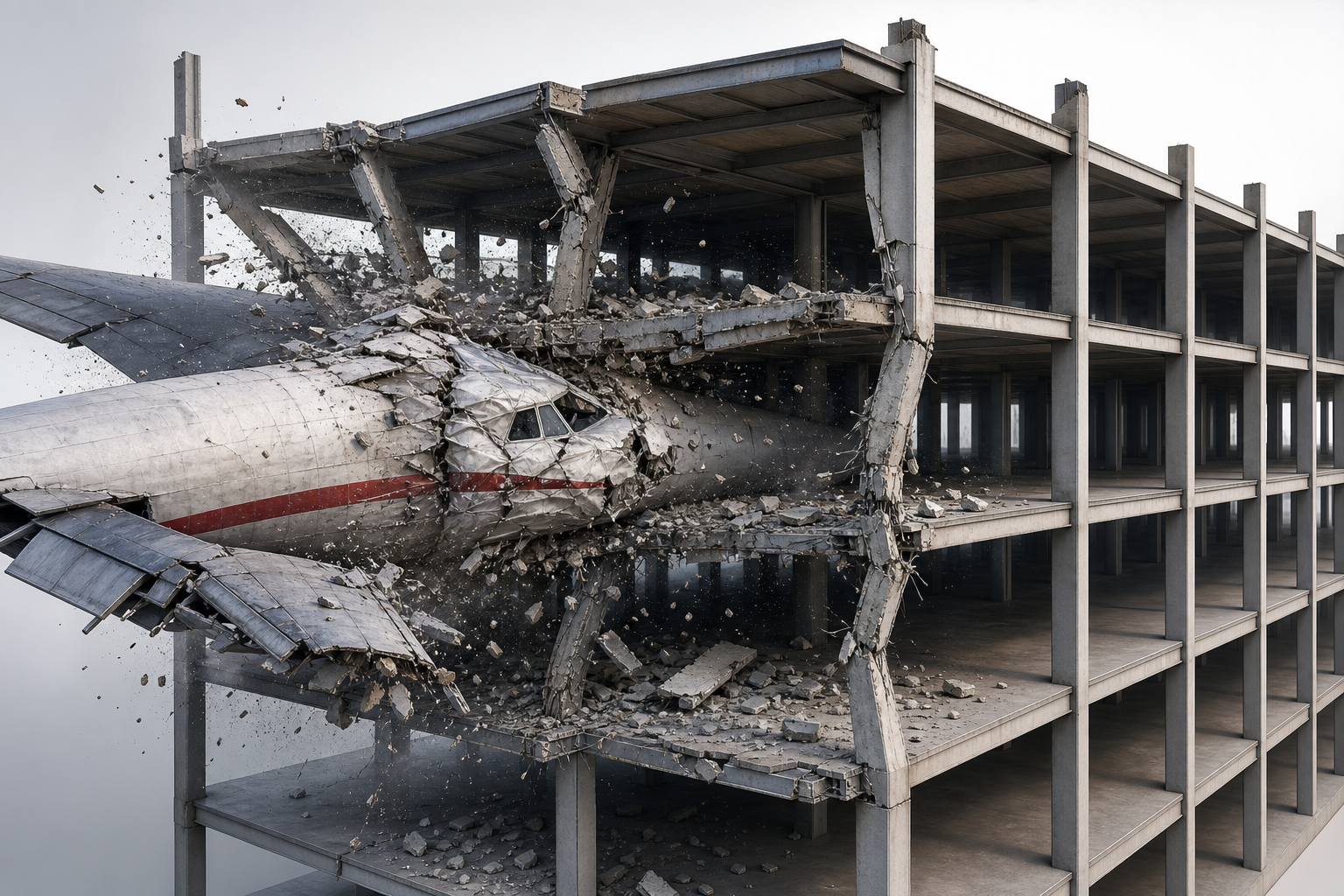
Aircraft impacts are not interchangeable events. The aircraft’s velocity and mass determine the kinetic energy available at impact. Because velocity is squared in the kinetic-energy relationship, it deserves special attention. Engine thrust is not the same measurement. Thrust tells you what the engines are doing; velocity tells you how fast the aircraft is moving.
That distinction matters when discussing AI 171. The aircraft was reportedly dealing with a loss of thrust shortly after take-off and appears to have been maneuvering when it struck a three-storey medical college hostel. Those circumstances indicate a very different collision from a high-velocity, deliberately directed impact. They do not, by themselves, provide a complete impact-energy calculation.
The aircraft that struck the World Trade Center towers on September 11, 2001 were traveling at high velocity, carrying substantial fuel, and directed into the buildings. The impacts damaged several floors at once. The comparison therefore changes more than one variable: speed, trajectory, fuel condition, target height, structural system, damage distribution, fire behavior, and access for emergency response.
When someone asks why one building stood while another fell, work through these checks in order:
- Establish the aircraft’s state. Look for evidence about velocity, mass, fuel condition, trajectory, and whether the collision was direct or glancing. Do not accept engine thrust as a substitute for impact speed.
- Locate the damage. Ask which columns, walls, floor connections, and service-core elements were struck. A large hole in non-critical material can be less destabilizing than less visible damage to a critical load path.
- Identify the structural system. A conventional beam-column frame, a perimeter tube joined to a central core, and a buttressed concrete core do not redistribute damage in the same way.
- Follow the fire. Determine whether fire remained local or spread across floors, whether fireproofing was damaged, whether combustible contents continued burning, and whether suppression was possible.
- Check the timeline. Separate the initial collision from later deformation, connection failure, load redistribution, and progressive collapse. A delayed failure calls for a sequence, not a single-cause slogan.
If a comparison supplies only the final images, it has omitted the information needed to support its conclusion. The honest response is not to fill those gaps with whichever story feels most satisfying. It is to mark the conclusion as unproven.
A building that remains upright after impact must also not be assumed safe. Connections, columns, floors, fire protection, and foundations can sustain damage that cannot be judged from a street photograph. Do not enter an impact-damaged building or treat a video as an occupancy assessment. Emergency authorities and qualified structural engineers must determine whether evacuation zones, shoring, restricted access, or demolition are necessary.
Collapse is a sequence, not a single event
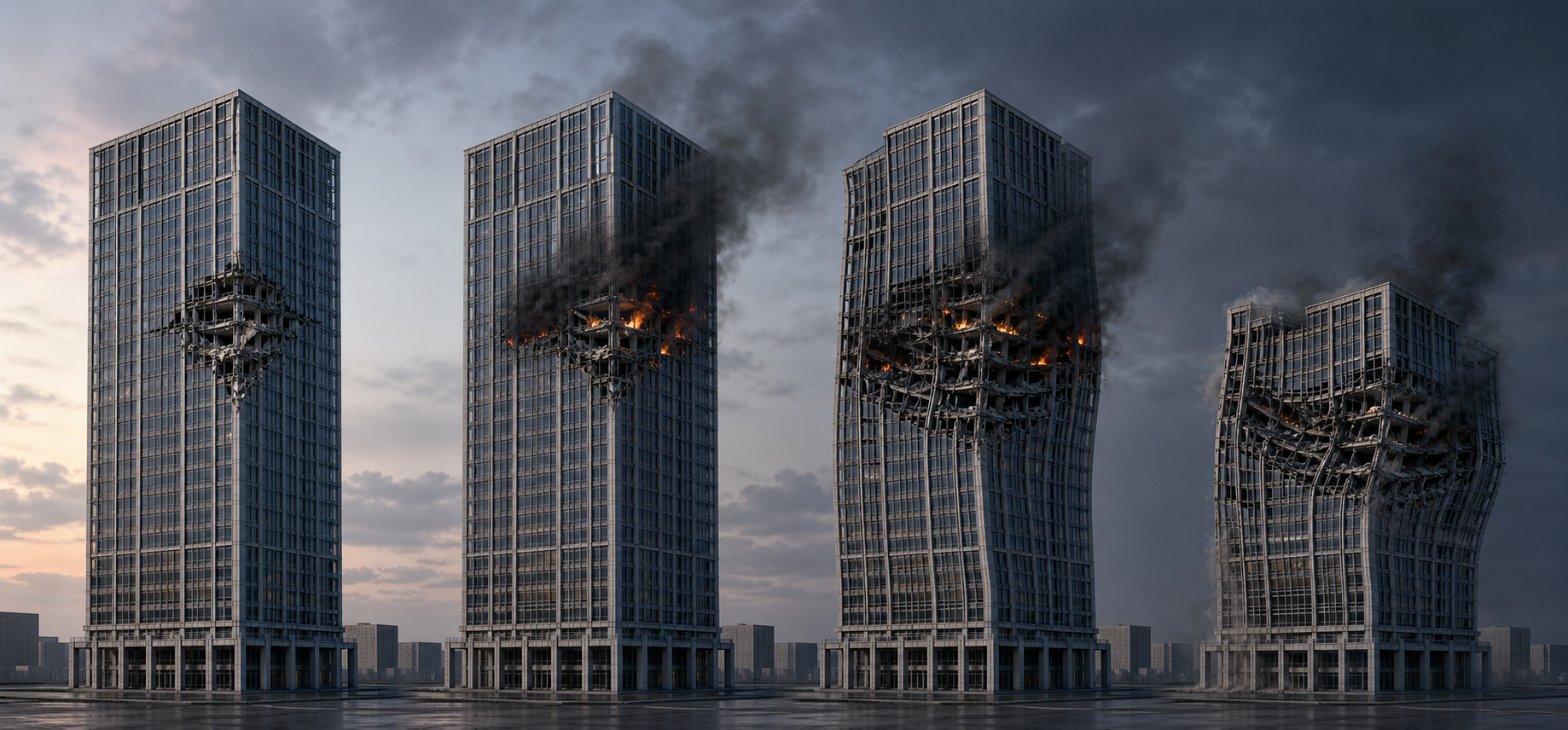
The first structural event is local damage. An aircraft can sever or deform columns, damage floor members, break connections, and strip fireproofing from steel. The immediate question is whether the remaining structure can redirect the loads that the damaged members had been carrying.
Survival of the initial impact answers only that first question. A building can stand after collision and still be moving toward failure as loads shift into fewer members and fire progressively reduces their capacity.
Fire is the next structural event. Jet fuel can spread ignition across a large area, but the aircraft’s fuel need not be the only material that burns. Office furnishings and other building contents can sustain severe fires after the initial fuel-fed phase. If the collision has displaced fireproofing, steel members can heat more rapidly.
Steel does not have to melt for this process to matter. Heating reduces its stiffness and strength. Long-span floor trusses can deflect, connections can lose capacity, and deformed floors can impose abnormal forces on the columns and frames to which they are attached. A structure designed for ordinary gravity and wind loads may then face a combination of missing members, redistributed weight, thermal expansion, sagging floors, and weakened connections.
Progressive collapse begins when failure in one part of a structure places demands on adjoining parts that they can no longer carry. The damage propagates beyond the place where it started. In the World Trade Center towers, the relevant causal chain was not simply “aircraft hits steel.” It involved impact damage, displaced fire protection, multi-floor fires, declining member capacity, deformation, connection behavior, and lost load paths. NIST concluded that the combination of aircraft damage and fire initiated the collapses.
WTC 7 is useful because it prevents an equally crude rule in the opposite direction. No aircraft struck that building. NIST attributed its later collapse to debris damage and uncontrolled fires that produced a critical internal failure associated with Column 79, followed by progressive failure. Whatever position you encounter, it must therefore account for two distinct possibilities: an aircraft impact does not guarantee global collapse, and the absence of an aircraft impact does not make fire-induced progressive collapse impossible.
This is the distinction to preserve in any discussion: a trigger begins the emergency, while the failure mechanism explains how the structure ultimately loses stability. Confusing the trigger with the entire mechanism is one of the fastest ways to misread a disaster.
The frame determines where damage travels
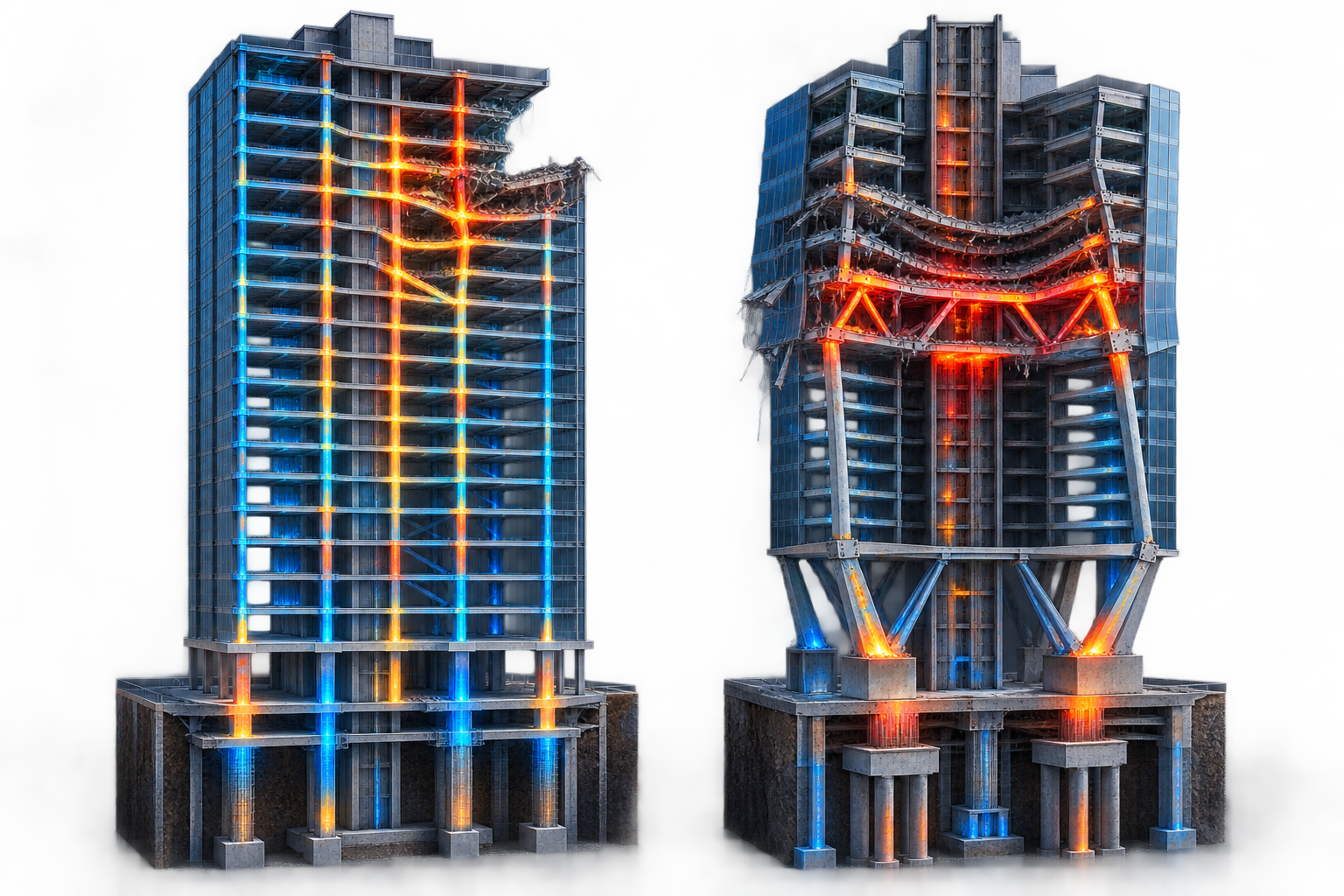
Buildings that look similar from outside can carry loads through radically different internal arrangements. Before comparing outcomes, find a framing diagram or a reliable description of the structural system. The most useful words to locate are “perimeter columns,” “central core,” “floor trusses,” “beam-column frame,” “connections,” “fireproofing,” and “load redistribution.”
| Structural system | How loads are organized | What you should not infer |
|---|---|---|
| Conventional beam-column frame | Internal beams and columns form a lattice with several potential paths for gravity and lateral loads. Local redistribution may preserve overall stability after limited damage. | A standing exterior does not prove that every column, connection, or floor is safe. |
| WTC tube-and-truss system | A dense steel perimeter worked with a central steel core. Long-span floor trusses connected the two and helped them act as one system. | Damage to the perimeter alone does not describe the whole event; floor connections, core damage, fireproofing, and thermal deformation also matter. |
| Burj Khalifa buttressed core | A hexagonal core and Y-shaped wings are supported by interlocking networks of walls and columns, creating multiple paths and substantial torsional rigidity. | Greater redundancy does not make a high-rise invulnerable or establish its response to an unspecified aircraft impact. |
The hostel struck by AI 171 had a conventional framed form and remained standing despite severe local damage. That outcome is consistent with a frame retaining enough alternate capacity after a lower-energy, localized event. It does not demonstrate how a tall tube-and-truss building should behave after a high-velocity impact and prolonged fires across several floors.
The World Trade Center towers used closely spaced perimeter steel columns linked to a central steel core by long-span floor trusses. The system efficiently resisted the demands placed on a very tall building while leaving large, usable floor areas. Its response to extraordinary damage depended on the continuing interaction of the perimeter, floors, connections, and core.
The Burj Khalifa illustrates why the word “skyscraper” is not a structural category precise enough for comparison. Its buttressed core, hexagonal center, and Y-shaped wings create a different topology with substantial load-sharing and torsional resistance. That can support redistribution after localized damage, but it cannot justify a claim that the building would survive every impact-and-fire scenario.
Redundancy is always conditional. Several load paths help only while enough of them remain intact and capable of receiving additional demand. A connection that survives impact may later weaken in fire. A column that remains intact may be overloaded after neighboring columns fail. A floor that appears secondary may be essential to tying major parts of the frame together.
So do not ask only, “How much of the building was hit?” Ask, “Which load paths were interrupted, which members inherited their loads, and what happened to those members afterward?” That change in question turns a visual comparison into a structural one.
Key takeaways: a claim-check you can use
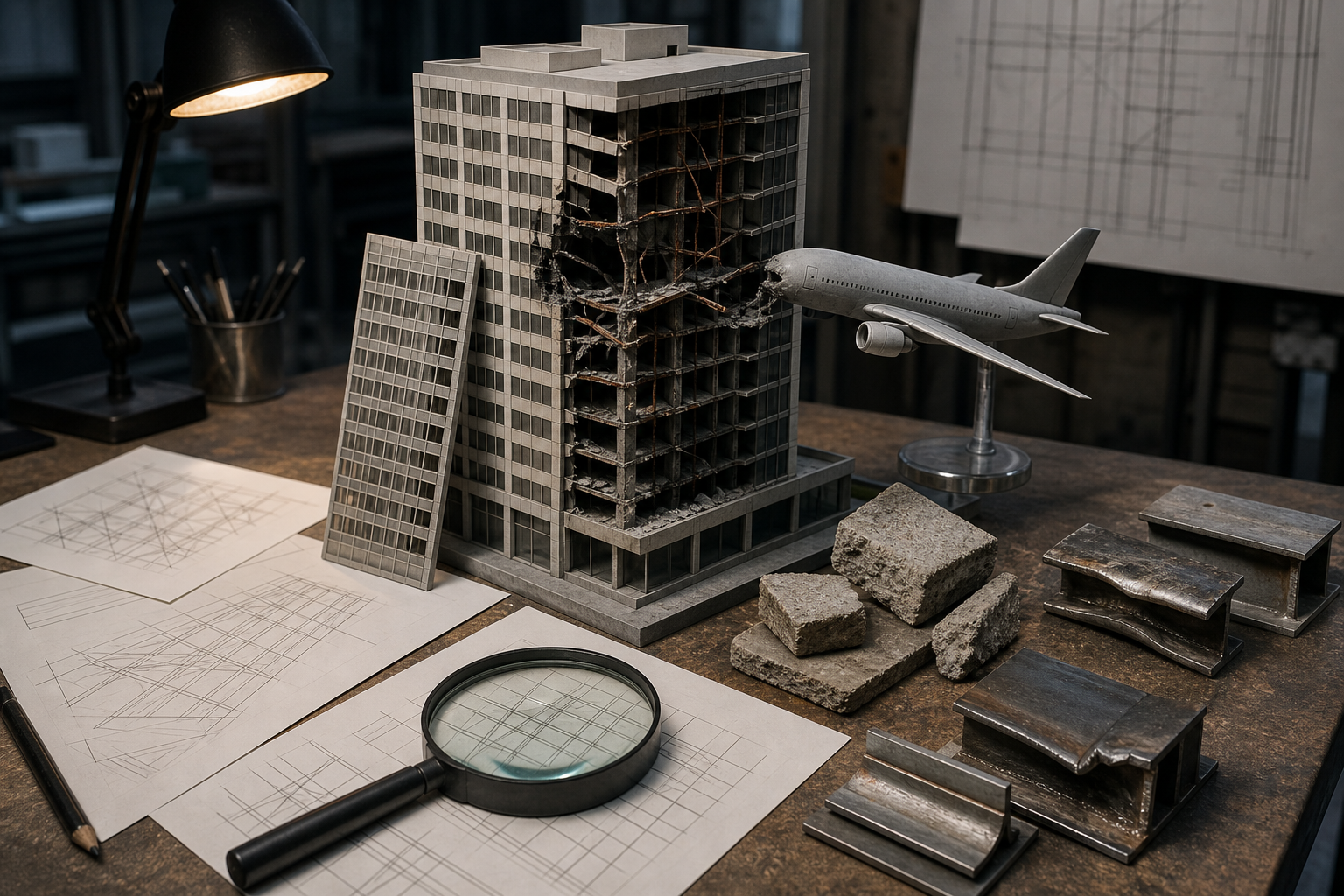
- Demand velocity evidence. “Low thrust” and “low speed” are not interchangeable. If impact velocity is unknown, the energy comparison remains incomplete.
- Compare structural systems. A mid-rise beam-column lattice cannot serve as a simple stand-in for a tube-and-truss tower or a buttressed-core supertall.
- Separate local damage from global stability. A dramatic opening in a facade does not identify every damaged load path, and an intact facade does not certify the interior.
- Include the period after impact. Fire spread, damaged fireproofing, heated steel, sagging floors, weakening connections, firefighting access, and elapsed time can determine whether initial survival becomes eventual collapse.
- Require a failure sequence. A credible explanation should connect damage to load redistribution, deformation, member or connection failure, and propagation. Naming only the aircraft, fuel, fire, or steel is not enough.
- Test the rule against WTC 7. An explanation that treats direct aircraft impact as necessary for every progressive collapse cannot account for NIST’s fire-and-debris finding in that case.
- Preserve uncertainty. If speed, damage location, framing details, fire duration, or connection behavior are missing, say that the available information cannot settle the claim.
Several warning signs should now be easy to notice. A collage substitutes resemblance for measurement. A claim about low engine thrust substitutes one variable for impact velocity. An argument that steel did not melt attacks a condition that structural failure does not require. A theory that ignores the time between impact and collapse leaves out the very period in which fire, deformation, and redistribution alter the building.
None of this asks you to accept a conclusion merely because an institution states it. It asks you to prefer an explanation that identifies observable stages and remains consistent across the cases it claims to explain. A theory earns confidence by accounting for the structural system, initial damage, fire environment, failure sequence, and contrary examples without inventing a new exception each time.
For a dharmic audience, the discipline is also ethical. Truthfulness loses its meaning if we apply scrutiny only to claims made by people we distrust. Compassion loses its meaning if victims become props in an argument. Hindu, Buddhist, Jain, and Sikh communities can disagree vigorously while still refusing careless inference, sensationalism, and contempt.
Before forwarding the next aircraft-impact comparison, write down the missing variables: velocity, trajectory, fuel condition, structural system, damaged load paths, fire development, and failure timeline. If the claim cannot survive those questions, do not circulate it as proof. Share the questions instead.
References
