
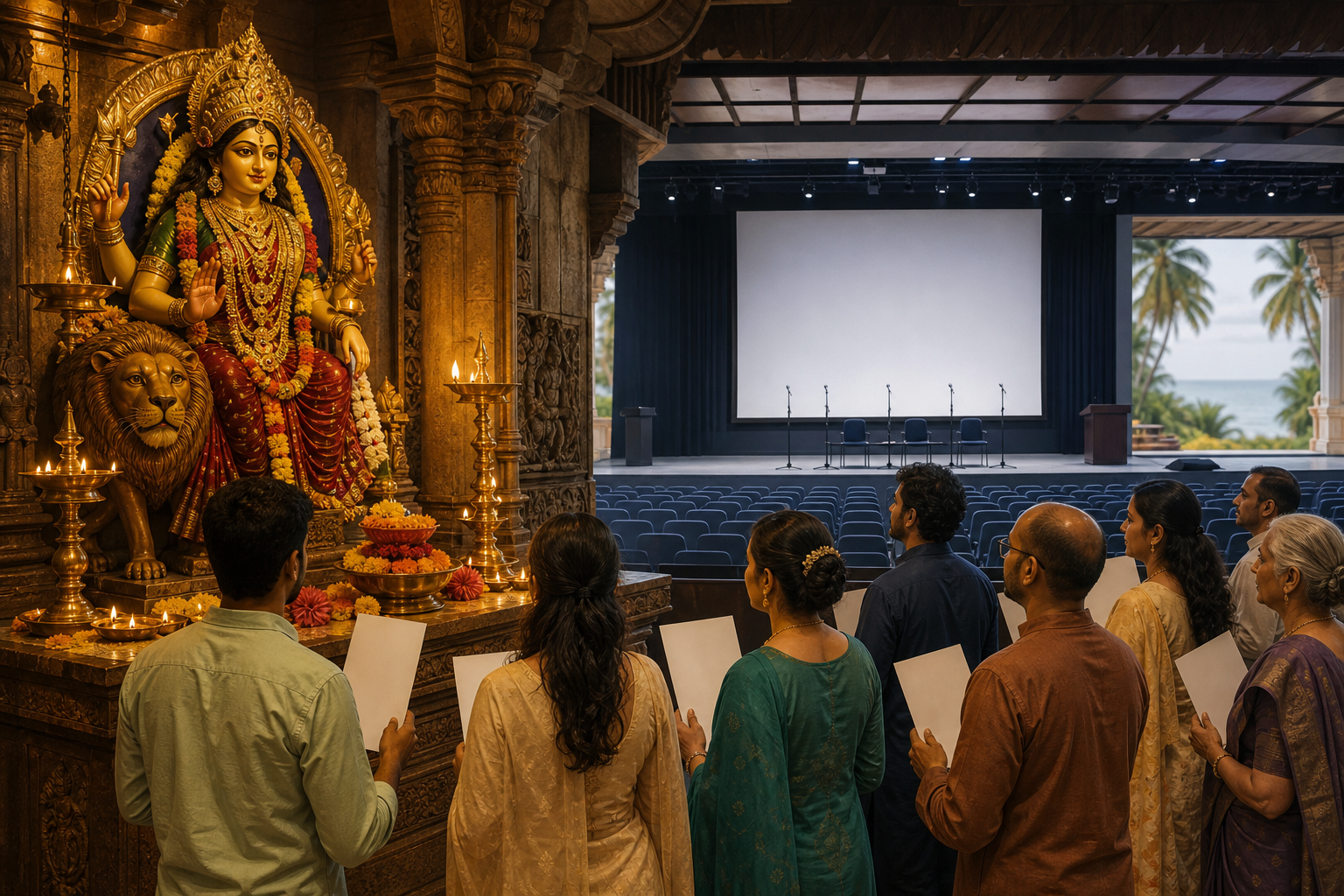
If the IFFI Goa clip left you angry, the useful question is not how loudly you can condemn it. The useful question is how to defend Goddess Chamundi’s dignity, demand a meaningful remedy, and avoid turning a legitimate grievance into another cycle of abuse.
A strong response has a clear sequence: verify the words and context, explain why they matter, direct the complaint to the responsible people, and ask for a specific correction. That gives devotees something firmer than outrage and gives cultural institutions a standard they can actually follow.
Separate the reported act from the unproven motive

At the International Film Festival of India (IFFI) in Goa, actor Ranveer Singh was reported to have referred to Goddess Chamundi as a ‘female ghost’ and imitated a sacred scene associated with Kantara. The reported words and gesture led to public criticism from devotees and others who regarded them as a trivialization of sacred imagery.
That is enough to raise a serious objection. It is not, by itself, proof of a deliberate intention to insult Hindus. Intent, meaning, and effect are related, but they are not the same claim. You do not have to invent a malicious motive in order to say that a public description was ignorant, demeaning, or unfit for a national cultural platform.
- The reported act: identify the exact words, gesture, speaker, event, and available recording.
- The cultural meaning: explain what the deity or sacred performance means to worshippers and why the description distorts it.
- The inferred motive: do not state intention as fact unless clear evidence establishes it.
This distinction matters when clips circulate faster than context. Before forwarding a fragment as proof, look for the full sequence, clear audio, and an unedited recording. If those are unavailable, say so. Use ‘reported’ or ‘alleged’ where uncertainty remains. Repetition does not convert an allegation into a verified quotation.
Precision does not weaken the protest. It protects it. A complaint grounded in what can be shown is harder to dismiss than a sweeping accusation about what someone supposedly thinks about Hinduism.
Why ‘female ghost’ is not harmless shorthand
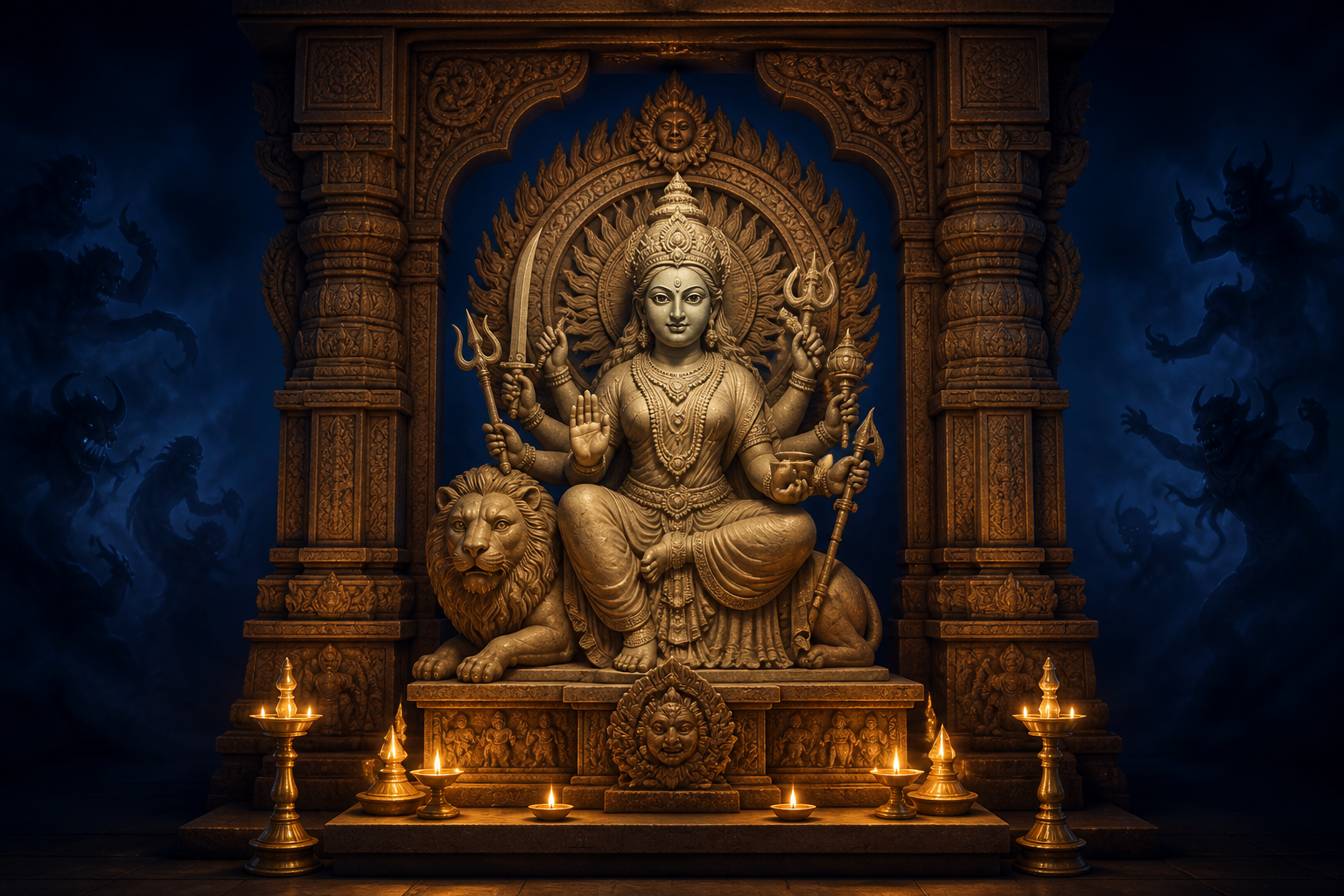
Chamunda or Chamundi is venerated as a powerful manifestation of Devi, or Shakti. She is not the feminine equivalent of a ghost, a horror character, or a decorative supernatural figure. Those categories are not interchangeable. Describing a worshipped deity through the vocabulary of a frightening apparition strips away the theological meaning that makes the image sacred.
The Kantara connection adds another layer. A gesture drawn from a sacred performance tradition may look like dramatic movement to someone outside that tradition. To a devotee or tradition-bearer, it can carry ritual memory, inherited discipline, and a relationship with the divine. Removing the gesture from that setting and using it as casual mimicry can therefore feel very different from imitating an ordinary film scene.
This does not mean every artistic use of a deity, ritual, or sacred image must be forbidden. It means the artist and presenter carry a greater burden of understanding. You can assess a depiction by asking practical questions:
- Accuracy: Is the deity or tradition named and described correctly?
- Context: Does the presentation help the audience understand the sacred meaning, or reduce it to a joke, costume, or horror trope?
- Framing: Is the gesture part of serious interpretation, or is its sacred charge being used for a cheap reaction?
- Consultation: Did the creators or organizers seek guidance from people who understand the tradition when the material required it?
These questions distinguish informed creative engagement from careless mimicry. Sacredness does not remove an image from cultural life. It changes the care with which that image should be handled.
How to make a firm complaint without escalating the harm

If you want accountability, decide what outcome would repair the injury. Anger can identify that a boundary was crossed, but it cannot by itself define the remedy. Use the following sequence.
- Preserve the evidence. Save the original link, the event name, the speaker’s words, and the relevant place in the recording. A screenshot of somebody else’s caption is not a substitute for the underlying clip.
- Check the surrounding context. Look at what came before and after the disputed moment. Context may explain a remark without making it acceptable, but your complaint should reflect whatever the complete recording shows.
- Name the distortion precisely. Explain that Chamundi is worshipped as Devi or Shakti and that describing her as a ghost misclassifies a sacred figure. If the objection concerns imitation, explain the ritual significance rather than merely declaring the gesture offensive.
- Address the responsible parties. Direct the grievance to the speaker, festival organizers, broadcaster, or official channel that can clarify the event and change future practice. Do not target relatives, junior staff, performers, or crew members who had no responsibility for the remark.
- Request a defined remedy. Ask for the full context to be published, a direct clarification, an acknowledgement of the hurt, a sincere apology where warranted, and safeguards for future presentations. A demand that names the repair is more useful than an open-ended call to ‘take action.’
- Keep protest lawful and peaceful. Do not issue threats, reveal private information, use religious slurs, or encourage intimidation. Those tactics can endanger uninvolved people, create legal exposure, and allow the original cultural grievance to be displaced by the conduct of protesters.
- Evaluate the response honestly. If the responsible party clearly acknowledges the words or gesture, recognizes their sacred significance, and changes future conduct, treat that as meaningful repair. Accountability loses its moral purpose if no act of correction is ever allowed to count.
A concise complaint could say: At IFFI Goa, Ranveer Singh was reported to have described Goddess Chamundi as a ‘female ghost’ and to have imitated sacred imagery associated with Kantara. Chamundi is worshipped as Devi or Shakti, so this framing trivializes a living sacred tradition. We ask for clarification of the full context, direct acknowledgement of the hurt, and safeguards for future festival presentations.
Notice what this wording does not do. It does not threaten, speculate about private beliefs, condemn an entire film industry, or turn disagreement into hatred of another community. Restraint here is not passivity. It keeps the moral attention on the act that requires correction.
Hindu, Buddhist, Jain, and Sikh traditions are not interchangeable, but compassion and self-command are intelligible across them. In public action, those values mean opposing disrespect without reproducing it. A Dharmic protest should be recognizable not only by what it protects, but also by how it conducts itself.
What IFFI and other cultural institutions should change
A festival cannot prevent every careless improvisation. It can prevent predictable ignorance and respond competently when something goes wrong. IFFI and comparable platforms should build cultural literacy into event preparation instead of treating religious sensitivity as a crisis-management problem.
- Before the event: give presenters a short briefing when a programme touches deities, rituals, festivals, or community-specific sacred practices. Flag terms and gestures that require accurate explanation.
- During preparation: consult relevant scholars and tradition-bearers. Their role should be to supply context and identify obvious distortions, not to impose an indiscriminate veto over artistic work.
- On stage: empower the host or moderator to correct a serious misdescription calmly. A brief factual intervention can prevent an improvised joke from becoming the festival’s defining moment.
- After a grievance: preserve the full recording, establish what was said, acknowledge the concern, and identify who owns the response. Silence creates a vacuum that speculation will fill.
- For future events: maintain a visible grievance route with an accountable decision-maker and a process for recording what changed. Devotees should not have to organize a mass campaign merely to discover where a cultural complaint belongs.
None of this requires a choice between artistic freedom and respect. Creative freedom protects the right to interpret, question, and even criticize religious ideas. It does not guarantee immunity from criticism when an artist misstates a living tradition. At the same time, cultural sensitivity should not become a pretext for banning every difficult portrayal. The relevant test is whether a work engages the tradition’s meaning or merely exploits its symbols as a stereotype.
What a credible repair sounds like
A useful clarification or apology should identify the disputed words or gesture, recognize why Chamundi is sacred, address the effect on devotees, and state what will change. Intent can be explained, but it should not be used to erase impact. ‘I did not mean it that way’ answers a question about motive; it does not answer the complaint about misrepresentation.
Likewise, a formula such as ‘sorry if anyone was offended’ places the problem entirely inside the listener’s feelings. A better response deals with the conduct itself: the description was inaccurate, the imitation was careless, or the setting demanded more respect. That is the difference between managing publicity and repairing trust.
Key takeaways
- The reported IFFI Goa incident warrants scrutiny, but the speaker’s motive should not be asserted without evidence.
- Chamundi is worshipped as Devi or Shakti; calling her a ghost is not a neutral translation of the sacred category.
- A strong complaint separates the verifiable act, its cultural meaning, and any inference about intention.
- Useful remedies include full context, direct clarification, acknowledgement, sincere apology where warranted, and better preparation for future events.
- Threats, harassment, private-information exposure, and communal abuse betray the grievance and put people at risk.
- Cultural consultation can improve artistic work without becoming a blanket veto on criticism or creative interpretation.
If you speak about the Chamundi controversy, make your next public statement do real work. Link to the fullest context you can find, retain words such as ‘reported’ where facts remain disputed, explain the sacred category accurately, and name the correction you seek.
If you organize cultural events, assign responsibility before the next controversy arrives: brief presenters, identify knowledgeable advisers, and give the public a clear grievance channel. Respect for sacred traditions becomes credible when it is built into ordinary practice, not announced only after devotees have been hurt.
References
