

If you are a temple trustee, gurdwara volunteer, parent, student, or community advocate trying to understand the 2025 hate-crime figures, begin with one restraint: do not turn 32 and 189 into a ranking of which community is safe. These are recorded offense counts, not estimates of each person’s risk.
You can still use the figures responsibly. The key is to separate offenses from victims, national classifications from lived identities, and evidence of bias from assumptions about motive. Those distinctions will help you communicate accurately, document incidents properly, and make a stronger case for protection.
What the 2025 figures actually count

U.S. law-enforcement agencies recorded about 189 anti-Sikh and 32 anti-Hindu offenses among 2,703 single-bias religious hate-crime offenses in 2025. Anti-Sikh offenses represented 7 percent of that religious-bias total, while anti-Hindu offenses represented 1.2 percent.
| 2025 measure | Anti-Sikh classification | Anti-Hindu classification |
|---|---|---|
| Recorded single-bias religious hate-crime offenses | About 189, or 7 percent of 2,703 | About 32, or 1.2 percent of 2,703 |
| Victims of religion-related hate crimes | About 193, or 6.9 percent of 2,798 | 34, or 1.2 percent of 2,798 |
The word “about” matters where counts have been derived from percentage shares. It avoids presenting calculated figures as more precise than the underlying percentages allow.
An offense is not the same unit as a victim, and neither figure should automatically be treated as an incident count. One incident can contain multiple offenses or affect more than one person. That is why the victim totals – about 193 Sikh-bias victims and 34 Hindu-bias victims – differ from the corresponding offense totals.
For public communication, say, “Agencies recorded about 189 anti-Sikh religious hate-crime offenses.” Do not shorten that to “189 Sikhs were attacked.” The second sentence changes an offense count into a count of people and assumes a form of conduct that the topline number does not specify. Likewise, 34 Hindu victims must not be described as 34 separate incidents.
Why 32 and 189 are not measures of personal risk
A larger count does not automatically mean a larger per-person risk. You would need suitable population or exposure denominators before making that comparison. These topline figures do not provide them, so a claim that a Sikh is a particular number of times more likely than a Hindu to experience a hate crime would not be supported.
- The totals cover recorded classifications. Conduct that was never reported, was not recorded as a crime, or was placed in another bias category will not appear in the anti-Hindu or anti-Sikh total.
- They do not form a complete Indian-American count. Indian Americans were not tabulated as a separate racial or ethnic group in these figures.
- Identity and administrative category can diverge. Depending on the circumstances and local classification, a victim of Indian origin could be counted under anti-Asian, anti-Hindu, anti-Sikh, or another form of bias.
- The toplines do not reveal local conditions. They cannot tell your temple, gurdwara, school, or neighborhood where incidents were concentrated or what underlying conduct occurred.
- One year alone does not establish a trend. You need comparable figures from other years before claiming that anti-Hindu or anti-Sikh hate crime is rising or falling.
It would also be wrong to add the Hindu, Sikh, and anti-Asian categories and label the result “hate crimes against Indian Americans.” Those classifications do not map neatly onto one national-origin identity, and some incidents may involve more than one perceived identity. Keep each published category intact and state the limitation plainly.
We should neither minimize the recorded offenses nor stretch them beyond what they can prove. The defensible conclusion is that U.S. agencies recorded anti-Hindu and anti-Sikh religious-bias offenses in 2025, with substantially different offense totals. The figures alone cannot explain the difference or calculate the two communities’ relative risk.
How to document an incident so the bias is visible
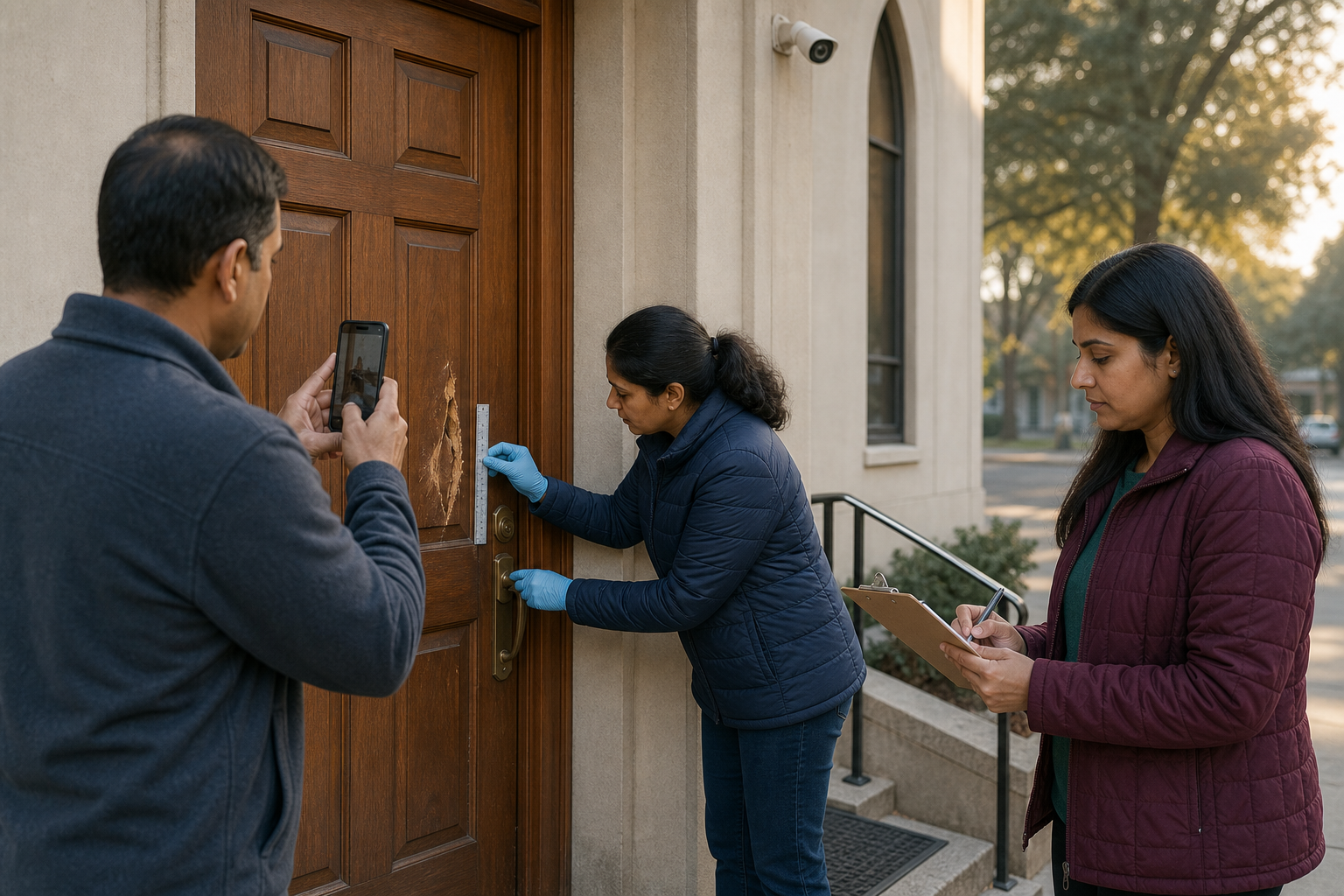
A hate-crime designation generally connects an underlying criminal act with evidence of bias. The exact legal test and available remedies vary by jurisdiction. A slur, hostile symbol, or anti-religious statement can be important evidence of motive, but an offensive statement by itself will not necessarily satisfy the local definition of a hate crime.
If you experience or witness suspected anti-Hindu or anti-Sikh conduct, use this sequence:
- Protect people first. If anyone is in immediate danger, call 911 and move to a safer place. Do not confront a suspected offender merely to obtain better evidence.
- Preserve original material. Keep photographs, video, damaged property, threatening messages, emails, voicemails, and relevant account information. Save originals rather than relying only on screenshots or rewritten versions.
- Write a factual event record. Note the date, time, location, sequence of events, physical conduct, property damage, and witness contact details. Separate what you directly observed from what another person told you.
- Record bias indicators exactly. Write down the precise words, symbols, gestures, or references to Hindu or Sikh identity. Note whether the conduct mentioned a turban, a place of worship, a deity, a religious symbol, a name, perceived ancestry, or another visible marker. Do not improve, soften, or guess at the language.
- Separate offenses, victims, and witnesses. One episode can involve several alleged offenses and several affected people. Listing those units separately helps prevent the same confusion found in careless readings of national totals.
- Report both the conduct and the suspected bias. Explain the underlying act first, then identify the facts that make you believe religion, race, ethnicity, or another identity motivated it. Ask for the incident or report number and ask how the possible bias has been recorded.
- Get qualified help when consequences are serious. Injury, a credible threat, repeated targeting, or possible legal deadlines warrants prompt attention from law enforcement and an appropriate victim-services professional or licensed attorney. A community volunteer can support you, but cannot replace jurisdiction-specific legal advice.
You do not have to prove the offender’s entire state of mind before making a report. Your job is to preserve and describe the evidence. The investigating agency decides what classification it will apply. If its category differs from the identity you reported, retain both entries in your own record rather than silently replacing one with the other.
Build a community record without distorting the count

Temples, gurdwaras, student associations, and civil-rights groups need a structure that preserves detail without exposing victims. A useful internal incident record should contain:
- A unique internal case identifier instead of a person’s name in working summaries.
- The date, time, location, and short description of the alleged conduct.
- The affected person’s self-described identity and the identity the offender appeared to perceive.
- The exact bias indicators, stored separately from a volunteer’s interpretation.
- Separate fields for the incident, possible offenses, affected people, and witnesses.
- Whether law enforcement was contacted, the report number, and the official bias classification if one was provided.
- The status of the matter, including whether information remains unverified.
- The person’s consent choices for internal use, referral, anonymized advocacy, or public disclosure.
Keep three layers distinct: what the affected person reported, what evidence the organization reviewed, and what law enforcement officially classified. If a Hindu victim reports religious hostility but the police record shows anti-Asian bias, preserve both facts. Do not convert the official category to anti-Hindu, and do not erase the victim’s account merely because the administrative label differs.
Use one incident record with linked offense and victim entries. Otherwise, the same episode may be counted once for every witness, every affected person, and every community group that received the report. Before publishing a total, check for duplicates and state whether you are counting reports received, distinct incidents, alleged offenses, victims, or official hate-crime classifications.
Hindu and Sikh organizations can cooperate on security, reporting education, victim support, and accurate public advocacy without collapsing their data into one category. Shared action becomes more credible when each community’s figures remain identifiable and the limits of any combined claim are disclosed.
Key takeaways and the next useful step
- The 2025 figures represent about 189 recorded anti-Sikh offenses and 32 recorded anti-Hindu offenses within the single-bias religious category.
- The corresponding victim figures are about 193 for anti-Sikh bias and 34 for anti-Hindu bias; victims, offenses, and incidents are not interchangeable units.
- The two offense totals cannot establish relative personal risk because suitable population or exposure denominators are absent.
- Indian-American victimization cannot be reconstructed by simply adding religious and racial categories.
- When reporting an incident, describe the underlying conduct, preserve the exact bias indicators, and ask how the classification was recorded.
- Community organizations should distinguish personal reports, reviewed evidence, and official classifications while protecting identifying information.
Your next useful move is concrete: add separate incident, offense, victim, bias-indicator, and official-classification fields to your temple or gurdwara reporting form before the next case arrives. Then brief the person who receives reports on evidence preservation, privacy, and referral. That will not remove hatred, but it will reduce your own counting errors and make every future safety or advocacy request more trustworthy.
References
