
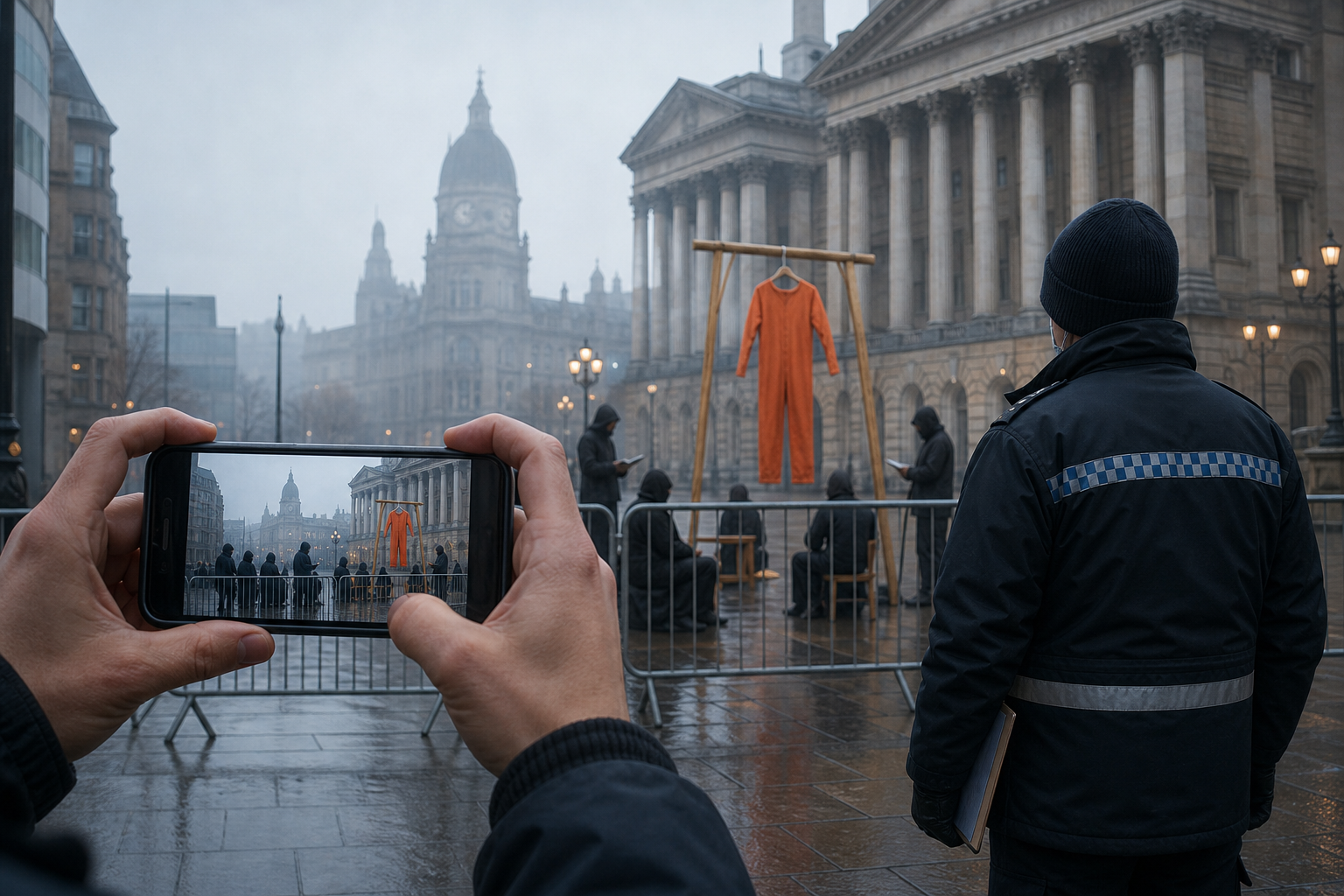
You have seen the Birmingham video: a small group outside Ramgee House, which houses the Consulate General of India, stages a mock execution using an orange jumpsuit and a mask of Prime Minister Narendra Modi. The scene evokes ISIS propaganda. You want to know whether it is merely repellent political theatre or something UK law can punish.
The honest answer is that the imagery may justify serious police scrutiny, but a viral clip cannot by itself establish a criminal offence. The useful questions are what happened, what was communicated, how a reasonable audience would understand it, whom it targeted, and what evidence exists beyond the edited footage. This framework will help you assess, preserve, and report that evidence without amplifying the spectacle.
This is general information for reporting and public discussion, not a legal judgment about any participant. If your own conduct, safety, or legal position is at stake, obtain advice from a UK-qualified lawyer.
Begin with the conduct, not the political label
Two shortcuts will lead you astray. The first is that anything offensive must be illegal. The second is that anything presented as protest must be protected. UK law leaves room for fierce political dissent, ridicule, masks, and shocking performance, but that protection does not automatically cover threats, intimidation, support for a proscribed organisation, or encouragement of terrorism.
Separate what you can observe from what you infer. In the Birmingham footage, the observable elements include a simulated execution, an identifiable political target, extremist-associated staging, and a location outside Indian consular premises. Calling the display ISIS-style is an interpretation of those elements. It is a plausible and important interpretation, but the legal analysis must still ask what the participants intended and what the whole performance communicated.
That distinction improves both public discussion and police reporting. Write that a performance depicted a simulated execution using imagery associated with ISIS propaganda. Do not leap from that description to declaring every participant a terrorist or announcing that a specific offence has already been proved. A request for investigation is not a verdict.
Key takeaways
- Repellent imagery is not automatically criminal, but calling it political theatre does not immunise it from the law.
- An orange jumpsuit, mask, slogan, or gesture should not be assessed in isolation. Sequence, words, location, target, audience, and surrounding conduct matter.
- A short social-media clip can justify reporting without being enough to determine guilt.
- Preserve the original material and its context before commenting, editing, or forwarding it.
- Condemn simulated killing precisely. Do not turn the acts of a small group into an accusation against an entire religious or ethnic community.
Five legal questions determine where the line may lie

No single UK offence is triggered simply because a protest resembles terrorist propaganda. Several legal routes may become relevant, however, and each asks a different question. Keeping them separate prevents the visual shock of the scene from replacing legal analysis.
1. Was the conduct threatening, abusive, or intimidating?
The Public Order Act 1986 can apply to threatening, abusive, or insulting conduct connected with harassment, alarm, or distress. Police may also impose conditions on assemblies when thresholds involving serious disorder, property damage, serious disruption to community life, or intimidation are anticipated.
For a witness, the practical question is not simply whether people felt offended. Record any words, gestures, movements toward individuals, attempts to surround or obstruct people, reactions from those nearby, and reasons someone reasonably feared violence. A simulated execution aimed at a public figure may be profoundly disturbing, but evidence of threats or intimidation directed at people present can materially change the public-order assessment.
Do not collapse two different powers into one. Conduct may be investigated as a possible offence, while an otherwise lawful assembly may separately be subjected to conditions because of the anticipated risk. A police decision to manage a protest does not itself prove that demonstrators have committed a crime.
2. Did an article suggest support for a proscribed organisation?
Section 13 of the Terrorism Act 2000 concerns wearing, carrying, or displaying an article in circumstances that arouse reasonable suspicion of support for a proscribed organisation. The circumstances are essential. Clothing or a colour that has an innocent use does not become illegal merely because terrorists have also used it.
An orange jumpsuit alone therefore proves very little. Investigators would look at the complete combination: the execution motif, masks, flags or signs if any are present, spoken words, chants, captions, gestures, and the participants’ conduct before and after the recorded moment. When reporting, preserve that combination rather than circulating a cropped still that strips away the very context the legal test requires.
3. Did the performance encourage or glorify terrorism?
Section 1 of the Terrorism Act 2006 addresses encouragement of terrorism, including glorification where a communication is likely to be understood as indirectly encouraging the commission or preparation of terrorist acts. Applying that provision to theatrical imagery is highly dependent on intent, audience understanding, and likelihood.
Imitation is not necessarily endorsement. A performance could invoke terrorist imagery to condemn terrorism, satirise it, threaten a target, celebrate past violence, or invite future violence. The visual vocabulary may look similar while the communicated meaning differs sharply. That is why the words spoken at the scene, the organisers’ description, the sequence surrounding the clip, and the accompanying online caption are not peripheral details. They may determine what the performance meant.
Look especially for an approving message about terrorist methods or an invitation to repeat them. Conversely, do not manufacture intent from aesthetics alone. The correct public demand is for a prompt, evidence-based assessment under the same standard that would apply regardless of the demonstrators’ cause.
4. Was an underlying offence aggravated by religious or racial hostility?
The Crime and Disorder Act 1998 provides aggravated forms of specified offences where racial or religious hostility is involved. If an underlying public-order offence is established, evidence that conduct targeted people because of religion or nationality can affect the offence and potential sentence.
This requires precision. Opposition to Narendra Modi, the Indian government, or a government policy is not automatically anti-Hindu hostility. A Hindu target does not, by itself, prove a religious motive. Evidence such as anti-Hindu slurs, threats against Hindus generally, targeting of people because they appear Hindu, or an effort to intimidate worshippers or community members would point to a different question from criticism of a political leader.
If you believe religious hostility was present, quote the exact words and describe the exact target. Avoid paraphrases such as hateful things were shouted. Specific evidence helps authorities distinguish political anger, nationality-based hostility, religious hatred, and a mixture of motives.
5. Did online publication create an additional issue?
The legal and practical assessment does not end when the demonstration disperses. The Counter-Terrorism and Border Security Act 2019 further addresses matters involving expressions of support and reckless dissemination of terrorist content online. Platform rules can separately apply to simulated executions, extremist imagery, and targeted intimidation.
Uploading a clip to document or condemn an incident is not the same communication as uploading it approvingly or using it to threaten someone. Captions, edits, music, hashtags, comments, and the account’s surrounding statements may change how an upload is understood. Preserve them when you report the content.
Do not repeatedly repost disturbing footage merely to demonstrate your outrage. Every public copy can enlarge the audience, detach the scene from its context, expose affected people to the imagery again, and encourage imitation. Send the original link through official reporting channels where possible. If you must publish for a legitimate civic reason, avoid celebratory framing and retain an unedited original privately for investigators.
A consular location adds responsibility, not automatic guilt
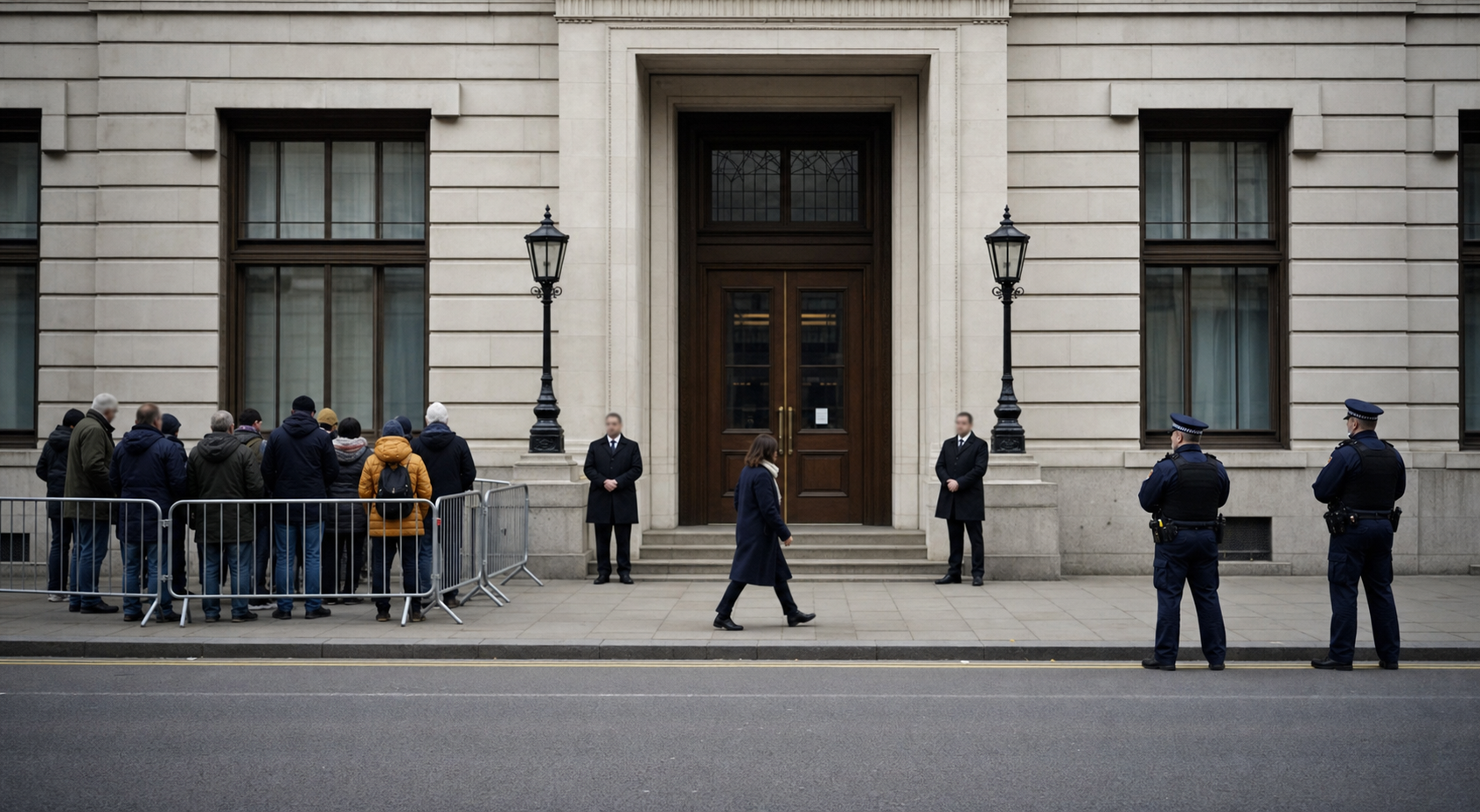
Ramgee House matters because it houses the Consulate General of India. Under the Vienna Convention on Consular Relations, the United Kingdom has obligations to take appropriate steps to protect consular premises against intrusion or damage and prevent disturbance of the peace or impairment of dignity.
That duty does not turn the pavement outside a consulate into a protest-free zone. Nor does it make criticism of India unlawful. It does mean that police planning must take threats, access, intrusion, property risk, and the functioning of the consular post seriously. Violent theatre at that location may carry an intimidating meaning that the same props in a clearly fictional stage production would not.
If you witness an incident at diplomatic premises, note whether entrances were blocked, people were prevented from entering or leaving, objects crossed the boundary, threats were directed at staff or visitors, or the premises were touched or damaged. Do not enter a confrontation to collect better footage. Your safety and an accurate account are more valuable than a dramatic close-up.
Use an evidence-first reporting sequence

The first hours of online circulation often produce the worst evidence. Clips are trimmed, captions are copied without verification, and confident allegations travel farther than the original context. If you possess the footage or witnessed the event, use this sequence.
- Deal with immediate safety first. If violence appears imminent or someone is in danger, contact the emergency services. Do not confront participants or try to seize props.
- Keep the earliest available version. Save the original link, account name, caption, posting time shown by the platform, and the unedited file if you lawfully possess it. Do not replace the original with a compressed or annotated copy.
- Capture the surrounding context. Preserve what happened immediately before and after the striking image. Include spoken words, signs, masks, clothing, gestures, the location, and any response from the crowd.
- Separate observation from conclusion. Write what you saw first. Then state why you believe it evokes a proscribed organisation, communicates a threat, or targets a religious community. This lets investigators test your inference without losing the underlying facts.
- Report through appropriate official channels. Give police the original material and factual chronology when you believe a threat, public-order offence, terrorist encouragement, or aggravated hostility may be involved. Use the platform’s reporting route for violent extremist imagery or targeted harassment as a separate step.
- Protect witnesses and targets. Do not publish names, addresses, faces, or contact details merely to prove that people were present. Provide relevant identifying information privately to the proper authority.
- Keep a record of the report. Retain the material submitted, the date of submission, and any reference supplied. That record allows a community organisation or lawyer to follow up without reconstructing the case from social-media fragments.
Report the strongest facts, not the largest number of accusations. Listing every statute you have encountered can obscure what officers need to assess. A clear chronology with original media, exact language, identifiable targets, and evidence of fear or disruption is more useful than a post announcing that several crimes definitely occurred.
If you did not witness the incident, say so. Identify who uploaded the version you received and avoid presenting copied captions as established fact. A second-hand report can still be useful, but its limits should remain visible.
A dharmic response must be firm without becoming collective blame
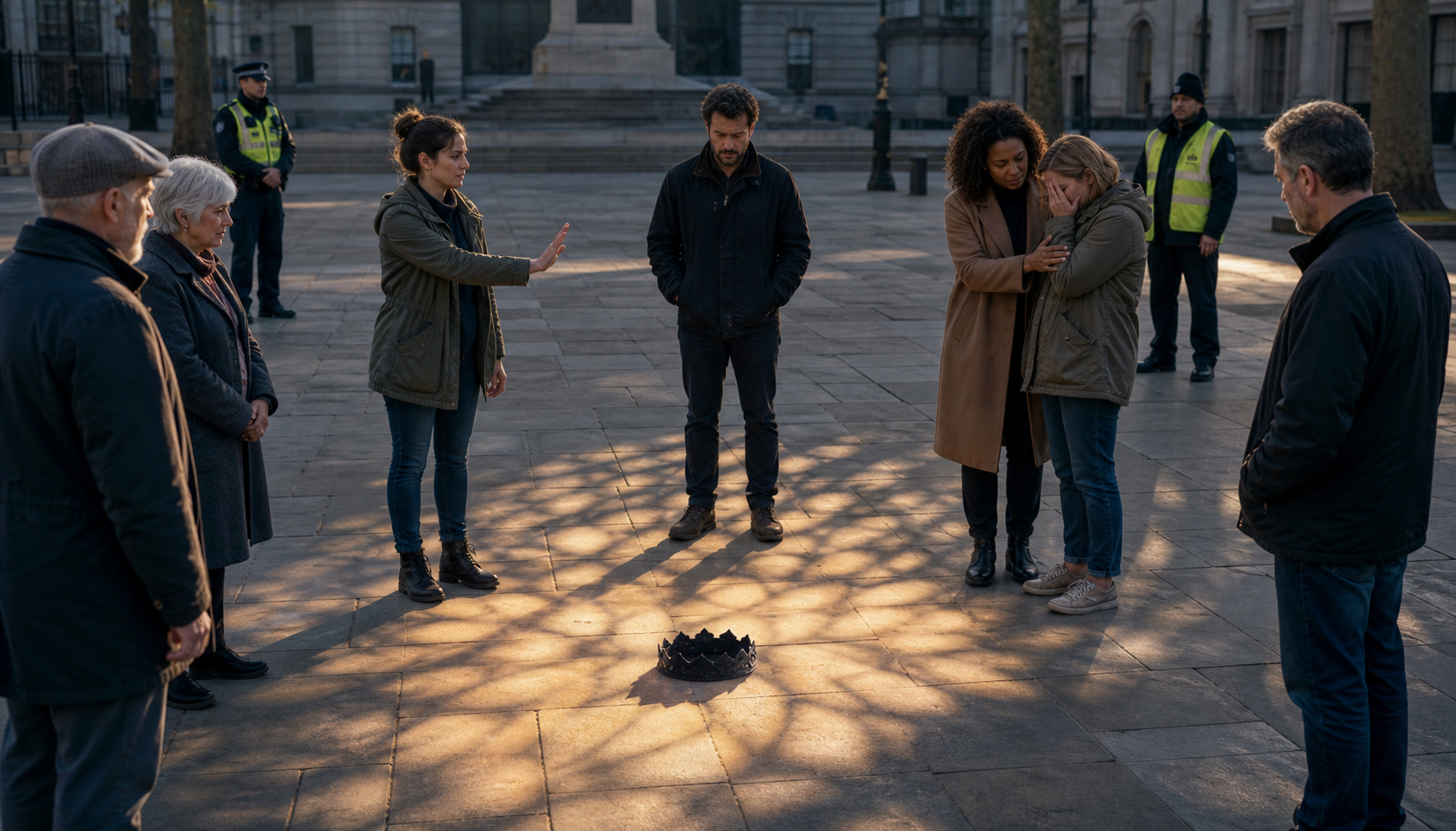
Ahimsa does not require silence in the face of intimidation. It requires discipline about how we oppose it. A simulated execution degrades political disagreement into a spectacle of annihilation. The answer is to isolate that conduct, protect those affected, and insist on impartial enforcement without reproducing the same dehumanisation.
That discipline matters when ISIS-associated imagery appears. Violent extremist aesthetics do not represent British Muslims, and Muslim voices joined Hindu, Sikh, Jain, and Buddhist concern about the Birmingham display. Assigning collective guilt would damage the interfaith trust that extremist spectacle is already capable of weakening.
A useful community statement should do five things: identify the conduct accurately; condemn simulated political killing; distinguish moral condemnation from a legal verdict; request prompt and even-handed investigation; and reject hostility toward any wider faith community. It should also make clear that anti-Hindu intimidation deserves recognition when the evidence supports it, while ordinary criticism of an Indian leader or policy is not automatically Hinduphobia.
Community organisations can prepare before the next demonstration. Nominate a liaison for police and council contacts, an evidence custodian who keeps original files, a spokesperson who avoids speculation, and a welfare contact for people distressed by the imagery. Agree in advance that public channels will link to a factual statement rather than repeatedly autoplaying a simulated killing.
The most effective standard is one you would accept when the politics are reversed: protect lawful dissent, investigate violent intimidation, apply terrorism law only where its elements are supported, and never excuse a mock execution because you sympathise with the cause behind it. If another such clip reaches you, preserve the context, make a precise report, and deny the spectacle the indiscriminate amplification it was designed to attract.