

Someone sends you a short video of young Bangladeshis handling firearms. The caption calls it preparation for a “Hindu-free” army or invokes Ghazwa-e-Hind. You have seconds to decide whether to share it, challenge it, save it as evidence, or warn others.
Do not let that speed decide what the footage means. A clip may establish that training occurred while proving nothing about the date, location, legal authority, command structure, or ideology behind it. The useful response is neither complacency nor panic. It is a disciplined test that separates an observable security concern from a conclusion the evidence cannot yet carry.
Key takeaways
- Footage of firearms training does not, by itself, identify the organization, its legal status, or its purpose.
- Bangladesh has lawful auxiliary and cadet structures that provide a plausible non-sectarian explanation for some training, but an official-looking uniform is not enough to confirm that explanation.
- No conclusive public evidence presently establishes a state-sponsored, sectarian “Hindu-free” force behind the circulating allegations.
- The decisive questions concern command, legal mandate, recruitment rules, curriculum, weapons control, and treatment of minorities.
- A direct, identifiable threat to people or temples warrants immediate preservation and reporting of evidence. A provocative caption without provenance warrants verification, not amplification.
First identify which kind of training you are seeing
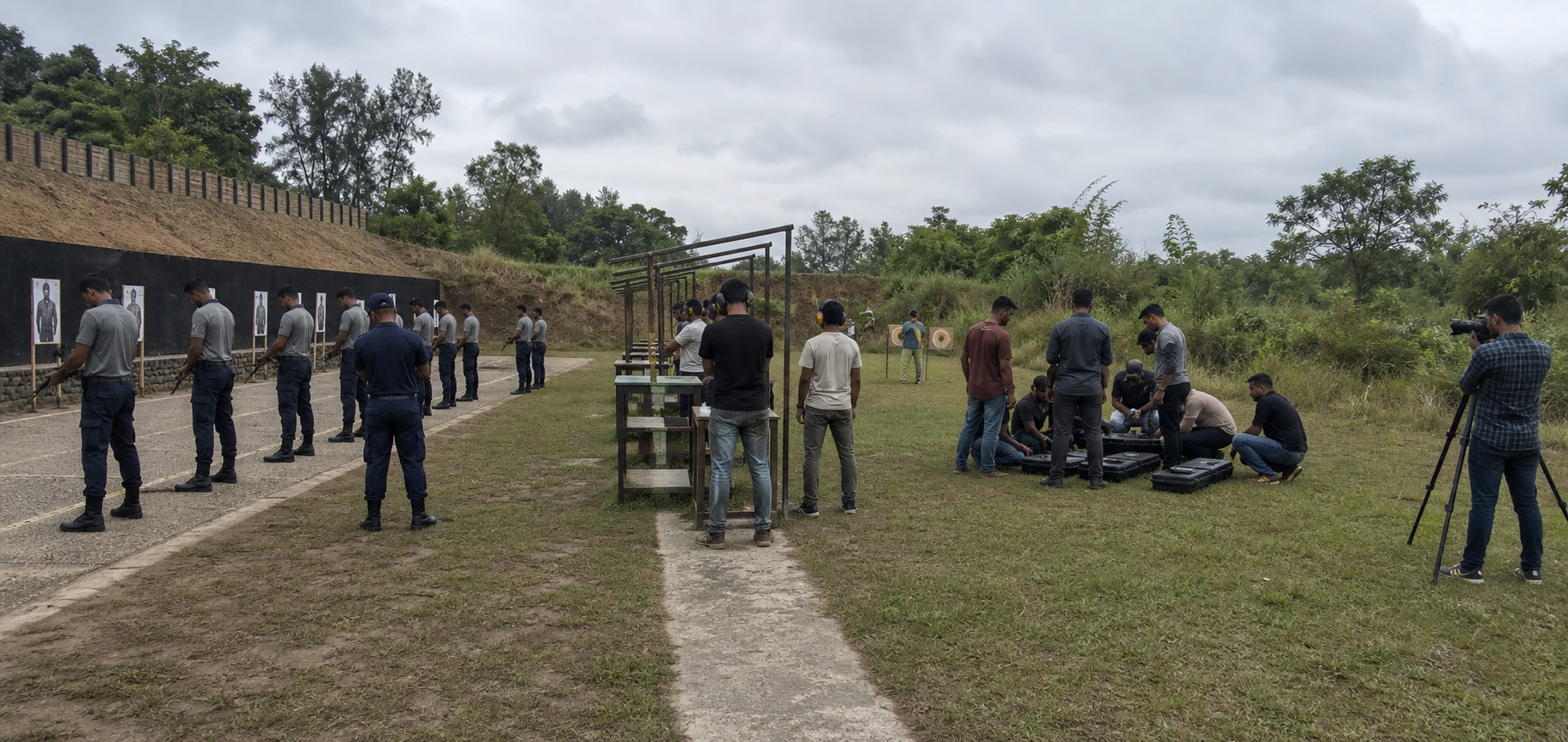
The word “training” collapses several very different situations into one frightening image. Before judging motive, classify the activity. Bangladesh maintains lawful civic and auxiliary structures, including Ansar-VDP and cadet corps, associated with preparedness, discipline, disaster response, and community security. Their existence does not authenticate any particular clip. It does show why the presence of young people, uniforms, drills, or weapons cannot settle the case on its own.
| Possible classification | Evidence that would distinguish it | Appropriate response |
|---|---|---|
| Lawful civic, cadet, or auxiliary activity | A named administering body, a legal mandate, published eligibility rules, an accountable curriculum, and controlled handling of weapons | Verify the program and demand transparency about safeguards rather than assigning an extremist motive from imagery alone |
| Irregular armed organization | No clear legal authority, opaque leadership, off-book recruitment, unexplained weapons custody, or activity outside an accountable chain of command | Seek independent verification and scrutiny from competent authorities, journalists, legal advocates, and minority representatives |
| Extremist mobilization | Verified sectarian instruction, explicit threats, discriminatory recruitment, identifiable militant affiliations, or operational targeting of a community | Treat it as a concrete security matter, preserve the evidence, protect potential targets, and report it without approaching armed participants |
These categories are not interchangeable. Lawful training can still be badly supervised or discriminatory. An irregular group may be dangerous without serving the state. Extremist mobilization requires evidence of ideology, affiliation, intent, or targeting, not merely a caption placed over a drill.
Use a two-question discipline when the images are disturbing: “What can I see?” and “What am I being told it means?” Firearms, uniforms, formations, and commands belong in the first answer. “State-sponsored,” “Islamist,” “anti-Hindu,” and “Ghazwa-e-Hind” belong in the second unless independent evidence connects those labels to the people shown.
Run every claim through a seven-step verification ladder

The circulating case has relied heavily on short video fragments and anecdotal reports without complete provenance. That does not prove the activity harmless. It limits the conclusions a responsible observer can draw. Work upward through the following checks and stop at the highest level the evidence actually supports.
- Write the claim precisely. “Young people are training with firearms” is different from “the Bangladeshi state is creating an anti-Hindu army.” The second claim adds a government sponsor, an institutional project, and a sectarian purpose. Each added element needs its own proof.
- Recover the earliest available upload. A repost may remove the original caption, crop an identifying sign, replace the audio, or attach footage to a new event. Save the full URL, account name, displayed upload time, caption, and uncut media before the chain disappears.
- Verify place and time separately. Look for signs, insignia, landmarks, weather, language, vehicle markings, or other details that can be checked. A Bangla caption does not establish that the scene was filmed in Bangladesh, and an upload date does not establish when the scene occurred.
- Identify the instructors and chain of command. Ask which institution employed the trainers, who authorized the exercise, and to whom participants were accountable. A uniform can be genuine, borrowed, obsolete, or misidentified. Treat it as a clue, not a conclusion.
- Locate the legal mandate. A lawful program should be capable of naming its administering authority, participant criteria, purpose, and rules. If no one can identify the mandate, that absence becomes a reason for scrutiny, not automatic proof of extremism.
- Test the ideological allegation directly. Look for authenticated recruitment material, instructions, speeches, slogans, exclusion rules, or threats connected to organizers. Anonymous comments beneath a video show what commenters believe; they do not establish what the trainers intended.
- Seek independent corroboration. One clip copied across many accounts remains one clip. Stronger corroboration comes from independently obtained records, identifiable witnesses, institutional confirmation, or separate footage that can be placed at the same event.
Use exact stopping language. If the evidence reaches only the third step, say: “The location appears consistent with Bangladesh, but the unit and purpose remain unverified.” If it identifies a unit but not an ideology, name the unit and leave the ideology open. This is not timid wording. It prevents a valid concern from being discredited by an unsupported conclusion.
Escalate verified danger without exposing vulnerable people
Warning signs that materially raise the risk
Some findings should change your response immediately. The most serious are not atmospheric signals such as angry music or an inflammatory repost. They are details that connect capability to intent and identify a possible target.
- An explicit threat against a named person, Hindu neighborhood, temple, festival, or other identifiable place
- A stated date, route, meeting point, weapons location, or operational instruction that can be checked
- Anti-Hindu or other sectarian language traceable to organizers or instructors rather than unrelated social-media users
- Recruitment rules or teaching material that explicitly exclude, dehumanize, or designate a minority as an enemy
- Evidence linking trainers, weapons, financing, or command to an unlawful militant organization
- Repeated, independently verified appearances of the same organizers in armed or threatening activity
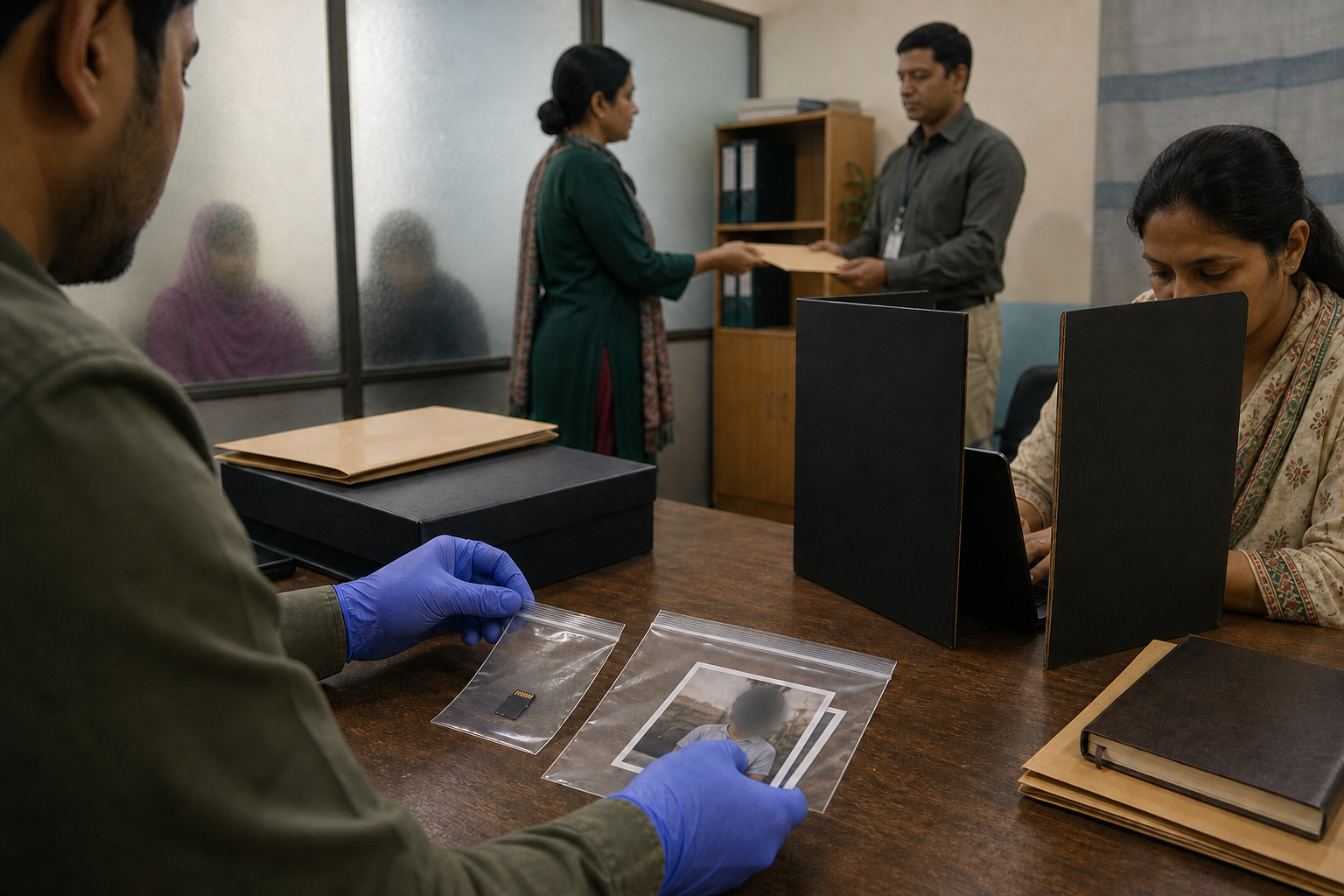
If you encounter a direct and credible threat, do not approach armed people or attempt a confrontation for better footage. Preserve the unedited material and its metadata where possible. Record exactly what identifies the target and timing. Pass it through a trusted local security, legal, journalistic, or community channel able to act. Avoid publicly posting a potential victim’s private address, travel pattern, telephone number, or the identity of a vulnerable witness.
How to communicate an allegation that remains unverified
Separate your notes into three fields: observed, reported but unverified, and still needed. This prevents the caption from quietly becoming part of the footage in your memory.
- Observed: Describe only visible or audible details, including uncertainty about edits and translation.
- Reported but unverified: Record who supplied the location, date, unit name, or ideological allegation. Do not erase the distance between a claim and a verified fact.
- Still needed: List the missing mandate, full recording, organizer identity, curriculum, recruitment criteria, or independent confirmation.
A responsible public caption could read: “This video appears to show young people receiving firearms instruction. We have not independently verified its date, location, administering unit, or purpose. No evidence shown here establishes the circulating claim of a state-backed anti-Hindu force. Authorities should identify the program, its legal basis, participant criteria, curriculum, weapons controls, and minority safeguards.”
That wording keeps the security question open and makes a falsifiable demand. It also avoids blaming Bangladesh’s entire Muslim population for conduct that has not been tied to a verified organization. Collective accusation can endanger Hindu minorities by increasing polarization while giving any genuine organizer cover inside a much broader communal dispute.
Demand disclosures that can settle the issue

Authorities should not expect the public to dismiss alarming footage on trust. The burden of reassurance belongs with the body conducting or permitting the training. Ask for concrete disclosures rather than a general denial:
- Which ministry, service, auxiliary body, cadet organization, school, or local authority administers the program?
- What legal order or institutional rule authorizes it?
- Who may participate, and are religious minorities admitted on equal terms?
- What does the curriculum teach about public safety, civilian authority, communal neutrality, and use of force?
- Who stores, issues, records, and recovers firearms and ammunition?
- What rule prohibits sectarian screening, propaganda, intimidation, or deployment?
- Where can a participant or minority resident report misconduct without retaliation?
- Will independent observers, journalists, or minority representatives be allowed to examine the program and publish their findings?
Bangladesh’s constitutional commitments to pluralism and minority protection provide a standard against which those answers can be tested. A constitutional promise is not proof of conditions on the ground. It does make sectarian exclusion, if documented, an accountability issue rather than a matter officials can dismiss as ordinary training.
The same precision matters across the border. India-Bangladesh relations are vulnerable to rumor cycles that can magnify cross-border tension. Bilateral monitoring should concentrate on verified extremist recruitment, weapons movement, threats, and organizational links. Broad communal suspicion produces noise; named actors, documented conduct, and accountable chains of command produce intelligence that can be acted upon.
A Dharmic security posture joins satya with ahimsa. Truthfulness prevents us from turning inference into fact. Non-harm prevents us from treating an entire community as guilty. Neither principle asks Hindus to ignore danger. They require us to document a real threat so carefully that it cannot be waved away as rumor.
When the next alarming clip reaches you, pause before forwarding it. Preserve the original, separate observation from allegation, climb the verification ladder, and demand the missing disclosures. If a concrete threat appears, escalate it promptly and protect the people it identifies. That combination of vigilance, restraint, and accountability serves Hindu security better than a dramatic label that outruns the evidence.
References
