

If you are trying to decide whether extremism in Bangladesh is an internal Bangladeshi problem or an Indian security problem, the useful answer is: it can become both. India should neither dismiss the danger nor treat every alarming incident as proof that an entire country or faith has crossed a point of no return.
The real test is whether extremist intent acquires organisation, money, documents, routes, recruits and protection from weak or distracted institutions. That is where a domestic current can become a threat to West Bengal and India’s Northeast. It is also where practical security policy begins.
Read the threat as a chain, not as a headline

Angry rhetoric is dangerous, but rhetoric and operational capability are not the same thing. Political polarisation, online radicalisation, local economic vulnerabilities and transnational jihadist narratives can reinforce one another. Bangladesh has disrupted organised cells through forceful state action, yet adaptive clusters can persist through digital spaces and informal networks.
Think of the danger as a chain. A grievance or political crisis supplies the opening. Propaganda turns that opening into an identity conflict. Recruiters and facilitators connect receptive individuals. Clandestine finance, false documents, weapons or criminal routes provide capability. Violence becomes possible when institutions fail to detect or break enough links.
When you encounter a report about extremism in Bangladesh, ask five questions before deciding what it means for India:
- Who is being targeted? Is this an isolated dispute, or part of recurring intimidation against minorities, secular activists or other civic voices?
- Is there evidence of organisation? Look for recruitment, financing, shared facilitators or repeated methods, rather than relying only on the ferocity of a speech or social-media post.
- Has intent become capability? Money, arms, forged documents, safe movement and operational planning matter more than slogans when assessing an immediate security threat.
- Is there a cross-border connection? A Bangladeshi extremist current does not automatically become an Indian threat. The risk rises when it touches routes, criminal syndicates, recruiters or support networks capable of operating across the frontier.
- Are institutions containing it? Police disruption, judicial follow-through, financial investigation and protection for threatened communities tell you more than a dramatic headline does.
No single answer proves that a cross-border operation exists. Convergence across several answers is what should raise the level of concern. This distinction helps you take targeted violence seriously without circulating claims that outrun the available evidence.
On the eastern frontier, logistics are the decisive issue
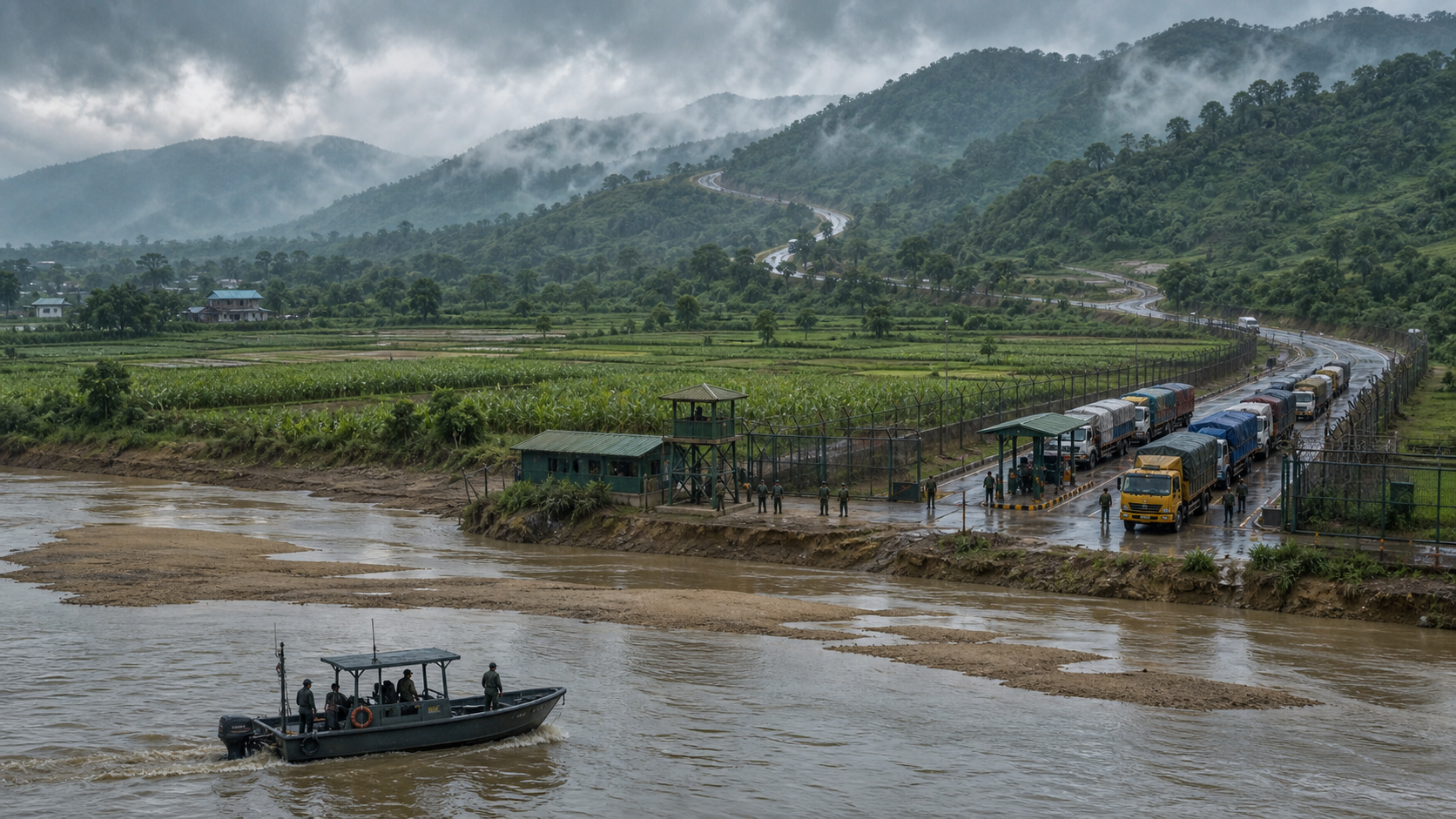
India’s eastern border is not a uniform line. It passes through rivers, wetlands and densely populated areas in which homes, livelihoods, transport and legitimate commerce sit close to the frontier. River fog and darkness can further complicate the distinction between ordinary movement and illicit activity. A security model designed mainly for dry land cannot simply be extended to every such corridor.
Porous stretches can carry forged documents, narcotics, arms and counterfeit currency. Those are criminal flows in their own right, but the same routes and facilitators can overlap with extremist support networks. That overlap matters because a militant cluster does not need to control an entire smuggling economy. It may need only a document supplier, a transporter, a corrupt intermediary or temporary access to an established route.
This is why border risk should be mapped by function as well as by district. Planners need to know where people can cross, where goods can be concealed, where forged identities enter circulation, where illegal finance changes hands and where older insurgent logistics might be reactivated. Assam, Meghalaya, Tripura, Mizoram and West Bengal do not face identical conditions, even though instability across the border can affect all of them.
Three operational priorities follow:
- Treat riverine stretches as their own security environment. Joint patrols, low-light surveillance, drones and appropriately placed sensors should cover the gaps that static barriers cannot.
- Investigate criminal and extremist logistics together. A seizure of counterfeit currency, narcotics, weapons or forged papers may reveal a wider facilitation network. Agencies should preserve the links among the transporter, financier, document supplier and intended recipient.
- Watch legacy routes without assuming that old insurgencies have returned. Improved bilateral cooperation has reduced earlier insurgent support problems, but dormant contacts and infrastructure remain more useful to an opportunistic network than starting from nothing.
Border residents are indispensable in this environment. They notice unfamiliar movement, coercion, sudden changes in local commerce and attempts to recruit or intimidate. Yet cooperation will shrink if every resident is treated as a suspect. Predictable enforcement, multilingual communication and quick resolution of legitimate complaints are therefore operational requirements, not public-relations extras.
Build one system from intelligence to prosecution

A drone can observe movement, but it cannot identify a financier, prepare admissible evidence or secure cooperation from the other side of the border. India’s eastern-security architecture must connect detection to investigation, disruption and prosecution. Otherwise each agency may perform its own task while the network survives between institutional boundaries.
- Create a shared operational picture. Integrated intelligence and current watchlists should connect border forces, police, intelligence agencies, financial investigators and their Bangladeshi counterparts. An alert must reach the agency able to act on it while the information is still useful.
- Match surveillance to the terrain. Smart fencing can help on suitable land stretches. Riverine areas require patrol craft, drones, low-light equipment and sensors selected for local conditions. Technology should close a defined vulnerability, not become the policy by itself.
- Follow the enabling money. Hawala channels, narcotics revenue and counterfeit currency deserve coordinated financial investigation. Disrupting the financier or criminal facilitator can disable several operational actors at once.
- Carry cases across the legal boundary. Mutual legal assistance, evidence sharing and secure extradition procedures are essential when suspects, transactions and witnesses are split between two jurisdictions. Speed matters, but due process matters too; evidence obtained or transferred carelessly can weaken the eventual case.
- Practise before a crisis. Joint tabletop exercises and simulations should test who shares an alert, who commands the response, how agencies prevent duplication and how both governments communicate during a fast-moving incident.
- Make communities part of prevention. Multilingual policing cells, livelihood support in vulnerable border villages and rapid grievance mechanisms reduce the openings through which smugglers and extremists can recruit, intimidate or purchase silence.
This system does not have to begin from zero. The Coordinated Border Management Plan, the 2015 Land Boundary Agreement and growing rail, road and inland-waterway connectivity provide an existing bilateral foundation. The next step is to make intelligence sharing, riverine coordination and legal cooperation work as a continuous architecture, rather than as measures activated only after a crisis.
Each layer should also be auditable. Officials should be able to show what vulnerability an investment addresses, which agency owns an alert, how a financial lead becomes a case and what happens when a border resident reports a credible concern. Procurement totals alone cannot answer those questions.
A Dharmic response protects minorities without collective blame

When Hindus, Buddhists, Christians, secular activists or other civic voices face intimidation or violence, vague appeals for calm are not enough. Threatened people need protection, offences need investigation and perpetrators need lawful punishment. Dharmic compassion does not require the state to become passive in the face of organised hatred.
Clarity about Islamist extremism must not become hostility towards Muslims as a population. Most Muslims in India and Bangladesh reject violence, and peace-affirming Muslim leaders can help deny extremists religious legitimacy and access to receptive audiences. Collective blame gives a radical movement exactly the polarised social field it wants.
This is not a choice between minority protection and interfaith harmony. Properly understood, each strengthens the other. Visible protection reassures vulnerable communities that the law is real. Cooperation with credible Muslim institutions isolates violent actors. Firm action against retaliatory vigilantism prevents one crime from becoming a cycle of mobilisation.
Temples, viharas, gurdwaras and community organisations can contribute without trying to perform police work:
- Nominate trusted contacts who can verify a rumour with local authorities before it is circulated as fact.
- Agree in advance on a public response to communal violence: condemn the offence, demand protection and prosecution, and reject retaliation against uninvolved people.
- Create civic-education programmes that explain how propaganda converts grievance into dehumanisation and recruitment.
- Maintain working relationships with peace-affirming mosques, madrasas and local administrators before a crisis makes communication difficult.
- Help threatened families reach lawful reporting, relief and grievance channels. Do not confront suspected militants or smugglers; credible information should go to the police or border authorities.
Interfaith work should never be used to silence a minority describing genuine danger. Its purpose is to establish enough trust for communities to distinguish a specific perpetrator from an entire population, reject fabricated rumours and act together when a real threat appears.
A six-question scorecard for eastern-security policy
Security announcements often sound comprehensive because they combine new equipment with determined language. You can judge their substance by asking whether they connect the entire chain of prevention and response.
Key takeaways
- Does information move in time? Look for real-time intelligence exchange, shared watchlists and named coordination mechanisms, not merely a general promise to cooperate.
- Does the investment fit the terrain? A serious plan differentiates riverine, wetland, densely settled and fence-suitable stretches instead of prescribing one technology everywhere.
- Can authorities trace the support network? Border interception should connect to investigation of forged documents, arms, narcotics, counterfeit currency and clandestine finance.
- Can bilateral cooperation produce a lawful case? Mutual legal assistance, evidence transfer and extradition procedures should carry an investigation beyond the initial detention or seizure.
- Are border residents treated as partners? Multilingual outreach, humane enforcement, livelihoods and rapid grievance resolution determine whether residents will keep sharing useful information.
- Does the plan defend pluralism under law? Protection for minorities and civic voices, legal safeguards for cyber-monitoring and rejection of collective punishment are measures of institutional strength, not concessions to extremism.
A plan that buys surveillance equipment but neglects finance, prosecution and local trust leaves exploitable gaps. A plan that speaks warmly about harmony but cannot disrupt an armed or financed network is equally incomplete. Strong policy joins hard capability, lawful institutions and social legitimacy.
When the next disturbing report arrives, resist the pressure to choose between denial and panic. Ask who is organised, what capability exists, which corridor or financier enables it, how institutions are responding and whether threatened communities are protected. Then support the measures that break those links while keeping India’s eastern frontier lawful, alert and socially resilient.
References
